

Turn recordings into transcripts and summaries in minutes
Upload audio or video for multilingual transcription, AI notes, and action items
It's 4 PM on a Friday, the meeting just ended, your notes are scattered everywhere, and the meeting minutes table your manager asked for is still blank. I've been in this situation more times than I can count, and I eventually realized the problem usually isn't typing speed — it's whether your tool can turn the meeting directly into a transcript, summary, and action items. This article starts with free plans and compares how Tinrec and Otter.ai differ when it comes to "meeting minutes tables."
Tinrec vs Otter.ai | Quick Overview
Tinrec is an AI meeting notes and collaboration tool for individuals and teams, focused on turning recordings into searchable, summarizable, queryable, and exportable data. Otter.ai is a mature AI meeting assistant with a long track record in English business meeting transcription, summarization, and team management, and it also offers desktop capabilities.
| Item | Tinrec | Otter.ai |
|---|---|---|
| Core positioning | AI meeting notes and team collaboration | AI meeting assistant and meeting automation |
| Free plan | Basic quota to try recording, import, summary, and transcription | Basic free, 300 minutes per month |
| Meeting capture | Desktop version captures system audio, no meeting bot needed | Meeting bot, desktop app, and other methods |
(Otter plan figures are based on the official pricing page; actual benefits are subject to the official website.)
Next, let's look at 5 dimensions: Chinese-language minutes and table output, how to get started with the free plan, online meeting recording methods, post-meeting follow-up and output, and team data retention.
Dimension 1 | Chinese Meeting Minutes and Table Output
Otter's strength is English business meetings — its English experience for transcripts, summaries, and AI Chat is mature. Although it can handle Chinese content, its minutes templates and workflows are not primarily designed for Chinese-speaking teams.
Tinrec covers Chinese, Traditional Chinese, and multilingual meeting scenarios. It can generate transcripts, AI summaries, chapters, key points, and action items, then use Agent post-processing to generate reports, tables, and documents. For needs like "my manager wants a meeting minutes table," this eliminates a round of manual organizing.
→ This dimension: Tinrec wins.
Dimension 2 | How to Get Started with the Free Plan
Otter's Basic plan is free at 300 minutes per month; Pro annual billing comes to about USD 8.49 per user per month, including 1,200 minutes of in-app recording per month and 10 file imports (according to Otter's official pricing page).
Tinrec's free version provides a basic quota that can be used to try recording, import, summary, and transcription. For temporary high-frequency use, you can consider a weekly card; if you have steady weekly needs, look at the Pro monthly card; if you need long-term recording data retention, look at the annual card. The team version offers, for first-time eligible users, 7 days, 1 free seat, and 300 minutes of shared team import quota.
→ This dimension: Both sides have free entry points; Tinrec's free version lets you try all the way through to summary and action-item post-processing.
Dimension 3 | Online Meeting Recording Methods
Otter covers real-time transcription for platforms such as Zoom, Microsoft Teams, and Google Meet, supports speaker identification and AI Chat, and is suitable for teams already used to English meeting workflows.
Tinrec's desktop version directly captures computer system audio, so you don't need to invite an extra bot into the meeting. It can record audio from Zoom, Google Meet, Microsoft Teams, Webex, and other meetings and generate real-time transcripts. Note that this still requires the user to actively open Tinrec and start recording — it does not automatically join all calendar meetings.
→ This dimension: Tinrec wins — no extra participant appears in the meeting.
Stop organizing recordings by hand
Upload audio or video and automatically get a transcript, summary, and action items
Dimension 4 | Post-Meeting Follow-Up and Output
Otter provides AI Chat, workflows, and team analytics, making post-meeting organization for English meetings quite convenient.
Tinrec supports AI Q&A around meeting content, allowing cross-meeting follow-up questions, action-item extraction, and export to Notion, Google Docs, OneNote, Dropbox, and other tools for further editing, or using Agent to produce reports, tables, and documents. For people who need to deliver minutes tables, this saves a lot of copy-pasting.
→ This dimension: Tinrec wins.
Dimension 5 | Team Data Retention and Governance
Otter's Business plan provides more management capabilities and is suitable for larger English-meeting teams.
Tinrec's team version provides an independent team space where meeting data belongs to the team. You can set owners, admins, and regular members, assign or revoke seats, view usage trends and details, manage team hotwords, query and export audit logs, and use the audio recycle bin. Note that the team version currently offers team-level sharing plus role and seat control — it is not file-level granular permissions.
→ This dimension: For Chinese-team meeting data retention, Tinrec is a better fit.
What Unique Advantages Does Each Have?
Tinrec's unique advantages:
- Bot-free recording of online meetings — the desktop version captures system audio and you're ready to go.
- Chinese and multilingual meeting experience, with real-time translation and bilingual viewing.
- After transcription, there's also AI Q&A, action-item extraction, multi-format export, and Agent post-processing.
- Team spaces turn meetings into team assets instead of leaving them in individual accounts.
Otter.ai's unique advantages:
- High maturity for English business meetings, with many integration and workflow options.
- Long accumulation in meeting automation and team analytics.
Conclusion: Which One Should You Choose?
• If you want Chinese meeting minutes and table output → Tinrec, which can directly generate summaries, action items, and document tables after transcription. • If you don't want a bot joining your meeting → Tinrec, whose desktop version captures system audio instead. • If you want to keep asking follow-up questions about meeting content afterward → Tinrec, which supports cross-meeting AI Q&A. • If your team needs member, seat, usage, and audit management → Tinrec team version. • If your meetings are almost all in English and you're already using Otter's workflow → Otter.ai is enough.
In one sentence: For most Taiwan users whose meetings are mainly in Chinese, Tinrec is the more complete choice. We suggest trying the free version with a recording of one of your own meetings first, then deciding whether to upgrade.
FAQ
Q1: Is a free meeting minutes table plan enough?
If you only occasionally organize one or two meetings, the free quota is usually enough to test the waters. Tinrec's free version lets you try recording, import, summary, and transcription; Otter Basic gives you 300 minutes per month.
Q2: Will Tinrec join my meeting on its own?
No. Tinrec's desktop version is user-initiated recording; it handles online meetings by capturing computer system audio, and it is not a calendar-based automatic meeting bot.
Q3: Can meeting minutes tables be generated directly?
Tinrec can generate summaries, chapters, and action items from meeting content, and use Agent post-processing to produce documents, reports, and tables. It can also export to common tools for further editing.
Q4: How good is recognition for Chinese meetings?
Tinrec covers Chinese and multilingual scenarios and supports team hotwords. Actual performance is affected by recording quality, noise, accents, overlapping speakers, and technical terminology. For important content, it's best to verify against transcript timestamps.
Q5: Who owns team version data?
Team resources belong to the team. When a member leaves, is removed, or loses their seat, the team resources they were responsible for can be handed over to other active members and will not disappear when the individual leaves.
Q6: What should I pay attention to before recording?
Depending on local regulations, recording and transcription may require participant consent. Before formal meetings, it's best to inform attendees and obtain authorization.
References
- 【Meeting Minutes Writing 2026】Format Tutorial | Free Template + Template Download - ProjectManager
- Free Meeting Minutes Templates (Word, Google Docs, PDF) | HiNoter Blog
- Quality Meeting Templates on Notion | Notion Marketplace
- Meeting Minutes Excel Templates with Formulas/Charts, Free Download - Pikbest
- Professional Meeting Minutes Excel Templates, Free Download and Online Editing in Google Sheets - Slidesdocs
Turn every recording into actionable outcomes
Get 60 free transcription minutes when you sign in. No credit card required.
Related Reading
You might also like

Tinrec vs Otter.ai 2026: 5-Dimension Comparison for Chinese Meeting Task List Generation
Automatically generating meeting task lists isn't just copying down to-dos. This article compares Tinrec and Otter.ai from a mid-level manager's practical perspective across five dimensions: Chinese meeting recognition, bot-free recording, to-do and task list generation, post-meeting processing, and team data retention. It honestly explains each tool's limitations and ideal users.

How to Extract Meeting Notes in 2026: 5 Steps from Recording to AI Summary
Tired of dealing with meeting notes after the meeting? This article tackles common pitfalls, outlines 4 key evaluation points for choosing an AI meeting notes tool, tests Tinrec's bot-free online meeting recording, AI summaries and Q&A, and team spaces, and compares it with Otter.ai, Granola, and Notta, highlighting differences and pitfalls to avoid.
Best Meeting Minutes Tools in 2026: Tested 3 Categories, This One Auto-Generates Action Plans and Saves the Most Time
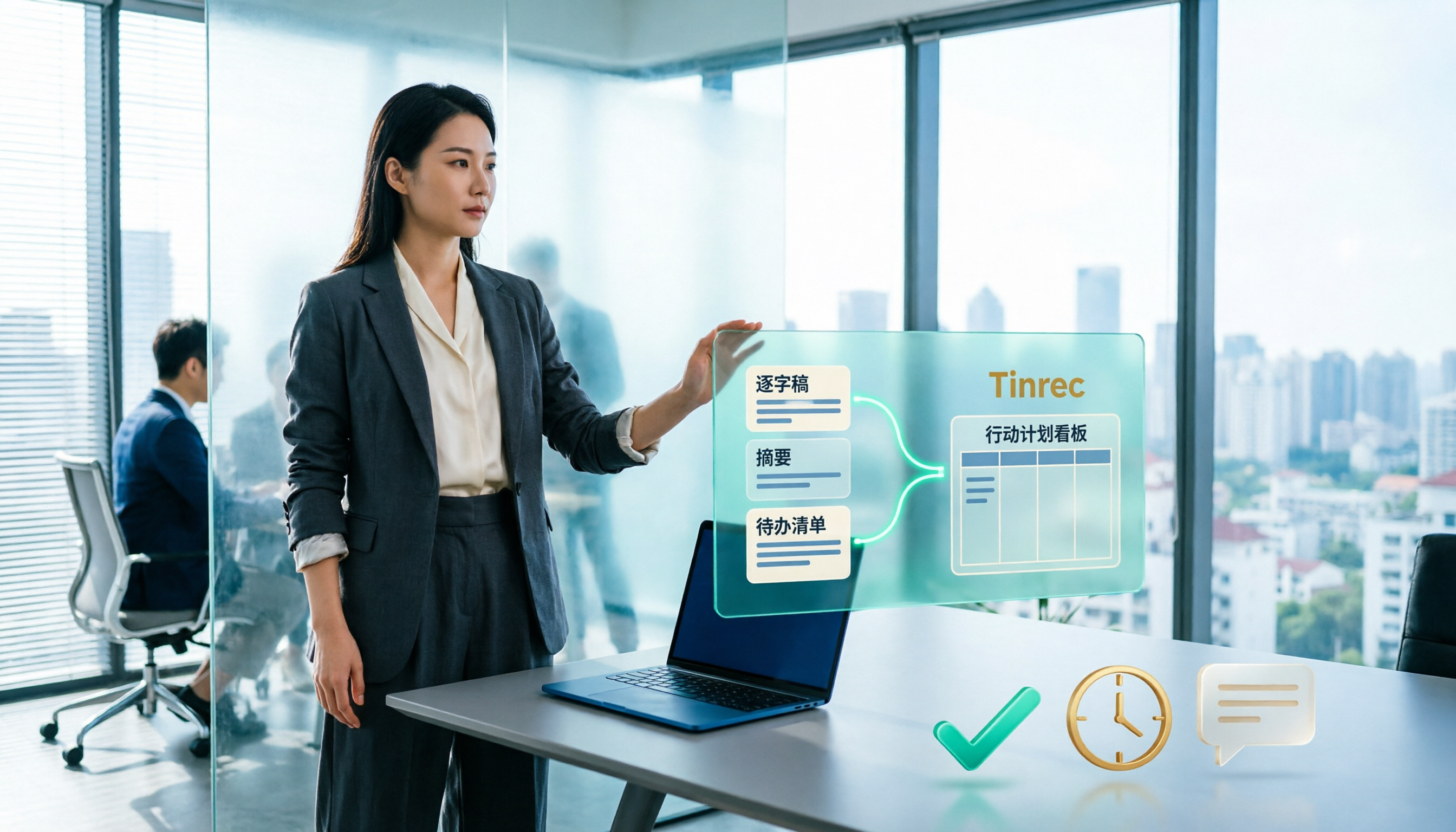
Meeting minutes record decisions, while action plans determine who follows up. This article breaks down the difference between the two and uses Tinrec as an example to demonstrate how to generate transcripts, summaries, and to-do lists in one go. It also compiles 5 key considerations and common questions for choosing a meeting minutes tool.

Best Meeting Minutes Follow-Up Email Tools? 2026 Test of 5 Methods, Key Is Within 24 Hours
Writing meeting minutes doesn't mean things will move forward. This article starts from the most common inefficient practices, breaks down the three-layer process of 'minutes → action → follow-up email,' includes AI prompts and email structures you can copy directly, and compares the applicable scenarios and limitations of 5 methods including template assignment, automated integration, and transcript plus AI summary, helping you send decisions out within 24 hours after the meeting.
2026 Meeting Action Item Management Tools Buying Guide: 4 Hands-On Tests and Selection Advice
The worst part of a meeting isn't missing notes—it's action items with no owner or deadline. Starting from real meeting scenarios, this article outlines 4 key points for choosing a meeting action item tool, hands-on tests Tinrec's bot-free recording, action item extraction, and AI Q&A, compares the positioning differences of Otter.ai, Notta, and Fireflies.ai, and finally offers selection advice based on use cases.

5 AI Post-Meeting Follow-Up Email Tools Compared: Which Workflow Actually Saves Time?
Meeting's over, but the notes aren't organized and the follow-up email hasn't been sent. This article breaks down the two approaches to AI-generated post-meeting follow-up emails—Gmail generation plugins and automated trigger workflows—across 5 dimensions, with ready-to-use prompt formulas and implementation steps to help you decide which method truly saves wrap-up time.
2026 Comparison of 3 Project Meeting Task List Templates: Which Saves the Most Time Without Missing Key Points?
After a project meeting ends, the task list is where the real work begins. This article breaks down the essential fields of a good project meeting task list template and tests Notta, Granola, PLAUD, and Tinrec in real scenarios for meeting notes, action item extraction, and team handoff, helping professionals choose the most time-saving approach that doesn't miss key points.
2026 Comparison of 2 Automatic Meeting Summary Report Generators: Tinrec vs Otter — Which Better Auto-Generates Action Minutes?
Automatic meeting summary report generation isn't just about feeding a recording into AI. This article compares Tinrec and Otter across dimensions—Chinese meetings, bot-free recording, post-meeting outputs, and team knowledge retention—to help you decide which tool better produces usable meeting reports automatically.
Meeting Minutes vs. Meeting Reports in 2026: 3 Key Differences and How to Write Each One
Confused about meeting minutes, meeting reports, and meeting notes? This article breaks down the differences using 3 key criteria, explains when to submit minutes versus a report, and tests how the AI meeting tool Tinrec generates summaries, action items, and reports from a transcript. It also includes selection advice and pitfalls to avoid for Otter.ai and Notta.