

Turn recordings into transcripts and summaries in minutes
Upload audio or video for multilingual transcription, AI notes, and action items
2026 Recording & Online Translation Tools Comparison: Good Tape vs Tinrec for Chinese Meetings
When you search for "Good Tape online translation," you're usually trying to figure out three things: first, can it turn foreign-language or mixed Chinese-English recordings into readable transcripts? Second, after transcription, can it also translate and summarize key points? Third, will this data stay in your workflow, or will you have to redo work after exporting? In this article, I'll take a "test it for you first" approach and evaluate Good Tape, Tinrec, Otter.ai, and Notta against the same set of needs.
Meeting Recording Pain Points—You Need a Solution, Not Just a Tool
A two-hour meeting followed by two hours of organizing is a daily reality for many office workers. If the meeting includes English, Japanese, or mixed Chinese-English, transcript organization becomes even more painful.
What's worse, many tools only give you a text file. You still have to find key points, extract action items, mark timestamps, and then paste everything into the team chat.
If what you need is "audio to text + translation + usable post-meeting data," then you can't just look at how many languages a tool supports. This article breaks it down using actual workflows.
Before Choosing a Recording & Online Translation Tool, Understand These 4 Key Points
1. Do you need transcription, translation, or both? Some tools excel at multilingual transcripts, while others focus on real-time translation or bilingual display. Good Tape's public information mainly revolves around audio-to-transcript, subtitles, and multilingual support; if you want to view original text, translation, or bilingual content during recording, Tinrec's product description includes real-time translation. Confirm your needs first so you don't buy a tool that only completes half the workflow.
2. Chinese and mixed Chinese-English recognition experience Taiwanese teams often mix Chinese and English in meetings, sometimes with technical jargon. Instead of just looking at the official language count, try it with your own meeting recording. Tinrec can handle Chinese, Traditional Chinese, and multilingual meeting scenarios, and you can maintain common terminology through team hotwords; actual results will still be affected by recording quality, accents, noise, and overlapping speech.
3. Post-meeting organization capability matters more than transcription minutes Transcripts are just raw material. Whether it can automatically generate summaries, chapters, action items, and whether you can continue asking questions about the meeting content determines how much time you save. Tinrec puts summaries, chapters, action items, AI Q&A, mind maps, and multi-format export into a single workflow—this is its biggest difference from pure transcription tools.
4. How do you record online meetings? Meeting bots need to join as participants, which some teams may mind. Tinrec's desktop version captures computer system audio and doesn't require an extra bot to join Zoom, Google Meet, Microsoft Teams, Webex, etc. Recording is initiated by the user, not automatically joining all calendar meetings.
Tinrec—Our Top Pick After Hands-On Testing
Tinrec is an AI meeting notes and collaboration tool for individuals and teams. Its positioning isn't just audio-to-text, but turning meeting recordings into searchable, summarizable, queryable, exportable, and further processable data.
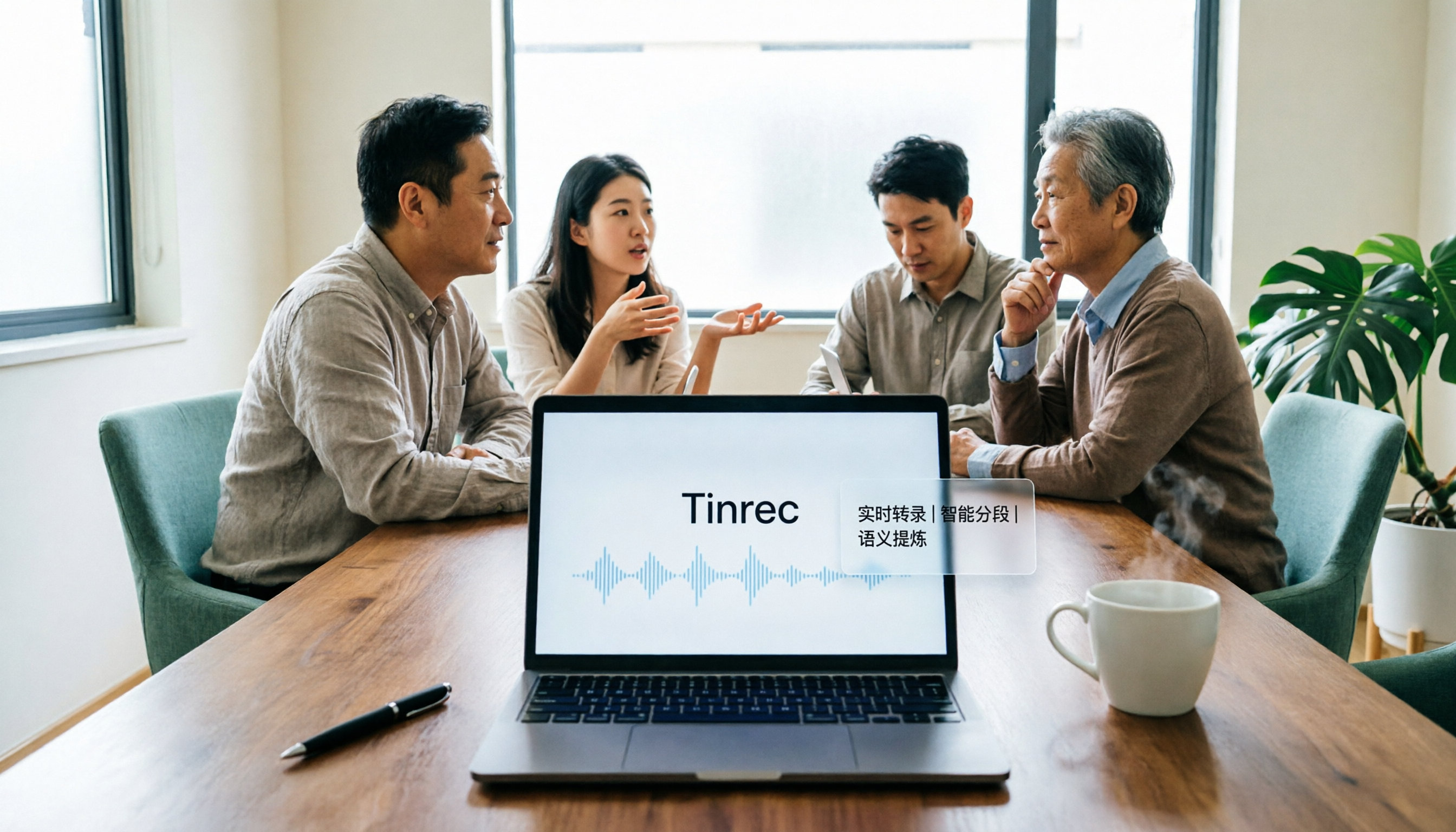
First, meeting recording. Tinrec's desktop version directly captures computer system audio, so when handling online meetings on Zoom, Google Meet, Microsoft Teams, Webex, etc., you don't need to add a meeting bot to the room. For external client meetings or internal weekly meetings, this is very practical: participants won't see an extra bot in the attendee list. You just open Tinrec and start recording, and transcripts are generated while the meeting is ongoing.
Second, post-meeting organization. After recording ends, Tinrec generates transcripts, AI summaries, chapters, and key points, and can extract action items. This means you don't get a long text you have to read from start to finish, but meeting data already divided into paragraphs and marked with decisions and action items. If the meeting includes cross-language content, you can view original text, translation, or bilingual content during recording, which is especially useful for mixed Chinese-English meetings.
Third, AI Q&A and post-processing. Tinrec supports continued questioning about meeting content, such as "Who mentioned the budget in the last meeting?" or "What were the client's concerns about the delivery date?" It doesn't just throw keyword search results at you; it answers based on meeting semantics. After the meeting, you can also generate meeting minutes, reports, tables, and documents, and export to Notion, Google Docs, OneNote, Dropbox, etc. for further use. For those who need to write weekly reports, organize client interviews, or do project tracking, this saves more work than simply downloading a txt file.
Stop organizing recordings by hand
Upload audio or video and automatically get a transcript, summary, and action items
Tinrec's team version puts the above workflow into a team space. Team data belongs to the team, and members can view and play back historical meetings; administrators can manage roles, seats, sharing rights, usage analytics, and audit logs. When a member leaves or loses their seat, team resources can be handed over to other valid members, so they won't disappear just because an individual leaves. Note that the team version is primarily team-level sharing, not file-level granular permissions; members without seats can view, play, and read, but cannot upload, edit, import, or export.
Limitations should also be clear. Tinrec's free version provides a basic quota, suitable for light use; if you have many meetings every week or need long-term retention, you'll need to evaluate paid plans. The team version is currently USD 29.80 per paid seat per month, or USD 199 per paid seat per year (about USD 16.58 per month). Each paid seat provides 2,000 minutes of team shared import quota per month; real-time recording is currently not deducted by minutes under an active team plan and active seat. Actual prices and benefits are subject to the official purchase page. Additionally, AI transcription can still be affected by audio quality, noise, accents, and overlapping speech; for important content, it's recommended to cross-check with transcript timestamps and recordings.
If you frequently handle Chinese meetings, want bot-free online meeting recording, and hope to use AI to find key points and action items directly after meetings, Tinrec is currently one of the best choices to fit into your workflow.
Besides Tinrec, What Other Options Are There?
Good Tape: A transcript tool built by Denmark's Zetland for journalists, using OpenAI Whisper. Third-party tutorials often say it supports 40+ languages, while the official page claims over 100. After uploading an audio file and entering your email, you can download the transcript or SRT; data is stored in the EU, GDPR-compliant, and deleted after 3 days if not registered. If you only need multilingual transcripts and subtitles, it's worth comparing; but for post-meeting AI Q&A, action item extraction, team seats, and usage management, Tinrec is more complete.
Otter.ai: A mature choice for English business meetings. Basic is free with 300 minutes per month; Pro is about USD 8.49 per user per month annually, including 1,200 minutes per month and 10 file imports. It's strong for English meetings and has many integrations. If you mainly record English meetings and your team is primarily English-speaking, Otter.ai is a reasonable choice. However, for Chinese meetings, bot-free desktop recording, and post-meeting multi-format workflows, Tinrec is more focused.
Notta: A multi-platform transcription and translation tool. Free is 120 minutes per month, max 3 minutes per session; Pro is about USD 8.17 per month annually, 1,800 minutes per month; Business is about USD 16.67 per seat per month annually and offers role permissions and usage reports. It overlaps significantly with Tinrec and is suitable for those who need file transcription and translation. But Tinrec emphasizes bot-free online meeting recording, AI Q&A, Agent post-processing, and team data retention; if you only compare price and minutes, you might overlook the cost of post-meeting organization.
Pitfall Guide: The 3 Most Common Mistakes When Choosing a Recording & Online Translation Tool
Pitfall 1: Only looking at language count, not actual audio files. Just because the official claim says 40 or 100 languages doesn't mean your meeting will transcribe well. Taiwanese offices often have air conditioning noise, keyboard sounds, multiple people talking over each other, and mixed Chinese-English—all of which affect results. It's recommended to test with a real recording of your own, not just promotional numbers.
Pitfall 2: Treating the transcript as the end goal. Transcripts are just raw material. If you have to manually Ctrl+F to find conclusions and copy-paste to make minutes every time, you're only using one-third of the tool. Tinrec's AI Q&A and action item extraction let you ask "What was the conclusion of this meeting?" right after recording, saving time flipping through long transcripts.
Pitfall 3: Ignoring team data ownership. Recording team meetings with a personal account means data may disappear when a member leaves. If meeting content is a team asset, choose a solution with team space, seat management, usage, and audit mechanisms. Tinrec's team version makes data belong to the team and allows resource handover when members change, which is much safer than simply sharing a personal account.
Conclusion: Which One Should You Choose?
In one sentence: if you need "Chinese meetings + online recording + post-meeting AI organization," Tinrec is the top pick in this article; if you just need to turn recordings into transcripts and subtitles, tools like Good Tape are also worth trying.
Scenario breakdown:
- Need Chinese or mixed Chinese-English meeting transcripts and real-time translation → Tinrec.
- Need bot-free recording for Zoom, Meet, Teams, Webex → Tinrec.
- Want to directly use AI Q&A, extract action items, and generate minutes after recording → Tinrec.
- Need team space, seats, usage, and audit → Tinrec team version.
- Only record English meetings, limited budget → Try Otter.ai free version first.
- Only need file transcription and subtitles, value EU privacy commitment → Good Tape is worth comparing.
It's recommended to start with a free version or trial quota and test with your most realistic meeting recording. Confirm transcription quality, translation needs, and post-meeting organization workflow before deciding whether to upgrade.
References
Turn every recording into actionable outcomes
Get 60 free transcription minutes when you sign in. No credit card required.
Related Reading
You might also like

2026 AI Meeting Notes Showdown: Tinrec vs Granola on Context Understanding and Post-Meeting Workflows
Nobody wants to re-listen to a meeting recording—that's the biggest pain point of AI meeting tools. This article focuses on context understanding and compares Tinrec and Granola across five dimensions: audio retention, input sources, Chinese language and translation, post-meeting outputs, and team governance, helping you decide which tool better fits your meeting scenarios.

Tinrec vs Microsoft Word Copilot (2026): 5-Dimension Comparison for AI Meeting Minutes in Word
Discover how Tinrec and Microsoft Word Copilot compare in generating AI meeting minutes for Word across 5 key dimensions: audio capture, Chinese transcription, post-meeting organization, Word delivery, and team collaboration. Find the most time-saving workflow for your meetings.

2026 AI Agent Meeting Tools Compared: Which Is Fastest for Chinese Meeting Notes and Action Items?
We tested four AI Agent meeting tools—Tinrec, Otter.ai, Notta, and Granola—comparing bot-free recording, Chinese transcription, post-meeting summaries and action items, AI Q&A, and team knowledge retention to help you choose the most time-saving solution for meeting notes.

2026 AI Meeting Productivity Tools: Bot-Free Recording + Auto Summaries & Action Items
Many people treat AI meeting tools as simple transcript generators, but what really impacts efficiency is post-meeting organization and follow-up. This article uses Tinrec to demonstrate how to go from bot-free recording, real-time transcription, AI summaries, and action item extraction to team workspace retention, and also covers purchasing checkpoints and FAQs.
2026 AI Meeting Assistant Comparison: Tinrec vs. Granola — Which Is Better for Chinese-Speaking Teams?
Starting from the most common misconception about AI meeting assistants, this comparison tests Tinrec and Granola across five dimensions: Chinese-language meeting experience, audio retention, post-meeting outputs, team governance, and cross-device use—helping you decide which workflow truly fits your team.

2026 Comparison of 4 Meeting Productivity Agents: Which One Actually Saves Post-Meeting Time?
The real work starts after the meeting ends. This article uses the same Chinese meeting recording to test the post-meeting workflows of Tinrec, Otter.ai, Fireflies.ai, and Notta—covering bot-free recording, summary and action items, AI Q&A, and team knowledge retention—to help you decide which meeting productivity agent truly saves time.

2026 AI Meeting Notes Tools Compared: Tinrec vs Otter.ai vs Notta vs Granola — Which Turns Meetings into Usable Data?
Stop taking notes yourself: a hands-on comparison of Tinrec, Otter.ai, Notta, and Granola covering transcripts, summaries, action items, and AI Q&A, plus buying criteria, team seat and pricing details, and pitfalls to avoid.

4 AI Agents That Generate Excel Files Tested: Which One Actually Produces a Usable .xlsx?
After a meeting, turning notes into an Excel file often means replaying the entire recording. This article starts from "where does the data come from" and compares four approaches: Tinrec, Excel's built-in Agent mode, Gemini Notebook Agent, and Aspose.Cells AI Generator. It also covers 5 key selection criteria, 4 common mistakes, and practical recommendations.

2026 Free AI Agent PPT Generation Options: 5 Tools Compared
AI Agent PPT generation tools are proliferating, but the real question is where the content comes from. This article reviews five available options in 2026, including Microsoft Copilot, MiniMax Agent, ChatPPT, and two self-hostable open-source projects. It also explains how to use Tinrec to turn meeting recordings into usable presentation material, with a pitfalls guide and selection advice.