
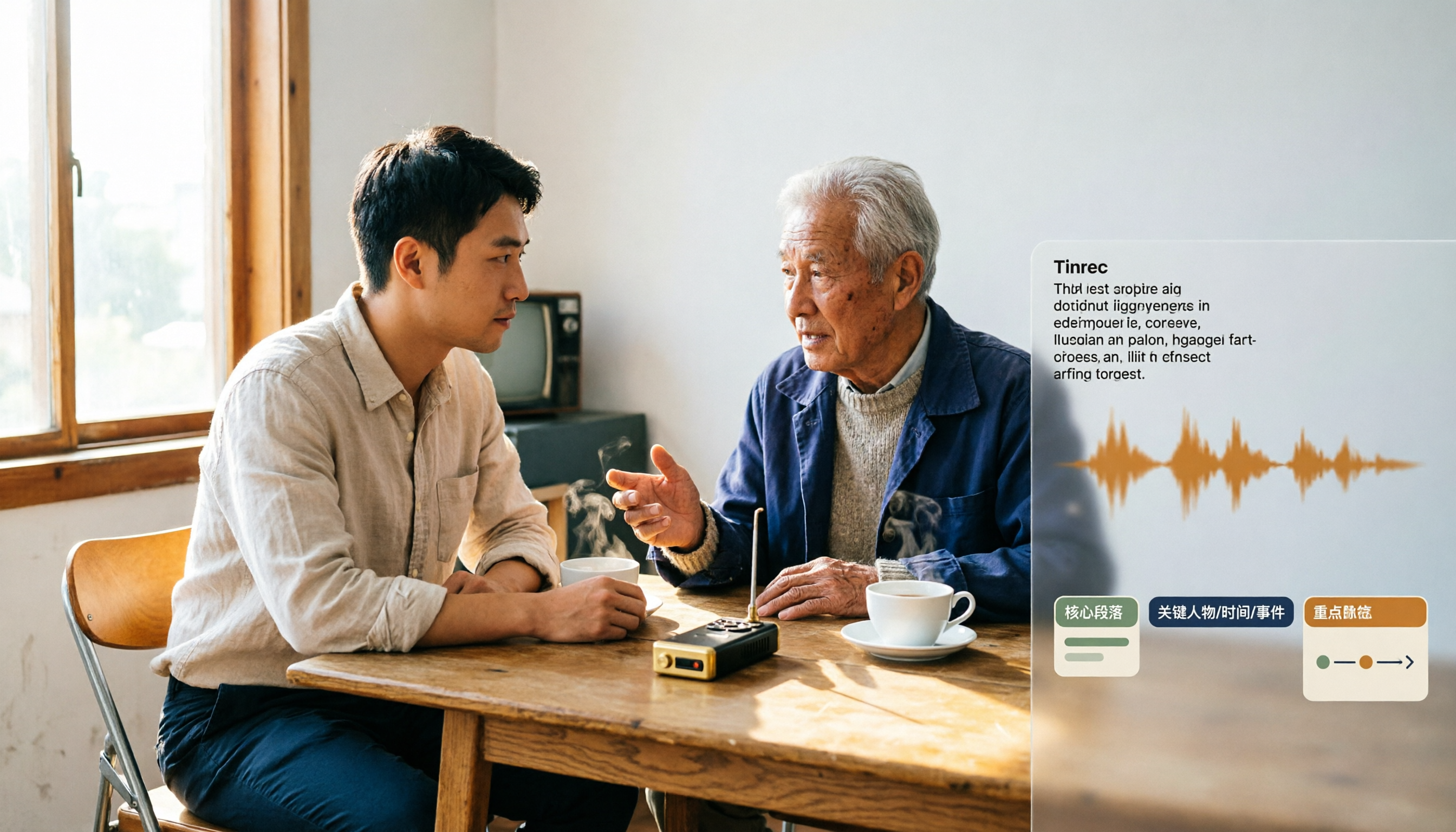
Turn recordings into transcripts and summaries in minutes
Upload audio or video for multilingual transcription, AI notes, and action items
2026 Comparison of 4 Audio-to-Transcript Tools: Before You Download Good Tape, Understand Your Workflow
What You Lack Isn't a Download Link, But a Workflow
A two-hour meeting recording can take an entire afternoon to transcribe.
But most people get stuck not because of typing speed.
It's that after the transcript is generated, you still have to read through it, extract key points, note action items, and figure out how to archive it.
I used to do the same. Throw the recording into a folder, paste the transcript into a note-taking app, and then nothing.
Three months later, when I need to find a specific decision, I only remember "it was mentioned somewhere," but can't locate it.
So I realized the real question isn't "which tool has 2% higher accuracy."
It's "after transcription, who can use this text and how?"
If you've ever felt this way—lots of recordings, transcripts too, but a mess when you actually need them—this article is for you.
Before Choosing a Transcription Tool, Understand These 4 Key Points
If you came here searching for "Good Tape software download," don't rush to install.
First, confirm: are you dealing with an existing audio file or an upcoming meeting? These require different tools.
First, recognition is just the starting point, not the end.
Most people compare accuracy. But even with high accuracy, you still get a 10,000-word document that needs manual digestion. What really saves time is whether that document is broken into summaries, sections, and action items.
Second, file mode vs. meeting mode.
Uploading an audio file, waiting for an email notification, downloading the transcript—that's "file mode." For live meetings, you need real-time transcription without post-meeting catch-up.
Third, don't just look at the language list; test with your own recording.
Official claims of supporting 40 languages are different from your meeting room with air conditioning noise, overlapping speech, and mixed Chinese-English. Test with a real recording—that's the truth.
Fourth, after data is stored, who can reuse it?
For personal use, this doesn't matter. But if you have colleagues, ask: whose account are these meeting records stored in? Will they be taken away if someone leaves?
Once you clarify these four questions, you'll know which direction to choose.
Tinrec (秒聽錄音) — The One I Kept After Testing
Tinrec (秒聽錄音) is an AI meeting notes and collaboration tool for individuals and teams, available on iOS, Android, desktop, and web.
I first used it for an online project meeting.
Previously, to record online meetings, you had to invite a meeting bot, adding a stranger to the call, and speakers would keep asking "who is that?"
Tinrec desktop works differently: it directly captures system audio without inviting any bot. The meeting proceeds, and the transcript grows alongside.
It handled the most time-consuming part after the meeting.
As soon as the meeting ends, AI summaries, sections, and action items are generated. Who is responsible for what and when it's due are listed directly, no need to listen to the recording again.
And you can "ask" it.
I type directly: "What was the conclusion about the budget in the last meeting?" It doesn't give me a bunch of keyword search results but reads the content and answers directly. This AI Q&A is my most used feature—it turns a meeting from three months ago into conversational data.
My test conditions: a ~20-minute Chinese meeting recording, recorded with desktop version, in an office environment (people walking, air conditioning noise). The Chinese transcript was well-structured; I only needed to fix a few proper nouns, and the rest could be used for summaries.
It also supports mixed Chinese-English content, multilingual meetings, and real-time translation, with options to view original, translated, or bilingual.
Three reasons I kept it:
1. No bot needed. Record online meetings directly on your computer without disrupting the meeting or explaining the extra account.
2. More to do after transcription. Summaries, sections, action items, mind maps, AI Q&A, export to Notion/Google Docs/OneNote—this entire chain is connected.
Stop organizing recordings by hand
Upload audio or video and automatically get a transcript, summary, and action items
3. Team version is a true team space. Meeting data belongs to the team, with roles and seats, usage trends, audit logs, and audio recycle bin (currently retained for 30 days). When members leave, data is transferred to other active members, not taken away. According to current product configuration, eligible teams can try 7 days free with 1 free seat, including 300 minutes of shared import quota.
Limitations:
The free version offers basic quota, suitable for trying a few meetings; if you have regular weekly meetings, you'll need Pro or annual plan. Also, accuracy is not guaranteed—recording quality, accents, overlapping speech, and technical terms affect results. For important content, I still cross-check with the original audio at timestamps.
Who it's for:
People who have weekly meetings and need to produce minutes and action items; those who don't want to invite bots to online meetings; and teams that need to accumulate meeting content as team data rather than scattered in personal accounts.
Besides Tinrec, What Other Options Are There?
Good Tape: Created by Danish news organization Zetland, using OpenAI Whisper technology, supports over 40 languages including Chinese. Upload audio, enter email, receive download link with time-coded text, plain text, or srt subtitle files. Unregistered files are deleted after 3 days, data stays in EU under GDPR. For those with an existing audio file who just want a one-time transcription, the process is very clean. But it lacks AI Q&A, action item extraction, and team space; post-transcription organization is still up to you.
Notta: A multilingual transcription tool with significant overlap with Tinrec. Free version: 120 minutes per month, max 3 minutes per file; Pro annual: about USD 8.17/month, 1,800 minutes per month. Suitable for file transcription, subtitles, and translation. But it lacks Tinrec desktop's bot-free system audio recording, and post-meeting AI Q&A and team data accumulation are not its focus.
TurboScribe: A cost-effective route for bulk file transcription. Free: 3 files per day, max 30 minutes per file; Unlimited annual: USD 120 (about USD 10/month), paid version max 10 hours or 5GB per file. For processing a batch of long audio files, it's indeed easier than Tinrec. But it's pure file transcription, no live meeting recording, no action item extraction, and no AI Q&A for content follow-up.
Pitfall Guide: 4 Most Common Mistakes When Choosing a Transcription Tool
Mistake 1: Treating "download" as the end.
This is the most common. Spend two days comparing which is more accurate, only to find after installation that you still have to read and organize the transcript yourself. No matter how good the tool, without the subsequent workflow, you only save typing time.
Mistake 2: Only looking at language count, not your scenario.
"Supports 40 languages" doesn't mean "your meeting records well." A meeting room with air conditioning noise, overlapping speech, and mixed Chinese-English is the real test. Testing with your own recording is more useful than any review.
Mistake 3: Ignoring how long files are kept.
Some services delete files after a few days if unregistered—good for privacy, but a limitation if you plan to accumulate meetings into a searchable database. Clarify whether you want "one-time transcription" or "long-term accumulation."
Mistake 4: Using it only as a typewriter.
If you only use transcription, you're using only one-third of its capabilities. After recording, ask it "what was the conclusion of this meeting" or "who promised what"—much faster than manually flipping through a 30-minute transcript.
Conclusion: Which One Should You Choose?
In short: first confirm whether you need "one-time transcription" or "a series of tasks after the meeting."
- Need live transcription during meetings and immediate summaries and action items after → Tinrec (desktop bot-free recording plus AI Q&A)
- Want to find key points via Q&A after recording, without manually flipping through transcripts → Tinrec (AI Q&A is its most obvious differentiator)
- Need to continue on phone, computer, and web → Tinrec (iOS, Android, desktop, web)
- Want to accumulate meetings as team-shared, transferable data → Tinrec Team (roles and seats, usage analytics, audit logs, audio recycle bin)
- Have an existing audio file, one-time transcription, zero budget → Good Tape or TurboScribe free plans are enough
No need to decide all at once.
Try Tinrec free version's basic quota with a real meeting recording to feel what "no post-meeting organization" means.
If it fits, upgrade later.
Test gradually, and you'll find the workflow that suits you.
References
- Good Tape - Google Play App
- Surpassing Yating, Reporters Cry Tears of Joy: What's So Great About Good Tape? | CommonWealth Magazine
- Good Tape: Automated Audio-to-Transcript Tool, Supports Multiple Languages Including Chinese
- Good Tape: Audio-to-Transcript Software Recommendation! The Tool That Best Understands Reporters' Needs | Comprehensive AI Tools Introduction - Future Commerce
- Good Tape Tutorial | Audio-to-Transcript Tool, Supports 40 Languages Including Chinese | Manager Today
Turn every recording into actionable outcomes
Get 60 free transcription minutes when you sign in. No credit card required.
Related Reading
You might also like

2026 Comparison of 3 Speech-to-Text Tools: When Google Docs Isn't Enough, How Tinrec Takes Over Meeting Notes
Many people search for 'speech to text Google Docs' to find a free way to transcribe, but Google Docs' voice typing is better for real-time dictation. It falls short for meeting recordings, summaries, action items, and team sharing. This article uses Tinrec as an example to show what speech-to-text can do, its core capabilities, practical use cases, and purchasing considerations, plus answers to common questions.

Tinrec vs Notta 2026: 5-Dimension Comparison for Chinese Meeting Transcription
Still unsure how to choose a speech-to-text app after scrolling through forums? This article breaks down three common pitfalls, compares Tinrec and Notta across five key dimensions, and includes positioning differences for Otter.ai and PLAUD Note, four pitfalls to avoid, and scenario-based recommendations to help you decide which tool truly saves post-meeting cleanup time.
4 Speech-to-Text AI Tools Tested and Compared in 2026: What Dcard Users Really Want to Know
There's a lot of discussion on Dcard and PTT about speech-to-text AI, but most people start by asking the wrong questions. This article addresses common misconceptions, outlines 4 key factors for choosing a tool, and compares Tinrec, Notta, Granola, and PLAUD in real tests, covering their free tiers, pricing, and limitations to help you find the one that truly saves time on meeting notes.

2026 Voice-to-Text App Comparison: Yating Transcript vs Tinrec — Which Should Students Choose?
Starting from the pain point of students taking notes in class, this hands-on comparison tests Yating Transcript and Tinrec, two apps popular on Dcard, across five dimensions: AI post-class organization, online meeting recording, file import and export, group project sharing, and Taiwanese accent recognition. It also provides selection advice for different student scenarios.

2026 Speech-to-Text Showdown: Google AI vs. Tinrec for Chinese Meetings — Which Saves More Time?
Starting from the backend API positioning of Google Cloud Speech-to-Text, this hands-on comparison tests out-of-the-box speech-to-text solutions. Using Tinrec as the primary example, it walks you through real-time transcription, bot-free online meeting recording, AI summaries, action item extraction, AI Q&A, and team spaces, plus 5 buying considerations and FAQs.
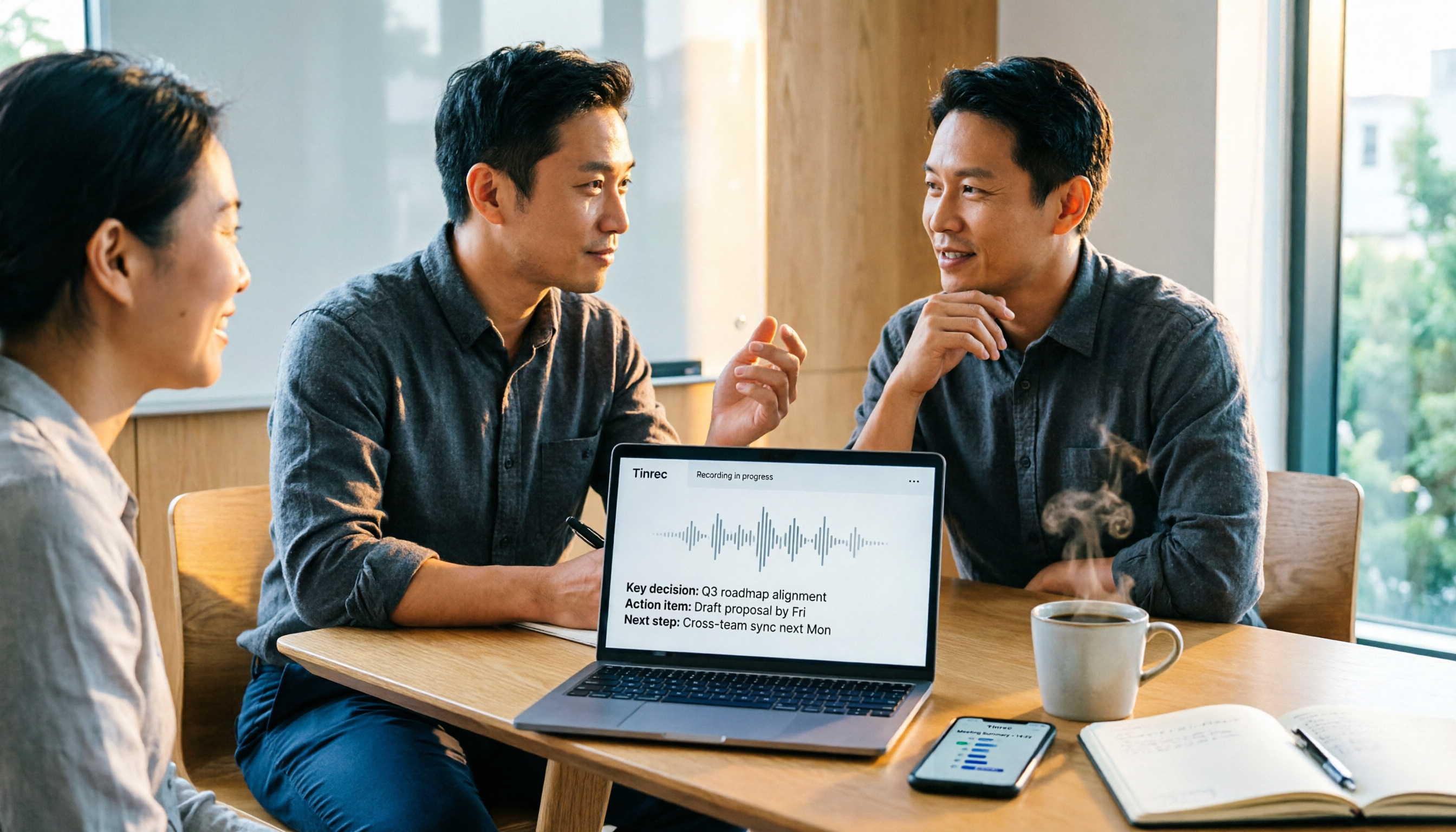
Apple Voice-to-Text vs Tinrec vs Plaud: 2026 Comparison — Which Saves the Most Time?
Starting with the iPhone's built-in Voice Memos transcription, this comparison examines Apple's built-in tools, Tinrec, and Plaud across meeting recording, AI organization, cross-platform support, and team collaboration. From a mid-level manager's perspective, it explains which solution best suits professionals with multiple weekly meetings.

2026 Speech-to-Text App Buying Guide: Tinrec vs Yating Transcription – Two Hands-On Tests and Recommendations
In Dcard and PTT discussions, there are many speech-to-text app choices. This article hands-on compares Tinrec and Yating Transcription, covering online meeting notes, post-meeting AI organization, cross-platform import, team collaboration, and multilingual accent support to help you find the right speech-to-text solution.

2026 Comparison of 3 Transcription Software: Why Good Tape Users Are Switching to Tinrec
A hands-on comparison of Good Tape and Tinrec in Chinese meetings, bot-free recording, post-meeting organization, and team collaboration. Good Tape has a solid reputation in the transcription market, but if you need to turn meetings into searchable, collaborative team data, Tinrec is a more complete choice. This article analyzes core experience, features, scenarios, and buying considerations.

4 Free Audio-to-Text Tools Tested: Is Good Tape Free? Which Is Best for Chinese Meetings?
Is Good Tape free? We compare the free plans of 4 audio-to-text tools, covering free quotas, direct online meeting recording, Chinese and mixed Chinese-English recognition, post-meeting summaries, action items, and AI Q&A, to explain who Tinrec, Good Tape, Otter.ai, and Notta are best for.