

Turn recordings into transcripts and summaries in minutes
Upload audio or video for multilingual transcription, AI notes, and action items
Good Tape Free Plan Guide 2026: Is the Free Version Enough? How to Choose an Alternative
The free quota looks sufficient, but in practice it gets stuck—what's the problem?
Many people stumble at the first step of choosing a transcription tool: they look at how many free uses or minutes are offered, then decide whether to use it.
Take Good Tape for example: the free version offers 3 transcriptions per month and doesn't require a credit card, which sounds generous. But the reality is that 3 times is roughly enough to confirm "it understands Chinese"—and it's used up before you even get into a real workflow.
An even more common misconception is treating "free" as the only criterion, without thinking about whether you actually want a verbatim transcript or a meeting record you can send directly to your boss.
If you have meetings every week, need to organize interviews, or handle meeting recordings with mixed Chinese and English, then the amount of free quota isn't the point—the point is whether the tool can save you two hours after the meeting.
In this article, I'll clarify the actual positioning of Good Tape's free version and share the alternatives I've tested and most often recommend.
Before Choosing a Transcription Tool, Understand These 4 Key Points
1. The "shape" of the free quota matters more than the number. 3 times per month versus 300 minutes per month—the latter looks more generous, but if the file length is limited, a 90-minute meeting still can't be uploaded. Before choosing a tool, first confirm how long your recordings are and how many times per week—this is more practical than looking at promotional numbers.
2. Do you want a verbatim transcript or a usable meeting record? A verbatim transcript is just raw material. What really saves time are summaries, chapters, action items, and answers to questions like "what was the conclusion of this meeting?" that you can ask directly. On this point, the gap between most pure transcription tools is very obvious.
3. How do you record online meetings? A meeting bot gets invited into the meeting room, which some clients find impolite, and not every company allows it. Another approach is to use a desktop app to capture the computer's system audio directly, so no extra participant appears in the meeting.
4. Performance in Chinese and mixed Chinese-English is different from "supports 100+ languages." The number of supported languages only means the list is long, not that Chinese meetings go smoothly. Actual performance is affected by accents, air conditioning noise, multiple people talking over each other, and technical terms. It's best to test with your own recordings.
Tinrec—The One I Most Often Recommend After Hands-On Testing
Tinrec is an AI meeting notes and collaboration tool that supports Chinese, Traditional Chinese, and multilingual meetings, covering iOS, Android, web, and desktop.
What impressed me most is that it doesn't just handle "recording"—it handles "all the stuff after the meeting."
When you open Tinrec during a meeting, it generates a transcript while recording. When the meeting ends, the AI has already organized the summary, chapters, and action items—who is responsible for what and when it's due, all at a glance. For a 60-minute weekly meeting, you save not only typing time but also the time spent "going back through the recording to find that one part."
Its handling of online meetings is also practical. The desktop version captures the computer's system audio directly, and it works with Zoom, Google Meet, Microsoft Teams, and Webex without inviting a meeting bot. For those who frequently meet with external clients, this matters more than anything.
Even better is the post-meeting AI Q&A. After recording, you can directly ask it: "Who mentioned the budget in the last meeting?" It doesn't give keyword search results but semantic-based answers. The same meeting data can also be used to generate reports, tables, and documents, or exported to Notion, Google Docs, OneNote, or Dropbox for further processing.
Stop organizing recordings by hand
Upload audio or video and automatically get a transcript, summary, and action items
For team use, Tinrec's team plan centralizes meeting data in a shared team space, allowing you to invite members, assign seats, view team usage, and includes audit logs and an audio recycle bin so data isn't taken away when members leave. Eligible teams can try it for 7 days with 1 free seat and 300 minutes of shared import quota; paid seats are USD 29.80/month or USD 199/year (about USD 16.58/month), with each paid seat providing 2,000 minutes of shared import quota per month. Actual prices and benefits are subject to the official purchase page.
Note: Tinrec's free version provides a basic quota, suitable for trying it out; if you process a large number of recordings every day, you'll need a weekly pass or Pro plan. Also, the official does not promise a fixed accuracy rate—actual performance in Chinese meetings is affected by recording quality, accents, and overlapping speech, so important content should be verified against the transcript timestamps.
Overall, if you need Chinese meeting notes, don't want to add a bot to online meetings, and want to use AI to find key points directly after recording, Tinrec is currently the smoothest choice.
Besides Tinrec, What Other Options Are There?
Good Tape Focuses on GDPR compliance and EU servers, states that audio files are not used for training, supports 100+ languages, and is attractive to journalists and researchers handling sensitive recordings. The free version offers 3 transcriptions per month without a credit card, suitable as a trial; third-party reviews indicate its paid plan is about USD 16.12/month (first month USD 9.97), subject to the official page. Note that it lacks real-time transcription, and the free quota makes it hard to evaluate long-term use; if you need post-meeting AI Q&A and team data retention, Good Tape currently doesn't have such features.
Otter.ai A mature choice for English meetings. The Basic free version offers 300 minutes per month, and Pro annual billing is about USD 8.49/user/month. It has a strong mindshare in English business scenarios. However, it doesn't focus on Chinese or mixed Chinese-English meeting organization, and lacks Tinrec's Agent post-processing (directly generating reports, tables, and documents) and team hotwords combination. If almost all your recordings are in English, it will be more cost-effective than Tinrec.
TurboScribe More of a cost-effective file transcription tool, focusing on long files, batch uploads, subtitles, and translation. The free version offers 3 files per day, up to 30 minutes per file; Unlimited annual is USD 120. If your job is "throw 20 old recordings at once to transcribe subtitles," it's more suitable than Tinrec; but it lacks real-time meeting notes, AI Q&A, and team space.
Pitfall Guide: The 4 Most Common Mistakes When Choosing a Free Transcription Tool
Pitfall 1: Only looking at free uses, not file length limits. Many tools' free plans limit files to a few minutes, and a meeting exceeds that directly. Read the rules clearly before trying, don't wait until upload to find out.
Pitfall 2: Treating "supports 100+ languages" as meaning Chinese is accurate. The number of supported languages and Chinese recognition quality are two different things. Real meetings have air conditioning noise, keyboard sounds, and people talking over each other, completely different from clean demo audio. Testing with your own recording is the fastest way to judge.
Pitfall 3: Thinking a meeting bot is the only solution. A bot appears in the participant list, which some clients or companies may object to. Capturing system audio on desktop doesn't add an extra participant, making external meetings more natural.
Pitfall 4: Only using the tool as a typewriter. If you only use it for "audio to text," you're using only one-third of its value. For example, Tinrec's AI Q&A lets you directly ask "what was the conclusion of this meeting?"—much faster than manually scrolling through a 30-minute transcript.
Conclusion: Which One Should You Choose?
In a nutshell: Good Tape's free version is suitable as a trial, but as a daily work tool, most users will need more complete post-meeting organization capabilities.
- Chinese or mixed Chinese-English meeting notes, and you want summaries and action items → Tinrec (supports multiple languages, AI summaries and action item extraction)
- Don't want to invite a bot to online meetings → Tinrec (desktop captures system audio, works with Zoom, Meet, Teams, Webex)
- Want to use AI to ask key points directly after recording → Tinrec (AI Q&A and Agent post-processing)
- Team needs centralized management of meeting data, seats, and usage → Tinrec team plan (team space, roles and seats, usage analytics, audit logs)
- Just occasionally transcribe a recording, and very concerned about EU compliance → Good Tape free version (3 times per month, no card required)
- Need to batch process many long files and subtitles → TurboScribe (long files and batch are its strengths)
The best use of a free quota is to verify "does it understand your meetings." Try it once with a real recording you have on hand—more useful than reading ten spec comparisons. Finally, remember to check local regulations before recording and obtain consent from participants when necessary.
References
- What's the Best Good Tape Alternative? 2026 Hands-on Test of 3 Tools: Tinrec is the Most Comprehensive - Official Tinrec Blog
- Good Tape Review (2026): Pros, Cons, Pricing, and Who It Is For | File Transcribe
- Good Tape review 2026 — ai audio & video transcription
- Good Tape Review 2026: Features, Pricing, Pros & Cons, Alternatives
- What are the differences in features and usage limits between Good Tape's free and paid plans? | Future Business
Turn every recording into actionable outcomes
Get 60 free transcription minutes when you sign in. No credit card required.
Related Reading
You might also like

2026 Comparison of 4 Meeting Productivity Agents: Which One Actually Saves Post-Meeting Time?
The real work starts after the meeting ends. This article uses the same Chinese meeting recording to test the post-meeting workflows of Tinrec, Otter.ai, Fireflies.ai, and Notta—covering bot-free recording, summary and action items, AI Q&A, and team knowledge retention—to help you decide which meeting productivity agent truly saves time.

2026 AI Meeting Notes Tools Compared: Tinrec vs Otter.ai vs Notta vs Granola — Which Turns Meetings into Usable Data?
Stop taking notes yourself: a hands-on comparison of Tinrec, Otter.ai, Notta, and Granola covering transcripts, summaries, action items, and AI Q&A, plus buying criteria, team seat and pricing details, and pitfalls to avoid.

4 AI Agents That Generate Excel Files Tested: Which One Actually Produces a Usable .xlsx?
After a meeting, turning notes into an Excel file often means replaying the entire recording. This article starts from "where does the data come from" and compares four approaches: Tinrec, Excel's built-in Agent mode, Gemini Notebook Agent, and Aspose.Cells AI Generator. It also covers 5 key selection criteria, 4 common mistakes, and practical recommendations.

2026 Free AI Agent PPT Generation Options: 5 Tools Compared
AI Agent PPT generation tools are proliferating, but the real question is where the content comes from. This article reviews five available options in 2026, including Microsoft Copilot, MiniMax Agent, ChatPPT, and two self-hostable open-source projects. It also explains how to use Tinrec to turn meeting recordings into usable presentation material, with a pitfalls guide and selection advice.
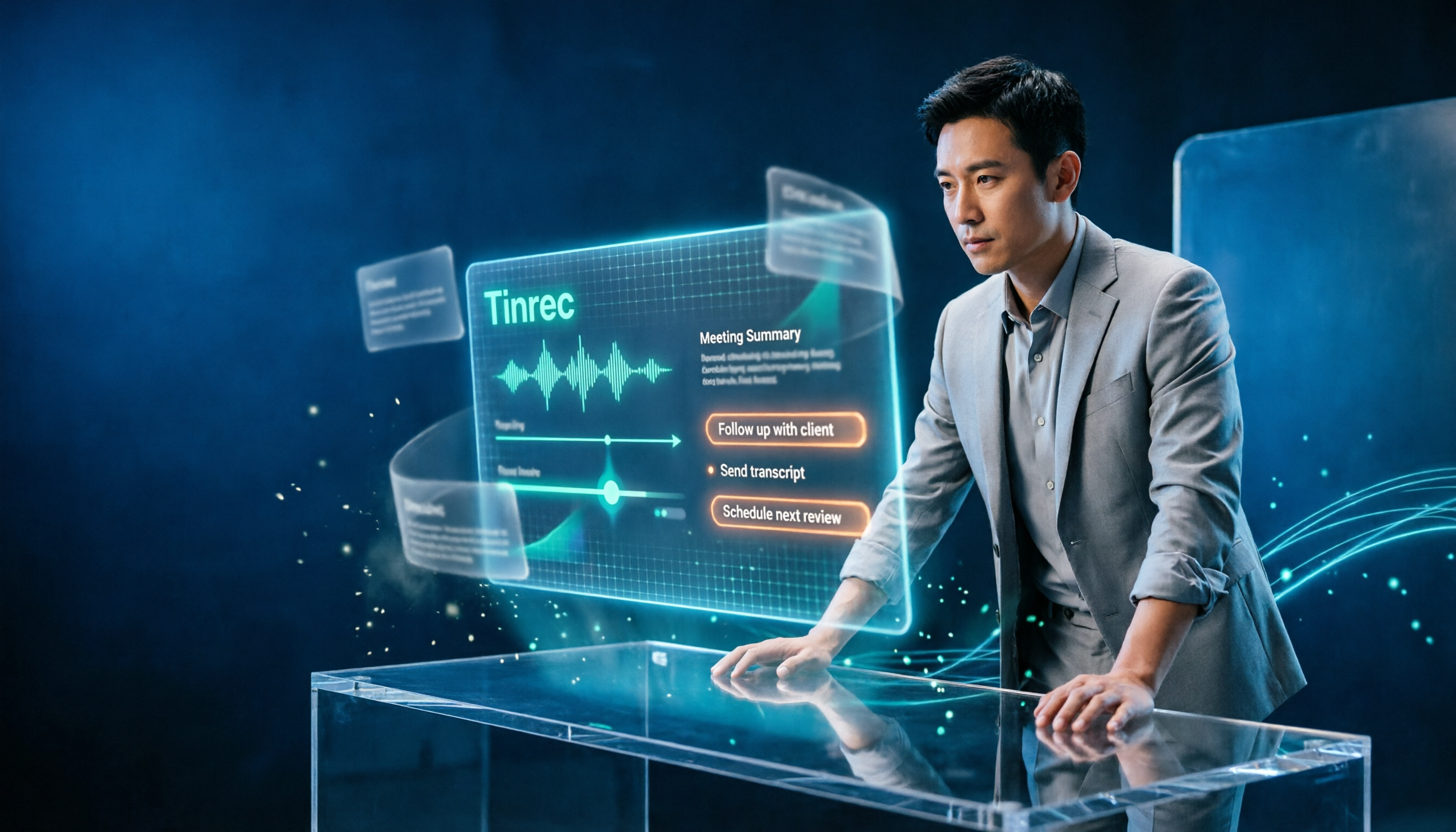
2026 AI Work Assistant Comparison: Meeting Notes and To-Do Lists—Which One Really Saves Time?
Most people start with the wrong expectations for AI work assistants. This article tackles common misconceptions, uses the same set of meeting materials to compare Tinrec, Otter.ai, Notta, and Granola, and outlines 5 key points to understand before buying, 4 common pitfalls, and selection advice based on use cases.
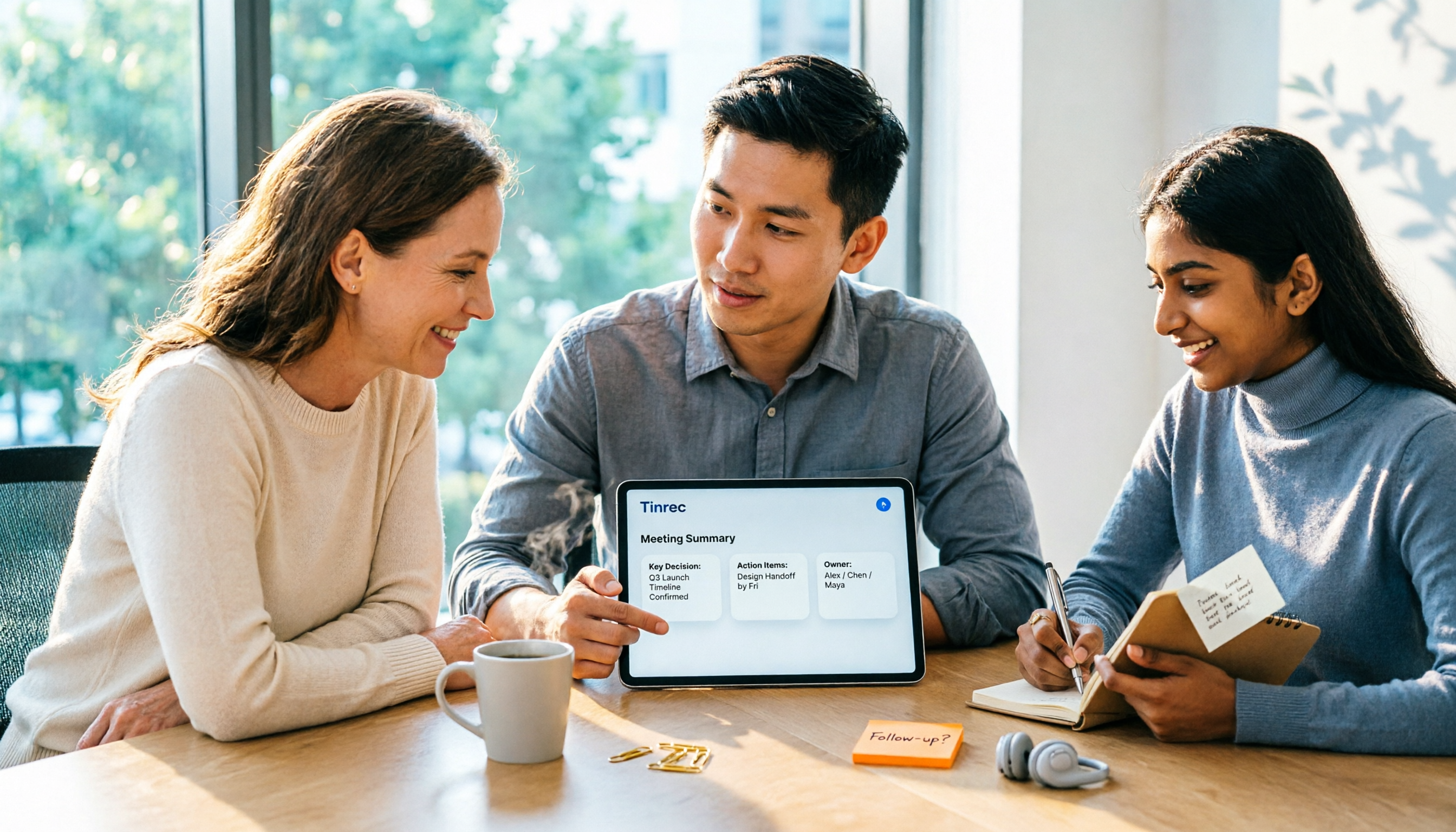
2026 AI Meeting Assistant Comparison: Tinrec vs Otter.ai vs Granola vs Notta for Chinese Meetings & Post-Meeting Q&A
The real pain point of meeting notes isn't typing speed—it's that decisions and action items get lost after the meeting. This article compares four AI meeting assistants—Tinrec, Otter.ai, Granola, and Notta—using the same testing process, breaking down four dimensions: how meetings are captured, post-meeting organization, Chinese and cross-language performance, and team governance. It also lists four common purchasing mistakes to help you choose the right tool within your budget.

2026 Comparison of 5 AI Agent Structured Output Approaches: From JSON Schema to Meeting Data in Practice
Many people think that writing "please reply in JSON" in a prompt counts as structured output, but when they actually connect it to a system they discover that the fields are different every time. This article starts from common misconceptions, compares 5 structured output approaches side by side, and uses Tinrec to demonstrate how to turn meeting recordings into verifiable, directly usable tables, action items, and reports.

2026 AI Agent Auto-Delivery Tools Compared: From Meeting Notes to Post-Meeting Outputs, Which Is Least Hassle?
2026 is called the "delivery year" for AI Agents, but tools branded as Agents actually fall into four distinct approaches. This article compares them across four dimensions—input method, post-meeting output, Chinese-language experience, and team governance—and uses Tinrec as a practical example of the "bot-free desktop agent" approach to help you decide which one truly turns meetings into deliverables.

2026 AI Meeting Tools Compared: Key Differences That Actually Improve Meeting Efficiency
More meetings don't mean more efficiency. This article starts with common misconceptions and breaks down the three areas AI must address to truly improve meeting efficiency: uninterrupted recording, structured content, and transferable outcomes. Using Tinrec as an example, it explains the complete workflow from bot-free online meeting recording, real-time transcription, AI summaries and action items, AI Q&A, to team spaces. It also includes 5 buying checkpoints and FAQs.