

Turn recordings into transcripts and summaries in minutes
Upload audio or video for multilingual transcription, AI notes, and action items
2026 AI Meeting Summary Tools Compared: 4 Options from Free to Paid
It's 3 PM, and you just finished a 90-minute cross-department meeting. Your manager asks in the group chat: "So what was decided? Who's responsible for what?" You look at the unorganized recording on your phone and all you can think about is rushing to produce meeting minutes before the end of the day.
This is a daily reality for many professionals. Meetings aren't hard to hold—the hard part is turning a pile of conversation into summaries, decisions, and action items that everyone can understand. That's why more and more people are searching for AI meeting summary tools, but with options ranging from free to paid, how do you choose? This article breaks down the differences among 4 common tools to help you avoid unnecessary detours.
The Pain Points of Meeting Minutes—You Need a Solution, Not Just a Tool
Let's start with a common scenario. In an in-person meeting, everyone is talking at once. You try to type while listening, but end up with only scattered keywords. Afterward, to recall who said what, you have to replay the recording from the beginning, and time slips away.
Another scenario is online meetings. After a Zoom, Google Meet, or Teams call, the platform may have a recording, but unorganized content is as good as not organized. Participants remember different versions, and follow-ups often don't align.
There's an even trickier one: Chinese meetings mixed with English technical terms, or clients communicating in a mix of Chinese and English. General transcription tools see a noticeable increase in errors with such content, which actually adds to proofreading time.
If you've encountered these situations, what you really need isn't just "turning recordings into text"—it's a meeting workflow that helps you produce summaries, action items, and even lets your team search later.
Before Choosing an AI Meeting Summary Tool, Understand These 4 Key Points
First, transcription quality depends on your meeting context. Official pages often claim "98% accuracy," but that's usually measured in quiet environments with standard accents. Real meetings have air conditioning noise, keyboard sounds, and overlapping speakers, so quality will be affected. Test with your own meeting recordings, especially for Chinese and mixed Chinese-English content.
Second, how does the meeting audio get in? Some tools require a "meeting bot" to join the online meeting as a participant; others capture system audio directly on your computer without adding an extra participant. The latter is usually less intrusive for external client meetings.
Third, can summaries and action items be used directly? Tools that only provide transcripts still require you to read through everything after the meeting. Tools that automatically generate summaries, chapters, and action items truly reduce post-meeting organization time.
Fourth, can the team use it together? If meeting data only exists in individual accounts, it's easily lost when colleagues leave or switch devices. Team spaces, member roles, and seat management determine whether meeting data can accumulate as a team asset.
Tinrec—Our Top Recommendation
Tinrec is an AI meeting notes and collaboration tool for individuals and teams, supporting web, desktop, and mobile. Its positioning isn't just recording-to-text, but turning meetings into searchable, collaborative, and actionable team data.
Let's start with the most impactful feature: bot-free online meeting recording. The Tinrec desktop app directly captures computer system audio for Zoom, Google Meet, Microsoft Teams, Webex, and other platforms, without inviting an extra bot to join. For those who frequently meet with external clients, this is practical—you don't have to explain "who that extra account is."
During the meeting, Tinrec can transcribe in real time. After the meeting, AI automatically generates summaries, chapters, and action items, organizing who's responsible for what and what's next in one place. If there's foreign language content, you can enable real-time translation and view in original, translated, or bilingual mode.
More uniquely, there's AI Q&A. After recording, you can directly ask questions about the meeting content, such as "What was the budget cap mentioned in the last meeting?" The system organizes answers based on semantics, rather than just throwing a bunch of keyword search results at you. Currently, few similar tools combine Q&A with post-meeting workflows.
Tinrec also supports uploading audio and video files, suitable for organizing historical meetings, interviews, or course recordings. Organized content can be exported to Notion, Google Docs, OneNote, Dropbox, etc., or further processed with Agent to generate reports, tables, and documents.
Stop organizing recordings by hand
Upload audio or video and automatically get a transcript, summary, and action items
Three advantages I think are worth noting:
- Good experience organizing Chinese and mixed Chinese-English content, plus support for team hotwords to include internal project abbreviations and technical terms, reducing recognition errors.
- Complete post-meeting workflow, from transcript, summary, action items to Q&A and export, without moving data between multiple tools.
- The team version provides independent team spaces, meeting data belongs to the team, members can view historical meetings after joining, and resources can be handed over when members leave, so data doesn't disappear with individual accounts.
Things to note:
Tinrec is not a meeting bot that "automatically joins all calendar meetings"—you need to actively initiate recording via the desktop app when needed. Also, the free version is mainly for light users to experience basic quotas; if you have a high volume of meetings or need team management features, you'll need a paid plan. The team version is currently USD 29.80 per paid seat per month, or USD 199 per paid seat per year (about USD 16.58 per month). Actual prices and benefits are subject to the official purchase page.
Who it's for:
If you frequently handle Chinese meetings, mixed Chinese-English content, want summaries and action items right after the meeting, and even want to share meeting data with your team, Tinrec is a top choice worth trying first.
Besides Tinrec, What Other Options Are There?
Otter.ai is a mature English meeting assistant, supporting Zoom, Microsoft Teams, Google Meet, with real-time transcription, AI Chat, and team management. The free version offers 300 minutes per month; Pro annual billing is about USD 8.49 per user per month. It has a strong mindshare for English business meetings, but Chinese meetings and mixed Chinese-English content are not its strong suit; if you need Chinese real-time translation and bot-free desktop recording, Tinrec is closer to your needs.
Notta overlaps significantly with Tinrec, both supporting multi-platform transcription, meeting notes, file import, and translation. The free version offers 120 minutes per month, max 3 minutes per session; Pro annual billing is about USD 8.17 per month, Business about USD 16.67 per seat per month. Notta has some accumulation in file transcription and subtitle translation, but if you care more about bot-free online meeting recording, team spaces, and AI Q&A, Tinrec's post-meeting workflow is more complete.
Granola is a bot-free AI meeting notes tool that transcribes in real time via desktop system audio and combines user handwritten notes to generate content. Basic is free, Business is USD 14 per user per month, Enterprise is USD 35 per user per month. Note that Granola does not support uploading pre-recorded audio files and does not save meeting audio; if you need to keep recordings, import historical files, or want Chinese real-time translation and more export options, Tinrec is more suitable.
Pitfall Guide: 3 Most Common Mistakes When Choosing an AI Meeting Summary Tool
Pitfall 1: Only looking at official accuracy claims. Many tools boast high accuracy, but actual performance is affected by recording quality, accents, background noise, and overlapping speakers. Test with your most common meeting scenarios, especially content with Chinese and many technical terms.
Pitfall 2: Ignoring how meeting audio is captured. If your meetings often include external clients, having a bot join might seem intrusive. First confirm whether the tool uses a bot to join or captures system audio directly like Tinrec desktop, as this affects smoothness of use.
Pitfall 3: Treating the tool only as a transcript generator. If you only use transcription, you're wasting the subsequent capabilities like summaries, action items, Q&A, and export. Tinrec, for example, lets you ask questions directly after the meeting, generate reports or tables, saving more time than simple transcription for those who need to deliver meeting minutes quickly.
Conclusion: Which One Should You Choose?
Overall, when choosing an AI meeting summary tool, rather than comparing who has prettier marketing numbers, go back to your meeting context:
- Need transcripts and summaries for Chinese meetings and mixed Chinese-English content → Tinrec
- Want to use AI Q&A to find decisions and action items after the meeting → Tinrec
- Don't want a meeting bot joining client meetings → Tinrec (desktop bot-free recording)
- Need team sharing of meeting data, member and seat management → Tinrec team version
- Mainly record English meetings, limited budget → Otter.ai free version is worth considering
We suggest starting with Tinrec's free version, running a recent meeting recording through it to confirm transcription quality and summary results meet expectations, then deciding whether to upgrade. After all, the best way to know if a tool works is to try it yourself.
References
- Meeting Ink - 2026 AI Meeting Notes Tool Test | 7 Speech-to-Text and Summary Speed Comparison | Meeting Ink - AI Meeting Notes Assistant Automatic Transcription and Summary
- Meeting Ink - AI Meeting Notes Assistant Automatic Transcription and Summary
- Organizing meeting minutes is painful? 5 NotebookLM AI note transformation tricks, accurate translation even with mixed Chinese-English and technical terms | BusinessNext
- Many people recently asked me if there are AI tools for meeting notes. They still type manually, often can't multitask, and waste time. I always answer—SeaMeet. Why recommend? Here's a summary: -Linked to Google Meet, online meetings sync transcripts and real-time summaries, super convenient. -No need to refresh, after the meeting, automatically emails all participants. -So easy to use that I taught middle-aged people with no AI experience in 10 minutes. -In-person meetings
- 2026's most recommended AI meeting notes神器, time-saving must-have tool for meetings!
Turn every recording into actionable outcomes
Get 60 free transcription minutes when you sign in. No credit card required.
Related Reading
You might also like

2026 Comparison of 3 Speaker Summary Tools: How Tinrec Helps You Know Who Said What
In meetings with multiple speakers, it's hard to remember who said what afterward. This article compares 3 speaker summary tools and uses Tinrec as an example to show how AI transcription, Q&A, and summaries can quickly organize each speaker's viewpoints and action items.
4 Free Transcription Generators Compared in 2026: Which Offers the Best Free Quota and Chinese Recognition?
There are many free transcription generators, but what really matters is how the free quota is calculated, how accurately Chinese and mixed Chinese-English are recognized, and whether the transcript can be used directly. This article uses Tinrec as an example to break down 4 common free approaches, core capabilities, practical use cases, and 5 key purchasing considerations, and answers common questions.

How Long Can iPhone Record? 2026 Guide: 48-Hour Limit + AI Meeting Notes
How long can an iPhone record? Apple's built-in Voice Memos can record up to about 48 hours with enough storage and battery, but the real challenge is what you do with the recording afterward. This guide clears up 3 common misconceptions and practical limits, then shows how Tinrec turns recordings into transcripts, summaries, chapters, and action items in real time. It also covers 5 key factors for choosing a recording-to-text tool and answers frequently asked questions.

4 Online Transcription Tools Tested for 2026: Which Is Best for Chinese Meetings?
Online transcription tools aren't just about speed. We tested Tinrec, Notta, Otter.ai, and TurboScribe, comparing them on Chinese meeting support, bot-free recording, AI Q&A, action item extraction, and team data ownership. We also cover 4 common buying pitfalls to help you find a solution that truly saves post-meeting cleanup time.

5 AI Meeting Summary Tools Tested in 2026: Which Has the Best Free Tier and Chinese Summaries?
Pasting a transcript into ChatGPT to summarize a meeting is a common mistake. This article, from a student's hands-on testing perspective, first highlights three pitfalls, then compares Tinrec and PLAUD Note across six dimensions, with one-sentence takeaways for Notta, Otter.ai, and Granola. It concludes with practical advice on whether free tiers are sufficient and which classes they suit.

4 AI Transcription Tools Tested for 2026: Which One Saves the Most Post-Meeting Time?
A mid-level manager's hands-on review of AI transcription tools: converting speech to text is just the first step. The real key is whether it can automatically generate summaries, action items, and build a team knowledge base. This article shares 5 criteria for choosing an AI transcription tool based on real meeting scenarios, and how Tinrec solves post-meeting follow-up pain points with bot-free recording, AI Q&A, and team spaces.
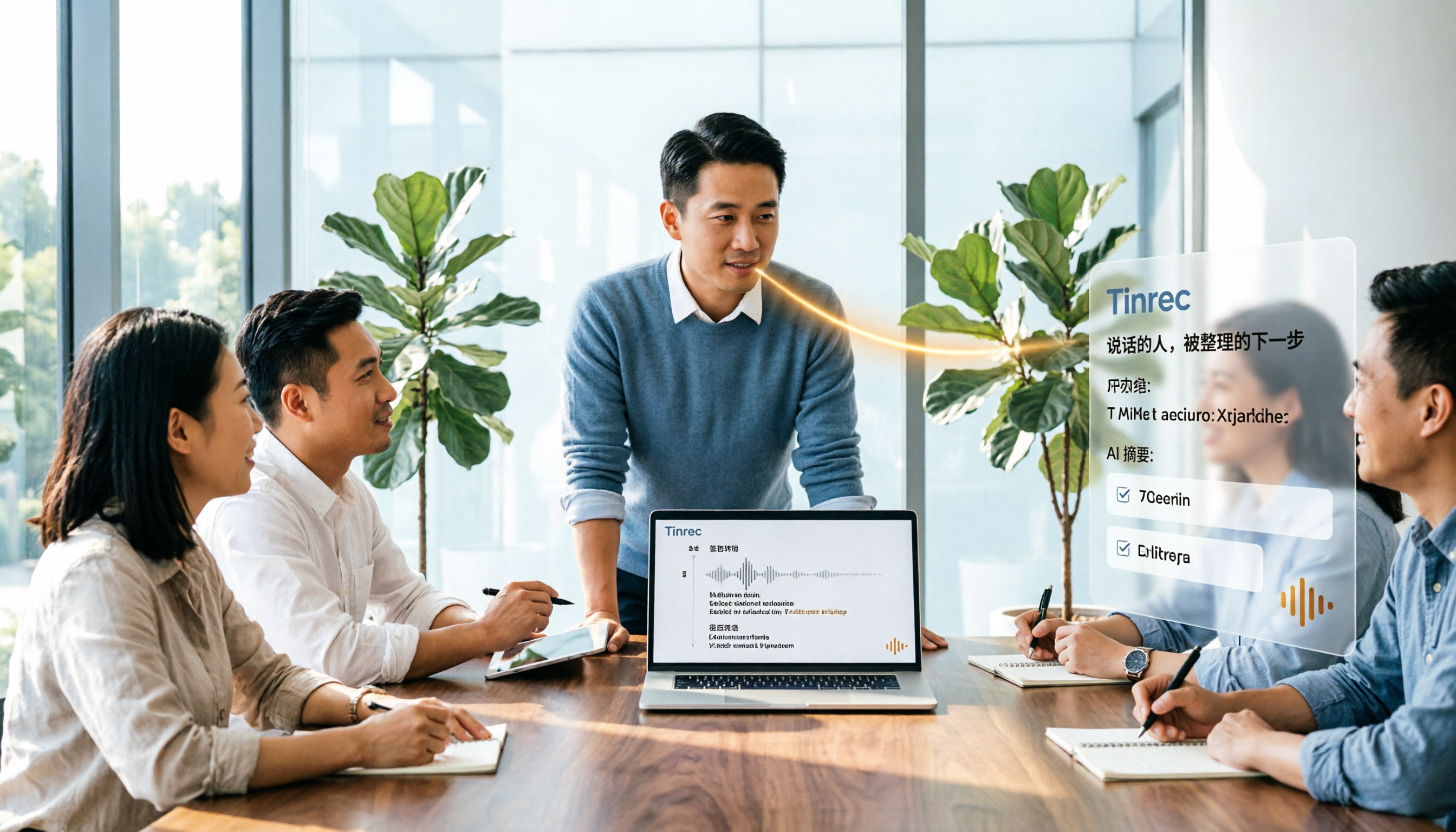
2026年4款AI会议记录工具实测对比:中文识别与AI待办谁最省时
每周开15场会的中层管理者实测4款会议记录自动化工具:从中英夹杂转写、AI摘要与待办提取,到团队空间与席位管理,说明Tinrec(秒听录音)为何在中文会议与会后整理流程胜出,并比较Otter.ai、Granola、Notta各自适合谁、限制在哪里。

Tinrec vs Granola 2026: 5-Dimension Comparison for Turning Recordings into Actionable To-Dos
Many people think that handing a recording to AI and asking for a summary will automatically produce a to-do list, but what they get is text that can't be tracked. This article focuses on 'turning recordings into trackable to-dos' and compares Tinrec and Granola across 5 dimensions: Chinese to-do recognition, recording sources, to-do output format, AI follow-up questions, and team data retention. It includes practical steps and FAQs to help you decide which workflow to use.

Tinrec vs Otter.ai in 2026: A 5-Dimension Comparison for Chinese Meeting Notes
How do you choose meeting note software in 2026? This article compares Tinrec and Otter.ai across 5 practical dimensions, outlines how Notta and Granola differ, and includes common pitfalls and tips to help you find the right AI meeting notes tool for Chinese meetings and team collaboration.