

Turn recordings into transcripts and summaries in minutes
Upload audio or video for multilingual transcription, AI notes, and action items
Two-hour meeting, two more hours to organize? Most people pick the wrong tool from the start
For many office workers, the pain point isn't the meeting itself—it's what comes after. After talking through everything in the conference room, you return to your desk and have to listen to the recording again, writing down who's responsible for what and when it's due. An entire afternoon disappears.
A more common misconception is thinking that finding a speech-to-text tool solves the problem. You end up with a 30-minute transcript and still have to read through it, highlight key points, and copy out action items—the tool just turns typing into reading, saving limited time.
The second misconception is going straight for a meeting bot. Bots need to join as a participant, which some corporate accounts block, or after recording you only get text with no summary, no action items, and no place for the team to review together.
The real problem has three layers: capture the meeting in the moment, organize it quickly afterward, and retain the data. If you're stuck on these three steps, the testing methods and buying criteria below are for you.
Before choosing a smart meeting collaboration tool, understand these 5 key points
1. How the meeting is recorded. There are two main approaches: a meeting bot joins as a participant, or the tool captures system audio directly from the user's computer. The former requires consent and may not be allowed by corporate accounts; the latter doesn't add a participant but requires the user to actively start the tool.
2. What you get after transcription. Just a transcript means the work falls back on you. Look for tools that automatically generate summaries, chapters, key points, and action items, and ideally let you ask questions directly about the meeting content.
3. Handling Chinese and mixed Chinese-English. Meetings often mix English and Chinese, plus product codes and internal jargon. When choosing a tool, check if it supports mixed Chinese-English and whether it has team hotwords to maintain terminology.
4. Can you take the results with you? Meeting notes usually end up in Notion, Google Docs, OneNote, or Dropbox. If export formats are limited, you'll still be copying and pasting manually.
5. Team-level data ownership. When a colleague leaves, does the meeting recording stay with the company or go with the person? Team spaces, member roles, seats, usage, and audit logs are all things to clarify when purchasing.
Testing conditions: This comparison uses the same mixed Chinese-English internal meeting recording, plus an online meeting, following each tool's standard workflow. Actual recognition results will be affected by recording quality, background noise, accents, overlapping speech, and technical terms. We recommend testing with your own team's real meeting clips, not just official demos.
Tinrec — the top pick after testing
Tinrec is an AI meeting notes and collaboration tool for individuals and teams, covering iOS, Android, and web, with a desktop version that handles Zoom, Google Meet, Microsoft Teams, Webex, and other online meetings.
During the meeting: no bot needed. Tinrec's desktop version captures system audio directly, without adding a participant—especially useful for corporate accounts that can't add external bots. It produces live transcription while recording, and for cross-language meetings you can enable real-time translation to view in original, translated, or bilingual mode.
After the meeting: more than just a transcript. After the meeting, AI generates summaries, chapters, and key points, and extracts action items from the discussion. The most impressive feature is AI Q&A—you can directly ask "What was the conclusion of this meeting?" or "What was the budget cap the client mentioned?" and it answers based on meaning, not just a list of keyword search results. You can then use Agent post-processing to generate reports, tables, and documents, or export to Notion, Google Docs, OneNote, Dropbox for further editing.
Team use: turn meetings into traceable assets. The team version is a separate team space, not a few people sharing a personal account. Data belongs to the team, and members can share and view. Admins can set owners, admins, and regular members, assign or revoke seats, view usage trends, member rankings, and audit logs, and maintain team hotwords and an audio recycle bin. When a member leaves or is removed, their team resources can be transferred to other active members. It's important to distinguish "roles" from "seats": roles determine who can manage the team and settings, seats determine who can record, upload, edit, and export; members without seats can still view, play, and read team data.
Stop organizing recordings by hand
Upload audio or video and automatically get a transcript, summary, and action items
Pricing: The first eligible team trial is 7 days, 1 free seat, 300 minutes of team shared import quota; team monthly is USD 29.80 per paid seat per month, annual is USD 199 per paid seat per year, about USD 16.58 per month, with each paid seat providing 2,000 minutes of team shared import quota per month. Under an active team plan and active seat, real-time recording currently does not deduct minutes; file and web imports use the team shared quota. Individual users can choose free, weekly, Pro monthly, or annual plans. Actual prices and benefits are subject to the official purchase page.
Pros: First, bot-free recording on desktop, so you can record even corporate meetings; second, after transcription it directly produces summaries, action items, and a queryable meeting database, saving the most time-consuming organization work; third, support for Chinese and multilingual scenarios with real-time translation and team hotwords, plus team space, seats, and usage management, suitable for teams that need to accumulate meeting data long-term.
Limitations: Requires the user to actively start the desktop version to record, not automatically join all calendar meetings; the official also does not recommend promising a fixed accuracy rate—recording quality, noise, accents, and overlapping speech all affect results, and important information should be verified against transcript timestamps and recording playback. Also, the team version currently focuses on team-level sharing, not file-level granular permissions.
Who it's for: Users who frequently have Chinese or mixed Chinese-English meetings, don't want to hand-write meeting notes, want to ask AI directly for key points after the meeting, or need to keep meeting data in a team space for unified management.
Besides Tinrec, what other options are there?
Otter.ai: A mature choice for English business meetings, free version 300 minutes per month, Pro annual about USD 8.49 per user per month. If meetings are almost entirely in English, it's sufficient; but it doesn't focus on Chinese and mixed Chinese-English meetings, and lacks Tinrec's team hotwords and queryable meeting database. (Prices subject to Otter's official pricing page)
Granola: Also a bot-free AI meeting notes tool, Business is USD 14 per user per month, strong at combining handwritten notes with AI. But the official states it doesn't retain meeting audio and doesn't support uploading pre-recorded audio files; to keep recordings, organize interview files, and multi-format export, Tinrec covers more. (Prices subject to Granola's official pricing page)
Notta: Good multilingual transcription and translation, free version 120 minutes per month, max 3 minutes per session, Pro annual about USD 8.17 per month. Positioning is close to Tinrec, but lacks desktop bot-free recording, AI Q&A, and team seat and audit governance capabilities. (Prices subject to Notta's official pricing page)
Pitfall guide: 4 most common mistakes when choosing a smart meeting tool
Pitfall 1: Treating the tool as just "speech to text." A transcript is just an intermediate product. If the tool has no summary, action items, and Q&A, you still have to review it yourself. When choosing, ask: After the meeting, what can I directly get that I can hand off?
Pitfall 2: Only looking at the official accuracy rate. Official demos are usually standard speech in a quiet environment. Real meetings have air conditioning noise, keyboard sounds, overlapping speech, and product codes flying around. Be sure to test with your own team's mixed Chinese-English recording.
Pitfall 3: Ignoring cross-platform and export. Record on your phone today, organize on your computer tomorrow, then throw it into Notion—if the tool doesn't support cross-platform or has limited export formats, you'll waste another half hour copying and pasting.
Pitfall 4: Not clarifying team data ownership and seats. "Everyone using one account" seems cheap, but permissions, usage, auditing, and departure handover are all unresolved. When purchasing for a team, ask: Who owns the data, who has permission to record and export, how is data handed over when a member leaves, and can deleted recordings be recovered?
Conclusion: Which one should you choose?
Back to the original question: You don't need a "transcription" tool, but a workflow from recording to delivery. Based on this testing experience:
- Need Chinese and mixed Chinese-English transcription, and want summaries and action items directly after the meeting → Tinrec (real-time recording, AI summary and action item extraction)
- Want to ask AI "What was the meeting conclusion?" right after recording → Tinrec (AI Q&A is a rare feature among similar tools)
- Use Zoom/Meet/Teams but corporate accounts don't allow bots → Tinrec (desktop captures system audio, no participant added)
- Want to keep meeting data in the team, manage seats and usage → Tinrec team version (team space, roles and seats, usage analytics, audit logs)
- Meetings almost entirely in English, budget first → Otter.ai (more cost-effective in this scenario)
We recommend first running a complete workflow with your own meeting recording in Tinrec's free version—from transcript, summary to Q&A—then decide whether to upgrade. Whether a tool can save you time, you'll know after one try.
References
- Google Meet: Online voice and video meeting calls | Google Workspace
- Smart meetings - Smart meetings and workspaces
- Smart meetings, meeting room management_Virsical
- AI meeting notes and action item tracking: Practical methods for SMEs to say goodbye to meetings without decisions | TheAI Academy
- What is a smart meeting room? A guide to benefits, feature suggestions, and application examples - DC Sales Portal
Turn every recording into actionable outcomes
Get 60 free transcription minutes when you sign in. No credit card required.
Related Reading
You might also like

2026年4款销售会议记录工具实测对比:免费额度谁最够用?
销售会议记录怎么写?本文拆解业务会议必记的4个字段与可直接套用的骨架,并实测比较 Tinrec、Notta、Granola、Otter.ai 四款工具的中文转写、AI 问答与免费额度,最后给学生与小团队的选用建议。

2026 Smart Meeting Collaboration Platforms Compared: Tinrec vs Granola — Which Is Better for Teams?
How do you choose a smart meeting collaboration platform in 2026? This article compares Tinrec and Granola across key dimensions—bot-free recording, audio retention, Chinese-language experience, post-meeting AI organization, team collaboration, and pricing—to help SMB managers and department heads quickly decide which platform best fits their team.

2026 Smart Meeting Collaboration Tools Compared: Which AI Meeting Assistant Saves the Most Time on Chinese Meeting Notes?
A mid-level manager who attends 15 meetings a week tested four common smart meeting collaboration approaches in 2026: built-in platform transcription, bot-based AI meeting assistants, standalone file transcription tools, and Tinrec, which he ultimately kept. The article covers real-world use cases, core capabilities, five key considerations when choosing a tool, and FAQs, including team plan roles, seats, and meeting data ownership.

Which AI Meeting Collaboration Platform Is Best? 2026 Hands-On Test of 4 Tools—This One Excels at Chinese Meetings
There are many AI meeting collaboration platforms on the market, but most people compare the wrong things. This article hands-on tests 4 tools, breaking down meeting capture methods, Chinese and mixed Chinese-English recognition, post-meeting organization workflows, team data ownership, and pricing. It also shares hands-on experience with Tinrec's bot-free recording, AI Q&A, and team spaces to help you decide which one fits your work rhythm.

Tinrec vs Notta 2026: 5-Factor Comparison for Chinese Meeting Collaboration Platforms
How to choose a smart meeting collaboration platform in 2026? This article addresses common pitfalls, outlines 5 key selection factors, shares hands-on testing highlights of Tinrec, and provides brief reviews and tips for Notta, Otter.ai, and Granola to help Chinese meetings and team knowledge retention find the right solution.

Tinrec vs Otter.ai 2026: 5-Dimension Test - Which Is Better for Chinese Meeting Collaboration?
In 2026, we tested smart meeting collaboration tools, comparing Tinrec and Otter.ai across five dimensions: bot-free recording, Chinese transcription, post-meeting organization, team collaboration, and pricing. We provide practical examples. If you're looking for a Chinese meeting note-taking tool, this hands-on review will help you decide which one suits you better.

2026 Smart Meeting Collaboration Tools Compared: Which One Actually Saves Time After Meetings?
From the perspective of a mid-level manager who holds 15 meetings a week, this article covers 3 latest changes in smart meeting collaboration in 2026, compares 4 common approaches through hands-on testing, and uses 5 buying criteria and 6 FAQs to explain how to choose an AI meeting note-taker and how to ensure post-meeting action items are not missed.

2026 Smart Meeting Collaboration Platforms Compared: Tinrec vs Notta — Which Builds Better Team Knowledge?
Discussions on PTT about smart meeting collaboration platforms often get stuck at 'you can record, but you can't use it.' This article compares Tinrec and Notta across meeting capture methods, Chinese transcription, post-meeting output, and team data ownership. It also covers Tinrec's bot-free online meeting recording, real-time translation, AI Q&A, action item extraction, and team workspace features to help you decide which workflow fits your meeting habits.
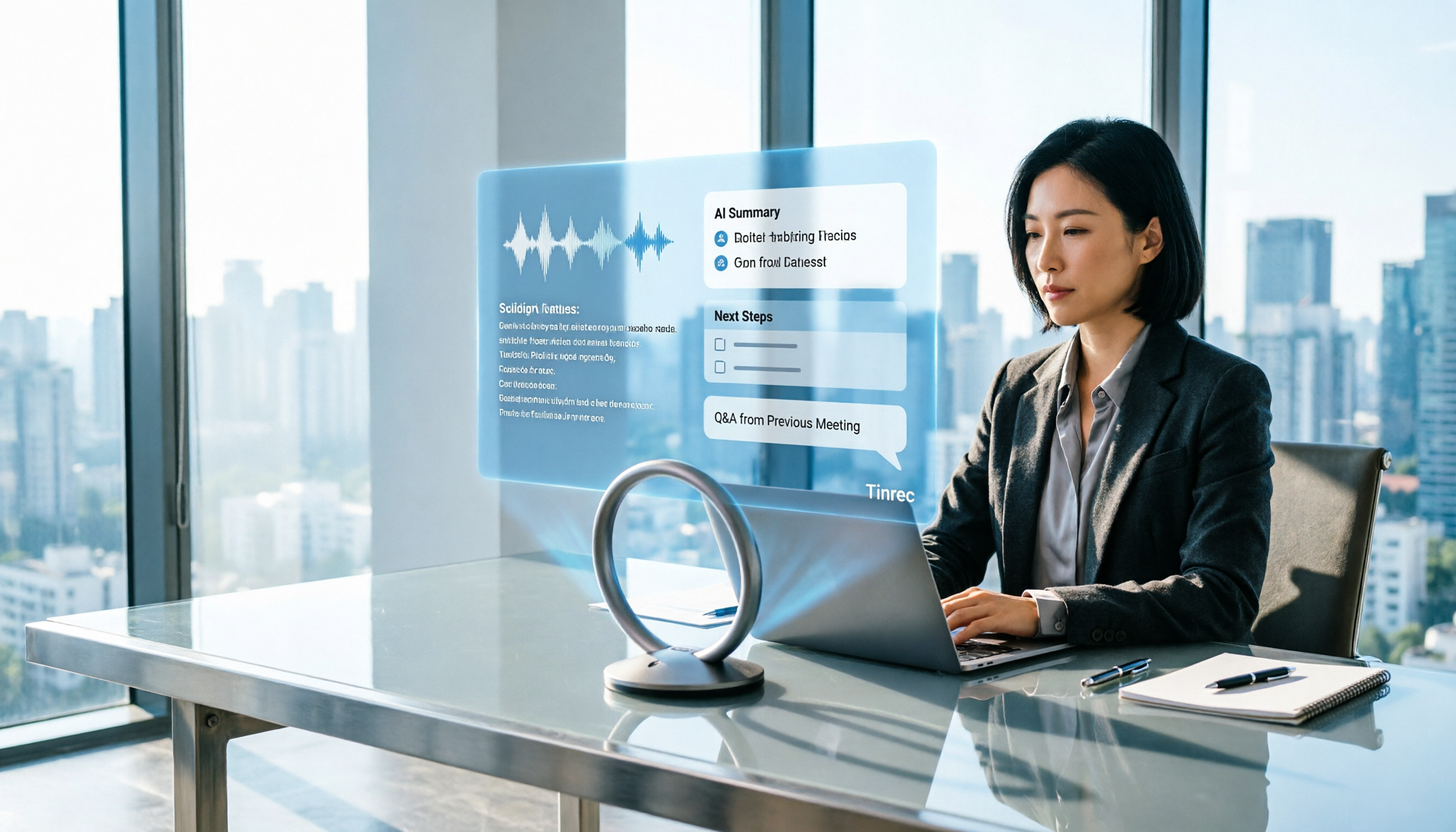
How to Use Tinrec in 2026: AI Meeting Collaboration with Bot-Free Recording & Auto-Generated Meeting Minutes
No one remembers decisions after a meeting? This guide uses Tinrec as an example to show you how to use an AI meeting collaboration platform in 5 steps: from creating a team workspace, recording online meetings without bots, generating transcripts, to AI summaries, action item extraction, and cross-meeting Q&A. It also covers FAQs, advanced tips, and alternatives.