

Turn recordings into transcripts and summaries in minutes
Upload audio or video for multilingual transcription, AI notes, and action items
It's 3 PM, and the meeting finally ends. You look at the 90-minute recording on your phone and realize you haven't started on the transcript yet. This is a daily reality for many office workers—two hours in a meeting, followed by two hours of organizing afterward.
Many people search for "iFLYTEK voice recorder transcription," hoping to find a tool that automatically turns meetings into transcripts. Hardware recorders do have their conveniences, but if you often attend meetings on your computer, there might be another option.
This article compares iFLYTEK voice recorders and Tinrec across five dimensions to help you determine which is better suited to your work style.
iFLYTEK Voice Recorder vs Tinrec | Quick Overview
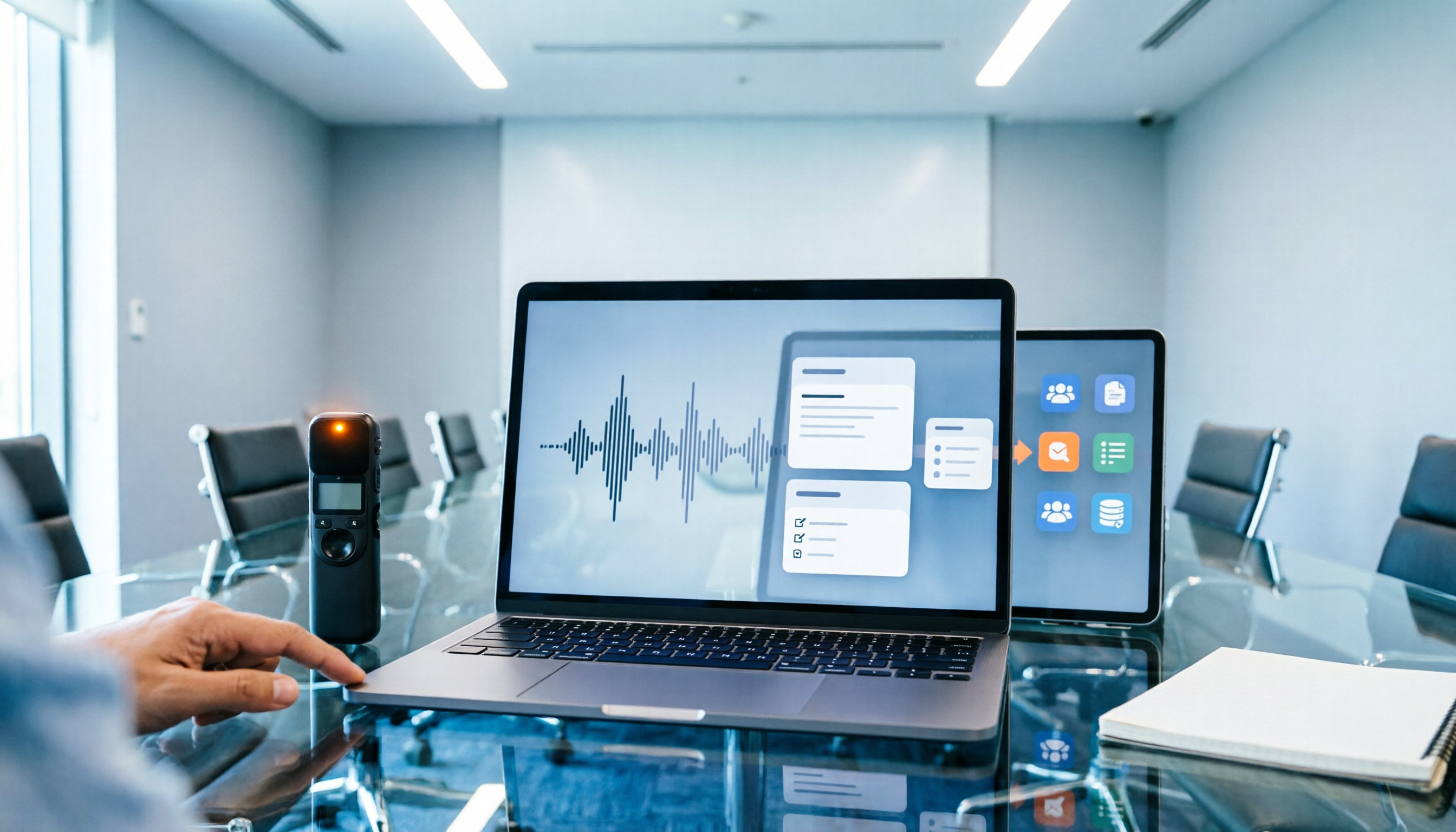
The iFLYTEK voice recorder is a standalone hardware device focused on portable recording and offline transcription; Tinrec is a software service that handles meeting recordings and post-meeting organization via web, desktop, and mobile app. Both can convert speech to text, but their workflows and suitable scenarios differ.
- iFLYTEK voice recorder: Requires purchasing hardware; the recorder itself handles audio capture, and transcription can be done online or offline.
- Tinrec: No additional hardware needed; supports live recording, bot-free recording for online meetings, audio file import, and offers AI summaries, to-dos, Q&A, and team spaces.
- Comparison dimensions: hardware requirements, online meetings, post-meeting organization, team collaboration, free plans.
Dimension 1 | Usage and Hardware Requirements
The iFLYTEK voice recorder requires purchasing a recorder first, such as the SR502T or SR702T. It has 2 directional and 6 omnidirectional microphones built in, with a recording range of up to 15 meters, suitable for placing the recorder in the center of a meeting table. In other words, you need the hardware first to start transcribing.
Tinrec, on the other hand, requires no additional equipment. It works on web, desktop, and mobile app; the desktop version directly captures computer system audio, while the mobile app is great for recording on the go. You can start as soon as you open the tool, without carrying an extra recorder.
→ In this dimension: Tinrec wins on entry barrier and multi-device use; the iFLYTEK voice recorder's advantage is its standalone hardware, ideal for those who don't want to rely on a phone or computer.
Dimension 2 | Recording Online Meetings
When recording online meetings with an iFLYTEK voice recorder, you typically need to play the meeting audio out loud for the recorder to pick up. According to sources, it can still record without internet, and you can upload for transcription later when connected. The benefit is that the recorder operates independently, but audio quality is affected by speaker volume and ambient noise.
Tinrec's desktop version directly captures system audio from Zoom, Google Meet, Microsoft Teams, Webex, and other meetings, without needing a meeting bot to join. That means no extra "participant" in the meeting, and a transcript can be generated right after recording.
→ In this dimension: Tinrec is better suited for users who frequently attend online meetings on a computer.
Dimension 3 | Post-Meeting Organization and AI Applications
The iFLYTEK voice recorder is powered by the Spark large model. According to sources, it can organize full-article summaries and individual speaker summaries, and online transcription supports "speaker separation," distinguishing up to 9 people and labeling them as "Speaker 1," "Speaker 2," etc. These features are very helpful for post-meeting organization.
Tinrec also offers AI summaries and chapters, and can further extract to-dos, generate mind maps, and support AI Q&A around meeting content. If needed, you can use an Agent for post-processing to generate reports, tables, and documents, then export to Notion, Google Docs, OneNote, Dropbox, and other tools.
→ In this dimension: Both have AI summaries, but Tinrec offers more comprehensive post-meeting workflow extensions.
Dimension 4 | Team Collaboration and Data Retention
The iFLYTEK voice recorder is essentially a personal device; recording files are stored on the recorder or in a personal app. If a team wants to share transcripts, they usually have to send files or copy links separately, and they can easily get scattered after members leave.
Tinrec's team version provides an independent team space where meeting data belongs to the team. Admins can invite members, assign roles and seats, and view usage analytics and audit logs. Even if a member leaves or loses their seat, team resources can be transferred to other active members and won't be taken away by individuals.
Stop organizing recordings by hand
Upload audio or video and automatically get a transcript, summary, and action items
→ In this dimension: Tinrec clearly wins in team collaboration and data governance.
Dimension 5 | Free Plans and Cost of Entry
The iFLYTEK voice recorder requires purchasing hardware first. Sources mention "lifetime free transcription, unlimited transcription," so for long-term use, the transcription cost is amortized over time. However, the hardware itself is an upfront expense, and prices vary by model; it's best to refer to the official purchase page.
Tinrec offers a free version to experience recording, import, summaries, and transcription. If you have a large number of meetings in the short term, consider a weekly pass; for steady weekly use, a Pro monthly or annual plan is suitable. The team version also has a 7-day trial, including 1 free seat and 300 minutes of shared team import quota, with subsequent monthly payment at USD 29.80 per paid seat per month, or annual payment at USD 199 per paid seat per year.
→ In this dimension: The iFLYTEK voice recorder is for those willing to buy hardware once and use it long-term; Tinrec's free version and flexible plans are better for office workers who want to try before deciding to pay.
What Are the Unique Advantages of Each?
Tinrec's unique advantages:
- No additional hardware needed; works on web, desktop, and mobile. Directly captures system audio for online meetings without a meeting bot.
- More comprehensive post-meeting organization, supporting summaries, chapters, to-dos, AI Q&A, mind maps, and report, table, and document generation.
- Team space centralizes meeting data, with roles, seats, usage, audit, and recycle bin, suitable for departments or project teams.
- Supports real-time translation and bilingual view; teams can also maintain hotwords to improve recognition of technical terms.
iFLYTEK voice recorder's unique advantages:
- Standalone hardware design, no need for a phone or computer nearby, suitable for portable recording, interviews, or situations without a computer.
- Sources mention support for offline transcription; you can record without internet and upload later when connected. Some models also support multilingual transcription and mixed Chinese-English content.
Conclusion: Which Should You Choose?
- If you frequently meet via Zoom, Google Meet, Teams, or Webex → Tinrec (desktop version directly captures system audio, no meeting bot needed)
- If you need post-meeting summaries, to-dos, AI Q&A, and report generation → Tinrec (more complete post-meeting workflow)
- If you need to share meeting data with your team, manage seats, and view usage → Tinrec (team space and governance capabilities)
- If you need a standalone hardware recorder for portable recording, or often record in environments without internet or a computer → iFLYTEK voice recorder (standalone operation, supports offline transcription)
- If you just want to try for free without buying hardware first → Tinrec's free version lets you try
Overall, for most office workers who meet at a computer and need post-meeting organization, Tinrec is a more complete choice. We recommend trying the free version with your own meeting recordings before deciding whether to upgrade. If your work style requires a standalone recorder, the iFLYTEK voice recorder is still worth considering.
FAQ
Can Tinrec and iFLYTEK voice recorder be used together?
Yes. You can record with the iFLYTEK voice recorder, then import the audio file into Tinrec to organize into transcripts, summaries, and to-dos. Tinrec supports importing audio and video files.
Does Tinrec require a meeting bot to join meetings?
No. Tinrec's desktop version directly captures computer system audio, supporting Zoom, Google Meet, Microsoft Teams, and Webex, without adding a bot participant to the meeting.
What is offline transcription on the iFLYTEK voice recorder?
According to sources, offline transcription does not require internet; data is only stored on the recorder. It is faster but usually less accurate than online transcription. Online transcription requires uploading audio files, offers higher accuracy, but takes some time.
Is Tinrec's free version enough?
The free version provides basic quota, suitable for occasional recording organization and trying summaries and transcription. If you have meetings every week, consider a Pro monthly or annual plan; for team use, consider the team version's 7-day trial.
Does Tinrec support Chinese?
Tinrec covers Chinese, Traditional Chinese, and multilingual meeting scenarios, and supports real-time translation and team hotwords. Actual performance is affected by recording quality, accents, noise, and overlapping speakers.
Can team members without a seat still view data?
Yes. Active members can still view, play, and read team data even without a seat; only with a seat can they record, upload, edit, import/export, and use team resources.
References
Turn every recording into actionable outcomes
Get 60 free transcription minutes when you sign in. No credit card required.
Related Reading
You might also like
2026 Smart Meeting Recorder Review: 5-Step Real Test from Recording to Meeting Minutes
How do you choose between smart recording hardware and meeting transcription software? This article compares Tinrec and PLAUD Note across 5 dimensions: device burden, online meetings, Chinese language processing, post-meeting output, and team knowledge retention. Find out whether you need hardware or a workflow, plus a step-by-step post-meeting organization process you can follow.

Tinrec vs Notta 2026: 5-Dimension Comparison of AI Meeting Minutes Tools
Tired of typing meeting minutes by hand? This article compares Tinrec and Notta across five dimensions—accuracy, meeting capture method, post-meeting processing, team governance, and pricing—and briefly reviews Otter.ai and Granola to help you choose the right AI meeting minutes tool.

2026 Smart Meeting Notes Tools Compared: AI Q&A Is the Real Time-Saver
The cost of meeting notes isn't typing—it's not being able to find or use them later. This article covers four key buying factors and compares smart meeting note tools like Tinrec, Otter.ai, Notta, and PLAUD, explaining why bot-free recording, AI Q&A, action item extraction, and team knowledge retention matter more than transcript length, plus a six-step starter guide you can follow.

Best AI Meeting Notes Tools in 2026: 5 Tested for Processing Time and Chinese Recognition
Where does the time go between a meeting ending and getting the notes? This article focuses on actual processing time, breaking down five stages: upload, transcription, summarization, and export. We tested five AI meeting notes tools for Chinese recognition and post-meeting organization, and explain why Tinrec stands out for saving time with bot-free recording and AI Q&A, plus buying criteria and common pitfalls.

2026 Top 5 AI Meeting Notes Software Compared: Generate Minutes Without a Meeting Bot
We tested 5 AI meeting notes apps in 2026, comparing how they capture meeting audio, transcribe Chinese, organize post-meeting workflows, and support team collaboration. We also detail free plan limits and paid thresholds to help you decide which one truly fits your work scenario.

4 Smart Meeting Notes Apps Compared: How to Choose for Chinese Meetings, Bot-Free Recording, and AI Q&A
The meeting ends, but the pain begins. This article starts from real meeting scenarios and outlines 4 key points for choosing a smart meeting notes app. It compares Tinrec, Otter.ai, Granola, and PLAUD Note on Chinese recognition, recording methods, post-meeting organization, and team collaboration, plus 3 common pitfalls to help you pick the right tool.

TTSMaker Review 2026: Free Text-to-Speech for Commercial Use and 3 Practical Limitations
TTSMaker is a free online text-to-speech tool. This review tests its Chinese and multilingual voiceovers, commercial-use license, and advanced settings, and outlines 3 practical limitations. It also covers when to use meeting transcription tool Tinrec.

What Software to Use for Video-to-Text in 2026? 4 Steps to Choose the Right Tool
What software should you use for video-to-text? This article first points out three common misconceptions, then compares Tinrec and Otter.ai across 5 dimensions: Chinese transcription, input sources, post-meeting organization, team collaboration, and pricing. It ends with selection steps and FAQs.

6 Text Conversion Tools Tested for 2026: How to Choose Between PDF to Text, Scanned OCR, and Meeting Transcription
This article tests and reviews 6 common text conversion tools, covering PDF to Word/TXT, scanned OCR, and meeting audio transcription. If you only need to convert PDF documents into editable text, iLovePDF, Adobe, and Smallpdf each have their strengths; if you want to turn meeting, interview, or lecture recordings into searchable, summarizable, and queryable data, Tinrec is our top choice.