
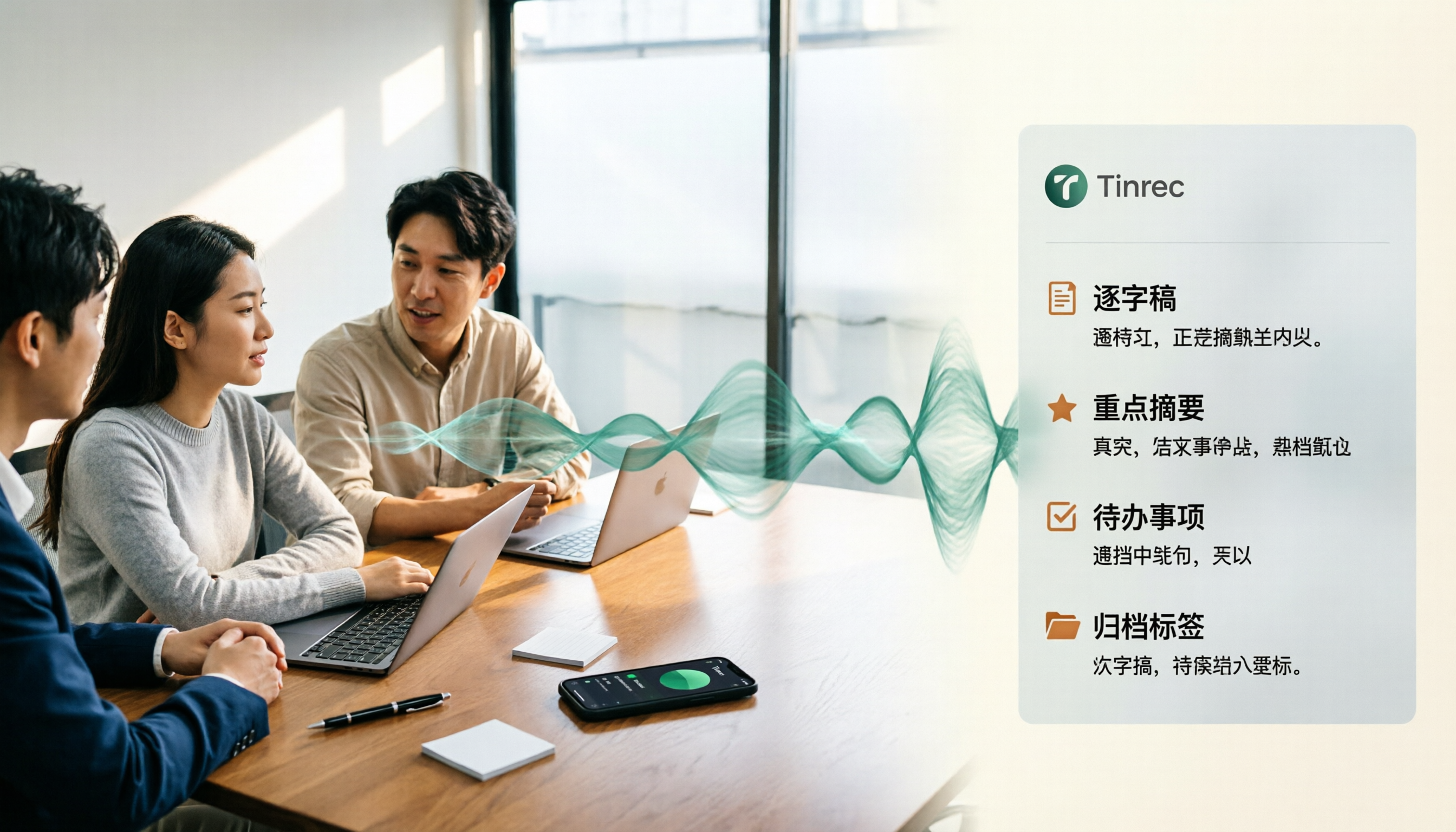
Turn recordings into transcripts and summaries in minutes
Upload audio or video for multilingual transcription, AI notes, and action items
Two-Hour Meeting, Two More Hours Organizing—You Don't Need a Recorder, You Need a Tool That Takes Over
One hour in an online meeting, then another hour replaying the recording, confirming who said what, and adding follow-ups. This is the daily reality for most professionals.
Chinese meetings add another layer of complexity. Mixed Chinese-English technical discussions, colleagues' accents, air conditioning hum, and keyboard clatter all cause strange typos in transcripts. Many people search for tools using the term "speech to text," but the real problem is the same: turning spoken words into written material that can be searched, cited, and handed off to colleagues.
There's also an often-overlooked scenario: teams. When recordings stay on personal phones, a single departure can break the entire year's meeting records.
This article isn't another feature list. Below, we compare four tools across three practical decision points: "How is the meeting recorded?" "What can you do after recording?" and "Who owns the team data?"—to help you determine which one fits your workflow.
Before Choosing a Speech-to-Text Tool, Understand These 5 Key Points
1. Accuracy depends on your own recordings, not ads Official claims of 98% or 94% are usually measured in quiet environments with a single speaker at standard speed. Real meetings have air conditioning, people talking over each other, and jargon—performance drops noticeably. The simple test: take your most difficult recording and try it yourself. Don't just look at website numbers.
2. Transcripts are an intermediate product, not the end goal If a tool only gives you a wall of text, you still have to read it from start to finish. What truly saves time is the layer after transcription: summaries, chapters, action items, and the ability to ask questions directly about the meeting content. How well this layer works determines whether you save 30 minutes or 3 hours.
3. How meetings get "recorded" varies greatly A common approach is sending a meeting bot to join the online meeting as a participant. Another is capturing system audio directly from your computer, without an extra account appearing on the participant list. The latter is better for external client meetings or situations where you need to control the attendee list. When choosing a tool, first ask: can your meetings accept an extra bot?
4. Team data ownership and handover Personal accounts and team spaces are two different things. If meeting data is meant for the whole department, check whether the tool offers independent team spaces, role and seat distinctions, resource handover when members leave, and usage and activity logs. Many tools only offer "shareable links" here—that's not team governance.
5. How quotas are calculated—look at where they're deducted Free quotas are usually just for trial. Pay special attention: "live recording" and "file import" often have separate quotas. Some plans don't deduct minutes for live recording, but uploading existing audio files consumes shared minutes. Asking about this before purchasing is more meaningful than comparing monthly fees.
Tinrec—Our Top Pick After Testing
One-sentence positioning: Tinrec is an AI meeting notes and collaboration tool for individuals and teams, covering iOS, Android, and web, with a desktop version handling online meetings.
How meetings get recorded: Tinrec's desktop version captures system audio directly, processing meeting audio from Zoom, Google Meet, Microsoft Teams, Webex, and other platforms without adding a meeting bot to the participant list. For those who frequently hold external client meetings, this is more practical than anything—the participant list stays clean, and you don't have to explain who the extra account is. Note: this is user-initiated recording, not automatic joining of every calendar event.
What you can do after recording: This is where Tinrec pulls ahead of pure transcription tools. During the meeting, it produces live transcripts; after, it automatically generates summaries, chapters, and action items—who's responsible for what, by when, all listed. You can continue asking questions about the meeting, such as "What was the conclusion about the budget in the last meeting?" It answers based on semantic understanding, not a list of keyword search results. For deliverables, it can generate reports, tables, and documents, or export to Notion, Google Docs, OneNote, Dropbox, and other existing workflows. For cross-language meetings, you can view original text, translation, or bilingual content during recording.
Stop organizing recordings by hand
Upload audio or video and automatically get a transcript, summary, and action items
Team version: If meeting data is for the whole team, Tinrec for Teams provides independent team spaces where meeting audio, transcripts, summaries, and action items are centrally stored. New members can directly view historical data. Admins can distinguish "roles" (who can manage the team and settings) from "seats" (who can record, upload, edit, and export), and view team usage trends, member rankings and details, activity logs, and an audio recycle bin. When a member leaves or is removed, their team resources can be handed over to other active members—data doesn't disappear with the personal account.
Real experience and limitations: We tested with several real Chinese meeting recordings and mixed Chinese-English interview clips. Transcripts automatically add punctuation and paragraph breaks, reading smoother than expected. But to be clear: accuracy is affected by recording quality, background noise, accents, and overlapping speech. Important content should still be verified against the original audio. On quotas: the free version offers basic quota for trial; the team version offers a 7-day trial for first-time eligible users, 1 free seat, and 300 minutes of shared team import quota. Paid seats are USD 29.80/seat/month monthly, or USD 199/seat/year annually (about USD 16.58/month), with each paid seat providing 2,000 minutes of shared team import quota per month. Under an active team plan and active seat, live recording currently does not deduct minutes. Prices and benefits are subject to the official purchase page.
Who it's for: Those who frequently handle Chinese or mixed Chinese-English meetings, don't want a bot joining meetings, want to use AI to find key points right after recording, and need to turn meetings into searchable team data.
Besides Tinrec, What Are the Alternatives?
Notta: Multilingual transcription and file processing are its strengths. Free version: 120 minutes/month, max 3 minutes per item. Pro annual: about USD 8.17/month, 1,800 minutes/month. Business annual: about USD 16.67/seat/month, offering unlimited transcription, role permissions, and usage reports. Its positioning leans more toward transcription and document processing; if you want to turn Chinese meetings into team assets and need governance capabilities like seat management, activity logs, and audio recycle bin, Tinrec's team space is a closer fit.
Otter.ai: A mature choice for English business meetings. Basic free version: 300 minutes/month. Pro annual: about USD 8.49/user/month, including 1,200 minutes of in-app recording and 10 file imports per month. If almost all your meetings are in English, its free quota is indeed competitive. But Chinese meeting punctuation, paragraphing, and mixed Chinese-English handling are not its strong suit, and generating reports or keeping data in a team space for further processing is not its focus.
Granola: Also takes the no-bot approach, capturing system audio and microphone from desktop devices, combined with handwritten notes to generate meeting content. Basic is free; Business is USD 14/user/month. Note: it does not support uploading pre-recorded audio files, nor does it save meeting audio—these two things are dealbreakers for those who need post-meeting verification or re-transcription. Tinrec can do both: importing existing recordings and retaining audio.
Pitfall Guide: 4 Most Common Mistakes When Choosing a Speech-to-Text Tool
Pitfall 1: Deciding based only on official accuracy claims. Those are usually ideal-condition numbers. Real meeting rooms have air conditioning, keyboards, and people talking over each other. Take your most troublesome recording and test it directly—real testing always beats spec sheets.
Pitfall 2: Thinking "transcribed to text" is the end. Transcripts are just raw material. If the tool lacks summarization, chapters, action items, and Q&A capabilities, you only save typing time—reading and organizing time remains unchanged.
Pitfall 3: Ignoring team data ownership. Meetings recorded on personal accounts can't be taken with you or left behind when you leave. If these meetings have value for the team, choosing a tool with independent team spaces and resource handover mechanisms is far cheaper than fixing it later.
Pitfall 4: Misinterpreting "can record" as "automatically records all meetings." Most tools require you to initiate recording, or conditionally join meetings. Also, before recording, confirm local regulations and obtain participant consent, especially for client and personal data situations.
Conclusion: Which One Should You Choose?
- Need transcripts, summaries, and action items for Chinese and mixed Chinese-English meetings → Tinrec
- Don't want a meeting bot on the participant list → Tinrec (desktop captures system audio)
- Want to use AI to ask questions about meeting content right after recording → Tinrec (AI Q&A is its core differentiator)
- Need to turn meetings into team data and manage seats, usage, and activity logs → Tinrec Team
- Almost all meetings are in English, zero budget → Otter.ai free version (the only exception recommendation in this article)
If you have several meetings every week, we suggest starting with Tinrec's free version, testing with your most realistic recordings, confirming that transcript and post-meeting organization quality meets expectations, then deciding whether to upgrade or adopt the team version.
References
- AI Speech to Text Fast Recording File Online to Text, Transcripts and Video Subtitles - Free Trial - cSubtitle
- Online Speech to Text AI, Free MP3 or Recording File to Text Transcript - MyEdit
- Online AI Speech, Video, Recording File Auto to Text - Free Trial - cSubtitle
- Speech-to-Text: AI Speech Input and Transcription | Google Cloud
- Tested 4 Best "Speech to Text" Online Tools Recommended, Free Instant Recording File to Transcript
Turn every recording into actionable outcomes
Get 60 free transcription minutes when you sign in. No credit card required.
Related Reading
You might also like

2026 Video-to-Text Extractor Comparison: Tinrec vs VEED.IO for Chinese Meetings
How to choose a video-to-text extractor? This hands-on comparison of Tinrec and VEED.IO covers Chinese transcription, online meeting recording, AI post-processing, team collaboration, and pricing to help you find the best tool.
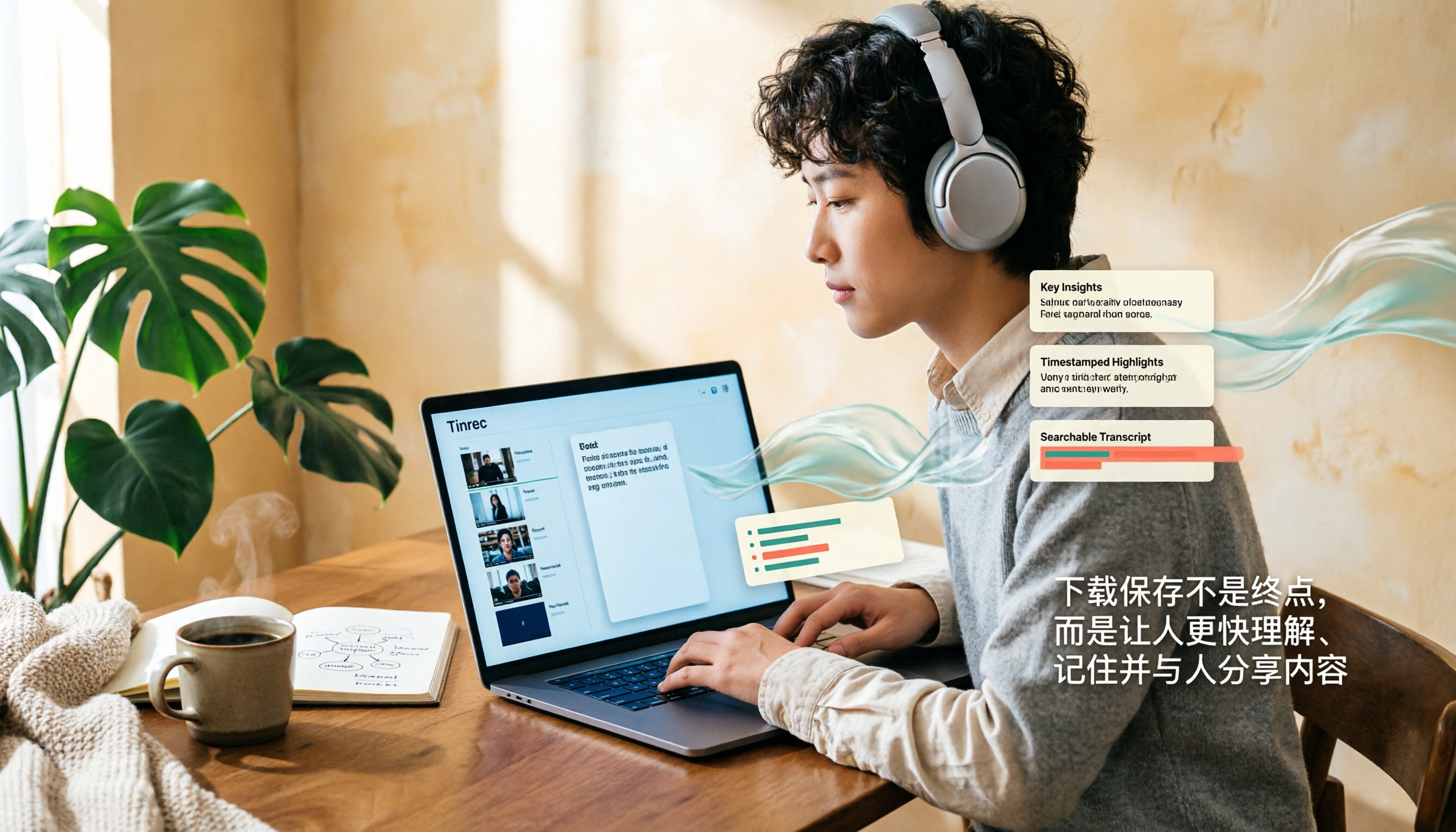
How to Download and Save YouTube Videos in 2026: A Complete 4-Step Tutorial
YouTube doesn't officially support direct video downloads. This guide covers three common methods—online tools, desktop software, and browser extensions—to save videos as MP4 or MP3 in 4 steps. It also explains how to use Tinrec to turn video content into searchable transcripts, summaries, and key points after downloading.

How to Take Better Notes from Short Videos in 2026: A 3-Step Template with AI Transcripts and To-Dos
Watching tons of how-to short videos but can't remember the key points? This guide offers a ready-to-use note-taking template for short video learning. It starts with common mistakes, then compares the transcription and organization capabilities of Tinrec, Notta, TurboScribe, and Granola, showing you how to use AI to turn videos into searchable, queryable, and actionable notes.

How to Transcribe Video to Text in Google Drive in 2026: 5-Step Tutorial and Tool Comparison
Google Drive's built-in automatic transcription can convert videos to text for free, but it currently only supports English. This guide walks you through the process in 5 steps and compares its limitations for Chinese videos, post-meeting organization, and online meeting recordings, as well as what Tinrec can fill in.

2026 Exam Video Summary Tools Compared: Which One Saves You Study Time?
A hands-on comparison of four exam video summary tools in 2026, covering no-subtitle video processing, timestamp traceability, AI Q&A, and note export, and explaining why Tinrec is better suited for turning course videos into reusable study materials.
How to Convert Music to MP3 in 2026: Online, No Install, Plus Audio Quality and File Size Explained
Want to convert music to MP3 but stuck on format, audio quality, and file size? This guide covers bitrate, file limits, and browser compatibility, walks through a 3-step online conversion process, and explains why meeting and interview recordings converted to MP3 still need an AI meeting notes tool like Tinrec to turn content into searchable, queryable data.
2026 Recording Transcription App Comparison: Tinrec vs Yating Transcript, Which Saves More Time Across 5 Key Dimensions?
How do you choose a recording transcription app? This article compares Tinrec and Yating Transcript across 5 dimensions, from Chinese and mixed Chinese-English transcription, online meeting capture methods, post-meeting summaries and action items, cross-device usage, to team collaboration and seat management, helping you determine which one better fits your work scenario.

6 Live Stream Summarization Tools Compared: Which One Can Extract Key Points from a 2-Hour Replay First?
Live streams often run one to three hours, making it hard to catch up later. This article reviews six solutions for summarizing live stream content, including Tinrec, Notta, TurboScribe, Otter.ai, PLAUD, and free transcription tools. It clearly lists their purposes, free quotas, and paid pricing, and explains how to choose based on different scenarios.

2026 Audio Transcription Guide: Tinrec's Bot-Free Recording + AI Q&A to Find Key Points
How to choose an audio transcription tool? This article compares Tinrec, Notta, TurboScribe, and Otter.ai from a decision-making perspective, outlines 4 key purchasing factors and 3 common pitfalls, and tests Tinrec's desktop version for bot-free online meeting recording, AI Q&A, and team spaces. It explains how it turns recordings into usable meeting data, along with pricing and use cases.