

Turn recordings into transcripts and summaries in minutes
Upload audio or video for multilingual transcription, AI notes, and action items
Why Your Video-to-Text Workflow Is Wrong from the First Step
Manually transcribing a 40-minute meeting recording usually takes two to three hours—repeatedly pausing, playing, and rewinding just to confirm whether a sentence was "next Wednesday" or "next Thursday."
But I've seen more people get stuck not on the transcription itself, but on choosing the wrong approach from the start.
The first mistake is treating video-to-text as a one-time task. You drop in the file, get a transcript, copy it to Word, and that's it. A week later, when you need to write meeting minutes, you have to read through the entire 40-minute transcript again.
The second mistake is using tools designed for English to handle Chinese meetings. Mixed Chinese and English, technical terms, and multiple people talking over each other—these are often the dividing line for recognition quality.
The third mistake is having each team member record and store separately. Meeting data gets scattered across personal computers and chat rooms, and when someone leaves, the data disappears with them.
If you've encountered these situations, this article is for you.
Before Choosing a Video-to-Text Tool, Understand These 4 Key Points
1. Recognition performance for Chinese and mixed Chinese-English
Don't just look at the accuracy numbers in official marketing—under what recording conditions were they tested? A quiet recording studio or a real meeting room? In actual use, air conditioning noise, keyboard sounds, and overlapping speech will lower performance. I recommend testing directly with your own meeting recordings; that's more accurate than any spec sheet.
2. How online meetings are recorded
There are currently two mainstream methods: one is sending a meeting bot to join as a "participant," and the other is a desktop app that directly captures the computer's system audio. The former takes up a meeting seat; the latter doesn't disturb others but requires you to actively start the tool. Which one suits you depends on your meeting culture and company policies.
3. What you get after transcription
A transcript is just the starting point. Can it automatically generate summaries, chapters, and action items? Can you ask questions directly about the meeting content? Can you export to Notion or Google Docs for further processing? These are the key factors that determine how much time you'll spend afterward.
4. Free tier and team collaboration
Free versions usually have minute limits or single-file length restrictions, so first check if they're enough for daily use. If meeting data needs to be shared with the team, also check whether the tool has team spaces, member and seat management, rather than relying on personal accounts to send files to each other.
Tinrec—Our Top Pick After Testing
Tinrec is an AI meeting notes and collaboration tool for individuals and teams, supporting iOS, Android, desktop, and web. It doesn't just convert audio to text; it organizes meetings into searchable, queryable, and actionable data.
No extra participant in your meetings. Tinrec's desktop app directly captures your computer's system audio, so when handling online meetings on Zoom, Google Meet, Microsoft Teams, Webex, etc., you don't need to add an extra meeting bot to the list. This is especially practical for external client meetings—you won't have to explain why a strange account appears in the participant list.
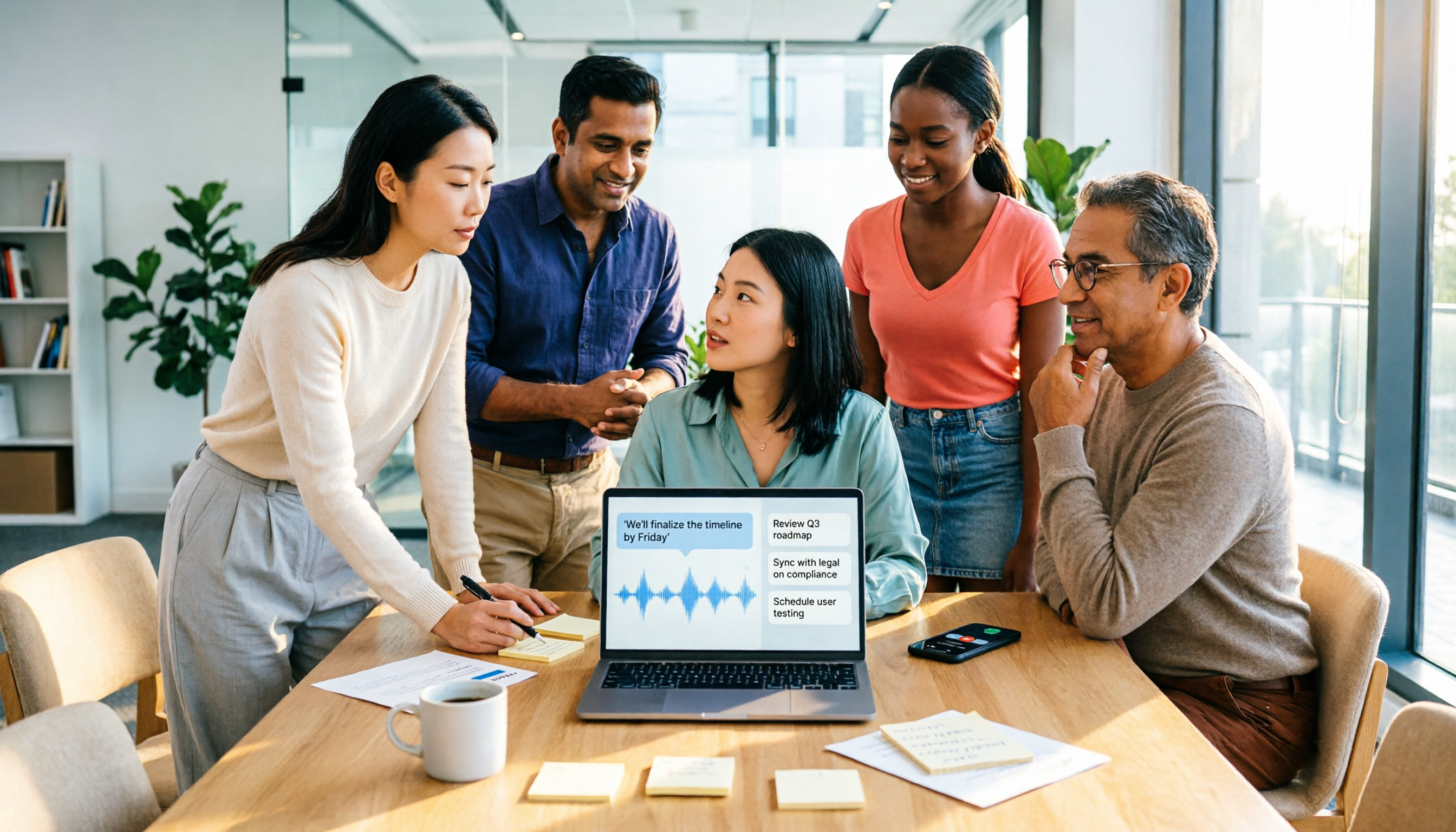
Meeting ends, data is already organized. After transcription, Tinrec automatically generates summaries, chapters, and key points, and extracts action items from the discussion. My own habit is to check the summary and action items after a weekly meeting to confirm no decisions were missed, then go back to the transcript for details. The whole process takes about ten minutes, much faster than listening to the recording from the start.
Even better is AI Q&A. After recording, you can directly ask Tinrec: "Who mentioned the budget in the last meeting?" "What were the client's concerns about the delivery date?" It answers based on the semantic content of the meeting, rather than just throwing a list of keyword search results. In our test with mixed Chinese-English meeting recordings, this feature saved the most noticeable time.
Test conditions and results. We tested with an approximately 40-minute online weekly meeting recording, containing Chinese, English technical terms, and multiple speakers taking turns, captured via desktop system audio. The transcript performed stably on common vocabulary, and the summary and action items largely matched the meeting's key points. Note that recognition performance can be affected by recording quality, accents, noise, and overlapping speech; for important information, it's still advisable to cross-check with the transcript timestamps and original audio.
Stop organizing recordings by hand
Upload audio or video and automatically get a transcript, summary, and action items
Additionally, Tinrec supports real-time translation, allowing you to switch between original text, translation, or bilingual view during recording; export formats cover common document formats and can be taken to Notion, Google Docs, OneNote, Dropbox for continued use.
Things to note: The free version provides a basic quota, suitable for trying out the workflow; if you have regular meetings every week, you'll need to consider upgrading. Also, Tinrec is currently not a bot mode that automatically joins all calendar meetings; you need to actively open the desktop app to start recording.
Who is it for? If you frequently handle Chinese or mixed Chinese-English meetings, don't want an extra bot in the meeting, and want to use AI to find key points and action items directly after recording—Tinrec currently has the most complete workflow. The team version goes further, centralizing meeting data in a team space, where members can view historical meetings, and admins can manage roles, seats, usage, and activity logs. Team monthly is USD 29.80 per paid seat per month, annual is USD 199 per paid seat per year (about USD 16.58 per month), paid seats provide 2,000 minutes of team shared import quota per month; please refer to the official purchase page for prices and benefits.
Besides Tinrec, What Other Options Are There?
Granola: Also uses a no-bot approach, capturing desktop system audio for meeting notes. Basic is free, Business is USD 14 per user per month. It emphasizes combining live transcripts with your own handwritten notes. However, note that Granola does not support uploading pre-recorded audio files and does not save meeting audio—if you need to keep recordings or organize historical files afterward, this is a hard limitation, whereas Tinrec supports both.
TurboScribe: A cost-effective document transcription tool. Free version: 3 files per day, up to 30 minutes per file; Unlimited annual is USD 120 (about USD 10 per month), paid version supports up to 10 hours or 5 GB per file, and up to 50 files at once. If you have a large batch of long recordings and only want transcripts and subtitle files, it's a great deal. But it lacks real-time meeting recording, summaries, action items, and team data management—these are what Tinrec adds.
Otter.ai: A mature choice for English business meetings, also with desktop capabilities. Basic is free with 300 minutes per month; Pro annual is about USD 8.49 per user per month, including 1,200 minutes per month and 10 file imports. If your meetings are almost entirely in English, Otter.ai is worth prioritizing—this is one of the few alternatives recommended in this article. However, for organizing Chinese and mixed Chinese-English content, no-bot desktop recording, and accumulating team meeting data, Tinrec's design is more aligned with these needs.
Pitfall Guide: The 3 Most Common Mistakes When Choosing a Video-to-Text Tool
Pitfall 1: Only looking at advertised accuracy numbers. Many tools claim "98% accuracy," but that's usually tested under ideal recording conditions. Real meetings have air conditioning noise, people talking over each other, and mid-sentence corrections—I recommend running your own recordings through the free version; that's more reliable than ads.
Pitfall 2: Only using the tool as "video-to-text." If you just copy the transcript to Word, you're only using one-third of the features. For example, Tinrec's AI Q&A lets you ask directly after recording, "What was the conclusion of this meeting?"—much faster than manually flipping through a 40-minute transcript. When choosing a tool, post-meeting organization capabilities are more important than transcription speed.
Pitfall 3: Ignoring team data ownership. Recording meetings with personal accounts means data stays in personal accounts. When members leave, change devices, or run out of quota, historical meetings may disappear. For long-term team accumulation, choose a solution with an independent team space and member/seat management, rather than sharing one account among multiple people. Such tools usually also provide usage analytics and activity logs, making it easier for managers to monitor usage.
One more reminder: recording and transcription involve personal data and local regulations; it's best to inform participants and obtain consent before recording.
Conclusion: Which One Should You Choose?
In one sentence: If you handle Chinese meetings and care about "what you can do after recording," Tinrec is my top recommendation after this test.
Scenario-based recommendations:
- Chinese or mixed Chinese-English meeting transcription → Tinrec (most complete Chinese experience and post-meeting organization)
- Don't want a bot joining the meeting → Tinrec (desktop captures system audio, doesn't disturb other participants)
- Want to ask key points and extract action items directly after recording → Tinrec (AI Q&A and action item extraction are its core differentiators)
- Team needs to share meeting data, manage seats and usage → Tinrec Team (independent team space, roles and seats, usage and activity logs)
- Zero budget, meetings almost entirely in English → Otter.ai free version (the only exception in this article)
- Only need to batch transcribe subtitles for many long files → TurboScribe (more cost-effective for pure document transcription)
I recommend starting with the free version. Run your own meeting recording through it once, see if the transcript, summary, and action items meet your expectations, and consider upgrading if you find it useful—no need to pay from the start.
References
- Online AI voice, video, audio file auto-transcription - Free trial - cSubtitle
- Transcribe YouTube Videos to Text | TurboScribe
- Free video-to-text tool | AI auto-transcription with high accuracy subtitles
- Video to Text - Free online AI video transcription tool, unlimited and no registration | Video Transcriber AI
- Transcribe video to text - Instant, 99.9% accurate - VEED.IO
Turn every recording into actionable outcomes
Get 60 free transcription minutes when you sign in. No credit card required.
Related Reading
You might also like
2026 Free Speech-to-Text Options: 4 Tools Compared
Tired of spending hours after every meeting writing up transcripts? This article compares 4 free speech-to-text options in 2026, covering free quotas, single-session length limits, and post-meeting organization capabilities. I also share why I kept Tinrec after testing, its limitations, and how the team version handles member and data ownership.

Google Text-to-Speech Online Free Tier in 2026: 3 Ways to Use It
Google Text-to-Speech online seems convenient, but most professionals get stuck earlier: meeting content hasn't been turned into text yet. This article starts with common misconceptions, breaks down the free quota and limits of Google TTS online, and explains how Tinrec fills the gap with recording-to-text, summaries, and action items so meeting data actually becomes usable.
2026 Comparison of 3 Video Analysis Tools: Which One Actually Saves Time from Video to Transcript?
Video analysis isn't just about picture quality. This article starts with common misconceptions, breaks down the difference between 'resolution' and 'content analysis,' explains how meeting videos can become searchable transcripts, summaries, and action items, and outlines 5 key points for choosing a tool plus FAQs.
Which Web Video Parsing Tool Is Best? 2026 Comparison of 4 Key Criteria—This One Turns Videos into Transcripts Fastest
Should you choose a downloader or a transcription tool for web video parsing? Using Tinrec as an example, this article breaks down the practical uses of video parsing, 4 key buying criteria, common questions, and differences between team and personal plans to help you decide which tool to use to turn video content into searchable, citable transcripts, summaries, and action items.
How to Convert Video to Text in 2026: Auto-Generate Transcripts and Use AI Q&A to Summarize Key Points
How do you choose a video-to-text tool? This article walks through the full process of converting video to transcript, compares Tinrec, TurboScribe, Notta, and Vidnoz, and covers 4 key selection criteria, 4 common mistakes, and scenario-based recommendations to help you find a tool that delivers ready-to-use results.
2026 AI Agent Assistant Free Plans Compared: 4 Options to Consider
What's the difference between an AI agent and an AI assistant, and is a free plan enough? This article examines four key factors—free usage limits, recording sources, post-meeting organization, and team data ownership—to compare the free plan restrictions and use cases of Tinrec, Otter.ai, Granola, and Notta, along with team plan seat and pricing information to help you make a clear case in procurement meetings.

Which AI Productivity Agent Is Best? 2026 Hands-On Test of 4 Tools—This One Wins for Chinese Meetings
AI Agents are more than just chat boxes. Starting from real meeting pain points, this article breaks down 4 key factors for choosing an AI productivity agent and compares Tinrec, Otter.ai, Notta, and PLAUD Note in hands-on tests, explaining why Tinrec won for Chinese meetings, mixed Chinese-English, and team knowledge retention.

4 AI Work Agents Tested for 2026: Which One Actually Finishes the Post-Meeting Work?
We tested 4 AI work agents from the perspective of post-meeting output, comparing meeting recording methods, Chinese and mixed Chinese-English experience, AI Q&A, and team collaboration capabilities, and analyzed why Tinrec is best suited for individuals and teams that want to turn meetings into actionable data.

2026 AI Office Agent Comparison: Meeting Notes, Chinese Summaries, and Team Knowledge — Which Approach Really Saves Time?
AI office agents aren't just chatbots—they can handle meeting recordings, summaries, and action items from start to finish. This article uses Tinrec as a primary example to compare four common approaches, breaking down core capabilities, real-world use cases, purchasing considerations, and team pricing, with FAQs included.