
Turn recordings into transcripts and summaries in minutes
Upload audio or video for multilingual transcription, AI notes, and action items
After every meeting or interview, staring at an hour-long audio file while browsing PTT for the best "audio-to-text" tool? Traditional manual transcription is time-consuming and exhausting, especially with Chinese accents and technical terms. This article directly addresses your pain points, offering a deep comparison of 6 popular tools, free tier analysis, a standard operation guide, and FAQ.
Quick navigation conclusion:
- Want accurate recognition of Taiwanese Hokkien and heavy Taiwanese accent? 👉 Priority to Yating
- Extremely concerned about data privacy and news-level security? 👉 Consider Good Tape
- Want to generate to-do items directly from recordings, or even use AI chat to query key points? 👉 Consider Tinrec as a candidate solution
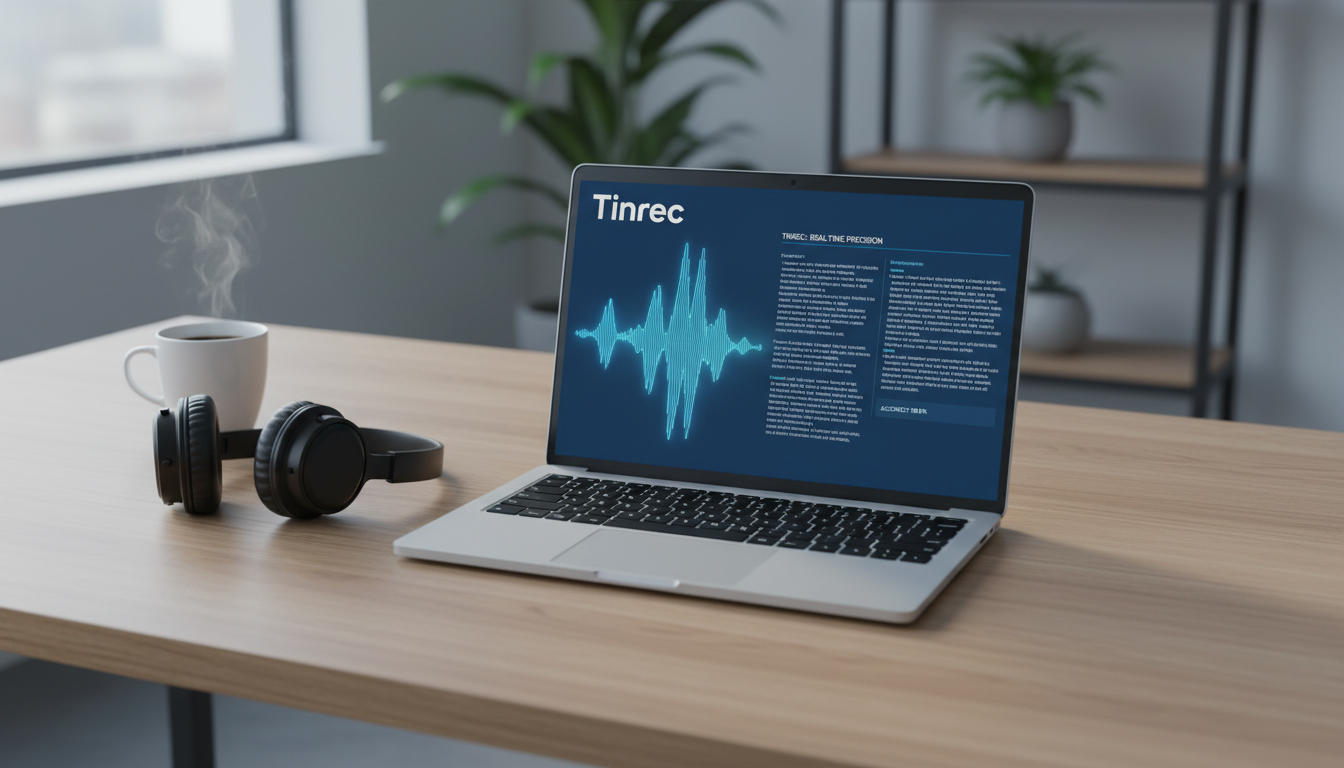
Goal Clarification and Preparation
Before using an audio-to-text tool, clarify your "output goal." Do you only need a raw transcript? Or a quick-to-read meeting summary, an actionable to-do list, or SRT subtitles for video editing?
Preparation tips:
- File format: Most tools support common audio formats like mp3, wav, m4a.
- Audio quality: Ensure a quiet recording environment with the speaker close to the microphone; this can improve AI recognition accuracy by over 20%.
- File naming: Use a "date_project_speaker" format for easy retrieval later.
In-Depth Review of 6 Audio-to-Text Tools Hot on PTT
Below are the most discussed and best-performing tools on PTT and other forums, with their pros, cons, and free tier limits.
1. Yating (Yating): The Localization Expert for Taiwanese Accent
Developed by Taiwan AI Labs, it has high recognition accuracy for Taiwanese-specific interjections and colloquialisms.
- Advantages: Supports Taiwanese Hokkien, extremely localized; live recording is free and unlimited for 30 days after registration.
- Limitations: Only 20 minutes of free upload transcription, processing speed can be slow at times.
2. Good Tape: Secure and Reliable News-Grade Transcription
Based on OpenAI's Whisper model, well-regarded in foreign journalist circles, known for high security.
- Advantages: End-to-end encryption, explicit policy of not using user data for AI training; very high accuracy.
- Limitations: Free plan only 3 times per month (30 minutes each), no speaker diarization, queuing during peak hours.
3. Vocol.ai: AI Meeting Assistant for Team Collaboration
Positioned as an AI meeting collaboration platform, suitable for teams needing conclusions.
- Advantages: Free plan includes speaker diarization, supports team shared workspaces.
- Limitations: New users get a one-time 60-minute free quota; advanced AI summaries require payment.
4. Notta: Real-Time Transcription and Multilingual Capability
A comprehensive voice processing tool with a modern interface, common for cross-border meetings.
- Advantages: Supports multiple languages, 120 minutes of transcription per month.
- Limitations: Speaker diarization is a paid feature; advanced features limited in free plan.
5. MyEdit: Lightweight Tool with Audio Processing Integration
Launched by CyberLink, combines basic audio editing and noise reduction.
- Advantages: Very fast conversion, built-in wind and background noise removal.
- Limitations: Free plan only offers partial preview; full transcription usually requires payment.
6. Tinrec (Miao Ting Lu Yin): Complete Workflow from Transcription to Action
While many tools only produce transcripts, Tinrec's design logic is "record → understand → action," focusing on post-use and decision efficiency.
- Advantages: Multi-device sync (iOS/Android/Web), automatically generates meeting minutes and to-do items from transcripts, and features a unique "AI chat query" function. Offers 100 minutes free per month.
- Limitations: Enterprise-level high usage requires a paid subscription.
Stop organizing recordings by hand
Upload audio or video and automatically get a transcript, summary, and action items
Ultimate Comparison Table: Core Dimensions of 6 Tools at a Glance
| Dimension | Yating | Good Tape | Vocol.ai | Notta | MyEdit | Tinrec |
|---|---|---|---|---|---|---|
| Language/Accent Support | Taiwanese Hokkien, Taiwanese-accented Mandarin | Standard Chinese (good) | Multiple languages | Multiple languages | Traditional Chinese, etc. | Automatic identification of 10 languages (incl. Cantonese/Taiwanese) |
| Free Tier | Upload 20 min / Live unlimited (30 days) | 3 times/month (30 min each) | One-time 60 min | 120 min/month | Preview only | 100 min/month |
| Speaker Diarization | Mostly paid | Not supported | Free | Paid | Not supported | Supported |
| AI Summary / Chat Query | No | No | Summary (partially paid) | Summary | No | Summary, to-do extraction, AI queries |
| Export & Integration | txt, srt | txt, srt, etc. | Team collaboration sharing | Multiple formats | In-platform viewing | Multiple format file export |
| Privacy & Security | Compliant with Taiwan security standards | High privacy, no AI training | Enterprise-level data protection | Standard protection | Deleted after 24 hours | Multi-device sync protection |
Practical Tutorial: How to Quickly Convert Audio Files to Transcripts and To-Do Lists
Once you understand the tools, we'll use Tinrec's interface workflow—which emphasizes 'post-use efficiency'—as an example to demonstrate 4 common scenarios. Each step corresponds to an actual work process, helping you transform complex information into high-value output.
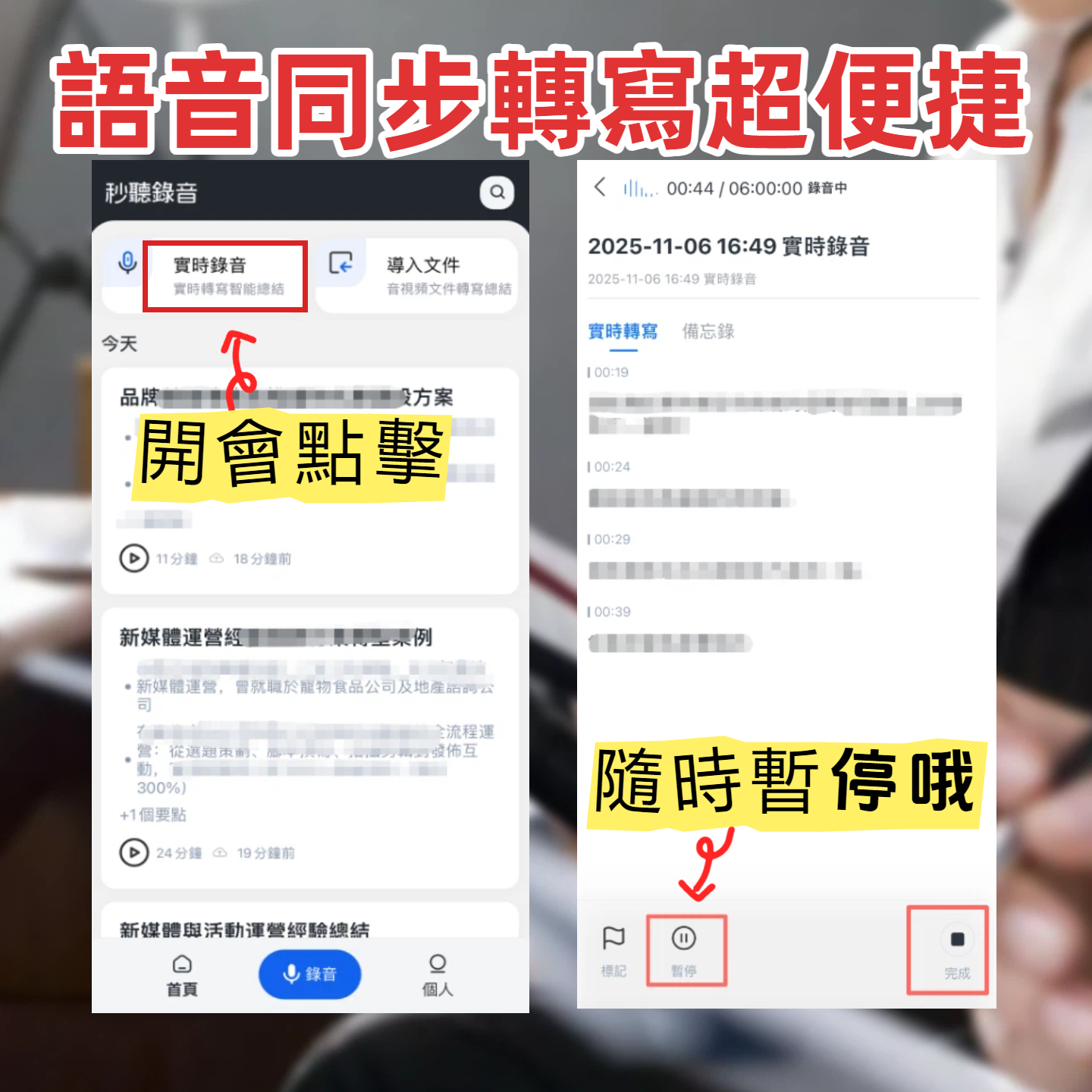
Step 1: Real-Time Speech-to-Text (For In-Person Meetings/Classes)
- Action: Tap "Real-Time Recording" on mobile or web; the system transcribes speech to text in real time.
- Expected Result: The transcript scrolls live on screen, no need to wait for the meeting to end to review content.
- Note & Value: This allows you to mark key points immediately during the meeting, significantly reducing post-meeting review time.
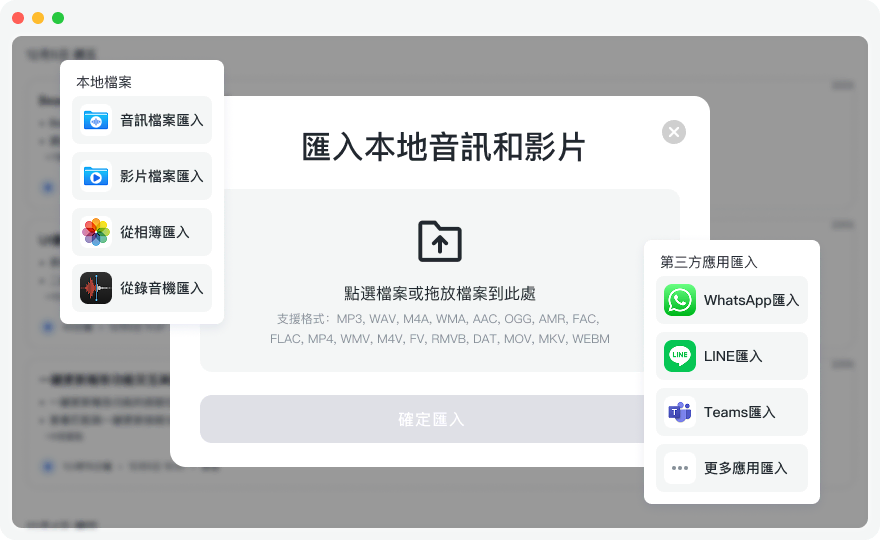
Step 2: Upload Audio File for Transcription (For Existing Recordings from Recorder/Phone)
- Action: Go to "Audio to Text" and drag-and-drop an mp3 or m4a file; the system auto-detects the language and generates a transcript.
- Expected Result: A timestamped transcript with automatically extracted "Meeting Minutes" and "To-Do List."
- Note & Value: This feature solves the problem of low information density in traditional transcripts, helping you quickly filter filler and get decision summaries.
Step 3: Paste Video Link for Direct Transcription (For YouTube/Podcast Summaries)
- Action: In the "Video to Text" section, paste a YouTube or Podcast link and click parse.
- Expected Result: The tool directly fetches the online audio and transcribes it, ideal for content creators collecting script material.
- Note & Value: No need to download the video first, saving disk space and intermediate steps.
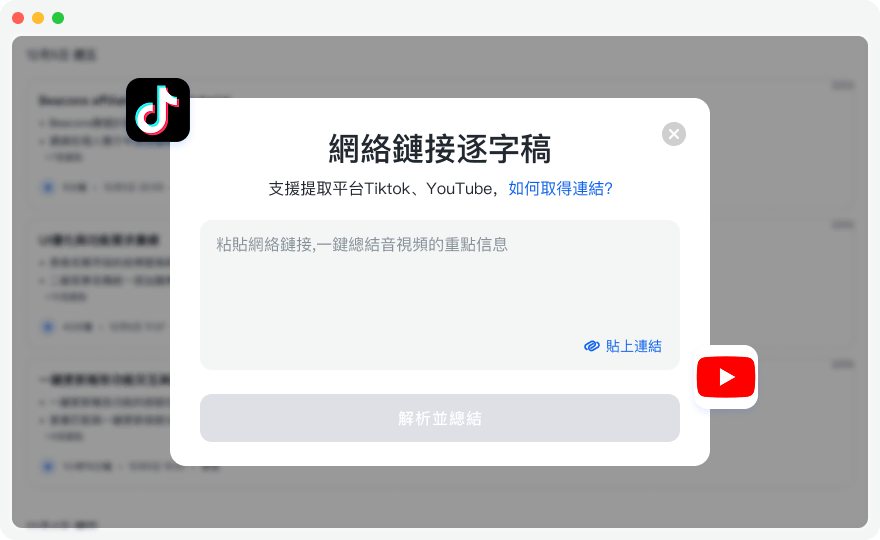
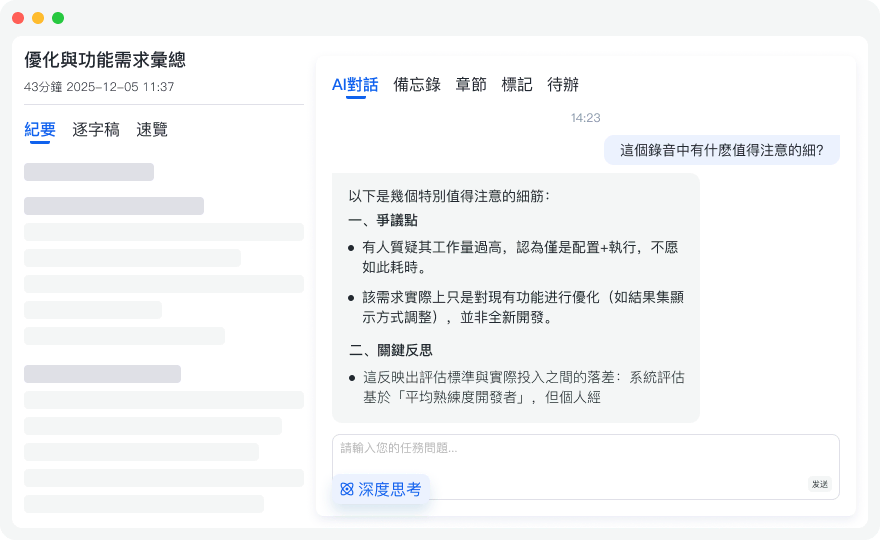
Step 4: Use AI Chat Query to Extract Key Points (For Long Meeting Records)
- Action: Next to the generated record, use the "AI Chat Query" function and ask something like: "What was the exact budget the manager mentioned?"
- Expected Result: The AI provides a precise answer based on that recording, with source location.
- Note & Value: Traditional transcripts only allow Ctrl+F for keywords; AI chat is like asking someone who attended the entire meeting, completely transforming the information retrieval experience.
Common Mistakes and Quality Validation Standards
Common operational mistakes: Overlapping speech from multiple people causing misidentification. If this happens, manually merge or correct speaker segments using timestamp editing in the tool's editor.
Validation standards for a usable transcript:
- Key technical terms are correct (optimize with custom dictionary if needed).
- Timestamps are precise and clickable to jump to the corresponding audio section.
- Automatically generated to-do list is actionable, with correct person-task mapping.
Frequently Asked Questions (FAQ)
Q1: Can I directly convert voice memos from iPhone to text? A1: The built-in iPhone voice memo feature is mainly for recording and currently cannot generate high-accuracy long transcripts. Export the audio file and upload it to a professional tool like Yating or Tinrec for transcription.
Q2: Can these tools record meetings from Teams or Google Meet? A2: For online meetings, you can play the meeting audio through your computer and use the web tool's "Real-Time Recording" function to capture it; alternatively, after the meeting, import the recording file downloaded from Teams/Meet into a tool that supports video-to-text.
Q3: What happens when the free quota runs out? Which tool is best for long-term use? A3: For users relying on regular quotas, Notta (120 min/month) and Tinrec (100 min/month) offer generous ongoing free allowances. For one-off super-long projects, try Vocol.ai's one-time 60-minute quota.
Q4: The transcript is all connected without punctuation. What should I do? A4: Older, simpler systems have this issue. Modern AI tools automatically insert punctuation based on speech pauses and segment by speaker, so no worries.
Q5: When multiple people talk simultaneously, does speaker diarization work accurately? A5: As long as voices don't completely overlap, tools with speaker diarization can generally distinguish different speakers. However, for best transcript quality, it's still recommended to follow a single-speaker principle during meetings.
Q6: Are these tools safe for business meetings? Will my data be used for AI training? A6: This is an important consideration. For highly confidential content, choose tools that explicitly state they do not use user data for model training (e.g., Good Tape) or those with encryption protection. As a practice, you can also refer to sensitive terms by code names when uploading to reduce risk.
Note: Free plans and features of the above tools are subject to change per official policy. Please refer to each official website for the latest information. We recommend trying them out yourself to find the best AI assistant for you, and free up your time for truly valuable thinking!
Turn every recording into actionable outcomes
Get 60 free transcription minutes when you sign in. No credit card required.
Related Reading
You might also like

5 Meeting Transcription Solutions Tested for 2026: How to Fix No Sound in Teams Meetings
When you can't hear audio in a Teams meeting, don't rush to restart the meeting—the issue could be muted speakers, wrong device selected, dead Bluetooth battery, driver problems, or system audio not checked when sharing your screen. This guide walks you through troubleshooting steps in the order a student actually tested them, compares the real-world performance of 5 meeting transcription solutions, and explains why I ultimately made Tinrec a staple for online classes and group projects.

6 Teams Meeting Recording Tools Tested and Compared for 2026: How to Recover Meeting Highlights Even When You Can't Hear the Other Party
When you can't hear the other party in a Teams meeting, don't rush to restart your computer. This article breaks down three scenarios—'you can't hear the other party,' 'the other party can't hear you,' and 'no sound when sharing video'—organizes a 6-step troubleshooting checklist, and then compares 6 meeting recording tools so that when audio issues occur, you can still recover transcripts, summaries, and action items afterward.

2026 AI Meeting Notes Tools: 5-Way Comparison — Understand the Criteria First to Avoid Choosing Wrong
Most people pick AI meeting notes tools based only on language count and free minutes, then end up with a tool they don't use for long. This article starts with 5 evaluation criteria that truly affect daily use, comparing Tinrec, Otter.ai, Notta, PLAUD Note, and others on meeting capture methods, post-meeting output, Chinese-language experience, data retention, and pricing transparency. It also covers 4 common buying mistakes and scenario-based selection advice.

4 AI Meeting Notes Apps Tested for 2026: Which Free Version Is Good Enough?
How to choose AI meeting notes software in 2026? This article tests and compares Tinrec, Notta, Granola, and TurboScribe across five dimensions: meeting capture method, post-meeting workflow, Chinese-language experience, team collaboration, and free tier limits. It also covers buying criteria, common pitfalls, and scenario-based recommendations.

2026 AI Meeting Notes Free Plans Compared: 4 Tools Side by Side
A 2026 comparison of free plans for 4 AI meeting notes tools: from hidden limits on free quotas, meeting audio sources, post-meeting outputs, to team roles and seats, clarifying the differences and use cases of Tinrec, Otter.ai, Notta, and Granola—helping you pick the one that truly fits without overspending.

2026 AI Meeting Notes Software: 5 Top Picks Tested and Compared — Is the Free Version Enough? Post-Meeting Organization Is Key
From free usage limits, Chinese transcription, bot-free recording, to team seat management, here are the key factors to consider when choosing AI meeting notes software in 2026. We also demonstrate Tinrec's complete workflow for post-meeting summaries, action items, AI Q&A, and team knowledge retention.

Best AI Meeting Notes Platforms in 2024: Testing 4 Options, Tinrec Excels for Chinese Meetings and Team Knowledge Retention
Many people treat AI meeting note platforms as simple audio-to-text converters, only to find themselves re-listening and catching up on action items afterward. This article covers selection criteria, pitfalls to avoid, and the positioning of Tinrec, Otter.ai, Notta, and Granola to help you determine which platform suits Chinese meetings, bot-free recording, and team knowledge retention.

2026 Free AI Meeting Notes Generators Compared: 5 Tools to Try
The meeting ends, and the overtime begins. This article examines five AI meeting notes generators from four angles: how free quotas work, how meetings are recorded, what you can do after the meeting, and how teams can take over later. It breaks down who Tinrec, Notta, Otter.ai, Granola, and TurboScribe are each best for, so you can verify—without spending money—whether a tool actually understands your meetings.

2026 AI Meeting Notes Comparison: 5 Tools Tested Without Bots — Which Handles Chinese Summaries Best?
For small-team leaders choosing an AI meeting notes tool, the real questions are where your meeting audio comes from and what you need after the meeting. This article tests 5 tools — Tinrec, Notta, Otter.ai, Granola, and PLAUD — across 4 key criteria: bot-free recording, post-meeting outputs, quotas, and team governance, to help you find the right fit for your meeting style.