
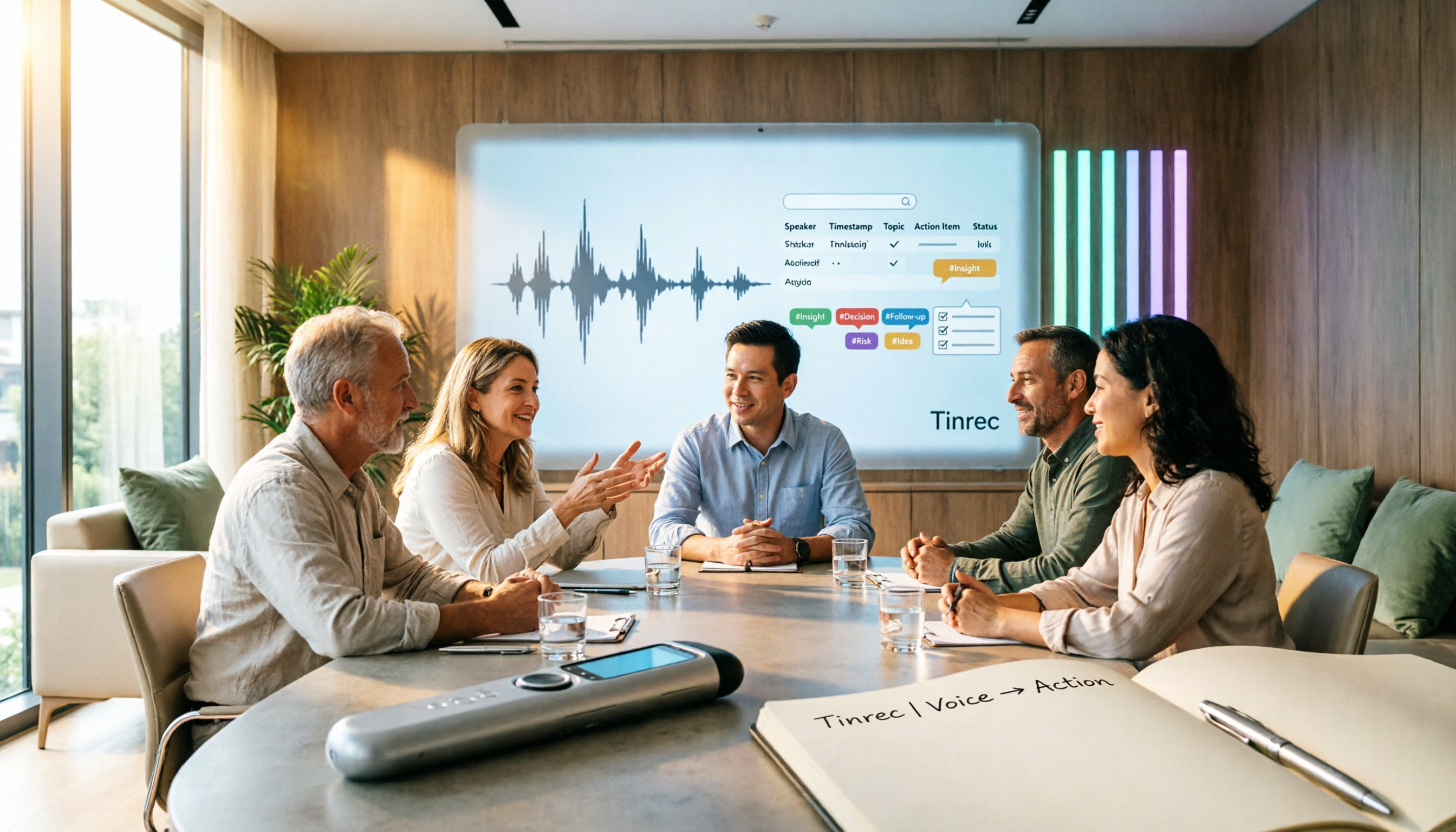
Turn recordings into transcripts and summaries in minutes
Upload audio or video for multilingual transcription, AI notes, and action items
Tinrec vs Notta 2026: 5-Dimension Meeting Notes Table Comparison — Which Saves More Time?
The Most Common Mistake with Meeting Notes Tables: Treating Transcripts as Meeting Minutes
Many people finish a meeting, convert the recording to text, paste it into a table, and think they're done. But such a table only has "who said what," not "what to do after the meeting." There are three common inefficient practices: first, pasting the transcript from beginning to end, which no one wants to read; second, mixing decisions and to-dos together, making it impossible to track responsible parties; third, only recording the date and attendees, but missing deadlines and next steps. A truly effective meeting notes table should at least separate "decisions," "actions," "owners," and "deadlines." Without owners and completion deadlines, meeting minutes are just a running log.
Before Choosing a Meeting Notes Table Tool, Understand These 5 Key Points
- Does it produce a transcript or an actionable table? Just converting audio to text isn't enough; it should also automatically extract to-dos, sections, and key points. Tools like Tinrec organize meeting content into summaries, sections, and to-dos, then further generate tables or documents.
- Should a bot join online meetings? Some tools require a bot to join the meeting, and the other party will see an unfamiliar account. If you often record Zoom, Google Meet, Microsoft Teams, or Webex, capturing system audio directly on the desktop is more natural.
- How accurate is Chinese and mixed Chinese-English? Taiwanese workplaces often mix Chinese and English, so when choosing a tool, consider how it handles Chinese meetings, mixed Chinese-English, and proper nouns. Tinrec supports multiple languages, real-time translation, and team hotwords, making it more suitable for Chinese scenarios.
- Can you query and export after the meeting? After recording, if you can only manually Ctrl+F to find keywords, efficiency is low. Being able to ask AI questions about the meeting content and export to Notion, Google Docs, OneNote, or Dropbox is what connects to your workflow.
- Is team data ownership clear? If meeting notes only exist in personal accounts, it's hard to hand over when a member leaves. Team versions should store data in a team space and manage permissions with roles and seats.
Tinrec (秒聽錄音) — Our Top Choice After Testing
Tinrec (秒聽錄音) is an AI meeting notes and collaboration tool for individuals and teams, supporting iOS, Android, and web. It doesn't just do audio-to-text; it turns meetings into searchable, collaborative, actionable data.
During a meeting, open Tinrec to record and transcribe simultaneously; for online meetings, use the desktop version to capture system audio without inviting a meeting bot. After the meeting, AI automatically generates summaries, sections, key points, and to-dos—who is responsible for what and what's next—much faster than manual organization. It can also organize content into reports, tables, and documents, suitable for post-meeting deliverables.
The most differentiating feature is AI conversational query. You can directly ask Tinrec: "Who mentioned the budget in the last meeting?" "What objections did the client have about the delivery date?" It doesn't just throw keyword search results; it answers based on semantic understanding. This is especially useful for finding historical meetings, interviews, and research data. Currently, not all competitors at the same price point treat this feature as core.
Stop organizing recordings by hand
Upload audio or video and automatically get a transcript, summary, and action items
Another strength of Tinrec is team spaces. The team version is not multiple people sharing a personal account, but an independent collaboration space where you can create multiple teams, invite members via link, set owners/admins/regular members, and assign or revoke seats. Team data belongs to the team, and resources can be handed over when members leave. Admins can also view usage trends, member rankings, details, and audit logs, and use the audio recycle bin and team hotwords.
Limitations should also be clear: the free version has only basic quota, and heavy users need to pay; accuracy is affected by recording quality, noise, accents, and overlapping speech, so important content should be verified against the transcript and recording. The team version currently has a first-time trial of 7 days, 1 free seat, and 300 minutes of shared import quota; paid seats are USD 29.80 per month, or USD 199 per seat per year (about USD 16.58 per month), with 2,000 minutes of team shared import quota per seat per month. Real-time recording is currently not deducted by minutes under an active team plan. Prices are subject to the official purchase page.
If you need Chinese meetings, bot-free online meeting recording, post-meeting AI Q&A, and team data accumulation, Tinrec is currently the best fit.
Besides Tinrec, What Other Options Are There?
Notta: A multi-platform transcription and translation tool. Free version: 120 minutes per month, max 3 minutes per session; Pro annual: about USD 8.17 per month, 1,800 minutes per month; Business annual: about USD 16.67 per seat per month. If you mainly do pure file transcription, subtitles, and translation, Notta is a reasonable choice; but if you want bot-free desktop recording, AI Q&A, and Agent post-processing, Tinrec's meeting workflow is more complete.
Otter.ai: A mature English meeting assistant. Free version: 300 minutes per month; Pro annual: about USD 8.49 per user per month. If you almost always record English meetings, Otter is very mature; but for Chinese and mixed Chinese-English meetings, real-time translation, and team data accumulation, Tinrec is more suitable for Taiwanese and Chinese users.
Pitfall Guide: The 3 Most Common Mistakes When Choosing a Meeting Notes Table
Pitfall 1: Treating transcripts as meeting minutes. Transcripts are raw material, not the finished product. The correct approach is to separate decisions and actions, and add owners and deadlines. Pitfall 2: Only looking at free minutes. Free quota is important, but whether you can do AI Q&A, generate tables, and export to existing tools after the meeting determines whether you actually save time. Pitfall 3: Ignoring team data ownership. If meeting data is scattered across personal accounts, it can't be found when a member leaves. Team versions should store data in a team space and manage permissions with roles and seats.
Conclusion: Which One Should You Choose?
Need Chinese meetings, mixed Chinese-English transcripts → Tinrec.
Don't want a bot in online meetings → Tinrec desktop version.
Want to ask AI directly after the meeting, generate tables and to-dos → Tinrec.
Team needs to share meeting data, manage seats and usage → Tinrec team version.
Mainly record English meetings → Otter.ai.
Pure batch file transcription and subtitles → Notta or TurboScribe.
We suggest trying Tinrec's free version first to experience the basic quota, confirm that Chinese transcription and AI organization meet your needs, then evaluate whether to upgrade. Choosing a tool isn't about who has more features, but whether that post-meeting table can actually be used for execution.
References
- Meeting Minutes Format Template [Copy Directly] 4 Key Points + Writing Examples, Fill It Out and Submit
- [Meeting Minutes Writing 2026] Format Tutorial | Free Template + Template Download - ProjectManager
- [Sample Form - General Affairs] Meeting Minutes | 101EIP.net
- Meeting Minutes and Sign-in Sheet Format Example
- Meeting Minutes Example
Turn every recording into actionable outcomes
Get 60 free transcription minutes when you sign in. No credit card required.
Related Reading
You might also like

2026 Comparison of 5 Meeting Minutes Methods: How to Choose Between Word Templates and Tinrec
How to choose a Word template for meeting minutes? This article starts with common pitfalls in note-taking, outlines the essential fields for formal and business meeting minutes, and compares manually filling Word templates with Tinrec AI meeting notes tool, covering Chinese transcription, bot-free online meeting recording, AI summaries and action items, team seats and pricing, and ends with 7 FAQs.

How to Take Meeting Minutes in 2026: 5 Steps from Template to AI Organization
How do you choose and fill out a meeting minutes template? This article first lays out copy-ready meeting minutes fields, then compares Tinrec and PLAUD Note across post-meeting output, online meetings, Chinese support, historical audio files, and team governance, helping you decide whether to fill in a template by hand or let an AI tool organize it for you.

5 Meeting Minutes Formats Compared in 2026: Which One Helps You Capture Every Key Point?
How do you choose the right meeting minutes format? This article starts with the most common transcription pitfalls, breaks down the use cases and essential fields for four formats—formal, summary, action-item, and verbatim—and uses Tinrec as an example to show how AI tools can automatically generate transcripts, summaries, and to-dos. It also covers five buying considerations, differences between personal and team plans, and FAQs.
2026年5款会议记录模板实测对比:哪种写法真能省下整理时间?
把会议记录写成逐字稿、会后凭记忆补写,是大多数人最常踩的坑。本文从常见误区切入,整理挑选会议记录模板的4个关键点,实测对比Tinrec(秒听录音)、Notta、Otter.ai、Granola与免费Word/Google文档模板,并附避坑指南与场景选型建议,帮你真正省下会后整理时间。
2026 AI Meeting Notes Tools Buyer's Guide: Notta Teams vs Tinrec Hands-On Comparison
Notta Teams or Tinrec—which should you choose? This article compares them across 5 dimensions: online meeting recording methods, Chinese-language meeting experience, post-meeting organization, team workspace and seat governance, and pricing and usage. It includes official plan information from both sides and recommendations for different user types, helping you avoid the common mistake of choosing based only on minutes.

Tinrec vs Notta 2026: 5-Dimension Comparison — Which AI Can Auto-Generate Meeting Minutes Templates?
Tired of filling out meeting minutes templates? This article breaks down the 6 essential fields every practical meeting minutes template needs, demonstrates how Tinrec uses AI to automatically generate transcripts, summaries, and action items, and compares Tinrec vs Notta across 5 dimensions to help you choose the most time-saving meeting documentation method.

4 Meeting Transcription Tools Tested for 2026: Which One Should You Choose for Chinese-Language Meetings?
How can you take meeting notes without missing key points? This article starts with 4 key criteria for choosing a meeting transcription tool, then compares Tinrec, Notta, Granola, and Otter.ai in recording methods, post-meeting organization, and team collaboration. It also covers common pitfalls and scenario-based recommendations.

Tinrec vs Yating: 2 Speech-to-Text Tools Compared for 2026 — Which Saves More Time?
How do you choose a speech-to-text tool? This comparison of Tinrec and Yating, two Chinese-language transcription services, covers five dimensions: recording input methods, post-transcription processing, real-time translation, team collaboration, and free usage limits. Includes FAQs to help you decide which fits your meeting and transcription needs.
How to Build a Taiwanese Hokkien Voice Workflow in 2026: TTS Tools + Tinrec Transcription
Looking for Taiwanese Hokkien text-to-speech tools but finding few options? This guide first reviews the TTS tools that can handle Taiwanese Hokkien and Taiwanese accents, then compares Tinrec and Yating Transcription across five dimensions to help you decide which tool to use for Taiwanese Hokkien and multilingual meeting recordings.