
Turn recordings into transcripts and summaries in minutes
Upload audio or video for multilingual transcription, AI notes, and action items
Why finding a vocologia artistica course for 2026 is so frustrating
In early 2026, you type "vocologia artistica 2026" into the search bar and get pages of Italian.
Nuova Artec's clinical vocology course says 200 hours, 100 ECM credits, and only 20 students. GIVA (Italian Association of Artistic Vocologists) says members can audit Almatu's Master at a discount. Unicusano's vocal medicine and singing continuing education course has a September 30 deadline. La Voce Artistica's 2027 Master's applications are open until December 12, 2026, and close when full.
Four websites, four deadlines, all in Italian.
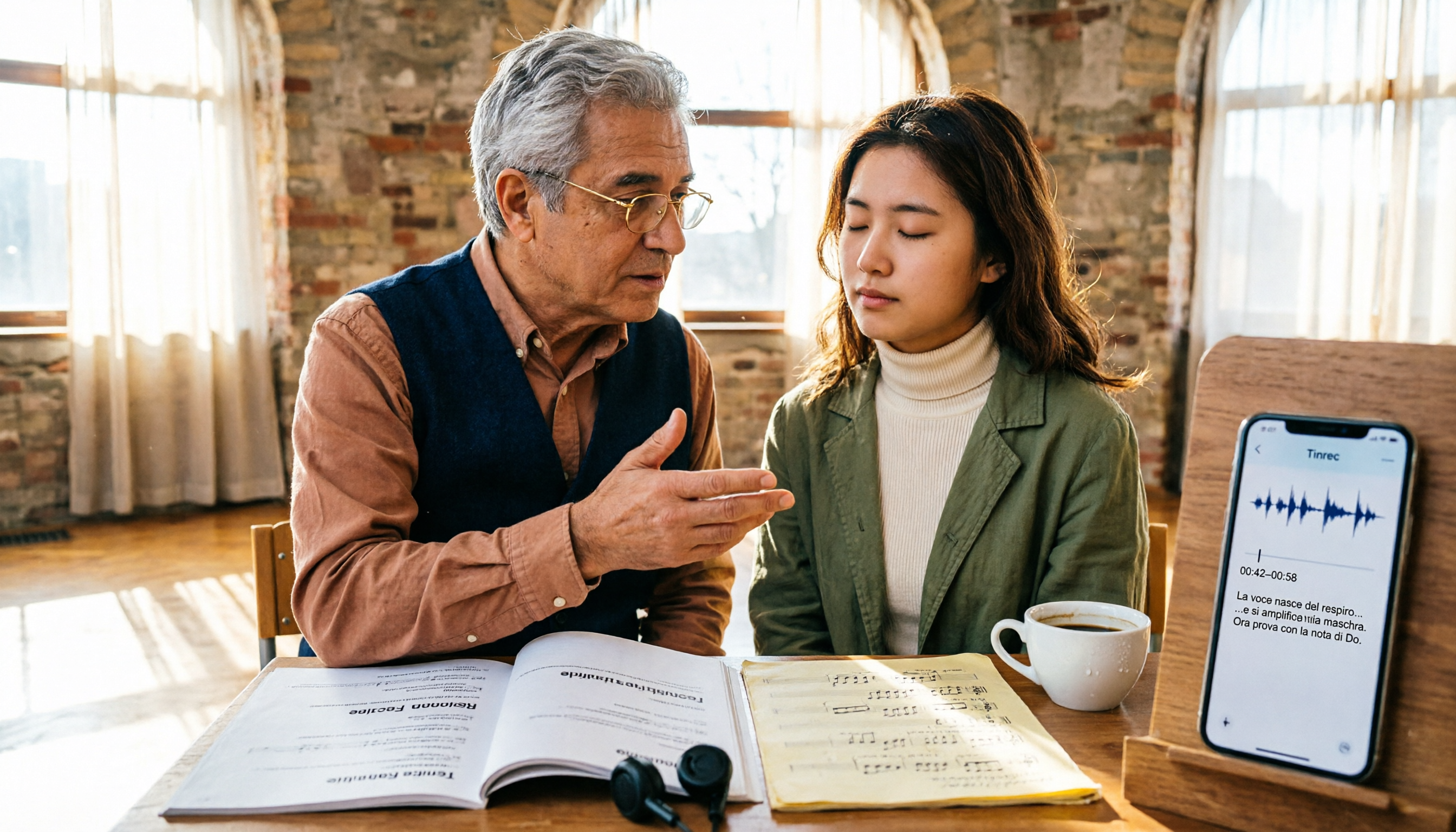
And the real trouble comes later. Even if you manage to enroll, in a two-hour online class the professor lectures in Italian about vocal fold closure and resonance. You listen while looking up words, and by the end you only remember a few keywords. When you want to review, you don't even have a recording.
This article isn't about applying to schools. It sorts out the differences between these 2026 courses and also solves the problem of how to capture lecture content.
5 key points to understand before choosing a vocologia artistica training resource
1. Know the direction: clinical vs. artistic
In Italy, vocologia artistica actually has two tracks. Nuova Artec's clinical vocology leans toward clinical, educational, and re-educational aspects, focusing on voice research and therapy. La Voce Artistica's Master directly splits into "artistic" and "clinical" tracks. Unicusano's continuing education course gives equal weight to vocal medicine, speech therapy, and singing.
Choose the wrong track and 200 hours will feel empty.
2. Will ECM credits be useful to you?
Nuova Artec's 200-hour course offers 100 ECM credits for the year and is aimed at speech therapists. If you're not in the Italian healthcare system, ask about the practical value of these credits first—don't just look at the impressive numbers.
3. Is the format remote or in-person?
Nuova Artec offers both FAD (distance learning) and in-person classes. For overseas learners, whether you can complete the course fully remotely is often more critical than the content itself.
4. Class size and deadlines
This is where people slip up most. Nuova Artec only accepts 20 students. La Voce Artistica is "December 12, 2026 or until full." Unicusano says September 30. Mix up the dates and you'll be waiting until next year.
5. Can you keep the content after class?
This is the least considered but most impactful factor for learning. Do you want to keep the lecture audio? Do you need a transcript? Can you see Chinese or English translation in real time? Can you later ask the recording, "What was that vocal exercise called?" These determine whether you actually learn over those 200 hours or just hear it pass by.
Tinrec — our tested pick for classrooms and lectures
Tinrec is an AI meeting notes and collaboration tool for individuals and teams, available on web, desktop, and mobile. It doesn't just convert speech to text; it organizes the entire content into searchable, summarizable, and queryable data.
For artistic vocology learners, it fills exactly the gap mentioned in point 5 above.
Live transcription with real-time translation
When you open Tinrec during an Italian online class, it transcribes as it records, and you can switch between original text, translation, or bilingual view. When the professor talks about resonance chambers, you don't have to stop to look up words—keep up with the content first, then refer back to the original later. This feature is especially useful for lectures with mixed Chinese-English or multiple languages.
No bot needed for online seminars
Tinrec's desktop version captures computer system audio directly, handling online meetings on Zoom, Google Meet, Microsoft Teams, Webex, etc., without needing an extra bot account to join as a listener. For small classes with only 20 spots, having an extra bot on the roster is awkward. Note that this doesn't mean it automatically joins all calendar meetings—you need to open Tinrec and start recording yourself.
After class: summaries, chapters, and action items—not a wall of text
A two-hour lecture can produce tens of thousands of words; reading it directly is painful. Tinrec automatically generates summaries, chapters, and key points, breaking long lectures into browsable sections. Action items extracted from discussions are useful for things like "vocal observation assignment due next week."
Ask questions about the recording
Stop organizing recordings by hand
Upload audio or video and automatically get a transcript, summary, and action items
This is the most practical part for me. During review, you can directly ask, "What were the three vocal register transitions the professor mentioned?" It answers based on semantics rather than dumping keywords. At this price point, conversational query is not common.
Shared space for teaching teams or study groups
The team version is a separate collaborative workspace, not multiple people sharing one personal account. Meeting data belongs to the team, and members can view historical data. Admins can manage roles, seats, sharing permissions, and usage, and can query and export operation logs. Deleted audio files can be recovered from the recycle bin (currently retained for 30 days).
Current team pricing: USD 29.80 per paid seat per month, or USD 199 per paid seat per year (about USD 16.58/month). Each paid seat provides 2,000 minutes of shared team import quota per month; real-time recording under an active plan is currently not deducted by minutes. Eligible teams can try 7 days free with 1 free seat and 300 minutes of shared import quota. Prices and benefits are subject to the official purchase page.
Honest limitations
Tinrec does not promise a fixed accuracy rate; actual performance depends on recording quality, background noise, accents, overlapping speakers, and technical terminology. Artistic vocology terms (vocal fold closure, cricothyroid muscle, passaggio) are specialized; the team version allows maintaining a custom vocabulary to improve recognition, but for important content, we still recommend cross-checking with transcript timestamps and audio playback.
Also, the free version is suitable for trying it out; long-term or high-frequency use requires payment. For occasional lecture organization, the free version works; for short intensive courses, consider a weekly pass; for steady weekly needs, Pro is suitable.
Who it's for
If you're taking vocology courses taught in Italian or English, need to keep original audio for repeated listening, want to ask questions in Chinese after class, or have a group of classmates who need to collectively process course materials—Tinrec is currently the most hassle-free choice.
Besides Tinrec, what other tools are worth considering?
Otter.ai: A mature choice for English business meetings. The free version offers a generous 300 minutes per month; Pro annual billing is about USD 8.49/user/month and includes 1,200 minutes per month. It also has desktop capabilities. But if your class is Chinese mixed with Italian and you need bilingual comparison and post-meeting team data processing, this isn't its strong suit.
Notta: Good multilingual transcription. Free version: 120 minutes per month, 3 minutes per session; Pro annual billing is about USD 8.17/month. Fine for short interviews, but 3 minutes per session is a stretch for a two-hour lecture. It lacks Tinrec's combination of bot-free desktop recording and team workspace.
Granola: Also bot-free, using system audio plus handwritten notes to generate content. Basic is free. Note that it does not save meeting audio files and does not support uploading pre-recorded audio—a major drawback for those who want to repeatedly listen to original audio for pronunciation practice.
Pitfall guide: 4 common mistakes when looking for vocologia artistica courses
Pitfall 1: Only looking at the course name, not the track. Both are called vocologia, but one is clinically oriented and the other artistically oriented. Confirm the faculty and syllabus before discussing enrollment.
Pitfall 2: Ignoring language and format. All-Italian instruction plus in-person classes is a double barrier for overseas learners. First confirm whether there's a remote option.
Pitfall 3: Waiting until the deadline. Rules like 20 spots and closing when full are common; some courses even start accepting applications in December of the previous year.
Pitfall 4: Recording without organizing. Recording a bunch of audio files but never opening them is the same as not recording. Using the tool as just a "voice recorder" only taps one-third of its value—real-time translation, chapter summaries, and conversational query are where time is saved.
Summary: How to plan for 2026
In one sentence: choose the right course direction and keep the content—then those 200 hours won't be wasted.
- Want clinical focus, need ECM credits, prefer small classes → Nuova Artec's clinical vocology (200 hours, 100 ECM, 20 spots)
- Want both artistic and clinical tracks, targeting 2027 enrollment → La Voce Artistica's Master, apply by December 12, 2026
- Want to supplement vocal medicine and singing practice → Unicusano's continuing education course, deadline September 30, 2026
- Want association resources and discounted Master auditing → GIVA, 2025–2026 academic year ongoing
- Want university course modules with textbook reading → University of Bologna's 2026/2027 Artistic Vocology, reference book: Fussi et al., "Vocologia artistica. La consapevolezza nel canto"
- Need to keep lecture content and ask questions → Tinrec; try the free version with one lecture, upgrade if it fits
One final reminder: recording and transcription involve others' lecture content. Before class, check course rules and local regulations, and obtain the speaker's consent when needed.
(Course information compiled from official websites of Nuova Artec, GIVA, Unicusano, La Voce Artistica, and the University of Bologna. Actual course offerings and registration details are subject to each institution's announcements.)
References
- Scuola di Vocologia Clinica edizione 2026 | Nuova Artec
- Gruppo Italiano Vocologi Artistici - Gruppo Italiano Vocologi Artistici G.I.V.A. APS
- Vocalità artistica, foniatria e canto - Unicusano
- Corsi e convegni per foniatri, logopedisti, maestri di canto e cantanti - La Voce Artistica
- 2026/2027 Artistic Vocology — University of Bologna
Turn every recording into actionable outcomes
Get 60 free transcription minutes when you sign in. No credit card required.
Related Reading
You might also like

Transkriptor vs Notta: Which Is Better? 2026 Comparison of 3 Tools — This One Is Better for Chinese Meetings and Team Knowledge Retention
Comparing Transkriptor and Notta? This article examines four angles: Chinese recognition, post-meeting organization, meeting audio capture methods, and team authorization. It also explains how Tinrec uses desktop-based bot-free recording for online meetings, generates summaries and action items, and compares publicly available data on language counts, custom vocabulary, free quotas, and pricing between Transkriptor and Notta to help you choose the right transcription tool.

3 AI Meeting Transcription Tools Tested: Otter vs Notta (Reddit Buzz) and How to Choose in 2026
We break down real Reddit discussions comparing Otter and Notta, covering meeting types, input sources, and post-meeting deliverables. Then we walk through the complete workflow with Tinrec—from recording and transcription to AI summaries and team knowledge retention—to help you decide which tool fits your needs.

Tinrec vs Yating Transcribe 2026: 5-Dimension Comparison — Which Is Better for Accuracy and Post-Meeting Organization?
People searching for 'Yating Transcribe accuracy' often need to know not just a single number, but how much time they'll spend organizing after transcription. This article compares Tinrec and Yating Transcribe across 5 dimensions: Chinese and mixed Chinese-English recognition, post-meeting output, meeting capture and input sources, cross-device and team collaboration, and pricing and trial flexibility. It also summarizes each tool's unique strengths and ideal users.

Tinrec vs iPhone Voice Memos in 2026: 5-Dimension Comparison — Which Recording App Should You Use?
iPhone's built-in Voice Memos is free and easy to use, but it often falls short for meeting notes, transcription, and post-meeting organization. This article compares Tinrec and iPhone Voice Memos across 5 dimensions—Chinese transcription, online meeting recording, AI Q&A, team collaboration, and pricing—to tell you which one to use in which situation.

Traditional Recording Apps vs Tinrec in 2026: A 5-Dimension Comparison — The Real Difference Is What Happens After Recording
Discussions about recording apps on PTT often revolve around issues like calls interrupting recordings, files ending up 0 seconds long, and Android internal recording failures. This article, from a student's practical perspective, breaks down the most common misconceptions when choosing a recording app and compares 'recording-only' vs 'record-and-organize' across 5 dimensions, explaining how Tinrec works in practice for transcripts, summaries, to-dos, and team collaboration.

How to Choose a Meeting Transcription Tool in 2026: Notta vs. Transkriptor + Tinrec's Differentiated Advantages
Meeting recordings sitting around for three days with no one organizing them? This article starts from real pain points, compares the positioning differences between Notta and Transkriptor, and explains how Tinrec uses bot-free recording, AI summary Q&A, and team spaces to turn meetings into searchable, transferable team data.

Yating Transcript Pricing 2026: Free Minutes and Hourly Rates Explained
Does Yating Transcript cost money? This guide breaks down the free quota, the NT$100 per hour plan, bulk purchases, and API billing. It also covers 4 key things to understand before choosing a transcription tool, and compares pricing models from Tinrec, Notta, Otter.ai, and others to help you decide which option is most cost-effective for you.

Notta vs TurboScribe in 2026: 3 Speech-to-Text Tools Tested—Which Saves the Most Time After Meetings?
Notta and TurboScribe are both popular speech-to-text tools, but one leans toward meeting notes and the other toward batch file transcription. This hands-on comparison examines their positioning, free tiers, and limitations, and explains how Tinrec differs in post-meeting organization and team collaboration to help you decide which fits you best.

2026 AI Voice Collaboration Platform Comparison: vocol.ai vs. Tinrec — Which One Ends the Post-Meeting Cleanup Nightmare?
Endless weekly meetings are bad, but post-meeting cleanup is the real nightmare. This article compares vocol.ai, Tinrec, Otter.ai, and Notta from a mid-level manager's hands-on perspective, covering Chinese transcription, post-meeting summaries, AI Q&A, team collaboration, and pricing. It also honestly points out each tool's limitations to help you decide which one deserves a spot in your team's workflow.