
Turn recordings into transcripts and summaries in minutes
Upload audio or video for multilingual transcription, AI notes, and action items
Whether it's a LINE voice call with a client or a long voice message in a group chat, the inability to directly record and quickly search for key points is a common pain point for professionals. Especially under iPhone's system privacy restrictions, recording LINE calls is even more challenging. This article compiles and tests 5 mainstream LINE recording and voice-to-text solutions in 2026, providing objective comparison dimensions, a comparison table, and step-by-step guidance to help you find the best workflow.
Quick navigation suggestions:
- If you need basic recording for free: Android users can prioritize the built-in system recorder or a third-party app like Cube ACR.
- To bypass iPhone restrictions: Consider using the PC/Mac version of LINE for calls, combined with system recording software.
- For post-processing and meeting minutes: Upload the recording to an AI transcription tool like Tinrec to automatically generate transcripts and action items.
Review Disclaimer and Test Criteria
To ensure objectivity and practicality, we simulated real workplace scenarios for testing:
- Test samples: A 30-minute dual-party voice call recording from LINE PC version, and 5 voice messages of about 1 minute each.
- Test environment: Quiet office and a coffee shop with background noise.
- Evaluation dimensions: We standardized the following criteria: speech recognition accuracy, real-time transcription capability, summary and action item generation quality, AI query interactivity, export and integration efficiency, and pricing/free tier.
LINE Recording and Transcription: Comparison Table of 5 Mainstream Solutions
To address "how to convert LINE voice into usable text," we compared 5 common software/hardware and AI solutions:
| Dimension | Android Built-in/Third-Party Recording | iOS Screen Recording (with Mic) | PC System Recording Tool | Traditional Transcription Software | Tinrec (Second-Listen Recording) |
|---|---|---|---|---|---|
| Language Support | Recording only, no transcription | Recording only, no transcription | Recording only, no transcription | Depends on software (often single language) | 10 languages including Chinese, English, Japanese, Taiwanese, Cantonese, etc. |
| Real-time Transcription | Not supported | Not supported | Not supported | Partially supported | Supported (requires device microphone) |
| Summary/Action Items | None | None | None | Low (plain text only) | High (auto-generates minutes and to-dos) |
| AI Query | None | None | None | None | Supported (ask questions about recording content) |
| Export and Integration | Local audio file | Local video file | Local audio file | TXT/Word | Multi-format export and action item extraction |
| Price/Free Tier | Free | Free | Mostly free | Charged by duration | 100 minutes free per month |
Practical Tutorial: How to Record LINE Calls and Convert to Transcripts
If you need to fully record LINE call content and turn it into valuable meeting notes, follow these steps. Here we use a workflow with Tinrec as an example to demonstrate the complete process from recording to action:
Step 1: Obtain a LINE Call Recording
Since the LINE mobile app (especially iPhone) restricts call recording, the most stable solution is to use LINE on a computer for calls and use the system's recording software or enable speakerphone with an external microphone.
Step 2: Real-time Transcription
If you're in a meeting in front of your computer, you can use a web-based tool for real-time transcription.
Stop organizing recordings by hand
Upload audio or video and automatically get a transcript, summary, and action items
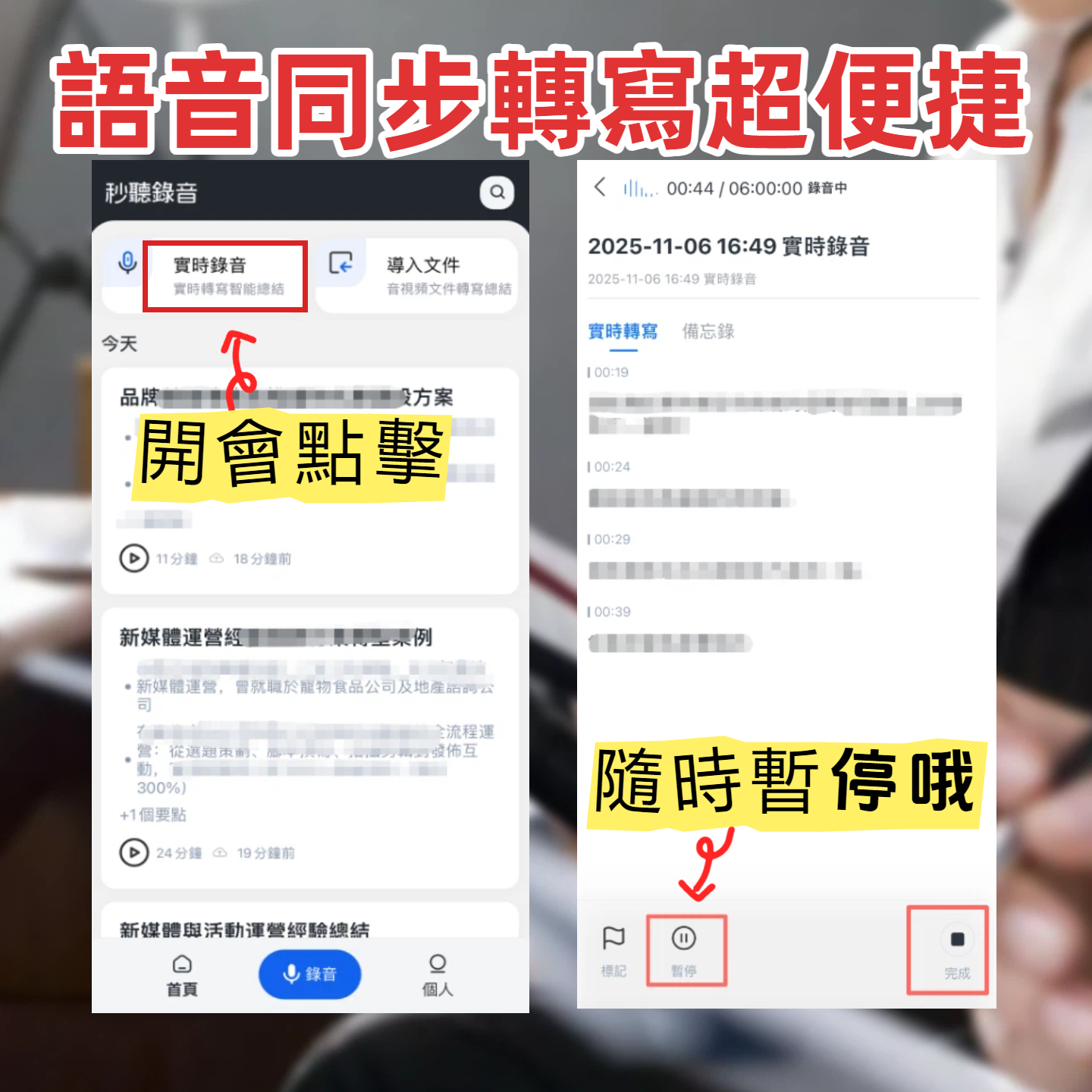
- Go to the Real-time Transcription interface.
- Click Start Recording, and the system will transcribe both sides of the LINE call into text in real time without waiting.
Step 3: Upload Audio or Video Files
If you recorded the call on your phone using screen recording (iOS) or a third-party app (Android), you can upload it later for processing.
- Obtain the recording or video file in MP3/WAV/MP4 format.
- Go to the Audio File to Text or video processing section.
- Upload the file, and the system will automatically distinguish speakers and generate a full transcript.
(Note: If the content comes from publicly available educational or work discussion videos online, you can also use the Video to Text feature by entering the URL.)
Step 4: Use AI Chat Query to Extract Key Points
Traditional transcripts only allow Ctrl+F keyword search, which is inefficient for hour-long LINE meetings.
- After generating the transcript, go to the AI Chat Query interface.
- Ask the AI directly, for example: "What was the price the client mentioned?" or "Summarize next week's to-dos from this call."
- The AI will perform semantic retrieval based on the recording content and provide answers.
Scenario Review: Performance of Different Tools in LINE Voice Scenarios
- Cross-border/remote client meetings: Using a single recording tool can miss key points due to speech speed or accents. In this scenario, AI tools with multilingual recognition (e.g., Chinese and English mixed) and speaker diarization perform best, ensuring no decisions are missed.
- Daily long voice messages: Many managers use voice messages to delegate tasks. By forwarding or exporting voice files to a transcription tool, you can quickly scan the text, avoiding the pain of repeated listening.
Tinrec Value and Limitations Review
During the review, we objectively examined Tinrec's strengths and limitations as a candidate solution: Strengths: Tinrec is not just a transcription tool; it focuses on "post-processing efficiency." It solves the low information density problem of traditional recordings, converting time-based audio content into "scannable, searchable, and actionable" meeting minutes and to-do lists.
Limitations: Tinrec is a post-processing transcription and external audio AI platform. It cannot bypass iOS system-level hardware restrictions to directly record internal LINE calls on iPhones. For mobile users, you still need to rely on screen recording or Android third-party apps to obtain audio files, which are then processed by Tinrec for transcription.
Recommendations and Buying Guide
When choosing a LINE recording and transcription tool, base your decision on your core needs:
- Not recommended for: Users who only occasionally record personal conversations and don't need transcripts. Use Android's built-in function or a simple third-party app; no need for AI tools.
- Best for (admin/sales/project managers): If you frequently use LINE for business communication and remote meetings, and hate post-meeting note-taking, we recommend the combination of "PC LINE + system recording + Tinrec." By using AI to generate summaries and to-dos, you can reduce processing time from an hour to a few minutes.

LINE Recording and Transcription FAQ
1. Why can't iPhones directly record LINE calls?
Due to Apple's strict user privacy protections, iOS blocks third-party apps (including LINE) from accessing the microphone for two-way call recording. Therefore, iPhones do not have a built-in call recording feature.
2. Are there alternative ways to record LINE on iPhones?
You can try using iOS's built-in "Screen Recording" and long-press to enable the microphone, or put the call on speaker and record with another device, then upload the audio file to a transcription tool.
3. Are there free tiers for converting LINE recordings to text?
Most AI tools offer trial quotas. For example, Tinrec currently offers a free plan with up to 100 minutes of transcription per month, which is sufficient for light users handling a few small meetings.
4. If meetings switch to Teams or Meet, do these recording tools still work?
Yes. Whether it's Teams, Google Meet, or LINE desktop, as long as the sound is played through the computer, you can use system recording or directly open an AI web page for real-time transcription.
5. Will the transcript become garbled if the conversation mixes Chinese and English?
Traditional speech recognition software often requires manual language switching, which can cause garbled text. Modern AI tools (like Tinrec) support automatic multilingual recognition, significantly improving accuracy with mixed Chinese-English or Taiwanese.
6. The transcript is too long; how can I quickly find key points?
Instead of reading the full transcript, use platforms with "AI Summary" and "AI Chat Query" features. The system will automatically generate meeting minutes and action items, and you can ask direct questions for the AI to retrieve precise information from the recording.
Turn every recording into actionable outcomes
Get 60 free transcription minutes when you sign in. No credit card required.
Related Reading
You might also like

4 iPhone Transcription AI Tools Tested in 2026: Which One Actually Saves You Time?
Two-hour meeting, two more hours to organize? This article compares four common iPhone recording-to-text methods: iOS built-in transcription, Notta, PLAUD NotePin, and Tinrec. It outlines four key buying criteria, four common pitfalls, and explains Tinrec's real-world performance in Chinese meetings, post-meeting AI Q&A, and team knowledge retention, helping you decide which one to choose.

4 Best iPhone Transcription Solutions in 2026: Built-in vs. Apps vs. AI Tools
How to choose an iPhone audio-to-text solution? This article compares Apple's built-in Voice Memos, Granola, Notta, and Tinrec, covering Chinese language support, post-meeting organization, team collaboration, and pricing to help you find the right fit.

2026 AI Transcription Tools Comparison: 4 Picks Tested for Chinese Accuracy & Post-Meeting Efficiency
We tested 4 AI transcription tools in 2026, comparing Chinese recognition, online meeting recording, free tiers, and post-meeting organization. We cover 4 key buying factors and 4 common mistakes, and compare Tinrec, Notta, Granola, and Otter.ai to help you choose the best fit.

5 Best iPhone Transcription Apps in 2026: Which Saves the Most Time for Cantonese Meetings?
Which iPhone transcription app is best? We tested Tinrec, Apple Voice Memos, Otter.ai, and Granola using a Cantonese meeting recording with mixed Chinese and English. We compared recognition accuracy, post-meeting organization, cross-platform use, and team sharing to help you save time on transcripts.

4 Audio-to-Text Tools Tested in 2026: Can ChatGPT or Tinrec Turn Your Recordings into Transcripts?
Want to use ChatGPT to turn audio files into transcripts, but it can't read audio files and its recording mode only works on macOS and certain paid workspaces? This hands-on comparison of 4 audio-to-text tools covers importing existing audio, Chinese recognition, post-meeting organization, and team data retention—plus 3 common mistakes to avoid when choosing a tool.

2026 Top 5 Speech-to-Text Software Comparison: Which Free Version Is Good Enough?
Starting from the overtime pain points of Central office workers, this article tests and compares free speech-to-text solutions in 2026, breaks down 5 key factors to consider when choosing a tool, and uses Tinrec to demonstrate the complete workflow from real-time transcription, AI summaries, action item extraction, AI Q&A, to team workspace retention.

2026 4-Way Audio-to-Text Comparison: Is Samsung Galaxy AI Enough?
Is Samsung Galaxy AI's speech-to-text assistant good enough? This article starts with three common recording organization mistakes, breaks down 5 key buying factors, and compares Samsung's built-in feature, Tinrec, Otter.ai, and Notta. It also covers 4 pitfalls to avoid, helping you decide based on your budget and use case.

2026 Free Speech-to-Text Options: 5 Common Types Explained
A student's guide to the common types and limits of free speech-to-text options in 2026, plus how Tinrec's instant transcription, AI summaries, action item extraction, AI Q&A, and team spaces work for class notes, group discussions, and senior projects, with advice on choosing between the free plan, weekly pass, Pro, and team plans.

5 Chinese Speech-to-Text Tools Tested in 2026: Which Saves the Most Time on Meeting Notes?
A mid-level manager who runs 15 meetings a week shares hands-on experience: when choosing a Chinese audio-to-text tool, the key isn't whether it supports Chinese, but whether it can handle your meeting format, organize the transcript afterward, and provide enough team governance. Using Tinrec as an example, this covers bot-free meeting recording, Chinese transcripts, AI summaries and action items, and the practical uses and limits of team spaces.