
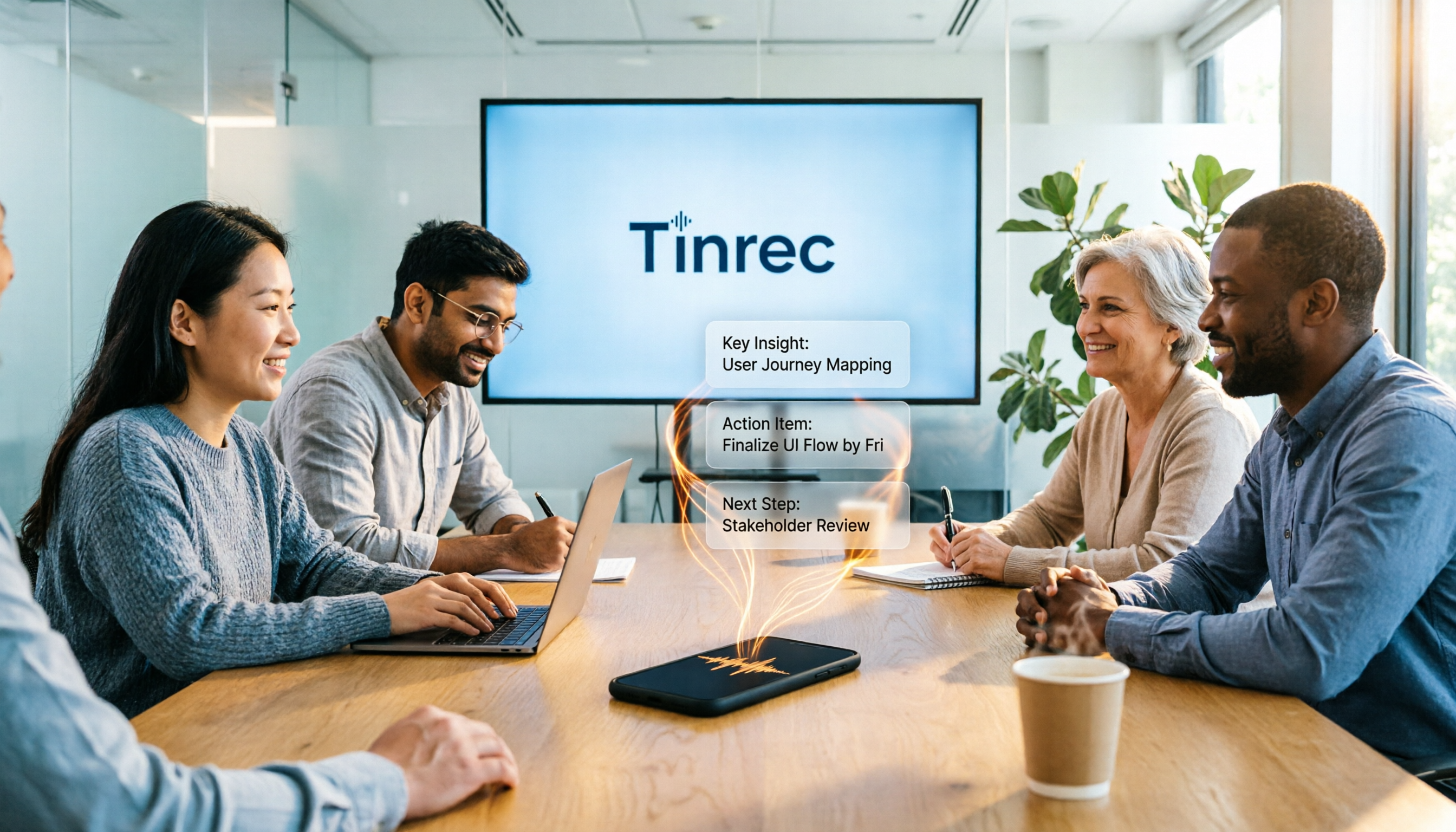
Turn recordings into transcripts and summaries in minutes
Upload audio or video for multilingual transcription, AI notes, and action items
How to Use AI Meeting Efficiency Tools in 2026: 5 Steps from Recording to Team Meeting Minutes
The Real Time Sink Isn't the Meeting Itself
It's 10 a.m. on a Monday. You walk into the conference room with your laptop, listening and typing in a document at the same time. At the end of the meeting, your manager turns and asks, "That budget item from last time—who was supposed to handle it?" You scroll through the notes you just typed, but you can't find that sentence anywhere.
This is a daily reality for many office workers. The meeting itself takes an hour, and organizing it afterward takes another hour—and even then, you might not find the key points.
Another scenario is even trickier: a two-hour cross-departmental meeting with three people talking at once, mixing Chinese and English, plus product codes and technical terms. You recorded it, but listening back to the entire two-hour file is more exhausting than holding the meeting again.
If you've experienced any of these situations, this article is for you. Below, we'll first cover the criteria for choosing a tool, then break down the options I've found most worth integrating into my workflow.
5 Key Points to Understand Before Choosing an AI Meeting Efficiency Tool
1. How the meeting gets "recorded" Some tools require a meeting bot to join the room, becoming an extra participant; others capture system audio directly from your computer. The former requires advance invitation, which often doesn't work for impromptu meetings; the latter just needs the app open to record. This point is especially critical for spontaneous meetings.
2. What you can do after transcription A tool that only provides a transcript is essentially outsourcing the typing—you still have to read through it yourself. What truly saves time is the ability to automatically generate summaries, chapters, and action items after transcription, and to let you ask questions directly about the meeting content.
3. Can it handle Chinese, mixed Chinese-English, and foreign language meetings? Meetings in Taiwan are rarely "pure Chinese." Product names, technical terms, and client company names are often in English. When choosing a tool, look at its ability to handle mixed languages and whether it offers real-time translation. Also, it's best if proper nouns can be manually maintained; otherwise, you'll have to re-correct them every time.
4. Can the team adopt it? Personal use and team use are two different things. For teams, the questions are: Who owns the data? Do meeting records remain after a member leaves? Who has permission to record and upload? Who bears the cost of usage?
5. How quotas are calculated A common pitfall is confusing "real-time recording minutes" with "file import minutes." Some plans don't deduct minutes for real-time recording but do for uploaded files; others are the opposite. Before buying, make sure to clarify which actions consume your quota.
One more thing that's easily overlooked: recording involves other people, so in practice you must comply with local regulations and obtain consent from participants when necessary.
Tinrec: Our Top Recommendation After Hands-On Testing
Tinrec is an AI meeting notes and collaboration tool for individuals and teams, available on iOS, Android, desktop, and web. It doesn't just convert audio to text—it turns meetings into searchable, summarizable, queryable, and exportable data.
Here's what a complete workflow looks like in practice:
Step 1: Decide how the meeting gets into Tinrec For in-person meetings or interviews, use real-time recording to transcribe as you record. For online meetings (Zoom, Google Meet, Microsoft Teams, Webex), use the desktop app to capture system audio directly—no need to invite a meeting bot. For meetings that already happened, upload the audio or video file; some public link content can also be imported.
Step 2: Transcription and translation start while recording The transcript is generated in sync during recording. For cross-language meetings, you can switch between original text, translation, or bilingual view, so participants don't have to wait until after the meeting to know what was said.
Step 3: Let AI structure it first As soon as the meeting ends, summaries, chapters, and key points are automatically generated. For a two-hour meeting, you can glance at a three-line summary to decide whether to read further—much faster than scrolling through the transcript from the beginning.
Step 4: Turn discussions into action items Tinrec extracts action items from the conversation. This is where many people find the most value—after the meeting, who needs to do what is already listed, so you don't have to guess.
Stop organizing recordings by hand
Upload audio or video and automatically get a transcript, summary, and action items
Step 5: Query, export, and retain This is where the biggest difference emerges. You can directly ask it: "What was the conclusion about the budget in this meeting?" It answers based on semantic understanding, not by dumping a bunch of keyword search results on you. Organized content can be exported to Notion, Google Docs, OneNote, Dropbox, and further processed with Agent to generate reports, tables, or meeting minutes documents.
For team use, the team plan puts all this into a dedicated space: data is stored centrally, new members can view past meetings; admins can manage roles, seats, sharing permissions, usage analytics, and audit logs; when a member leaves or loses their seat, team resources can be transferred to other members—they don't leave with the person.
Pros
- No meeting bot needed: the desktop app captures system audio directly, so you can record impromptu meetings too.
- Transcript is just the starting point: summaries, chapters, action items, mind maps, and AI Q&A all connect to post-meeting work.
- Team knowledge retention: team spaces store meetings centrally, with separate management of members, seats, usage, and audits.
Limitations
- The free plan offers basic quota, suitable for trying out the workflow; if you handle long meetings daily, you'll need to evaluate an upgrade. Actual quotas and pricing are subject to the official purchase page.
- Transcription quality is affected by recording quality, ambient noise, accents, overlapping speakers, and proper nouns. For important content, cross-check with transcript timestamps and audio playback.
- The team plan currently focuses on team-level sharing, not file-level granular permissions; members without a seat can view and play data, but need a seat to record, upload, edit, and export.
Who it's for People who frequently hold online meetings, whose meetings are mainly in Chinese or mixed Chinese-English, who need to produce minutes and action items afterward, and who want meeting data to stay with the team rather than scattered across individual hard drives.
Pricing (Team plan, per official information) Eligible teams can try 7 days free with 1 free seat and 300 minutes of team shared import quota. Team monthly billing is USD 29.80 per paid seat per month; annual billing is USD 199 per paid seat per year, equivalent to about USD 16.58 per month. Each paid seat provides 2,000 minutes of team shared import quota per month; real-time recording under an active plan is currently not deducted by the minute. The personal plan offers a free version, weekly pass, Pro monthly, and Pro annual—choose based on your usage frequency.
What Else Is Out There Besides Tinrec?
Granola Also bot-free, using desktop system audio and microphone input, focusing on "your handwritten notes + AI enhancement." Official plans: Basic free, Business USD 14 per user per month. Note that it doesn't support uploading pre-recorded audio files and doesn't save meeting audio. If you need to keep recordings, import historical files, or retain data in a team space, Tinrec is more complete in this regard.
Notta A mature tool for multilingual transcription and translation. Free plan: 120 minutes per month, 3 minutes per session; Pro annual billing is about USD 8.17 per month. Suitable for file transcription and subtitle processing. But if you want bot-free recording of online meetings, post-meeting AI Q&A, and Agent post-processing, Tinrec's workflow is more cohesive.
Otter.ai A veteran choice for English business meetings. Basic free: 300 minutes per month; Pro annual billing is about USD 8.49 per user per month. It's reasonable for teams whose meetings are primarily in English. If your meetings are mainly in Chinese or mixed Chinese-English and you need real-time bilingual viewing and team hotwords, Tinrec's Chinese experience will be closer to actual use.
Pitfall Guide: 4 Most Common Mistakes When Choosing AI Meeting Tools
Pitfall 1: Only looking at the official accuracy rate. Lab numbers and your conference room are two different things. Air conditioning noise, keyboard sounds, three people talking over each other—results will vary greatly. The best approach is to test with a real recording of your own.
Pitfall 2: Treating "having a transcript" as the end goal. A transcript is just raw material. What really saves time is summaries, chapters, action items, and querying. If a tool only gives you text, you still have to read through two hours of content yourself.
Pitfall 3: Assuming a team plan means "multiple people sharing one account." It's not. Check whether it has independent team spaces, roles and seats, usage and audit features. Also confirm one thing: when a member leaves, will the meeting data disappear with them?
Pitfall 4: Ignoring recording consent. For recordings involving clients or employees, first confirm regulations and company policies, and obtain consent when necessary. No matter how good the tool is, this step cannot be skipped.
Conclusion: Which One Should You Choose?
In short: rather than finding the tool with the "best transcription," find the one that makes post-meeting work easiest.
- Frequently hold Zoom, Meet, Teams meetings and don't want to invite a bot → Tinrec (desktop app captures system audio directly)
- Meetings mainly in Chinese or mixed Chinese-English, need bilingual view → Tinrec (real-time translation + team hotwords)
- Want to ask questions directly about meeting content and generate reports afterward → Tinrec (AI Q&A + Agent post-processing)
- Team needs to jointly store meetings and manage seats and usage → Tinrec Team plan
- Meetings are almost entirely in English and you just want a generous free plan → Otter.ai is worth comparing
- Mainly batch-converting existing audio files to subtitles → Tools like TurboScribe are more suitable
I recommend starting with the free plan on a real meeting, going through the five steps of "record → summarize → action items → export," and then deciding whether to upgrade. Paying after you're comfortable is safer than buying an annual plan upfront.
References
Turn every recording into actionable outcomes
Get 60 free transcription minutes when you sign in. No credit card required.
Related Reading
You might also like

2026 Comparison of 4 Meeting Productivity Agents: Which One Actually Saves Post-Meeting Time?
The real work starts after the meeting ends. This article uses the same Chinese meeting recording to test the post-meeting workflows of Tinrec, Otter.ai, Fireflies.ai, and Notta—covering bot-free recording, summary and action items, AI Q&A, and team knowledge retention—to help you decide which meeting productivity agent truly saves time.

2026 AI Meeting Notes Tools Compared: Tinrec vs Otter.ai vs Notta vs Granola — Which Turns Meetings into Usable Data?
Stop taking notes yourself: a hands-on comparison of Tinrec, Otter.ai, Notta, and Granola covering transcripts, summaries, action items, and AI Q&A, plus buying criteria, team seat and pricing details, and pitfalls to avoid.

4 AI Agents That Generate Excel Files Tested: Which One Actually Produces a Usable .xlsx?
After a meeting, turning notes into an Excel file often means replaying the entire recording. This article starts from "where does the data come from" and compares four approaches: Tinrec, Excel's built-in Agent mode, Gemini Notebook Agent, and Aspose.Cells AI Generator. It also covers 5 key selection criteria, 4 common mistakes, and practical recommendations.

2026 Free AI Agent PPT Generation Options: 5 Tools Compared
AI Agent PPT generation tools are proliferating, but the real question is where the content comes from. This article reviews five available options in 2026, including Microsoft Copilot, MiniMax Agent, ChatPPT, and two self-hostable open-source projects. It also explains how to use Tinrec to turn meeting recordings into usable presentation material, with a pitfalls guide and selection advice.
2026 AI Work Assistant Comparison: Meeting Notes and To-Do Lists—Which One Really Saves Time?
Most people start with the wrong expectations for AI work assistants. This article tackles common misconceptions, uses the same set of meeting materials to compare Tinrec, Otter.ai, Notta, and Granola, and outlines 5 key points to understand before buying, 4 common pitfalls, and selection advice based on use cases.
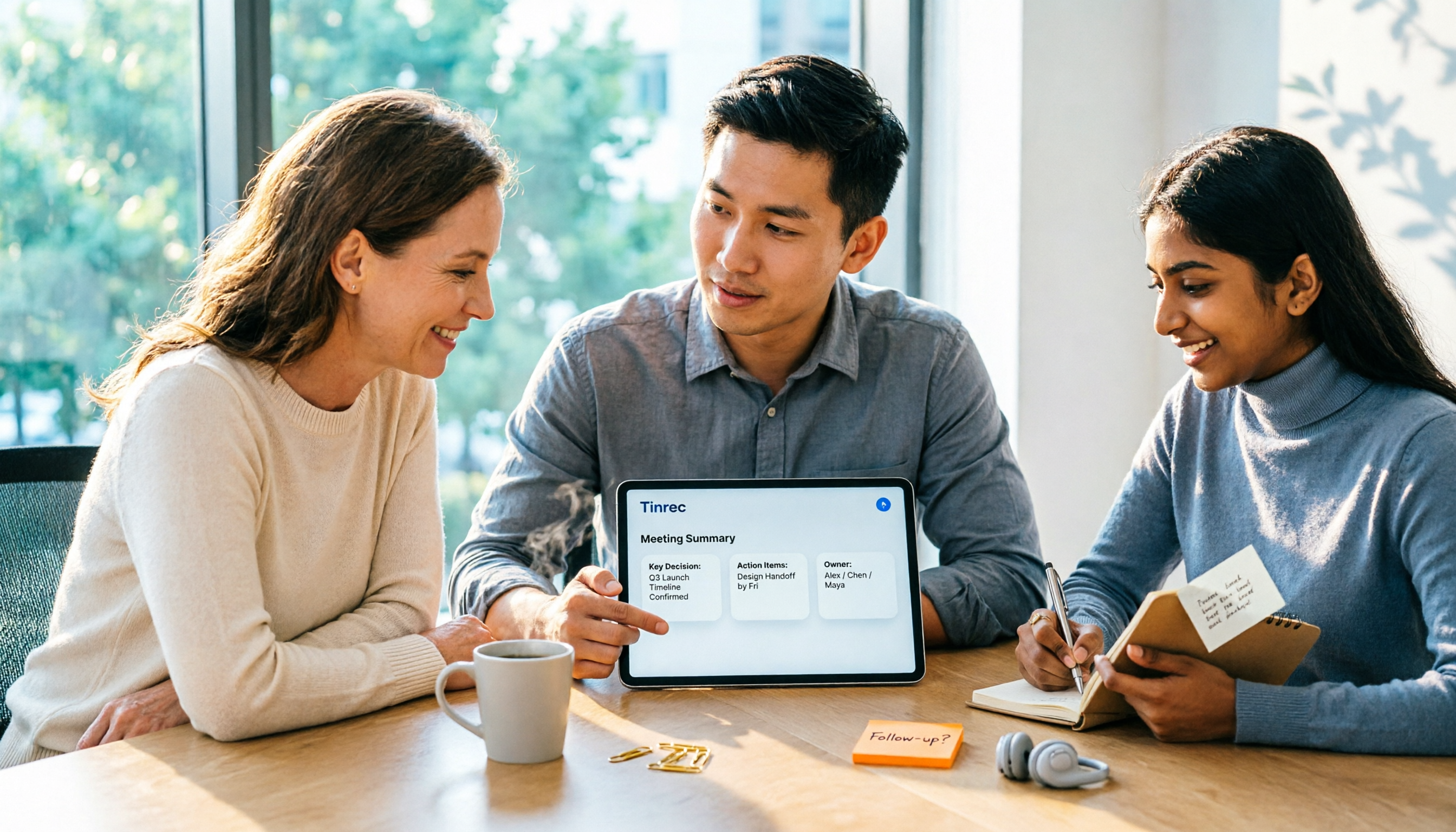
2026 AI Meeting Assistant Comparison: Tinrec vs Otter.ai vs Granola vs Notta for Chinese Meetings & Post-Meeting Q&A
The real pain point of meeting notes isn't typing speed—it's that decisions and action items get lost after the meeting. This article compares four AI meeting assistants—Tinrec, Otter.ai, Granola, and Notta—using the same testing process, breaking down four dimensions: how meetings are captured, post-meeting organization, Chinese and cross-language performance, and team governance. It also lists four common purchasing mistakes to help you choose the right tool within your budget.

2026 Comparison of 5 AI Agent Structured Output Approaches: From JSON Schema to Meeting Data in Practice
Many people think that writing "please reply in JSON" in a prompt counts as structured output, but when they actually connect it to a system they discover that the fields are different every time. This article starts from common misconceptions, compares 5 structured output approaches side by side, and uses Tinrec to demonstrate how to turn meeting recordings into verifiable, directly usable tables, action items, and reports.

2026 AI Agent Auto-Delivery Tools Compared: From Meeting Notes to Post-Meeting Outputs, Which Is Least Hassle?
2026 is called the "delivery year" for AI Agents, but tools branded as Agents actually fall into four distinct approaches. This article compares them across four dimensions—input method, post-meeting output, Chinese-language experience, and team governance—and uses Tinrec as a practical example of the "bot-free desktop agent" approach to help you decide which one truly turns meetings into deliverables.

2026 AI Meeting Tools Compared: Key Differences That Actually Improve Meeting Efficiency
More meetings don't mean more efficiency. This article starts with common misconceptions and breaks down the three areas AI must address to truly improve meeting efficiency: uninterrupted recording, structured content, and transferable outcomes. Using Tinrec as an example, it explains the complete workflow from bot-free online meeting recording, real-time transcription, AI summaries and action items, AI Q&A, to team spaces. It also includes 5 buying checkpoints and FAQs.