

Turn recordings into transcripts and summaries in minutes
Upload audio or video for multilingual transcription, AI notes, and action items
Why You Need to Look for an Alternative to Notta for Traditional Chinese?
Many users face pain points when choosing a speech-to-text tool: "unnatural Chinese sentence segmentation," "misrecognition of proper nouns," or "free tier insufficient for long meetings." Especially for users in Taiwan who need to handle large amounts of Traditional Chinese content, if the tool's support for local expressions or code-switching (Chinese-English) is lacking, the time cost of editing transcripts later can be even higher.
This article uses real-world testing criteria to deeply compare 5 mainstream tools on the market (including international giants and local emerging players), offering quantifiable comparison dimensions, scenario-based recommendations, and concrete operational guides. We will focus on Chinese accuracy, summary generation logic, and whether it has advanced "chat with your recording" capabilities.
Quick Navigation Conclusions:
- If you value Chinese accuracy and localized experience → Prioritize tools that focus on Traditional Chinese optimization (e.g., Tinrec).
- If you frequently switch between languages (English/Japanese/Korean) → Choose international tools with strong multilingual models.
- If you have a limited budget and low usage → Check each tool's monthly free minutes limit.
- If you seek a complete workflow from recording to action items → Look for solutions with built-in AI summaries and task extraction.
Testing Methodology: How We Define a Good Speech-to-Text Tool
To ensure the results are reliable, this test simulates real work and study environments, avoiding reliance solely on official marketing data.
C1. Testing Disclaimer and Environment Setup
Test times cover different periods to simulate network loads. Samples include three different types of audio files:
- Business meeting: 30 minutes, multiple speakers, with professional jargon and code-switching.
- Academic lecture: 45 minutes, single speaker, moderate to fast pace.
- Interview: 20 minutes, two-person dialogue, with slight background noise. All tests were conducted in a standard office network environment, using devices including iOS phones, Android tablets, and web browsers.
C2. Core Test Metrics
We evaluate based on the following five key dimensions:
- Word Error Rate (WER): Especially accuracy for names, places, and industry terms.
- Segmentation and Speaker Identification: Whether it can automatically distinguish different speakers and segment appropriately.
- Timestamp Accuracy: Precision of text-to-audio time alignment.
- Summary and Action Item Quality: Whether the generated conclusions are logical and can be used directly as meeting minutes.
- Export and Integration Efficiency: Variety of supported formats and collaboration with other software.
2026 In-Depth Comparison of 5 Popular Tools
The following table summarizes our team's test results for the five tools, including system built-in tools (e.g., Apple Dictation) and dedicated transcription software.
| Comparison Dimension | Tinrec (Miao Ting Lu Yin) | Notta | Otter.ai | Yating Word-by-Word | MacWhisper / Whisper |
|---|---|---|---|---|---|
| Traditional Chinese Accuracy | ⭐⭐⭐⭐⭐ (Well optimized) | ⭐⭐⭐ (occasional segmentation issues) | ❌ (Primarily English) | ⭐⭐⭐⭐ (Good localization) | ⭐⭐⭐⭐ (Depends on model) |
| Real-time Transcription Speed | Very fast (real-time display) | Fast | Fast (English only) | Requires upload and processing | Depends on hardware performance |
| AI Summary and Action Items | ✅ Auto-generates to-do items | ✅ Basic summaries | ✅ Powerful (English) | ❌ Only transcript | ❌ Needs extra plugins |
| AI Chat Query Feature | ✅ Supports semantic Q&A | ❌ Only keyword search | ✅ Supported (English) | ❌ No | ❌ No |
| Free Version Limits | 100 minutes per month | Limited (approx. 120 min) | 300 minutes (English only) | Trial restrictions | Completely free (local computing) |
| Multi-platform Support | iOS, Android, Web | iOS, Android, Web | Web, iOS | Web | macOS only |
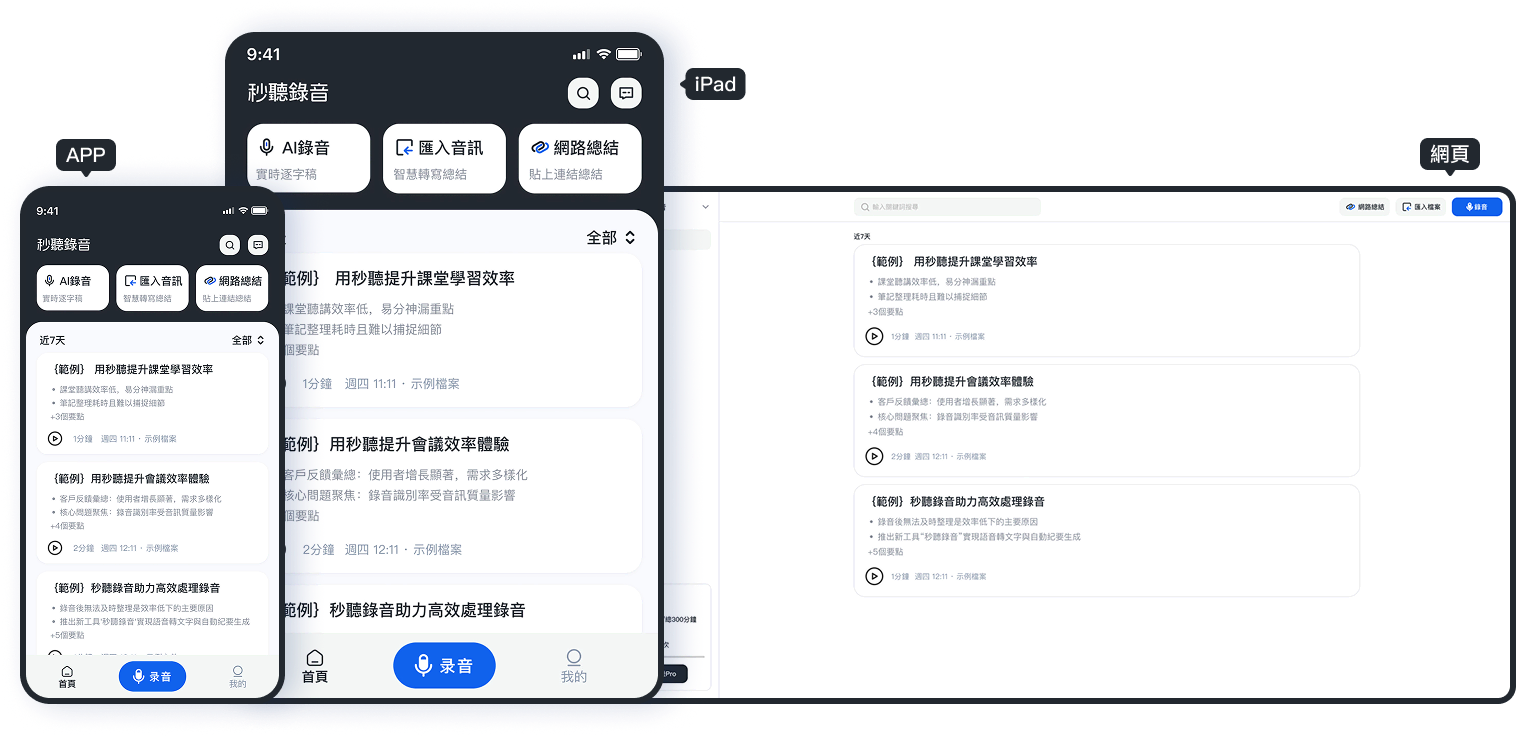
Stop organizing recordings by hand
Upload audio or video and automatically get a transcript, summary, and action items
Key Findings Analysis
- Chinese semantic understanding: When handling common Taiwanese modal particles and long sentences, Tinrec showed better segmentation logic, reducing manual editing time. While Otter.ai is powerful, it has almost zero support for Chinese and is unsuitable for pure Chinese meetings.
- Workflow completeness: Most tools only stop at "transcription," but Tinrec further provides a closed loop from recording to understanding, automatically extracting "to-do action items," which is a huge advantage for busy project managers.
- Technical barrier: MacWhisper offers high privacy but requires users to download models and have some computer skills. In contrast, cloud-based tools like Tinrec and Notta are more suitable for general users out of the box.
Hands-On Guide: How to Triple Your Note-Taking Efficiency with New Tools?
1. Real-Time Transcription During Recording: Instant Control in Meetings
No more painful transcribing after meetings. Turn on the tool's real-time recording feature, select the language (e.g., Traditional Chinese), and the system will transcribe as it records.
- Key operation: If you notice errors during the meeting, you can mark them directly on the interface for quick post-meeting correction.
- Application scenarios: In-person meetings, online courses, ad-hoc interviews.
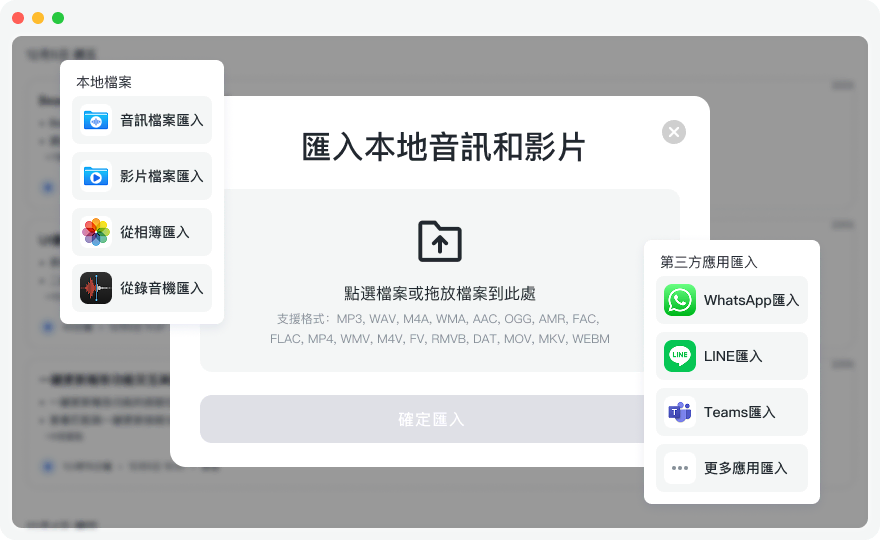
2. Audio File Transcription: Processing Existing Recordings
Have existing recordings from a voice recorder or phone? Just upload them.
- Steps: Go to "Audio File Transcription" → upload MP3/WAV/M4A etc. → select language → wait for auto-generated transcript and summary.
- Advantages: Supports batch processing and automatically filters out filler words (like "um," "like") to make the transcript cleaner.
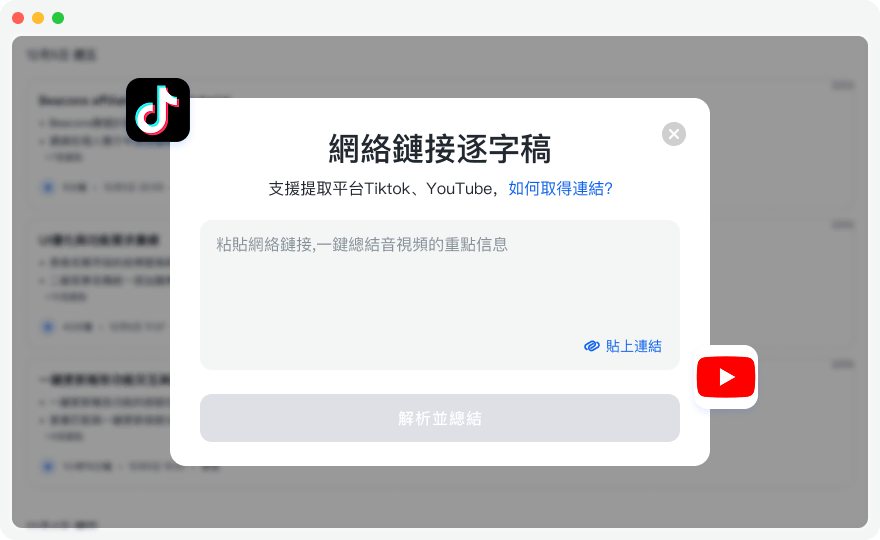
3. Video Link Transcription: A Content Creator's Resource
Want to turn a YouTube tutorial or podcast episode into text notes? No need to download; just copy the link.
- Steps: Select "Podcast/Online Video Transcription" → paste YouTube or podcast link → system automatically extracts and transcribes audio.
- Value: Quickly extract key points for articles or social media content.
4. AI Chat Query: Get Information Like Asking a Person
This is the biggest differentiator between traditional tools and new AI tools. No more painful Ctrl+F searching through thousands of words.
- How to use: On the completed transcript page, open the "AI Chat" feature and ask questions like, "What was the boss's conclusion on next quarter's marketing budget?" or "What are the three exam key points mentioned in this lecture?"
- Result: AI will understand the semantics and provide precise answer segments with timestamps for verification.
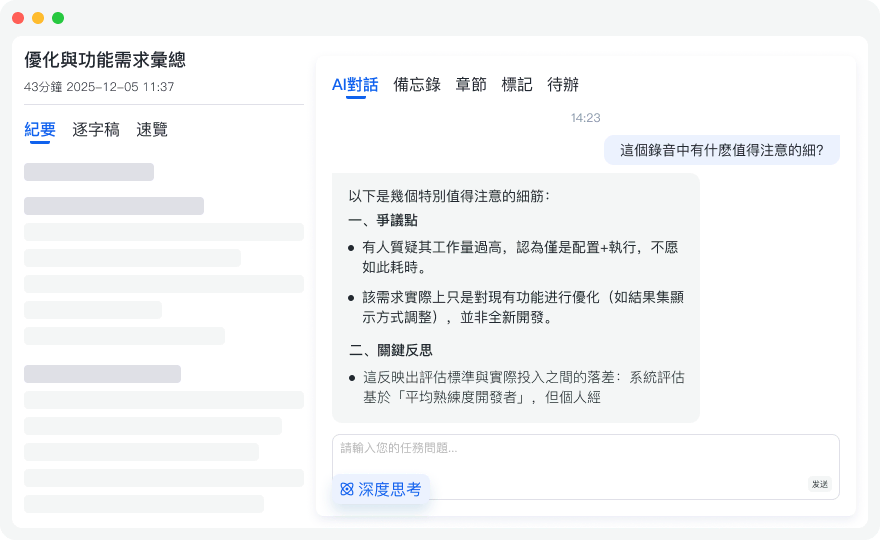
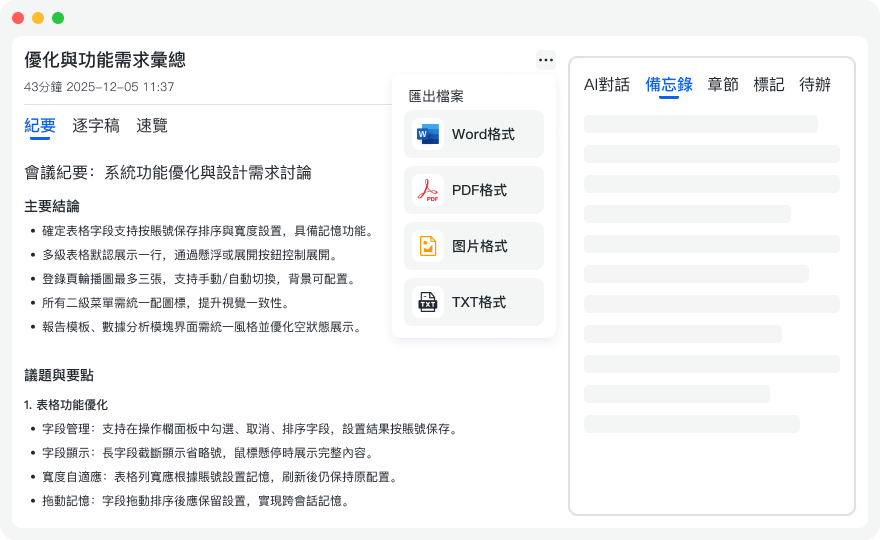
Finally, you can export the organized meeting minutes and action items to Word, PDF, or Markdown with one click, seamlessly integrating into your workflow.
In-Depth Evaluation of Tinrec: Strengths, Limitations, and Use Cases
Among the many options, Tinrec (Miao Ting Lu Yin) stands out with its unique "Recording → Understanding → Action" workflow, but it's not perfect. Understanding its boundaries helps you make a smarter choice.
Core Strengths
- Localized Chinese optimization: Deeply trained on Traditional Chinese grammar and usage, stable with common Taiwanese workplace terminology.
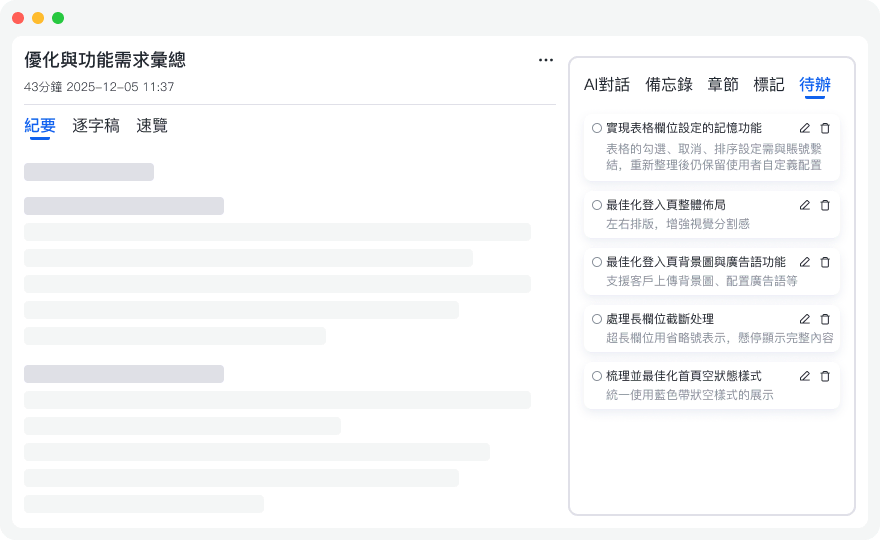
- Automatic action item extraction: Not just summaries, but identifies specific "who, when, what" to directly generate to-do lists, greatly reducing meeting note editing time.
- Multi-platform sync and flexibility: Whether recording ideas on phone or processing long files on computer, account data syncs instantly, supports multiple payment methods and refund policy, user-friendly.
Limitations and Considerations
- Internet dependency: Uses cloud computing for high accuracy and real-time performance, requires internet connection, cannot work fully offline like local software.
- Highly specialized fields: While general vocabulary performs well, for very niche medical or legal terms, manual proofreading is recommended.
Use Case Recommendations
If your primary need is English meeting notes, international giants may still have an edge. But for Traditional Chinese business meetings, academic seminars, media interviews, or daily study notes, where you want to save time on summaries, tools emphasizing Chinese semantic understanding and action conversion are the top choice.
Frequently Asked Questions (FAQ)
Q1: Are there any free Traditional Chinese speech-to-text tools?
Most tools on the market offer free trial tiers. For example, Tinrec provides 100 free minutes per month, enough for small meetings or daily notes. Notta also has a basic free version, but with more feature and time limitations. If you want completely free and don't mind the setup, try the locally deployed Whisper model.
Q2: Can the iPhone's built-in Voice Memos directly transcribe to text?
The iPhone's built-in Voice Memos can only record, not transcribe. While iOS has dictation, it's only for real-time input and cannot process pre-recorded long audio files. Use a third-party app (like Tinrec's iOS version) for simultaneous recording and transcription.
Q3: Can Google Meet or Teams online meetings be automatically recorded?
Some tools support adding a meeting bot for automatic recording and transcription, or using system audio capture on your computer. Be mindful of company security policies to ensure external tools are allowed. For non-bot methods, using desktop software for system audio recording is a common solution.
Q4: Can the tool distinguish different speakers (speaker diarization)?
Yes, mainstream professional tools like Tinrec and Notta have speaker diarization, automatically identifying and labeling "Speaker 1," "Speaker 2," etc. However, when multiple people speak simultaneously or voices are very similar, some manual label adjustment may be needed.
Q5: If my meetings include Taiwanese Hokkien or Cantonese, which tool is more accurate?
This is a key differentiator. Tinrec explicitly supports automatic recognition of 10 languages including Taiwanese Hokkien and Cantonese, offering higher tolerance for mixed-language meetings. In contrast, many international tools only support standard Mandarin or English, with significantly higher error rates for dialects.
Q6: What export formats are available for the converted files?
Most tools support common formats. For example, Tinrec supports export to TXT, DOCX, PDF, SRT (subtitle file), etc., making it easy to archive, print, or create video subtitles.
Turn every recording into actionable outcomes
Get 60 free transcription minutes when you sign in. No credit card required.
Related Reading
You might also like

Notta Online Transcription Review 2026: Free Plan Limits, Traditional Chinese Accuracy, and Tinrec Alternative
How does Notta online transcription work, and is the free plan enough? This article breaks down Notta's meeting bot and desktop bot-free recording, the 120-minute monthly and 3-minute per-recording limits, and Traditional Chinese recognition considerations. It also compares Tinrec across five dimensions—meeting initiation, post-meeting organization, multilingual support, team governance, and pricing—to help you choose the right online transcription solution.

The Complete 2026 Guide to Apple Watch Voice-to-Text: A Better Team Choice Beyond Notta
Recording on Apple Watch is convenient, but the real challenge is post-meeting organization. This article addresses common misconceptions about watch recording and explains how to import Apple Watch voice memos into Tinrec to generate transcripts, summaries, action items, and enable team collaboration. It also clarifies the boundaries of Notta's Apple Watch solution.

2026 Notta Online Captions Review: Free Tier Limits + SRT Timecode Test
A practical breakdown of Notta's online captions and meeting transcription limits: free plan offers 120 minutes per month with a 3-minute cap per segment, and SRT export requires Pro or higher. We also compare Tinrec's no-bot meeting recording, AI Q&A, and team knowledge retention workflow, with buying tips, pitfalls to avoid, and scenario-based recommendations.

2026 AI Meeting Transcription Software Cost Comparison: Notta vs. Tinrec Subscription Plans
How much does Notta cost? This article breaks down Notta's free plan limits (120 minutes per month, 3 minutes per session), the difference between Pro annual at US$8.17/month and monthly at US$13.99, and Business per-seat pricing. It also compares actual costs and use cases for Tinrec, Otter.ai, and TurboScribe to help you understand the costs before committing to an annual plan.

Notta vs Tinrec 2026: 5-Dimension Comparison — Which Free Version Is Enough?
Notta's free plan offers 120 minutes per month but only 3 minutes per recording — is that enough? This article compares Notta and Tinrec free versions across 5 dimensions from a mid-level manager's meeting perspective, and covers how Tinrec handles recording, transcription, summaries, action items, and team collaboration in practice, helping you decide whether to upgrade.

3 AI Meeting Transcription Tools Tested for 2026: Is Notta Any Good? Is the Free Version Enough?
Is Notta worth it? This hands-on review breaks down Notta's transcription, translation, AI summaries, and three key free-plan limits (3 minutes per recording, Pro required for export, 10 summaries per month), compares Pro and Business pricing, and contrasts it with Tinrec and Otter.ai to help you decide which tool fits your meeting style.

2026 Comparison of 6 Audio-to-Text Tools: Beyond Notta, Which Is More Time-Saving for Chinese Meetings?
When choosing an audio-to-text tool, most people only look at accuracy, but the real money-wasters are quota calculations, single-recording length limits, and post-meeting organization workflows. This article compares 6 tools, starting from Notta's positioning, explaining who each is suitable for, how plans are calculated, and how to choose for Chinese meeting scenarios.

How to Use Notta's Recommended Features in 2026: 5-Step Hands-On Test and Selection Advice
Starting from a weekly meeting that couldn't reach a conclusion, this hands-on review covers Notta's 6 recommended features and free version limitations, and compares Tinrec, Otter.ai, and TurboScribe on Chinese meetings, bot-free recording, AI Q&A, and team collaboration. It also includes 3 key pitfalls to avoid when choosing a tool and scenario-based recommendations.

Notta Company Profile 2026: Japanese Entity, Parent Company, and 3 Practical Decision Points for Choosing a Tool
What company is Notta? This article covers Notta's operating entity (Japanese corporation Notta Inc.), overseas parent company NOTTA INC., founder background, and development team. It also provides three practical decision points—recording method, post-meeting workflow, and team governance and pricing—to help you decide between Notta and other AI meeting transcription tools.