
Turn recordings into transcripts and summaries in minutes
Upload audio or video for multilingual transcription, AI notes, and action items
For professionals, students, or content creators who use Cantonese as their primary communication language, organizing audio recordings can be a nightmare. Unlike standard Mandarin or English, Cantonese has unique colloquial grammar (spoken vs. written language divergence), and in meetings within Hong Kong or overseas Chinese communities, code-mixing of Chinese and English is common. Many speech recognition software on the market have inconsistent support for Cantonese, leading to error-ridden transcriptions that take longer to proofread than re-listening.
This article analyzes the latest speech-to-text technology trends in 2026 and recommends software with high-accuracy Cantonese recognition to help you break free from tedious manual transcription.

The Pain Points: Why Is Cantonese Audio Transcription So Hard?
In the era of digital work, we face a flood of voice information daily: Zoom/Teams meetings, lecture recordings, interview content. However, traditional transcription methods face three major bottlenecks:
- Spoken vs. written language conversion gap: Cantonese speech recognition not only needs to accurately hear but also faces the issue of "what to write." Some tools output Cantonese characters (e.g., 佢, 嘅), while others try to convert to written Chinese, causing logical confusion in the final output.
- Mixed language recognition difficulty: In professional settings, Cantonese conversations often include many English terms (code-mixing). Traditional tools usually support only a single language (pure Chinese or pure English), resulting in garbled characters or phonetically similar Chinese characters when encountering English.
- Low information density, high cost of re-listening: A 60-minute meeting recording, if manually transcribed into a verbatim transcript, takes an average of 3 to 4 hours. Moreover, recordings are difficult to search—after a week, you can't recall at which minute a certain decision was made.
Therefore, modern tool selection criteria have shifted from simple "recorders" to smart assistants with "AI understanding" capabilities.
Comparison of Popular Cantonese Speech-to-Text Tools in 2026
To help you filter out truly useful tools, we compared common general-purpose dictation tools and the new-generation AI recording note software Tinrec across dimensions critical for Cantonese users: multilingual recognition, content comprehension, and action transformation.
| Dimension | Built-in Dictation/Notes on Phone | Traditional Voice Recorder/Recording App | Tinrec |
|---|---|---|---|
| Cantonese Recognition | Basic (requires manual keyboard language switch) | Records only, no transcription | Excellent (specially optimized for Cantonese and multilingual mixing) |
| Mixed Chinese-English Recognition | Poor (easily misses or recognizes incorrectly) | None | Supported (automatic language switching) |
| Real-time Transcription | Yes (but prone to interruption in long recordings) | None | Supported (stable long recording with real-time output) |
| AI Summary & Action Items | None | None | Auto-generated (meeting minutes, to-do items) |
| Content Search Method | Keyword search (Ctrl+F) | Scrubbing the timeline | AI Chat Search (ask: "What was the meeting conclusion?") |
| Supported Platforms | Limited to single OS (iOS/Android) | Single device | Cross-platform (iOS, Android, Web) |
| File Import & Transcription | Not supported | Not supported | Supported (audio/video files, YouTube links) |
As shown above, while built-in dictation is fine for text messages, for long meetings or interviews, AI tools like Tinrec that focus on the complete "Record → Understand → Act" workflow have a clear advantage.
In-Depth Review: How Tinrec Solves Cantonese Users' Pain Points
Tinrec is an AI recording assistant that emphasizes high real-time performance and subsequent application. Unlike tools that only provide cold transcripts, it acts like a personal secretary that takes notes for you.
Stop organizing recordings by hand
Upload audio or video and automatically get a transcript, summary, and action items
1. High-Precision Recognition for Cantonese and Multilingual Mix
For Cantonese users, the biggest concern is whether the app understands "Hong Kong-style Chinese" or interspersed English words. Tinrec supports automatic recognition of Cantonese, Mandarin Chinese, English, Japanese, Korean, German, Taiwanese Hokkien, and 10 other languages.
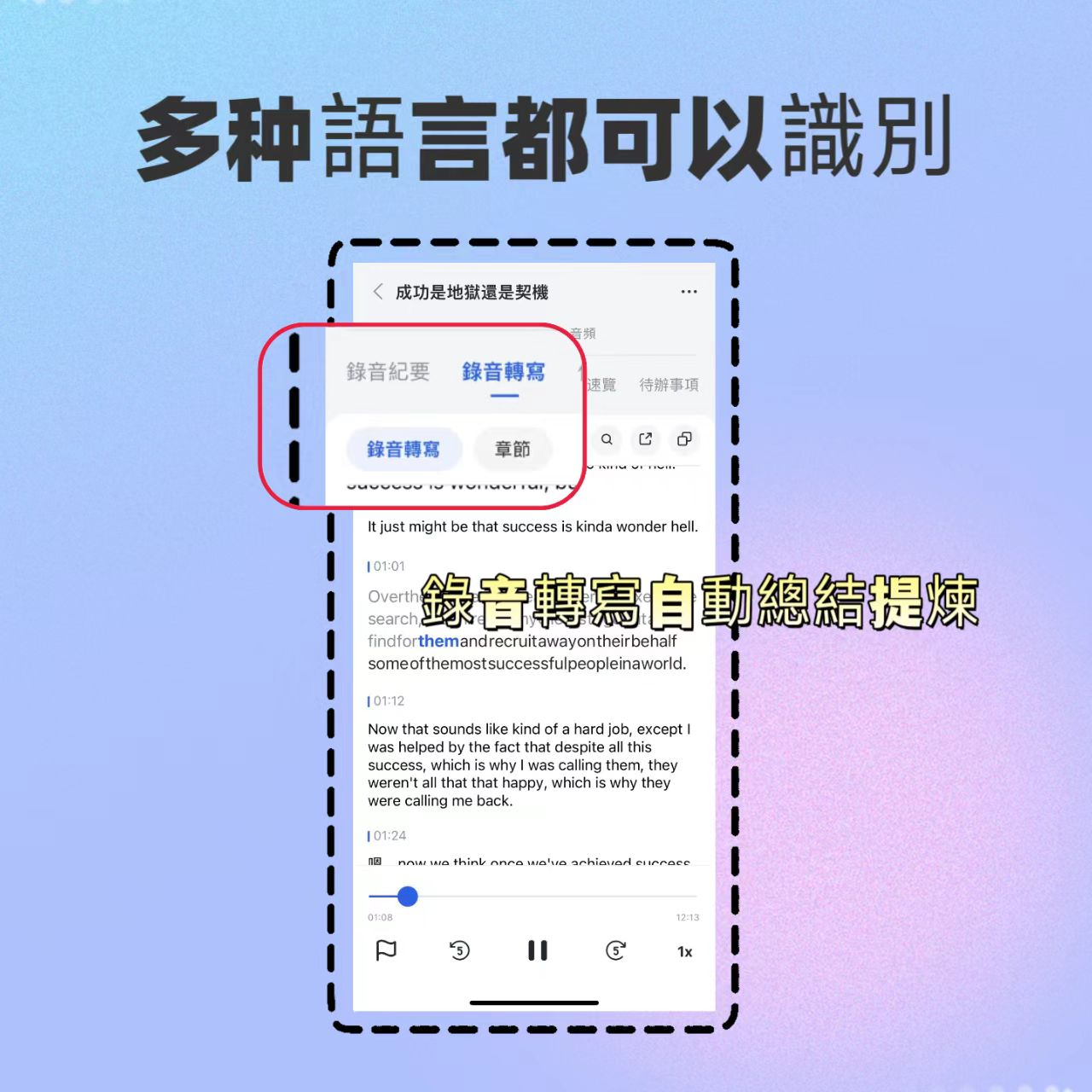
In real tests, even with fast-paced Cantonese conversations or English proper nouns thrown in, Tinrec maintained high recognition accuracy, converting speech to text on-screen in real time. This is very useful for cross-border meetings or foreign language learners.
2. Beyond Transcription: Auto-Generates Meeting Minutes & Action Items
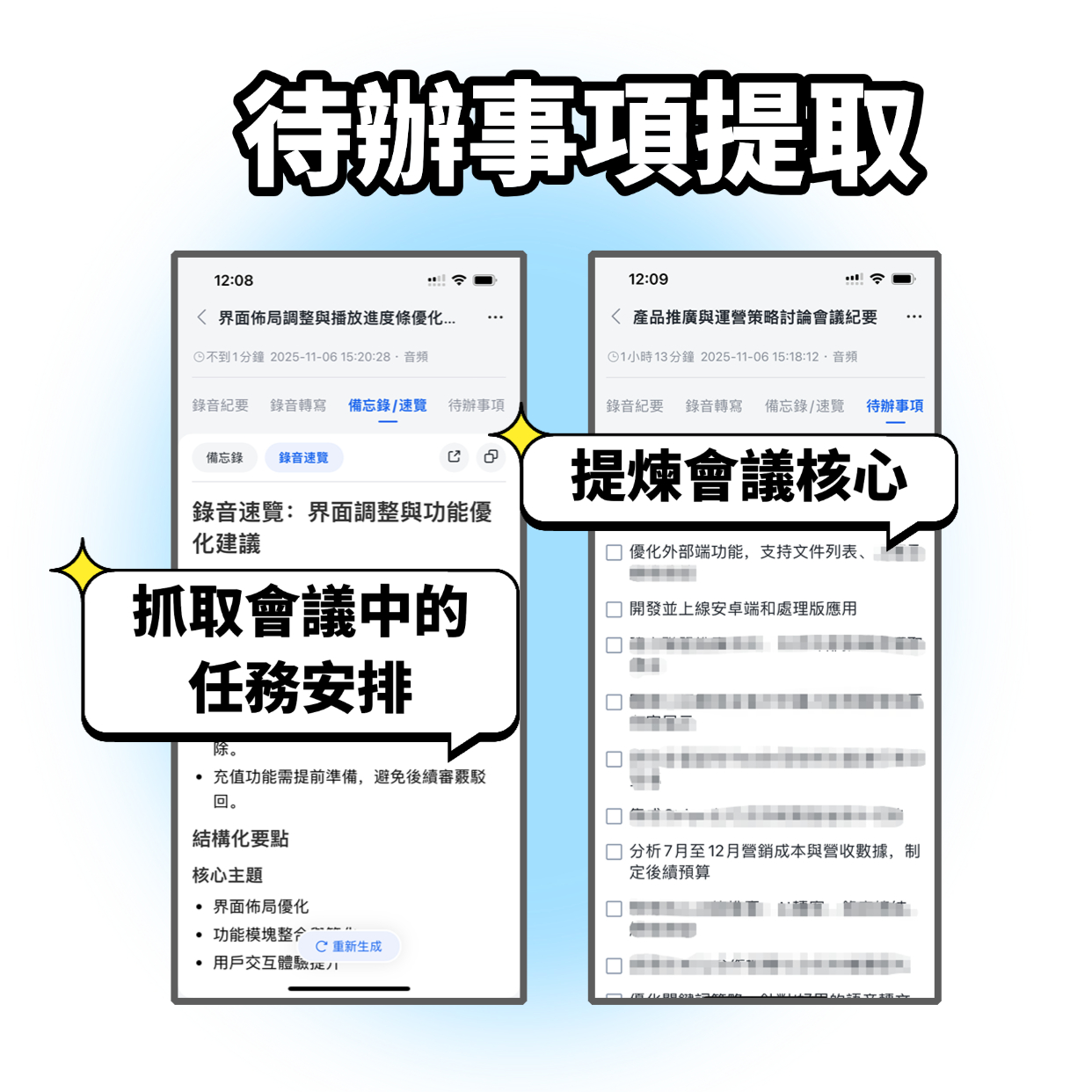
This is the biggest difference between Tinrec and traditional transcript tools. Transcripts often run thousands of words and are tiring to read. After recording, Tinrec uses AI to analyze the entire content and automatically extract:
- Summary: Quick grasp of what the meeting covered.
- Action Items: Automatically captures who promised to do what.
- Key Decisions: Marks important conclusions.
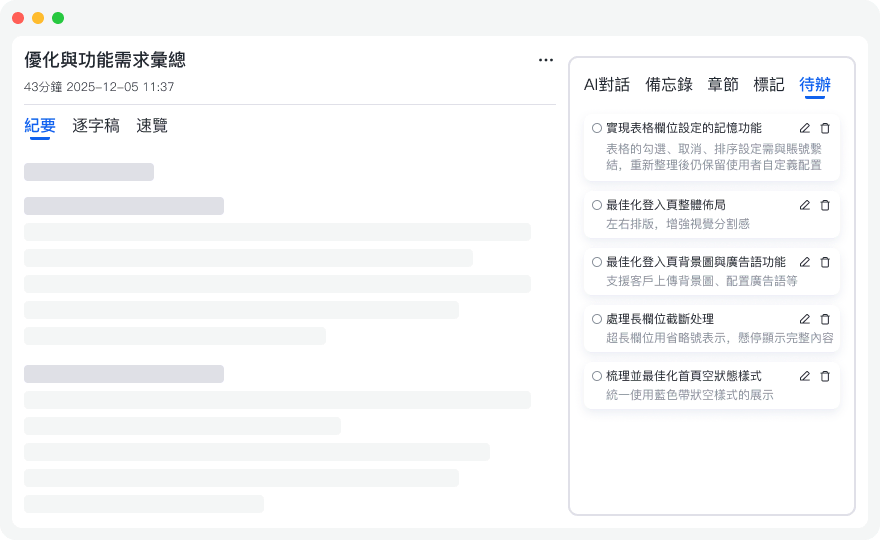
This transforms recordings from "dead data" into "actionable checklists," drastically reducing post-meeting note-taking time.
3. Pioneering AI Chat Search: Find Answers by Asking
Traditional recordings require scrubbing through progress bars, and transcripts only allow keyword search (Ctrl+F). But sometimes we forget specific keywords and only remember the gist. Tinrec has a built-in AI Chat Search function, allowing you to ask in natural language:
- "What was the conclusion about the budget in this meeting?"
- "What marketing suggestions did David mention in the meeting?"
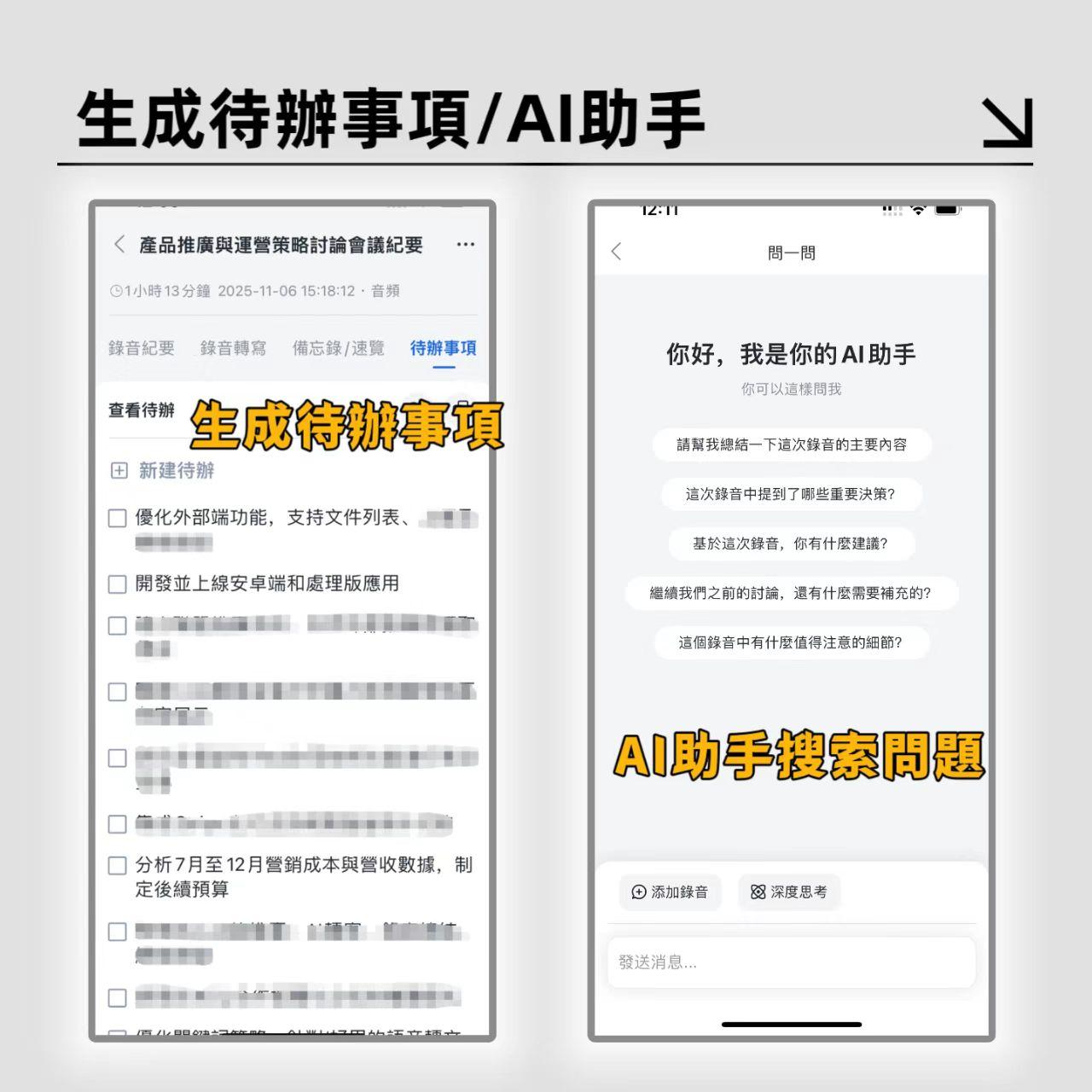
AI will answer based on the recording content, giving you an assistant with a photographic memory to recall key points anytime.
4. Speaker Differentiation & Multi-Device Sync
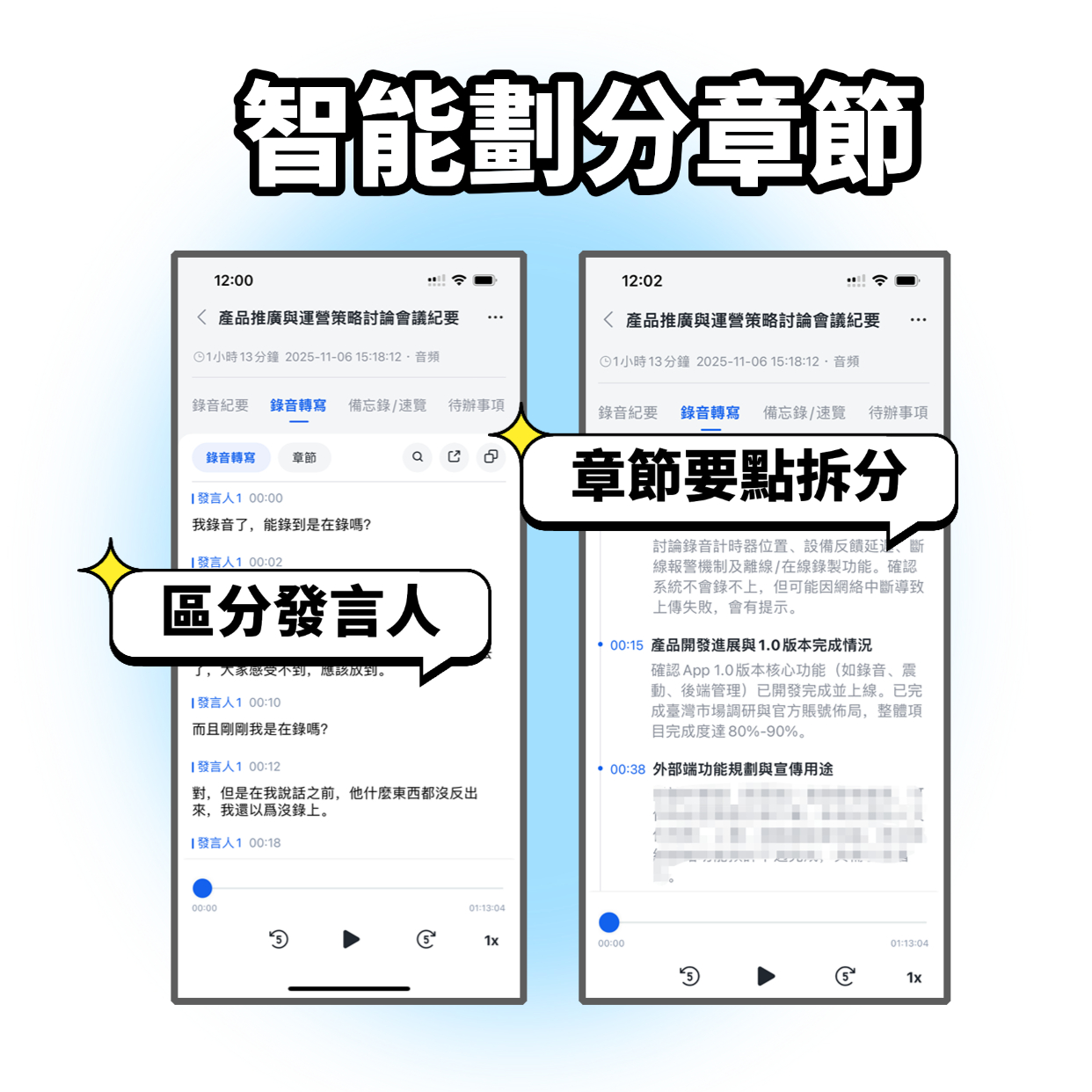
In multi-person meetings, Tinrec can automatically differentiate speakers and segment the content, making the transcript read like a script rather than a wall of text. Additionally, it supports sync across iOS, Android, and web—record on your phone, then continue editing, exporting, or sharing on the web via computer.
Hands-On Tutorial: How to Quickly Organize a Cantonese Meeting with AI
Below, using Tinrec as an example, we show how to quickly turn a Cantonese meeting into usable text:
Step 1: Start Live Recording or Import a File
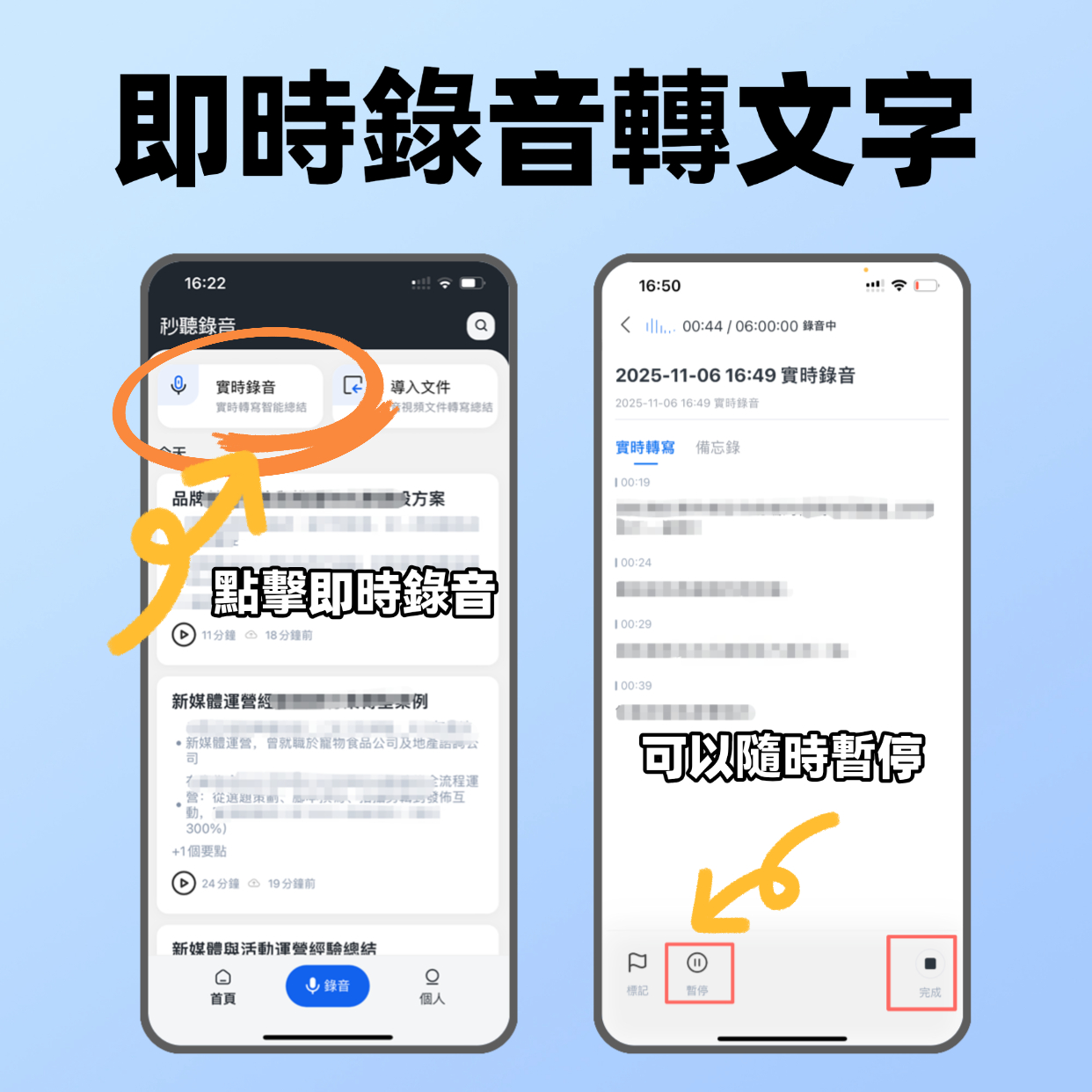
- Live meeting: Open the app or web version, select "Record & Real-time Transcription," ensure language includes "Cantonese." Tap start recording, and see text appear on screen in real time.
- Existing file: If you already have an audio or video file, use the "Audio File Transcription" feature to upload directly; even a YouTube video link can be processed via the "Podcast/Online Video Transcription" feature.
Step 2: Mark Key Points in Real Time
During recording, if you hear important content, tap the flag button on the interface to quickly locate that point during review without re-listening to the entire irrelevant part.
Step 3: Generate AI Summary & Action Items
After recording ends, the system automatically processes transcription. Click the "AI Notes" or "Summary" tab to check the auto-generated meeting minutes and to-do items. You can manually tweak these to ensure 100% accuracy.
Step 4: Review Using AI Chat
When writing a detailed report, use the AI chat box in the bottom-right corner and ask: "Please summarize the discussion on product launch timeline." The AI will extract the essence from the lengthy content.
Step 5: Export & Share
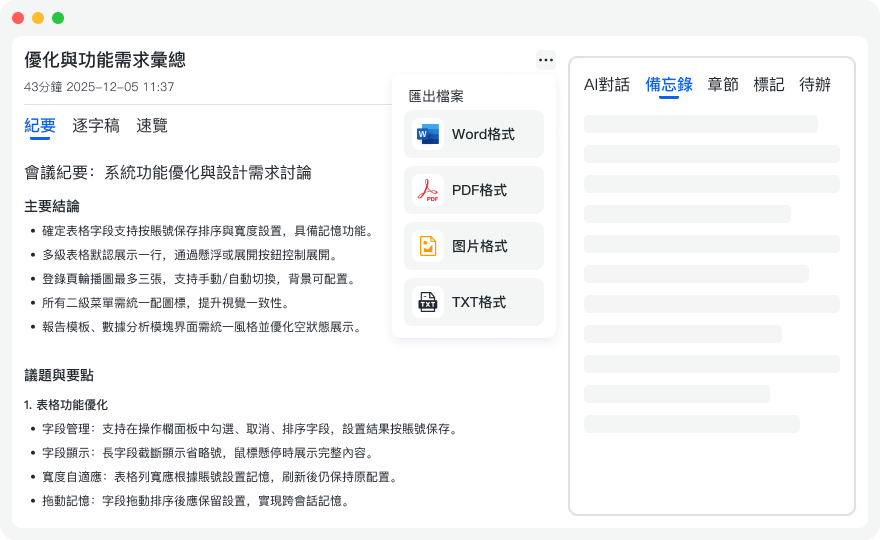
After confirming accuracy, export the transcript or summary as PDF, Word, or plain text, and send directly to team members or save to note-taking apps like Notion.
Frequently Asked Questions (FAQ)
Q1: Does Tinrec support iPhone and Android? Yes, Tinrec supports multi-device sync across iOS App, Android App, and Web version, with account data shared across platforms.
Q2: Is this software free? Tinrec offers a free plan with 100 minutes of transcription per month. For higher usage, choose Basic ($4.9/month, 600 minutes) or Pro ($8.25/month, 1200 minutes).
Q3: Can it recognize Cantonese mixed with English (Chinglish)? Yes. Tinrec's model is trained on multilingual data, providing better recognition for mixed Chinese-English content compared to traditional single-language engines, reducing the chance of garbled characters.
Q4: Can I upload pre-recorded MP3 or video files? Yes. Besides live recording, you can upload audio files (MP3, M4A, WAV, etc.) and video files for transcription, and even parse YouTube links.
Q5: Can the generated transcript be edited? Yes. You can edit the recognition results, modify speaker names, and re-export on both the web and app.
Q6: How does it handle long meetings (e.g., over 2 hours)? Tinrec is designed for long recordings, supporting stable recording and transcription for extended periods. Through "Chapter Splitting" and "AI Summary" features, users avoid facing a wall of text and can quickly grasp the key points of lengthy meetings.
Choosing the right Cantonese speech-to-text tool can dramatically improve your work efficiency. No longer chained to manual transcription, let Tinrec handle the "recording" and "organizing" so you can spend your valuable time on "thinking" and "deciding."
Turn every recording into actionable outcomes
Get 60 free transcription minutes when you sign in. No credit card required.
Related Reading
You might also like

5 AI Post-Meeting Follow-Up Email Tools Compared: Which Workflow Actually Saves Time?
Meeting's over, but the notes aren't organized and the follow-up email hasn't been sent. This article breaks down the two approaches to AI-generated post-meeting follow-up emails—Gmail generation plugins and automated trigger workflows—across 5 dimensions, with ready-to-use prompt formulas and implementation steps to help you decide which method truly saves wrap-up time.

Tinrec vs Otter.ai 2026: 5-Dimension Comparison — Which Free Meeting Minutes Template Works Better?
How do you find free meeting minutes templates? This article compares Tinrec and Otter.ai across 5 dimensions — Chinese-language minutes and table output, free plan entry points, bot-free online meeting recording, post-meeting follow-up and output, and team data retention — to help you decide which one fits your meeting scenario better.

2026 Comparison of 3 Project Meeting Task List Templates: Which Saves the Most Time Without Missing Key Points?
After a project meeting ends, the task list is where the real work begins. This article breaks down the essential fields of a good project meeting task list template and tests Notta, Granola, PLAUD, and Tinrec in real scenarios for meeting notes, action item extraction, and team handoff, helping professionals choose the most time-saving approach that doesn't miss key points.
2026 Comparison of 2 Automatic Meeting Summary Report Generators: Tinrec vs Otter — Which Better Auto-Generates Action Minutes?
Automatic meeting summary report generation isn't just about feeding a recording into AI. This article compares Tinrec and Otter across dimensions—Chinese meetings, bot-free recording, post-meeting outputs, and team knowledge retention—to help you decide which tool better produces usable meeting reports automatically.
Meeting Minutes vs. Meeting Reports in 2026: 3 Key Differences and How to Write Each One
Confused about meeting minutes, meeting reports, and meeting notes? This article breaks down the differences using 3 key criteria, explains when to submit minutes versus a report, and tests how the AI meeting tool Tinrec generates summaries, action items, and reports from a transcript. It also includes selection advice and pitfalls to avoid for Otter.ai and Notta.
2026 Comparison of 3 Meeting Notes to PRD Tools: Which One Turns Transcripts into Developer-Ready Requirement Docs?
The meeting is over—now the pain begins. This article starts from the real struggles product managers face when writing PRDs, breaks down 4 key points for turning meeting notes into requirement documents, tests Tinrec's performance in bot-free recording, AI follow-up questions, and team knowledge retention, and compares use cases for Otter.ai, Notta, and Granola. Includes two copy-paste prompt templates.
How to Choose a Meeting Agent Tool in 2026: 5 Steps to Compare Tinrec and Top Alternatives
How do you choose a meeting agent tool? This guide walks you through 5 steps—meeting format, capture method, post-meeting output, team governance, and pricing logic—using Tinrec and Notta as examples to explain why more teams are focusing on post-meeting organization and data retention.
2026 Free Meeting Minutes Table Generation Tools: 4 Options Reviewed
2026 free meeting minutes table generation tools reviewed: hands-on testing of Tinrec, Otter.ai, Notta, and TurboScribe. From Chinese meeting transcription, automatic table and to-do generation, bot-free recording to team collaboration, learn how to pick the right tool and stop typing meeting notes overtime.
4 Free Meeting Action Item Table Generators in 2026: A Complete Review
We tested four free tools that automatically generate meeting action item tables in 2026: Tinrec, Otter, Notta, and Fireflies. Find out which one saves students and teams the most time.