
Turn recordings into transcripts and summaries in minutes
Upload audio or video for multilingual transcription, AI notes, and action items
Facing a one-hour Cantonese interview recording or meeting notes and still manually pausing, typing, and replaying? Not only is it inefficient, but it’s also frustrating when encountering Cantonese-English code-mixing (Chinglish) or background noise. For content creators, administrative staff, or students, choosing an AI tool that accurately recognizes Cantonese can save you hours of time.
This article provides an in-depth review of popular Cantonese AI transcription tools on the market, including accuracy data, feature comparison tables, and hands-on tutorials. If you're a video creator who values converting spoken Cantonese into written subtitles, Subanana performs excellently. If you're a professional or learner who needs meeting minutes and action items, Tinrec (Miao Ting Recorder) is a powerful productivity candidate. For a completely free option, consider pyTranscriber.
Why is Cantonese speech-to-text so difficult?
Cantonese ASR technology has always been more challenging than Mandarin or English, mainly due to two obstacles:
- Cantonese-English code-mixing (Chinglish): In Hong Kong workplaces and daily conversations, English words are often mixed in (e.g., "What's the schedule today?"). Many single-language model AIs fail to handle this correctly.
- Spoken vs. written Cantonese: Recordings often use spoken Cantonese (e.g., "hai6 m4 hai6"), but formal documents or subtitles need written Cantonese (e.g., "si4 m4 si4"). Most tools only do verbatim transcription, leaving heavy post-editing work.
Therefore, when choosing a tool, don't just look at "transcription"—consider its ability to handle mixed languages and its efficiency in post-processing.
2026 Review: 6 Selected Cantonese AI Transcription Tools
We’ve compiled the latest test data and features for a side-by-side comparison to help you decide quickly.
Tool Specifications & Use Case Comparison Table
| Tool Name | Core Purpose | Cantonese Mixed Recognition | Written Form Conversion | Pricing Model | Best For |
|---|---|---|---|---|---|
| Subanana | Video subtitles | ⭐⭐⭐ (Excellent) | Yes (Unique) | Free / Paid | Subtitle groups, YouTubers |
| Tinrec | Meeting/study productivity | ⭐⭐ (High) | Auto summary | Free / Subscription | Office workers, students, meeting minutes |
| Premiere Pro | Professional editing | ⭐⭐ (Medium) | No | Subscription | Professional video editors |
| Taption | Online subtitle editing | ⭐ (Average) | No | Free trial | Lightweight video creators |
| ArcTime | Cross-platform subtitle software | ⭐⭐ (Medium) | No | Credit system | Users needing subtitle effects |
| pyTranscriber | Open-source transcription | ⭐ (Average) | No | Completely free | Tech-savvy users, budget-conscious |
1. Subanana: Top Choice for Video Creators
According to test data, Subanana achieves up to 97.5% accuracy in Cantonese-English code-mixing scenarios and is one of the few tools that can directly convert spoken Cantonese into written Cantonese. It can automatically correct certain brand names, significantly reducing subtitle proofing time, making it ideal for Hong Kong creators producing high-quality subtitles.
2. Tinrec (Miao Ting Recorder): Smart Assistant for Meetings & Learning
Unlike pure subtitle tools, Tinrec is designed for "recording to action." It supports recognition of 10 languages including Cantonese and can transcribe in real time while recording. Its core advantage is that after processing, the AI automatically generates meeting minutes and action items, allowing users to grasp key points without replaying the entire recording. For users who need to organize lecture notes or international meeting records, it's a comprehensive solution combining transcription and understanding.
Stop organizing recordings by hand
Upload audio or video and automatically get a transcript, summary, and action items
3. Adobe Premiere Pro: Built-in Convenience for Editors
As an industry standard, Pr's built-in speech-to-text is most convenient for editors—no need to switch software. However, its recognition rate for code-mixing is about 89.4% and it is sensitive to background noise, making it suitable for professional users already in the Adobe ecosystem.

4. pyTranscriber: Open-Source Solution for Budget-Conscious Users
This software, based on the Google Speech Recognition API, is completely free. Although installation is a bit technical and the interface is basic, its recognition in quiet environments is acceptable. It's suitable for users who don't mind spending time on proofreading and want zero cost.
Deep Dive: From Verbatim Transcript to AI-Driven Decisions
Many people fall into the trap of thinking "any text output is fine." In reality, unorganized verbatim transcripts have very low information density and are tiring to read. That's exactly what new AI note-taking tools like Tinrec aim to solve.
- Traditional tools (e.g., pyTranscriber): Give you a big wall of text; you have to read from start to finish and manually highlight key points.
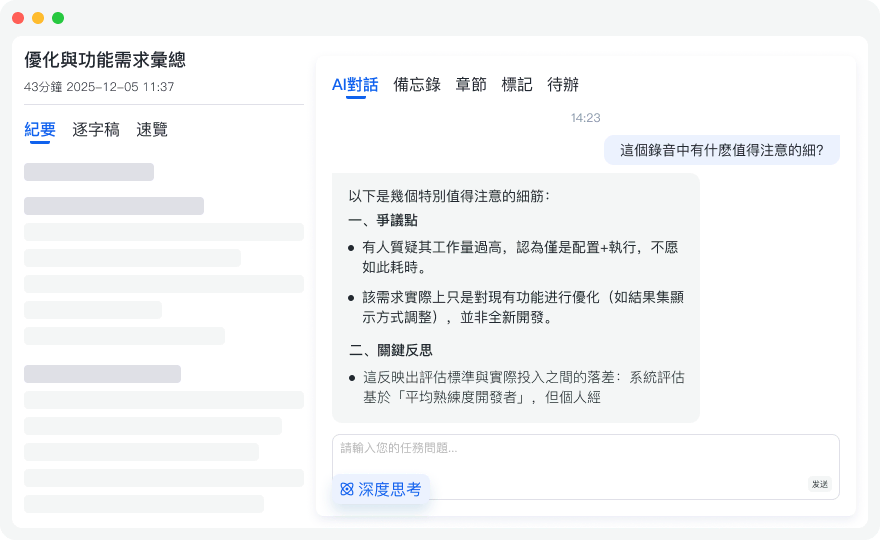
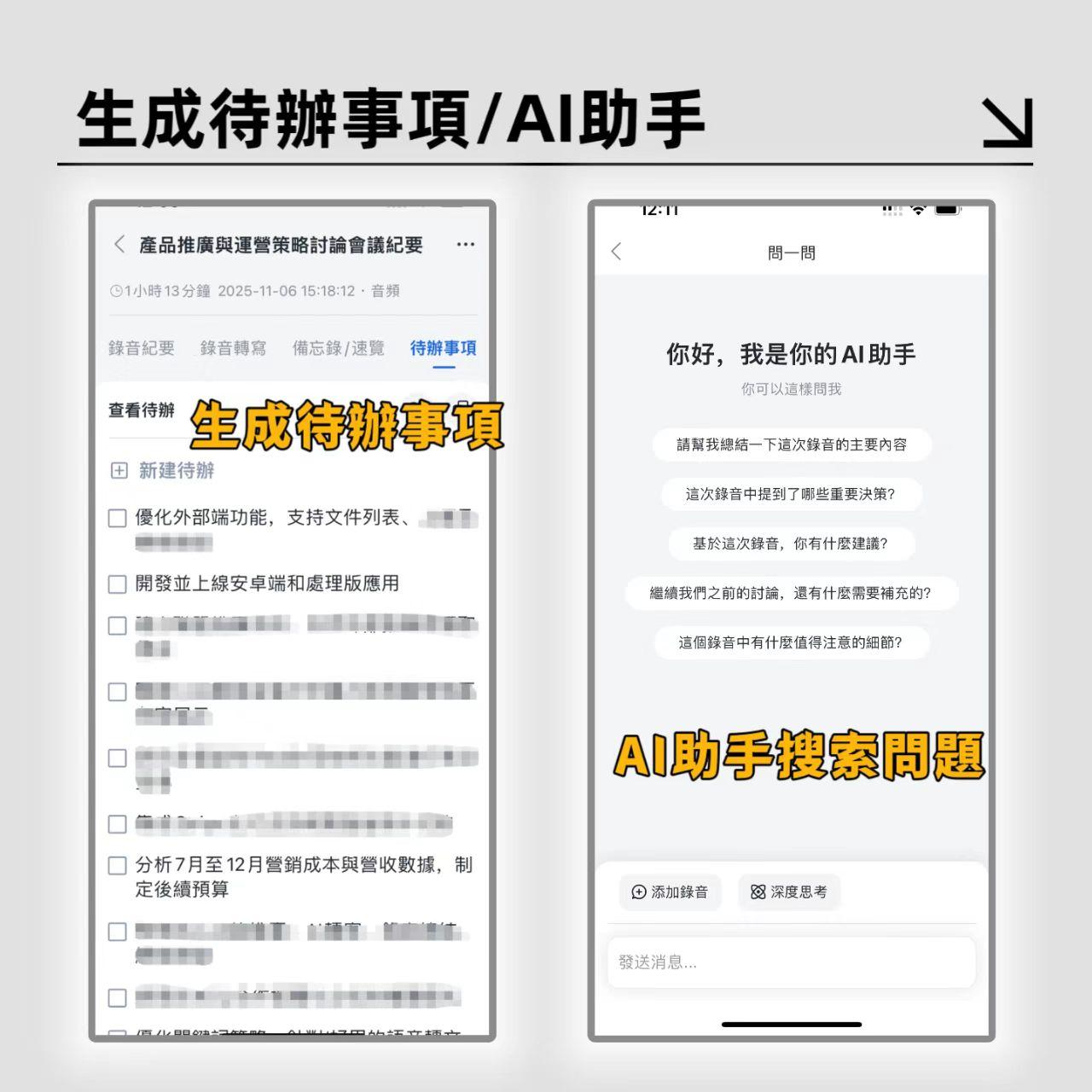
- AI note-taking tools (e.g., Tinrec): Emphasize "AI understanding" beyond transcription. For example, its AI chat query feature lets you ask questions about the recording like talking to a person (e.g., "When is the budget deadline mentioned in the meeting?"), and the system answers based on semantic understanding, saving you from Ctrl+F searching.
Hands-On Tutorial: How to Quickly Organize Cantonese Recordings & Videos with AI
Using Tinrec's workflow as an example, we show how to turn messy audio into actionable notes.
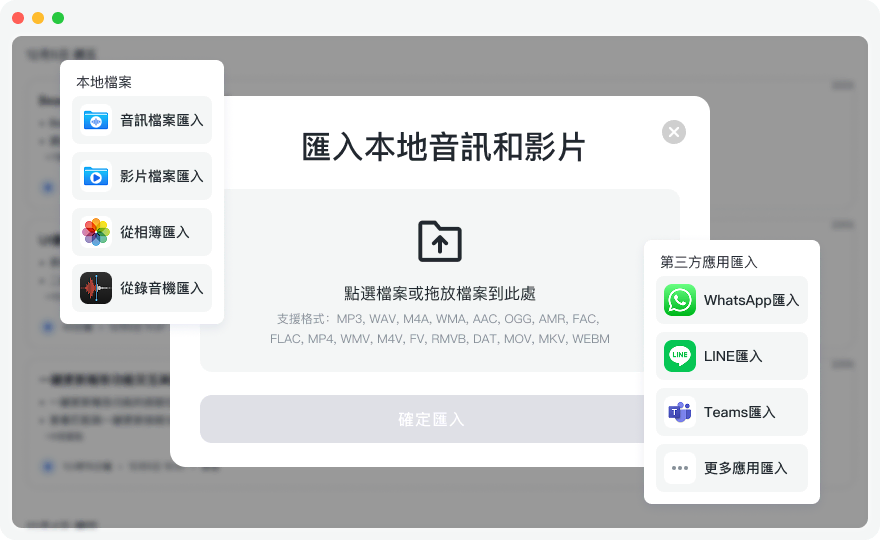
Step 1: Choose Recording Source
Depending on your scenario, Tinrec offers three entry points:
- Live meeting/class: Use the mobile or web version to start real-time transcription, watching text appear as you record.
- Existing files: If you already have an .mp3 or .m4a file, directly import it via "Import Audio/Video File."
- Online videos: To transcribe a Cantonese interview or tutorial on YouTube, just paste the link and let the system parse it.
Step 2: AI Transcription & Speaker Diarization
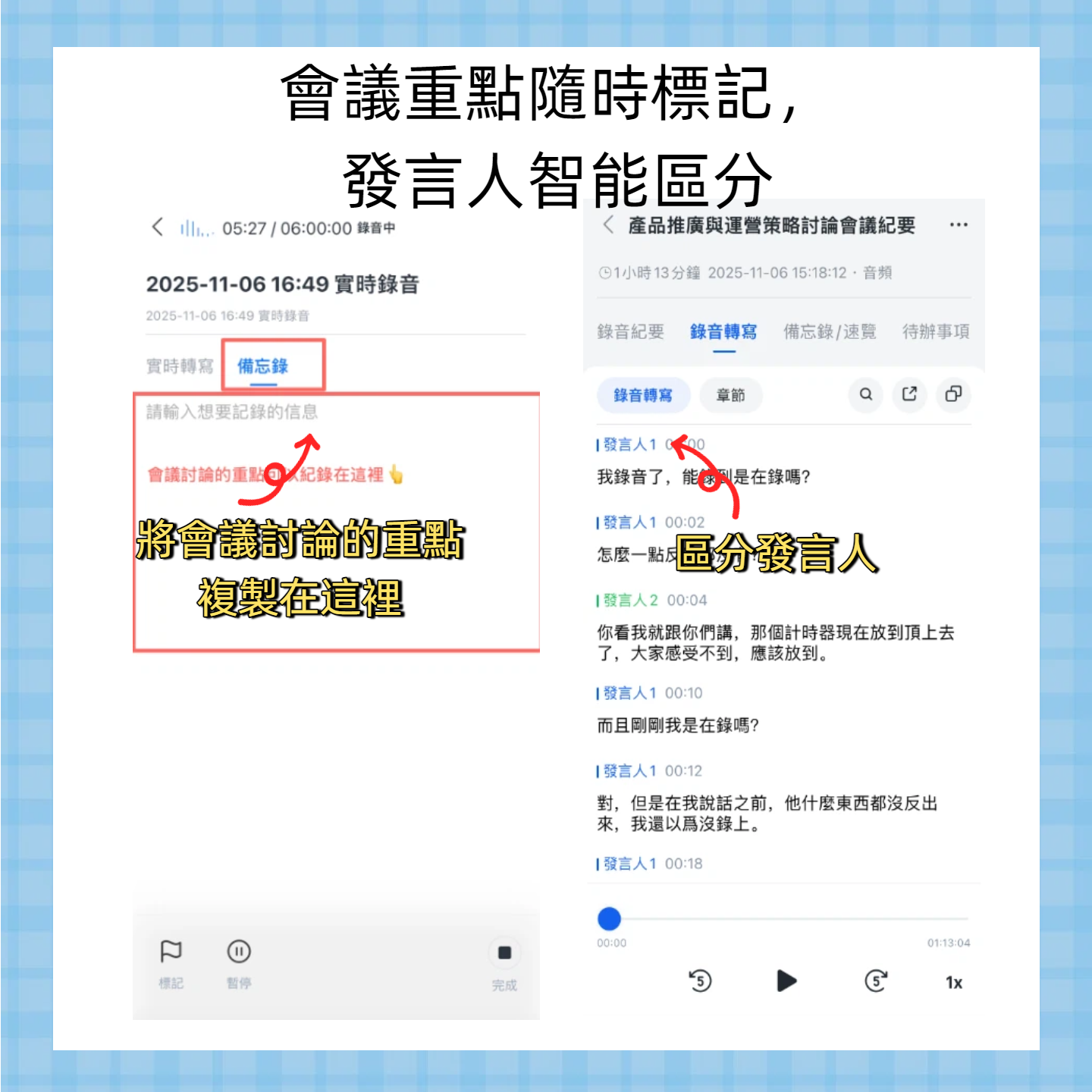
After uploading, the system automatically transcribes speech to text. For multi-speaker meetings, Tinrec supports voiceprint recognition to automatically differentiate speakers (Speaker Diarization), making the conversation record clearer and avoiding confusion over who said what.

Step 3: Generate Summary & Action Items
This is the most critical step. Instead of spending time re-reading tens of thousands of words, directly view the AI-generated "Meeting Minutes" and "Action Items." This summary condenses lengthy conversations into bullet-point conclusions, making it easy for post-meeting follow-up or exam revision.
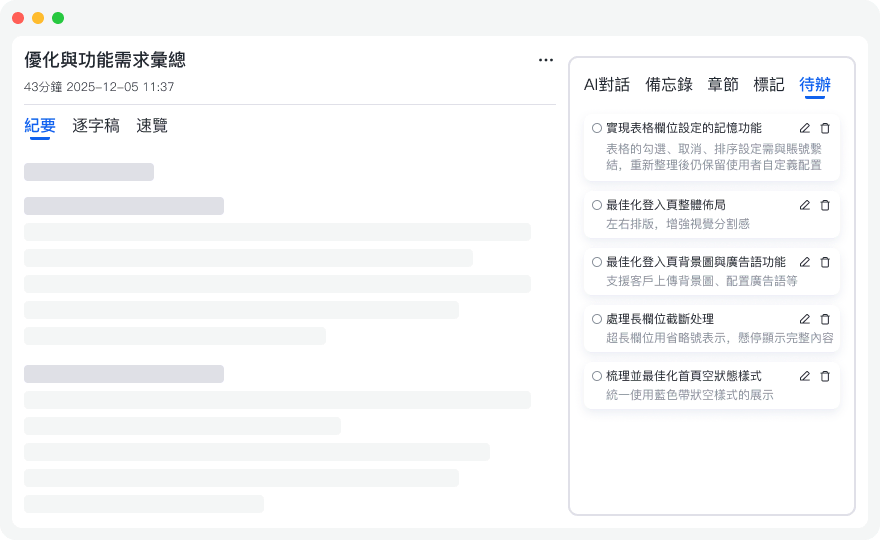
Step 4: AI Interactive Query
If the summary misses details, use the AI chatbox on the right to ask questions about the recording. For example: "What was the client's specific feedback on product pricing?" The AI will backtrack through the recording and summarize for you.
Frequently Asked Questions (FAQ)
Q1: Which tool is best for handling Hong Kong-style spoken subtitles? If you need to convert spoken Cantonese (e.g., "hai6 ge3") to written Cantonese (e.g., "hai4 dik1") for subtitles, Subanana is the best choice—its accuracy and conversion logic are designed for this pain point.
Q2: Do these tools support mobile use? Most professional software (e.g., Premiere, ArcTime) require desktop versions. However, Tinrec and Taption support cross-platform use. Tinrec offers iOS and Android apps, suitable for businesspeople and students who need to record anytime, anywhere.
Q3: Do these tools have free tiers? Yes. pyTranscriber is completely free (but needs manual installation). Subanana and Tinrec offer free trial credits (Tinrec free plan provides 100 minutes of recording per month), allowing lightweight users to test them out.
Q4: Can I directly convert a YouTube link to text? Yes. Subanana, Taption, and Tinrec all support this. It's very useful for transcribing podcast interviews or online courses without downloading the video file.
Q5: Can AI still recognize speech in a noisy environment? Background noise significantly affects accuracy. According to tests, Subanana performs better in noise resistance. For Tinrec, it's recommended to stay close to the audio source or use a directional microphone for more accurate meeting minutes and summaries.
Q6: Is the generated data secure? For enterprise users, data privacy is crucial. Choose services with clear privacy policies. Tinrec uses encrypted transmission technology and allows users to delete their data, ensuring meeting content stays confidential.
Turn every recording into actionable outcomes
Get 60 free transcription minutes when you sign in. No credit card required.
Related Reading
You might also like

2026 Comparison of 4 Meeting Transcription Tools: Who Does Permission Management Best?
Who should see meeting notes? This article examines four key points—roles and seats, team-level sharing, data ownership after member departure—and compares the permission management designs of Tinrec, Otter.ai, Fireflies.ai, and Granola, plus four common pitfalls to help you think clearly before adoption.

2026 Comparison of 4 Tencent Meeting AI Notes Alternatives: Which Handles Bot-Free Recording and Post-Meeting Q&A Best?
Tencent Meeting's built-in AI notes are sufficient for single-platform users, but when meetings span Zoom, Meet, and Teams, or when you need to process client-sent audio files, the issue isn't accuracy—it's whether the tool can handle all your sources. This article uses the same set of meeting materials to test four approaches, comparing input sources, recording methods, post-meeting Q&A, and team data retention, and highlights the three most common mistakes when choosing a tool.

2026 Tinrec Meeting Data Governance Tutorial: Bot-Free Recording + Team Data Retention
After the meeting ends, does the data really stay? This article starts from the decision-making focus of 'meeting data governance,' guiding you through four key decision points. It tests Tinrec's bot-free recording, AI Q&A, and team space, compares the applicable scenarios of Otter.ai, Notta, and Granola, and includes a pitfall avoidance guide and a quick-start checklist.

Tinrec Personal vs Team Space: What's the Difference? 2026 Comparison
What's the difference between Tinrec Personal and Team Space? This article compares data ownership, sharing permissions, member seats, usage governance, and real-world scenarios to help you decide whether to use Personal or Team.

Tinrec vs Notta 2026: 5-Factor Comparison for Enterprise Meeting Data Management
Enterprise meeting data is scattered across recordings, chat rooms, and personal laptops. Which tool should you choose to centralize management? This article compares Tinrec and Notta across 5 key purchasing dimensions, with brief reviews of Otter.ai and Granola, to help you find the best solution for your team's meeting assets.

2026 AI Meeting Agent Guide: How Tinrec Turns Meetings into Searchable, Actionable Data
A hands-on guide to AI meeting agents for college students. It starts with common pitfalls, explains why meeting bots or transcripts alone aren't enough, and compares Tinrec with Otter, Notta, and Granola on meeting capture, Chinese recognition, AI Q&A, recording retention, and free tiers. It also covers practical uses for lectures, group discussions, project interviews, and internship meetings.

2026 Comparison of 4 Meeting Notes Tools: Which One Has the Best Team Audit Logs?
From team audit logs and seat management to Chinese meeting transcription, we compare Tinrec, Otter, Fireflies, and Notta to help you find the best meeting notes tool for team governance.
2026 Comparison of 4 Meeting Data Sharing and Governance Tools: Which One Can Truly Turn Meetings into Team Assets?
Sharing meeting data is not the same as governing it. This article starts with the most common sharing pitfalls teams encounter, outlines four key purchasing criteria: data ownership, roles and seats, post-meeting outputs, and retention and recovery. It tests Tinrec and compares it with Otter.ai, Notta, and PLAUD to help you determine which tool can truly turn meetings into usable team data.

2026 Meeting Audio Recycle Bin Guide: Recover Deleted Recordings Within 30 Days + Handover When Team Members Leave
Can deleted meeting recordings really be recovered? This guide starts with three common misconceptions, explains how a meeting audio recycle bin works, retention periods, and team data handover considerations. It also compares Tinrec, Granola, Otter.ai, and PLAUD in terms of audio file retention and post-meeting organization, with 4 key buying tips to avoid pitfalls.