
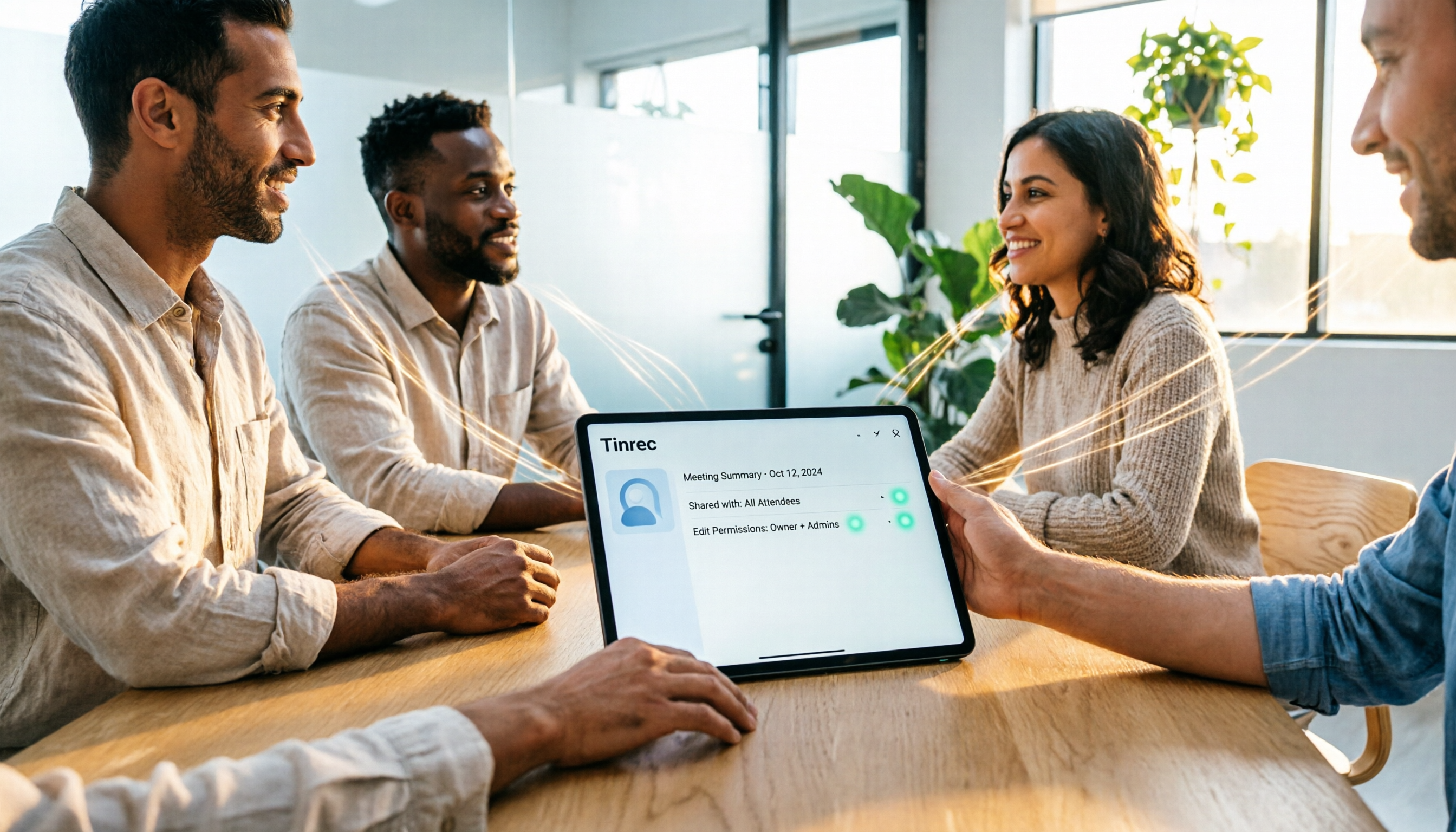
Turn recordings into transcripts and summaries in minutes
Upload audio or video for multilingual transcription, AI notes, and action items
Who should see meeting notes? Many teams only think about this after adopting a tool.
By the time you discover that a new colleague can see salary review meetings from two years ago, or that a former employee took customer interview recordings with them, it's usually too late.
This article doesn't discuss transcription accuracy; it focuses on the most easily overlooked yet hardest-to-fix aspect: permission management for meeting notes. I'll use the same criteria to compare several common tools and finally tell you which one is most complete in "keeping things under control."
Meeting Note Permission Management: What You're Choosing Isn't a Feature, It's "Who's Responsible When Things Go Wrong"
Let me start with three situations I've actually heard about.
First: All company meeting notes are stored in a single cloud folder—HR meetings, client quotes, product pricing all mixed together, just because "setting permissions is too troublesome."
Second: Meeting recordings are stored in personal accounts. When the person in charge leaves, three years of meeting data disappears with them.
Third: The company bought the enterprise version but discovered that "members" and "seats" are two different things. Some people can't upload at all, while others can delete a whole year's recordings.
These are not transcription quality issues; they are permission design issues.
Meeting notes are special—they contain both the collaborative value of "everyone needs to see" and the governance need of "not everyone should see." If you only look at transcription accuracy when choosing a tool, you're only evaluating half the picture.
Before Choosing a Meeting Note Tool, Understand These 4 Permission Key Points
1. Roles and seats are not the same thing
Many tools only give you two identities: "admin/member," but in practice you need to handle two things separately: who can manage the team (role) and who can use resources (seat).
This distinction is important. In the same team, some people only need to read historical meeting notes and don't need recording, uploading, or editing permissions. If the tool can't separate "view" from "use," you can only open everything or close everything.
2. Is it team-level sharing or document-level permissions?
This is the most easily confused point by marketing talk.
Some tools advertise "permission management," but actually do team-level sharing—as long as you're an active member, you can see all team data, and governance actions are controlled by roles.
True document-level ACL (setting who can see each document individually) is another matter. Most teams don't actually need it, but you need to know which one you're buying to avoid wrong expectations.
3. After a member leaves, who owns the data?
If meeting data is tied to personal accounts, personnel turnover means data loss.
A more reasonable design is: data belongs to the team. When a member exits or is removed, the resources they were responsible for are transferred to other active members, rather than letting data get stuck in a deactivated account.
4. Is anyone using it? Has anyone touched it?
The most common problem after purchase is: you bought 20 seats, but only 3 people actually use them.
If the tool can show team usage trends and member usage details, you can adjust before renewal. Similarly, if important operations have audit logs to check, disputes can be clarified.
These four points are also the main criteria I used in this hands-on test.
Tinrec – We Actually Tried It, the Most Complete Permission Management
Tinrec is an AI meeting note and collaboration tool for individuals and teams, supporting iOS, Android, desktop, and web. It doesn't just convert sound to text; it organizes meeting recordings into searchable, summarizable, queryable, and exportable team data.
The first difference I noticed when trying it was "no bot recording." The desktop version directly captures computer system audio, handling online meetings like Zoom, Google Meet, Microsoft Teams, Webex without inviting a meeting bot as a participant. For external client meetings, this is actually quite critical.
But what really made me include it in this recommendation is the team version's permission structure. It clearly separates "roles" and "seats": roles determine who can manage the team, members, audit, and team settings; seats determine whether members can record, upload, edit, import/export. Members without seats can still view, play, and read team data—this design is very practical for teams that "just want everyone to access historical meetings."
After running through a full cycle, here are a few features I'd particularly mention:
Stop organizing recordings by hand
Upload audio or video and automatically get a transcript, summary, and action items
Team space and resource handover. Meeting data belongs to the team, not the uploader. When a member exits, is removed, or loses their seat, the team resources they were responsible for can be handed over to other active members, avoiding the situation where data leaves with the person.
Usage analytics and audit logs. Administrators can see team usage trends, member rankings, and usage details, and can query, filter, and export important operation records. This saves a lot of time for those who need to justify budgets to upper management.
Audio recycle bin and team hotwords. Accidentally deleted audio can be restored before permanent cleanup begins; currently the recycle bin retention period is 30 days (TODO not in recycle bin scope). Team hotwords allow maintaining team-specific terminology, especially helpful for teams with many product names and project codes.
Pricing: Team version annual payment USD 199 per paid seat per year, about USD 16.58 per month; monthly payment USD 29.80 per paid seat per month. Eligible teams get a 7-day trial with 1 free seat and 300 minutes shared import quota. Paid seats provide 2,000 minutes shared import quota per seat per month; real-time recording under active team plans and active seats currently does not deduct minutes. Prices and benefits are subject to the official purchase page.
Limitations to note: Currently the team version is team-level sharing, not document-level ACL; you cannot set different access scopes for individual files. Also, if you only occasionally organize a recording, the personal version (free, weekly pass, Pro monthly, Pro annual) is enough; no need to buy team version for one person. Also, AI organization cannot guarantee 100% accuracy; for important content, it's recommended to cross-check with transcript timestamps and recording playback.
Who it's for: Departments or project teams that need Chinese meeting notes, don't want bots joining meetings, and want to turn meeting data into team assets.
Besides Tinrec, What Other Options Are There?
Otter.ai: A mature English AI meeting assistant. Basic free version has 300 minutes per month; team and enterprise capabilities are complete, and it also offers desktop capabilities. If your meetings are almost entirely in English, Otter is a reasonable choice. But if you need a Chinese meeting experience and governance details like team hotwords and audio recycle bin, Tinrec's corresponding design is closer to Chinese teams' usage habits.
Fireflies.ai: Strengths are meeting automation, meeting bots, AI summaries, and many third-party integrations. Annual Pro is USD 10 per seat per month; sales analytics and automation workflows are indeed mature. The difference is that Fireflies mainly joins meetings via bot, while Tinrec's desktop version doesn't need an extra participant; also Tinrec's team seat and resource handover mechanism is easier to handle in teams with frequent member turnover.
Granola: Also uses a no-bot approach, transcribing in real-time via desktop system audio and microphone. Business is USD 14 per user per month; its "user notes + AI enhancement" experience is good. But note that it does not save meeting audio and does not support uploading pre-recorded audio files. If you need to keep recordings, import historical files, or recover accidentally deleted data via recycle bin, Granola currently cannot do this.
Pitfall Guide: The 4 Most Common Mistakes When Choosing a Meeting Note Tool
Pitfall 1: Treating "all members can see" as permission management. Team-level sharing is convenient, but it's not fine-grained permission control. Before adoption, think clearly: are there any types of meetings (e.g., HR, salary, legal) that absolutely cannot be shared with the whole team? If so, you can't rely solely on team-level sharing.
Pitfall 2: Not distinguishing roles and seats first. Many people estimate by "headcount" when purchasing, resulting in buying a bunch of unused seats or too few so core members can't use them. First list "who manages, who records/uploads, who only reads," then calculate how many seats you need.
Pitfall 3: Never thinking about the day someone leaves. Meeting data tied to personal accounts is like putting company assets in a personal drawer. When choosing a tool, ask directly: after a member is removed, will data be automatically handed over?
Pitfall 4: Buying and then discovering no one uses it. Without usage data, you won't know if seats are wasted. Before annual renewal, you must have team usage and member details to compare.
Summary: Which One Should You Choose?
Back to the original question: Who should see meeting notes?
If you want a tool that clearly explains "who can manage, who can use, who can only view," I'd recommend trying Tinrec first.
- Need Chinese meeting notes + team data accumulation → Tinrec (team space, role and seat separation)
- Don't want meeting bots joining online meetings → Tinrec (desktop captures system audio)
- Team has people coming and going, don't want data leaving with them → Tinrec (resource handover and audio recycle bin)
- Need to justify budget, need usage and audit records → Tinrec (usage analytics and audit logs)
- Meetings almost entirely in English, team overseas → Otter.ai or Fireflies.ai
I suggest running a real meeting cycle with the team version's 7-day trial before deciding. 7 days, 1 free seat, 300 minutes shared import quota is enough to go through inviting members, assigning seats, and viewing usage. Decide after trying; no need to pay upfront.
References
- How to Hold an Effective Meeting | Jia Wei CPAs
- Attachment 3: Meeting Minutes of Condominium Owners (Format for Reference) 1. Meeting Time: Year Month Day Hour Minute
- Manage recording policies for Teams meetings and events - Microsoft Teams | Microsoft Learn
- [Knowledge Collaboration Column] 10 Easy Steps to Achieve a Paperless Meeting Process
- Manage recording and transcription options for Microsoft Teams meetings for sensitive meetings - Microsoft Teams | Microsoft Learn
Turn every recording into actionable outcomes
Get 60 free transcription minutes when you sign in. No credit card required.
Related Reading
You might also like

4 Best Audio-to-Text Tools for Chinese Meetings in 2026: Real-World Comparison
How to choose the right audio transcription tool? This article starts with common pitfalls, outlines 4 key buying factors, then compares Tinrec, Otter.ai, Granola, and TurboScribe in real-world tests for Chinese meeting transcription, bot-free recording, AI summary Q&A, and team data retention. It ends with a guide to avoid mistakes and recommendations based on your needs.
7 Best Free Audio-to-Text Transcription Tools in 2026: A Complete Comparison
Tired of spending hours transcribing meeting recordings? This guide reviews 7 free audio-to-text transcription solutions in 2026, comparing free tiers and paid pricing for Tinrec, MyEdit, cSubtitle, Otter.ai, Notta, TurboScribe, and Granola. Learn each tool's free limits, pricing, and ideal use cases to find the best fit for your transcription needs.

4 Meeting Transcription Tools Tested for 2026: Which One Actually Builds a Team Knowledge Base?
The real pain point with meeting notes isn't that nothing gets written down—it's that what's written down never gets used. Starting from real meeting scenarios, this article breaks down 4 key decision points for choosing a meeting transcription tool, compares Tinrec, Granola, Notta, and PLAUD in hands-on testing, and outlines the 3 most common buying mistakes, helping you turn scattered meeting content into a searchable, queryable, transferable team knowledge base.

2026 Comparison of 4 Tencent Meeting AI Notes Alternatives: Which Handles Bot-Free Recording and Post-Meeting Q&A Best?
Tencent Meeting's built-in AI notes are sufficient for single-platform users, but when meetings span Zoom, Meet, and Teams, or when you need to process client-sent audio files, the issue isn't accuracy—it's whether the tool can handle all your sources. This article uses the same set of meeting materials to test four approaches, comparing input sources, recording methods, post-meeting Q&A, and team data retention, and highlights the three most common mistakes when choosing a tool.

2026 Tinrec Meeting Data Governance Tutorial: Bot-Free Recording + Team Data Retention
After the meeting ends, does the data really stay? This article starts from the decision-making focus of 'meeting data governance,' guiding you through four key decision points. It tests Tinrec's bot-free recording, AI Q&A, and team space, compares the applicable scenarios of Otter.ai, Notta, and Granola, and includes a pitfall avoidance guide and a quick-start checklist.

Tinrec Personal vs Team Space: What's the Difference? 2026 Comparison
What's the difference between Tinrec Personal and Team Space? This article compares data ownership, sharing permissions, member seats, usage governance, and real-world scenarios to help you decide whether to use Personal or Team.

Tinrec vs Notta 2026: 5-Factor Comparison for Enterprise Meeting Data Management
Enterprise meeting data is scattered across recordings, chat rooms, and personal laptops. Which tool should you choose to centralize management? This article compares Tinrec and Notta across 5 key purchasing dimensions, with brief reviews of Otter.ai and Granola, to help you find the best solution for your team's meeting assets.

2026 AI Meeting Agent Guide: How Tinrec Turns Meetings into Searchable, Actionable Data
A hands-on guide to AI meeting agents for college students. It starts with common pitfalls, explains why meeting bots or transcripts alone aren't enough, and compares Tinrec with Otter, Notta, and Granola on meeting capture, Chinese recognition, AI Q&A, recording retention, and free tiers. It also covers practical uses for lectures, group discussions, project interviews, and internship meetings.

2026 Comparison of 4 Meeting Notes Tools: Which One Has the Best Team Audit Logs?
From team audit logs and seat management to Chinese meeting transcription, we compare Tinrec, Otter, Fireflies, and Notta to help you find the best meeting notes tool for team governance.