
Turn recordings into transcripts and summaries in minutes
Upload audio or video for multilingual transcription, AI notes, and action items
Facing hours of meeting recordings or lectures, have you ever felt overwhelmed? The most painful part is often not the "recording" itself, but the double time spent afterward re-listening and transcribing word for word, or even missing key decisions. Traditional voice recorders only save sound; they can't help you "understand" the information.
This article reviews 7 popular AI voice-to-text tools on the market in 2026, comparing them across dimensions like transcription accuracy, AI summary capabilities, language support, and cross-platform convenience. Whether you need highly accurate transcripts or want to query recording highlights as if having a "conversation," this article will give you clear recommendations.
Quick Navigation & Conclusion:
- If you prioritize high accuracy and multilingual translation: Consider iFlytek Hearing first.
- If your team deeply uses a specific office ecosystem: Go directly with Feishu Meeting Minutes or DingTalk Flash Notes.
- If you need "AI chat query" to quickly retrieve recording highlights: Tinrec and Tongyi Tingwu are worth noting; Tinrec focuses on converting recordings into actionable items.
Why Do You Need a Recording Tool with "AI Chat Query" Capabilities?
Traditional speech-to-text (STT) tools solved the pain of manual typing but created a new problem: reading through tens of thousands of words remains time-consuming. New-generation AI recording tools integrate LLM (large language model) capabilities to address the following pain points:
- Low information density: No need to re-listen to a 1-hour audio file; AI can generate a structured summary in under a minute.
- Difficult retrieval: Traditional tools rely on keyword search (Ctrl+F), while modern tools support "semantic querying." For example, you can ask the AI: "What exactly did the boss require for Q3 budget?" and get answers based on the recording content.
- Lack of actionability: After a meeting, AI automatically generates a to-do list that connects directly to your workflow.
In-Depth Review of Popular Voice-to-Text Tools in 2026
Based on market conditions and hands-on testing, here are the key features of several mainstream tools:
1. iFlytek Hearing: The Professional's Choice for Transcription
As an industry veteran, iFlytek Hearing has deep expertise in Chinese speech recognition.
- Core strengths: Official data shows accuracy up to 98%, stable even with accents or Southern Mandarin. Supports translation among 10 languages and dialects including Chinese, English, Japanese, and Cantonese.
- Best for: International meetings, media interviews demanding high accuracy, multilingual conversations.
- Drawbacks: Some advanced features require a paid subscription.
2. Feishu Meeting Minutes: Efficient Collaboration for Teams
Deeply integrated into the Feishu (Lark) office suite, this is a standard tool for many digital teams.
- Core strengths: Powerful "voiceprint recognition" automatically identifies speakers; generated meeting notes can be shared directly within the team, with intelligent key point summaries.
- Best for: Enterprise teams already using Feishu for daily work.
- Limitations: High entry barrier for non-Feishu users; features depend on the platform ecosystem.
3. Tongyi Tingwu: A Learning Assistant for Deep Analysis
Developed based on Alibaba Cloud Tongyi Qianwen LLM, it excels at handling long audio.
- Core strengths: Supports real-time captions and Chinese-English translation; after recording, extracts keywords, agenda, and action items. Great for academic discussions or strategy meetings.
- Best for: Students and researchers who need in-depth analysis of conversation content.
4. Tencent Meeting / DingTalk Flash Notes / WPS Office
These are "scenario-embedded" tools:
- Tencent Meeting: Convenient for turning on transcription during meetings, but features are basic.
- DingTalk Flash Notes: Powered by DAMO Academy technology, suitable for DingTalk ecosystem users; generates timestamped records.
- WPS Office: Good for occasional audio file processing in documents, but free version has limits.
Stop organizing recordings by hand
Upload audio or video and automatically get a transcript, summary, and action items
5. Tinrec: From Recording to Action with AI
Tinrec is a multi-device AI tool focused on converting "sound" into "actionable information," with an emphasis on efficient information retrieval after recording.
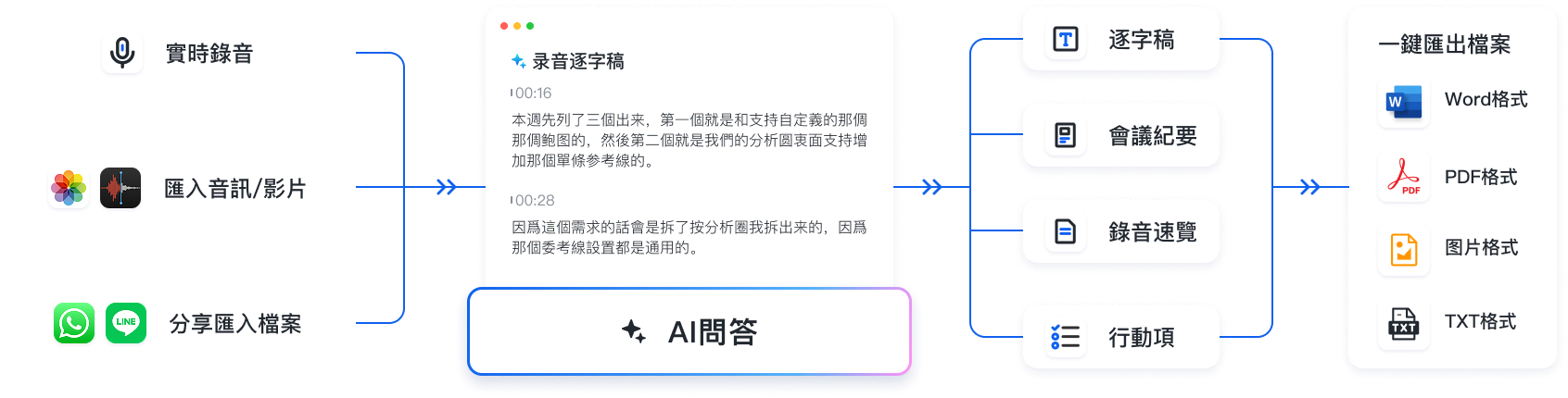
- Core features:
- AI Chat Query: This is the key solution highlighted in this article. Users don't need to browse the entire transcript; they can ask questions about the recording content as if speaking to a person, and the AI answers based on the facts.
- Multiple modes: Supports live recording, audio file upload, and even parsing YouTube/Podcast links into text notes.
- Multilingual recognition: Supports 10 languages including Chinese, English, Japanese, Korean, and Cantonese, suitable for language learning or international meetings.
Comparison Table: 7 AI Recording Tools
To help you choose more intuitively, here's a comparison across key dimensions:
| Dimension | Tinrec | iFlytek Hearing | Tongyi Tingwu | Feishu Meeting Minutes | Tencent/DingTalk | WPS Office |
|---|---|---|---|---|---|---|
| Core Focus | Full workflow: record/understand/act | Professional high-accuracy transcription | Deep analysis & learning | Team meeting collaboration | Meeting/office add-on | Document processing add-on |
| AI Chat Query | ✅ Yes (key feature) | ❌ (summary only) | ✅ Yes | ❌ (summary only) | ❌ | ❌ |
| Live Recording Transcription | ✅ Yes | ✅ Yes | ✅ Yes | ✅ Yes | ✅ Yes | ❌ (file upload only) |
| Language Support | 10 languages incl. CN/EN/JP/KR/Cantonese | Multiple languages & dialects | CN/EN/JP etc. | CN/EN/JP | CN/EN | Basic languages |
| Online Video to Text | ✅ Yes (YouTube/links) | File upload required | ✅ Yes (browser extension) | File upload required | ❌ | ❌ |
| Supported Devices | iOS, Android, Web | All platforms | All platforms | All platforms | All platforms | PC/Mobile |
| Free Tier | 100 minutes/month | Trial/paid mainly | Limited free/paid | With enterprise subscription | Basic features free | Membership restrictions |
Practical Tutorial: How to Quickly Extract Recording Highlights with AI
If you want to "use" recordings rather than just "save" them, here's a step-by-step guide using Tinrec as an example, showing how to leverage AI Chat Query to quickly capture key points:
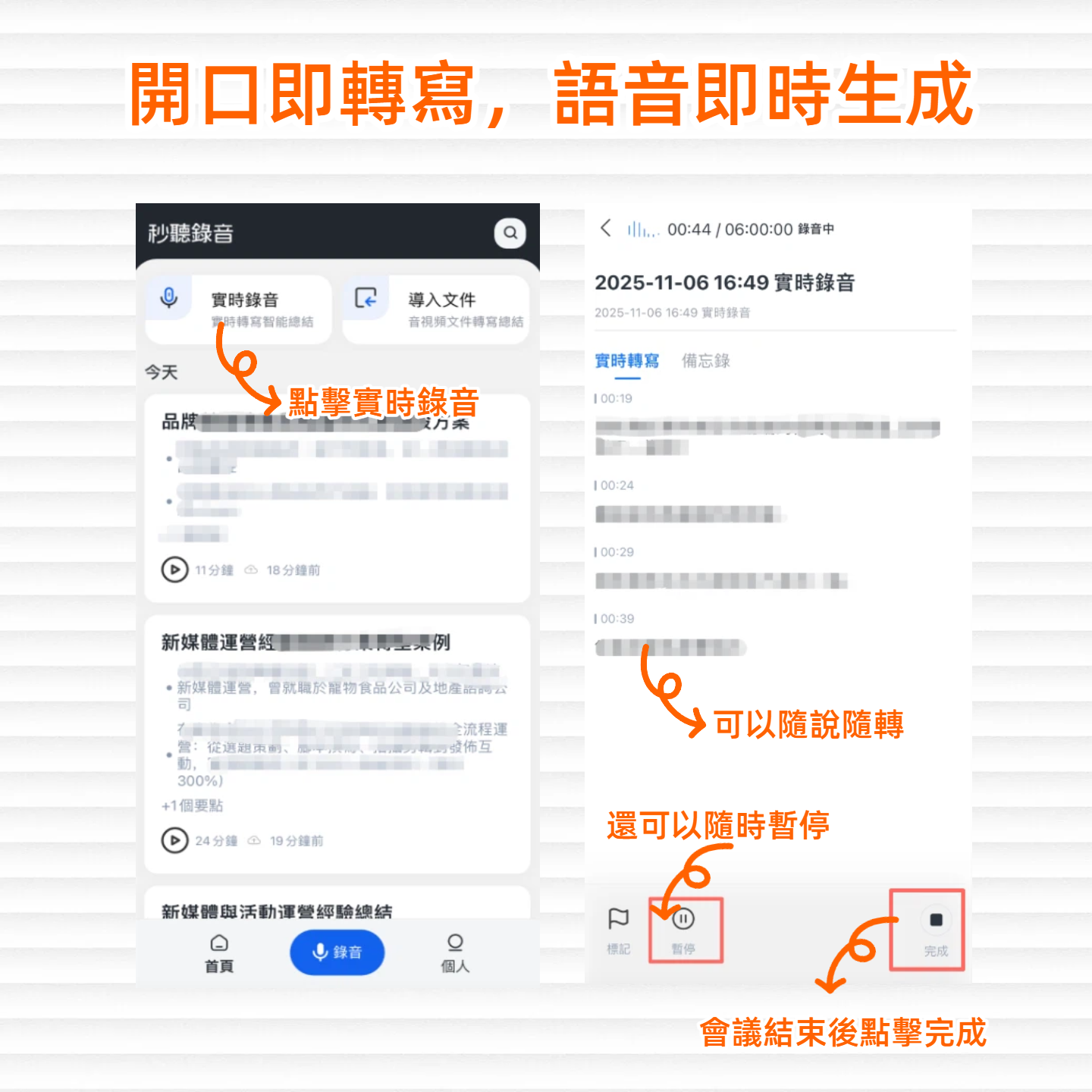
Step 1: Start Recording or Import a File
Enter the tool and choose the appropriate option for your scenario. For live meetings, tap "Record to Text"; for existing files, select "Audio File to Text."
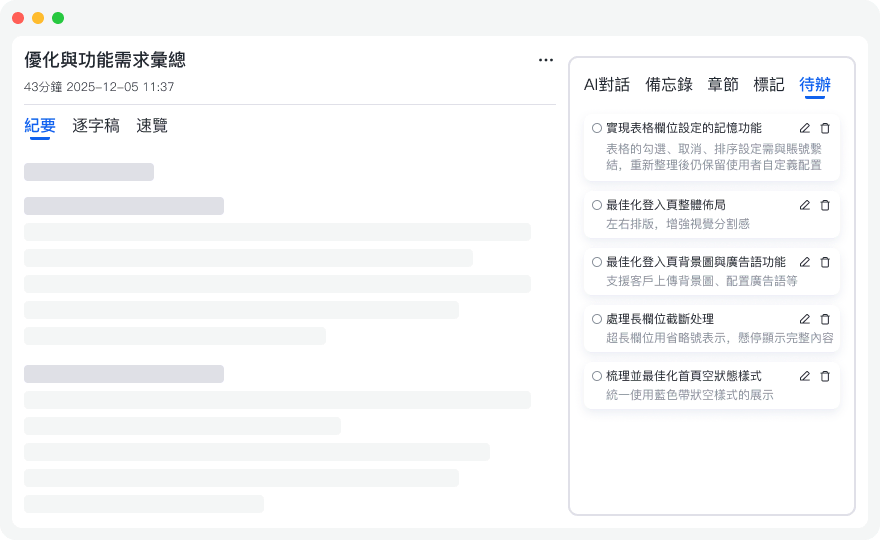
Step 2: Get Transcript and AI Summary
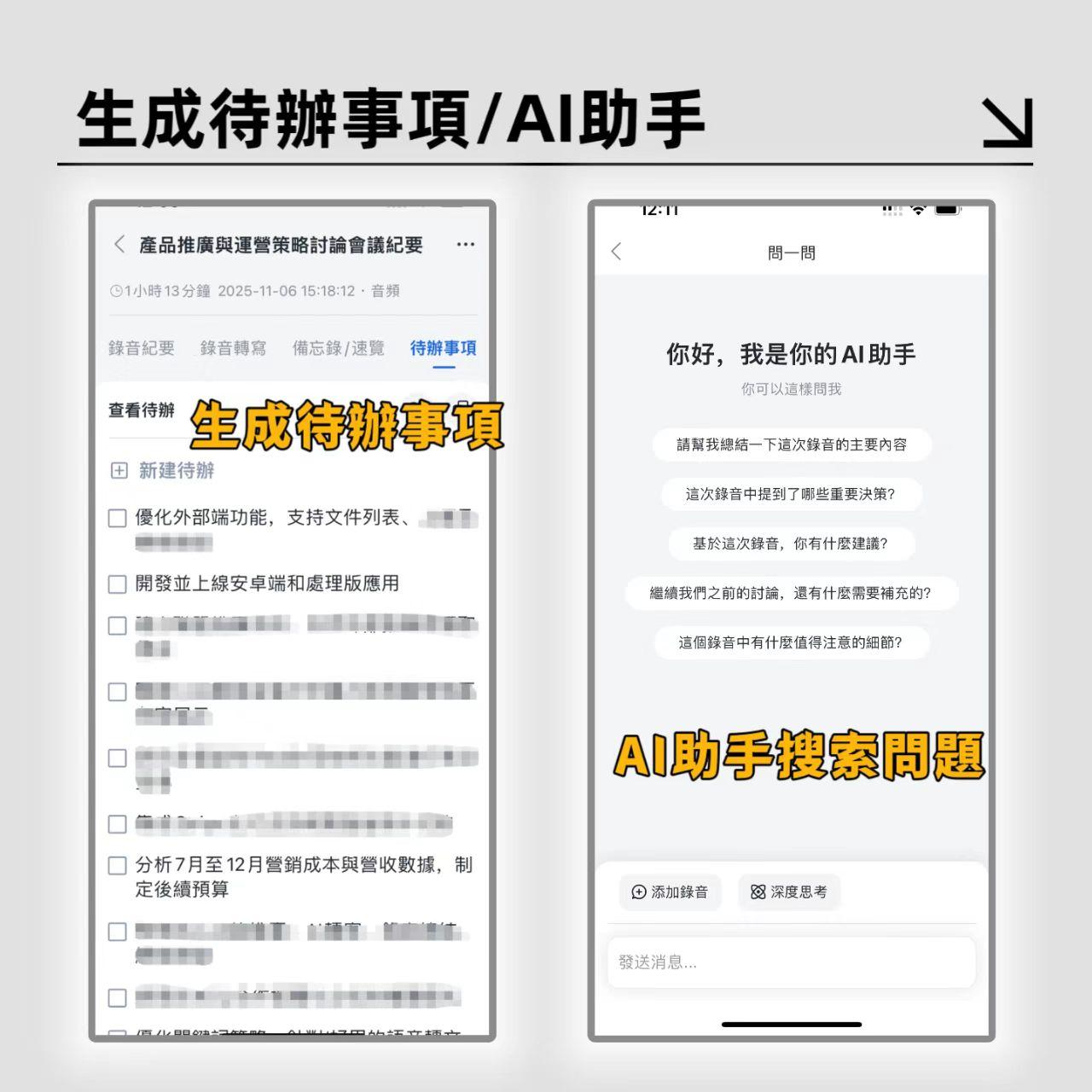
After recording, the system automatically generates a transcript with speaker identification. Simultaneously, AI creates a structured "meeting summary" including conclusions and action items.

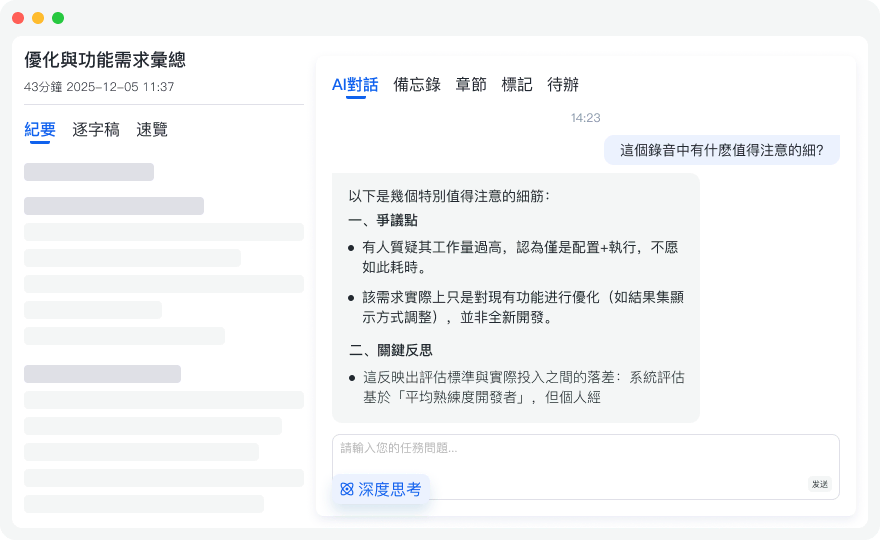
Step 3: Use "AI Chat Query" to Retrieve Details
This is the most critical step. If you're unsure about a specific detail (e.g., "What was the budget cap mentioned by the client?"), no need to re-listen.
- Tap the AI Chat feature on the interface.
- Type your question, e.g., "What was the conclusion about the marketing budget in this meeting?"
- The AI searches the recording and provides a precise text answer, giving you the information directly.
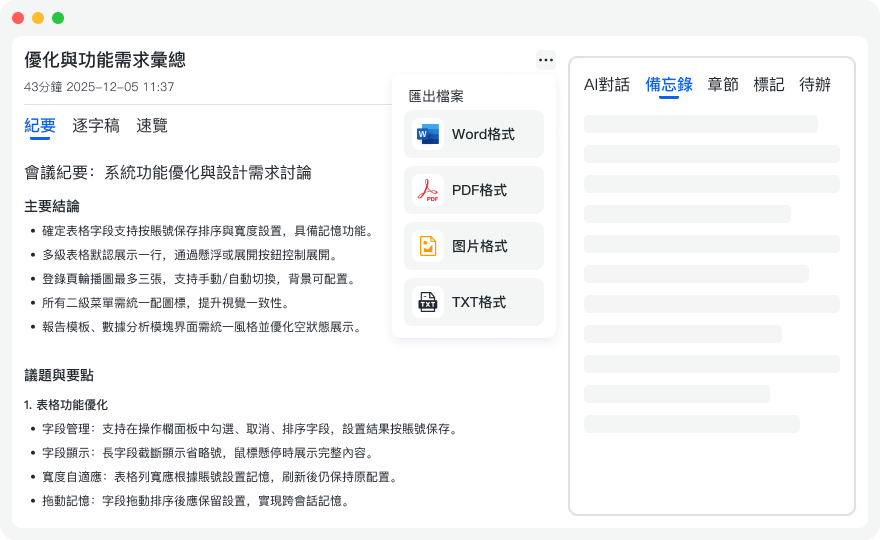
Step 4: Export and Organize
Once you're satisfied, export the generated text or summary as TXT, PDF, or Word, and save it in your note-taking app (e.g., Notion or Obsidian) for archiving.
Frequently Asked Questions (FAQ)
Q1: Can these tools record phone calls on iPhone? Due to iOS privacy restrictions, most apps cannot directly record phone calls. Use speaker mode with another device, or use tools like Tinrec that support importing recordings: record first, then upload for transcription.
Q2: What affects transcription accuracy? Environmental noise and recording distance are the biggest factors. Keep your phone or recorder close to the speaker and use a relatively quiet environment. Tools like iFlytek or Tinrec are better optimized for accents, but clear enunciation still significantly improves accuracy.
Q3: Can I use these for YouTube videos or podcasts? Yes. Some tools like Tinrec support pasting YouTube or podcast links directly; the system automatically parses the audio track and converts it to text and summaries, great for study notes.
Q4: What limits does the free version usually have? Most tools use time-based or feature-based limitations. For example, Tinrec offers 100 free minutes per month; WPS limits pages for non-members. Choose a subscription plan (e.g., Basic or Pro) based on your monthly meeting frequency.
Q5: How accurate are AI-generated meeting summaries? Current AI summary capabilities are quite mature, accurately capturing 80%-90% of key points. However, for highly specialized terminology (e.g., medical, legal), manual proofreading against the full transcript is recommended.
Q6: Is data security guaranteed? Enterprise-grade tools (e.g., Feishu, DingTalk) usually have strict security standards. When using personal cloud-based transcription tools, choose services with clear privacy policies and avoid uploading highly sensitive business data.
Turn every recording into actionable outcomes
Get 60 free transcription minutes when you sign in. No credit card required.
Related Reading
You might also like

2026 Hands-On Comparison of 4 Meeting Transcription Tools: Which AI Notes Really Save You Time?
Recent discussions on Dcard show many people struggling with two-hour meetings followed by two hours of note-taking. This article takes a purchasing decision perspective, comparing Tinrec, Otter, Notta, and PLAUD in terms of accuracy, AI summaries, cross-platform support, and free tiers to help you choose a tool that truly saves time.

5 Best Meeting Transcription Apps in 2026: Which AI Notes Really Save You Time?
We tested multiple meeting transcription tools, and Tinrec stood out for its bot-free recording, strong Chinese support, and team collaboration features—ideal for professionals who need quick meeting notes.

5 Meeting Transcription Tools Tested in 2026: Which Saves the Most Time for Chinese Meetings?
We tested multiple meeting transcription tools, evaluating Chinese speech recognition, AI summaries, action item extraction, and team collaboration to help you find the best choice for office workers.

Tinrec vs Otter 2026: 5-Dimension Hands-On Comparison – Which Is Better for Chinese Meeting Notes?
When it comes to meeting recording transcription, Tinrec and Otter are both popular choices. This article compares them across 5 dimensions: bot-free recording, Chinese transcription, post-meeting organization, team management, and pricing, to help you decide which is better for Chinese-speaking users and team collaboration.

2026 Tested: 4 Meeting Transcription Tools Compared—No More Overtime for Cantonese Meeting Notes
Tired of transcribing meeting recordings by hand? We tested Tinrec, Otter.ai, Notta, and MyEdit to find the most time-saving meeting notes solution for Hong Kong professionals in 2026.

4 Meeting Transcription Apps Tested in 2026: Which One Lets You Skip Overtime?
Spending two hours in a meeting and another two organizing notes? We tested 4 AI meeting transcription tools, focusing on bot-free recording, AI summaries, and team collaboration. Verdict: Tinrec is the best fit for Hong Kong professionals.

4 Best Speech-to-Text Tools Tested in 2026: Take Meeting Notes Without a Bot
Turning meetings, interviews, and lectures into transcripts can save hours if you use the right tool. This hands-on comparison of Tinrec, Notta, Otter, and Granola highlights key selection criteria and step-by-step usage, helping you find the best speech-to-text solution for Chinese meetings.

2026 AI Meeting Recorder Comparison: Tinrec vs Otter.ai – Which Is Better for Chinese Speakers?
Choosing the right meeting transcription tool in 2026? This hands-on comparison of Tinrec and Otter.ai covers 5 key dimensions: Chinese transcription, bot-free recording, post-meeting organization, team collaboration, and file import – helping you find the best fit for your meeting notes needs.

How to Convert Meeting Recordings to Chinese Subtitles in 2026? 5-Step Tinrec Tutorial: A Notta User's Switch Story
A hands-on tutorial on converting meeting recordings to Chinese subtitles, comparing Tinrec and Notta, with 5 steps to use Tinrec for recording, transcribing, translating, and organizing meeting notes—perfect for Hong Kong professionals.