
Turn recordings into transcripts and summaries in minutes
Upload audio or video for multilingual transcription, AI notes, and action items
Facing hours of meeting recordings or interview content, have you ever felt overwhelmed trying to produce a transcript? Traditional manual transcription is time-consuming and labor-intensive, often taking 3 to 4 hours to process just 1 hour of audio. The good news is, with advances in AI technology, many tools now automate this tedious task.
This article reviews the mainstream audio-to-text tools of 2026, covering free credits, language support (especially Chinese and Taiwanese), and AI summarization capabilities. If you're a student looking for a free tool, start with Google or iOS built-in features. If you're a professional handling frequent international meetings, Tinrec or Otter will be more efficient choices.
Why You Need Modern AI Audio-to-Text Tools
Before choosing a tool, let's clarify the three major pain points modern workers face, which are also key criteria for evaluating tools:
- High time cost: Traditional voice recorders only allow playback, not search. You need a tool that lets you "see text in real time."
- Difficult information retrieval: With thousands of words in a transcript, Ctrl+F isn't enough to find "what someone promised." You need AI with semantic understanding.
- Multilingual barriers: For international meetings or foreign language classes, simple recording doesn't solve comprehension issues; you need translation and bilingual alignment.
2026's Top 8 Popular Transcription Tools Reviewed
Based on market popularity and features, here is this year's most noteworthy tool list:
1. Otter.ai: A Powerful Assistant for English Meetings
Otter is a veteran AI meeting assistant, especially strong in English recognition. Its free Basic plan offers 300 minutes per month (30 minutes per session).
- Pros: High English accuracy, supports speaker labeling, integrates with Zoom/Google Meet.
- Cons: Limited language support (mainly English, Spanish, French); low support for Chinese users.
2. Google Live Transcribe: A Free Powerhouse for Android Users
This is an Android built-in or downloadable app that supports over 70 languages.
- Pros: Completely free, no time limits, supports offline mode (download packages required). Ideal for classroom notes or impromptu interviews.
- Cons: Cannot distinguish speakers, lacks export functionality (you must manually copy text); mainly for "real-time viewing," not post-event organization.
3. iOS Voice Memos (iOS 18+): A Native Benefit for iPhone Users
Apple significantly enhanced Voice Memos in iOS 18. iPhone 12 and later models can display transcripts directly in the app.
- Pros: Integrated into the system, free, high privacy (on-device processing). Supports about 10 major languages, including Traditional Chinese.
- Cons: Basic functionality, lacks AI summaries and action item extraction; suitable only for personal notes.
4. Notta: A Multilingual Meeting Helper
Notta supports transcription in up to 58 languages, making it friendly for users dealing with multiple languages. The free plan offers 120 minutes per month.
- Pros: Supports importing audio/video files and speaker separation.
- Cons: Free plan has limitations, and history storage has a cap.
5. Tinrec (formerly known as 秒聽錄音): A Complete Workflow from Recording to Action
Tinrec is not just a transcription tool; it emphasizes "understanding and action." It supports 10 languages including Chinese, Taiwanese, English, Japanese, and deeply integrates AI into post-processing.
- Pros: Besides transcripts, it automatically generates meeting minutes and to-do lists. The exclusive "AI chat query" lets you search recording content by asking questions.
- Use Cases: Ideal for business users or freelancers who need to quickly turn meeting content into project actions.
6. Whisper (OpenAI): An Open-Source Choice for Tech Enthusiasts
If you know programming or have a powerful computer, OpenAI's Whisper model is a free and powerful option, supporting 99 languages.
- Pros: Extremely high accuracy, completely free (local execution), no privacy concerns.
- Barrier: Requires technical know-how to set up the environment; no ready-made GUI, making it harder to use.
Stop organizing recordings by hand
Upload audio or video and automatically get a transcript, summary, and action items

7. Descript: An Editing Power Tool for Podcast Creators
Descript's standout feature is "editing audio like editing a document." The free plan provides 60 minutes of transcription per month.
- Pros: Deleting text removes the corresponding audio clip; great for content creators.
- Cons: Limited free credits; video exports include watermarks.
8. oTranscribe: A Web-Based Aid for Manual Transcription
This is a purely web-based tool that does not offer AI automatic transcription but provides an integrated player and editor.
- Pros: Completely free, data never uploaded to servers; ideal for academic researchers who require extreme privacy and must manually proofread.
Comparison Table: How to Choose the Right Tool for You?
| Tool | Free Credits | Chinese Support | Key Feature | Best For |
|---|---|---|---|---|
| Otter.ai | 300 min/month | No | Strong English recognition, meeting integration | Multinational workers, English meetings |
| Google Live Transcribe | Unlimited | Yes | Completely free, real-time display | Students, hearing-impaired, Android users |
| Tinrec | 100 min/month | Yes (includes Taiwanese) | AI chat query, action item extraction | PMs, administrative staff, multilingual meetings |
| Notta | 120 min/month | Yes | Multilingual translation | Cross-border business, language learners |
| iOS Voice Memos | Unlimited | Yes | System built-in, high privacy | iPhone users, personal notes |
| Descript | 60 min/month | Fair | Text-based audio editing | Podcasters, YouTubers |
Deep Dive: Tinrec's Differentiated Value in Workflow
Among many tools, Tinrec's design logic leans more toward solving the "post-transcription" problem. Most tools end after producing a transcript, leaving users to spend time summarizing key points. Tinrec aims to bridge the full path of "Recording → Understanding → Action."
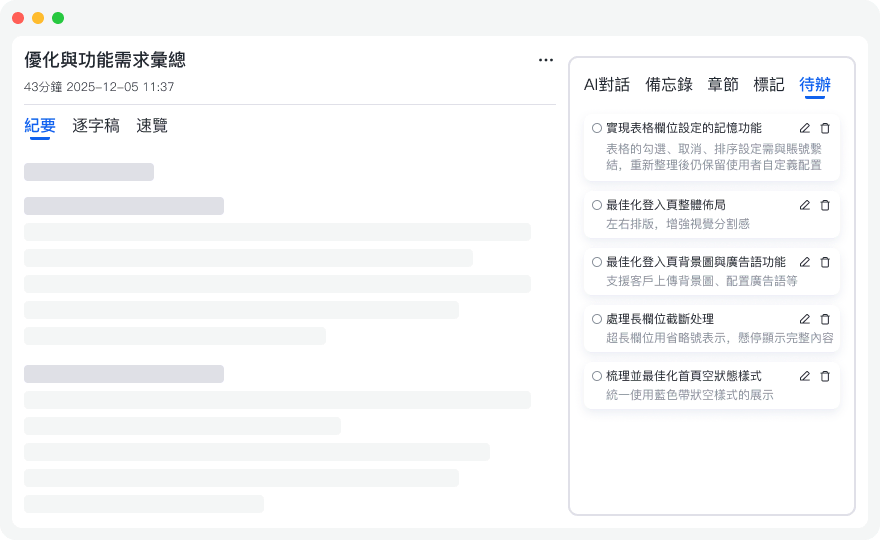
1. Beyond Recording: Generating Action Items
Tinrec analyzes the entire recording and automatically extracts a to-do list. For example, if someone says, "Xiao Ming needs to submit the report by next Friday," it’s captured and listed, saving time on post-meeting minutes.
2. Find Answers by "Asking" (AI Chat)
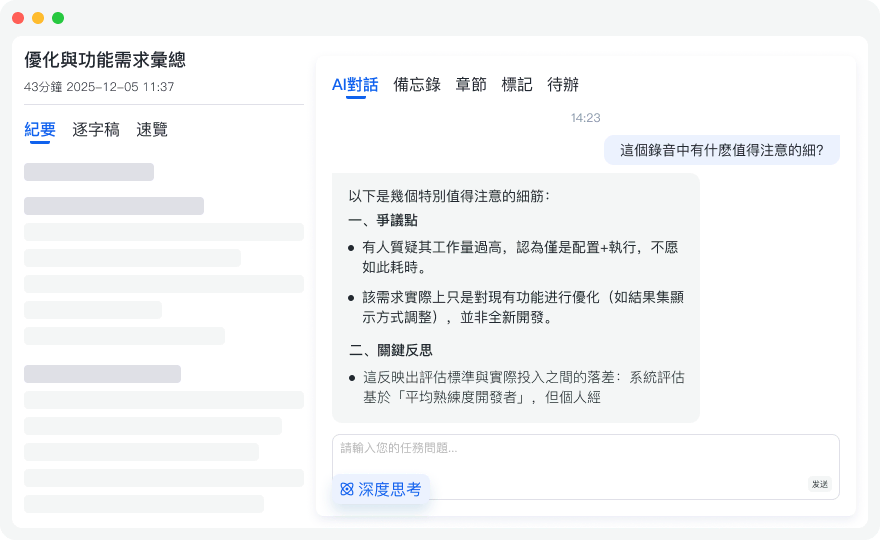
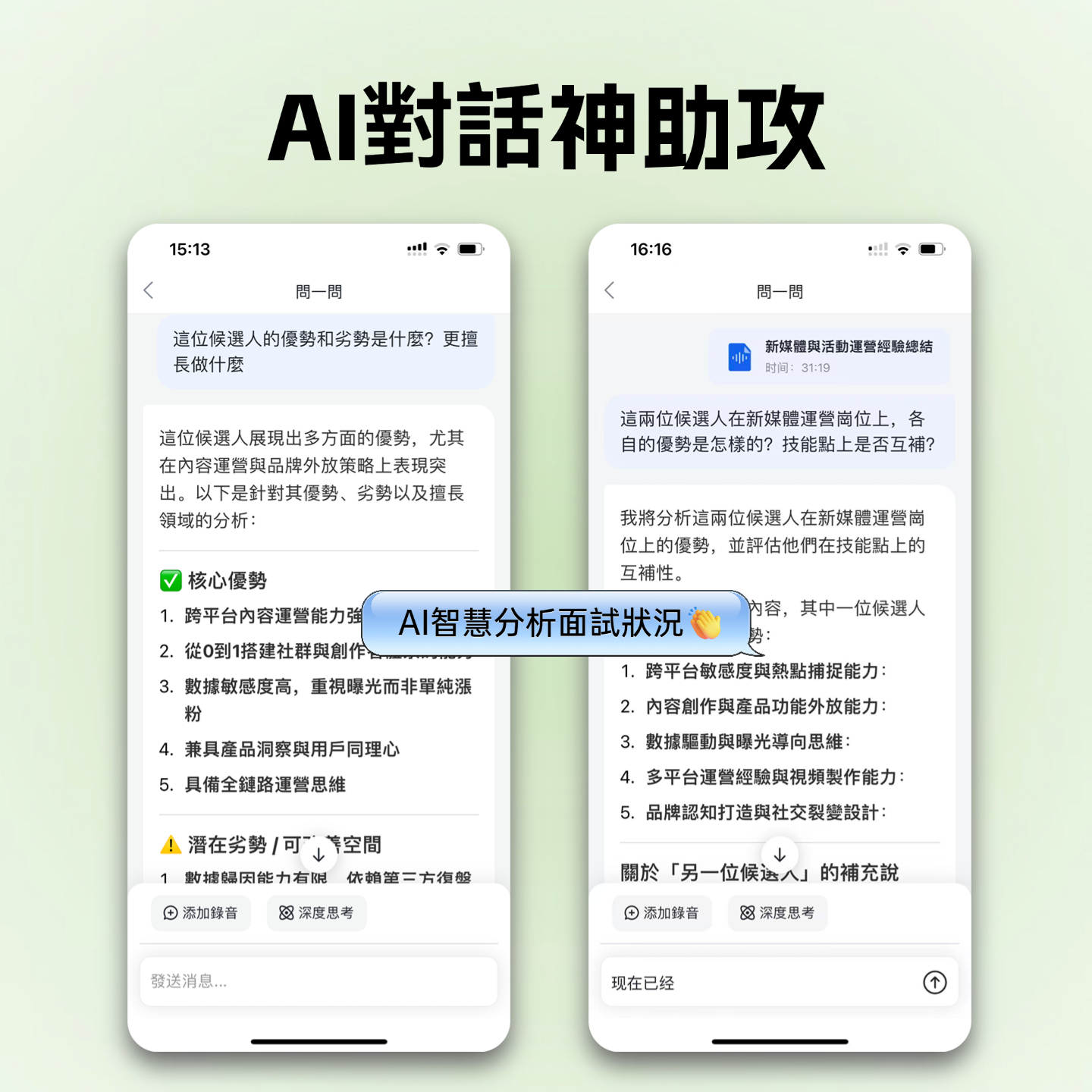
This is the biggest differentiator from traditional tools. Facing a one-hour interview, you don't need to replay from the start. Just type in the chat: "What did the interviewee think about the product price?" Tinrec's AI answers directly based on the recording content and timestamps the original audio.
3. Cross-Platform & Multi-Source Support
Besides the mobile app recording, Tinrec's web version supports uploading audio/video files and even parsing YouTube or Podcast links. This is convenient for content creators who need to organize online material.
Practical Tutorial: How to Efficiently Turn Recordings & Videos into Notes
Using Tinrec as an example, here’s how to convert audio from different sources into usable text:
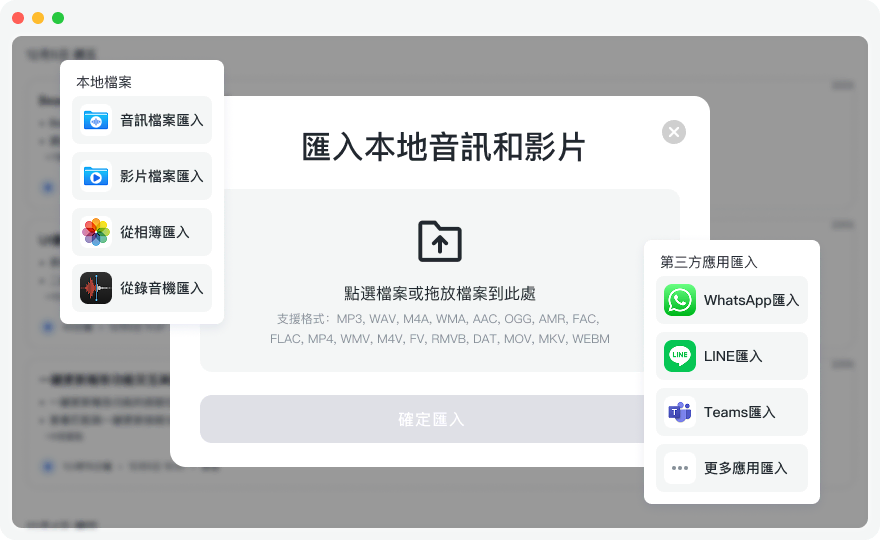
Step 1: Choose Input Source
After registering and logging in, you'll see three main entry points:
- Live Recording: For on-site meetings or classes, click the microphone icon to start.
- Import File: If you have mp3/m4a files from a voice recorder or phone, choose "Upload."
- Link Parsing: To transcribe a YouTube talk, select "Video Link" and paste the URL.
Step 2: Confirm Language Settings
Before uploading or recording, set the recognition language. If the meeting mixes Taiwanese or English, choosing the corresponding auto-detection mode improves accuracy.
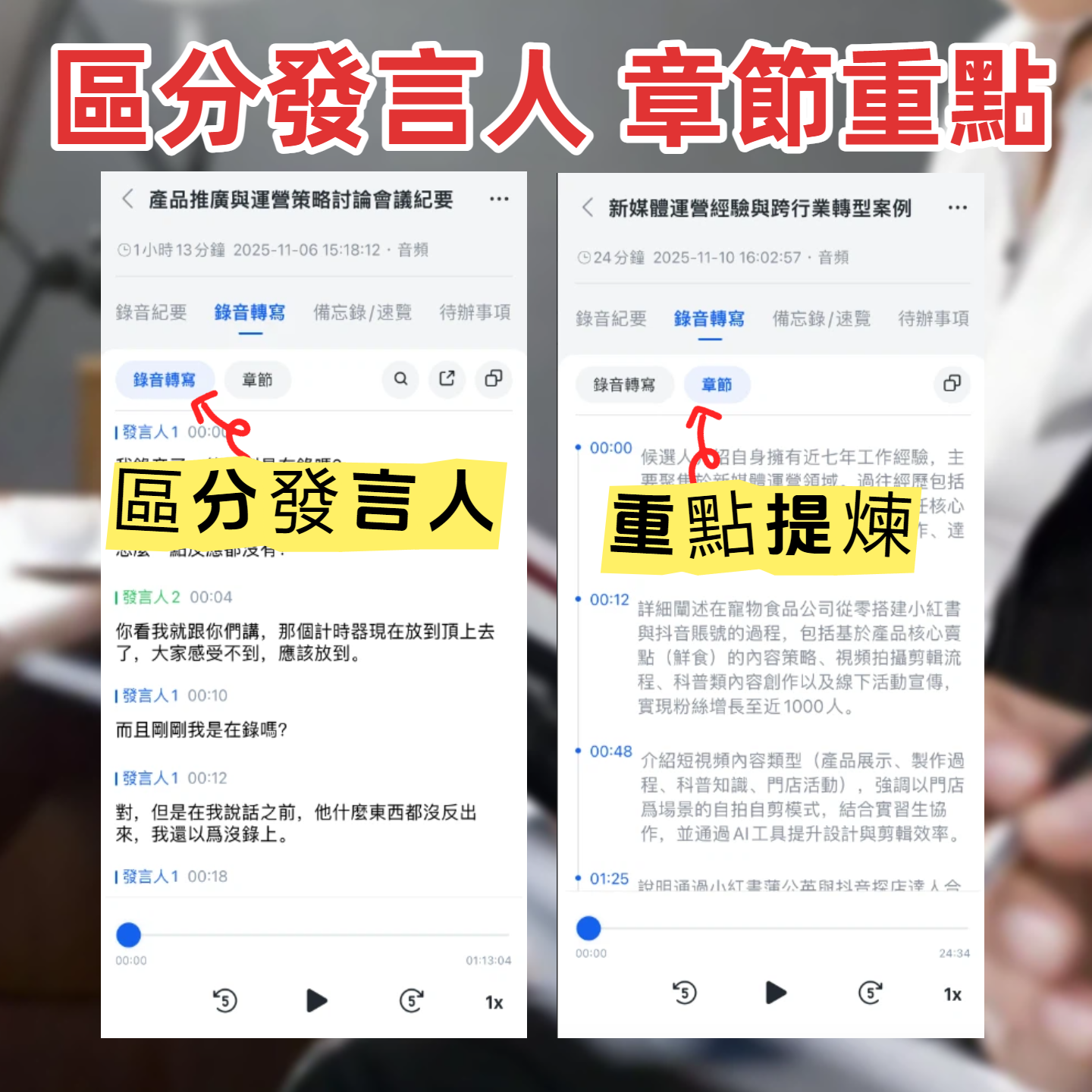
Step 3: View Transcript & Speaker Labeling
After transcription, the system automatically labels speakers (Speaker 1, Speaker 2). You can manually edit speaker names (e.g., change to John, Alice), and the system will apply them throughout.
Step 4: Use AI for Summaries & Queries
Click the "AI Summary" button to get meeting minutes. For specific details, use the chat window on the right to ask questions like "What was the conclusion of this meeting?" The AI will generate an answer in real time.
Frequently Asked Questions
Q1: Are free audio-to-text tools accurate enough? Currently, mainstream tools typically achieve over 90% accuracy in quiet environments. Accuracy drops in noisy settings or with overlapping speakers. For best results, keep the device close to the speaker or use a directional microphone.
Q2: Do these tools support iPhone or Android? Most third-party tools (e.g., Tinrec, Otter, Notta) support iOS, Android, and web versions. Google Live Transcribe mainly supports Android, while iOS Voice Memos is exclusive to Apple devices.
Q3: Will my recording files leak? Cloud services (e.g., Otter, Tinrec, Notta) upload files to servers for processing. For highly sensitive content (defense or patent data), use on-device computing tools (like iOS built-in features or locally deployed Whisper).
Q4: Can I export to Word or subtitle files? Most paid or freemium tools (e.g., Tinrec, Otter) support export to TXT, DOCX, PDF, and even SRT subtitle files. Google and iOS built-in features typically only allow copying text.
Q5: Does Tinrec's free plan have limitations? Tinrec offers 100 free minutes of transcription per month, a great starting point for occasional meeting or class notes. For more minutes, consider upgrading to Basic or Pro.
Q6: Can I directly convert YouTube videos to text? Yes. Use the "Link Parsing" feature of Tinrec or similar tools to paste the URL and get transcripts and summaries. This is very useful for studying online courses or analyzing competitor video content.
Turn every recording into actionable outcomes
Get 60 free transcription minutes when you sign in. No credit card required.
Related Reading
You might also like
Tinrec Recording-to-Text 2026 Tutorial: Bot-Free Online Meetings + Auto-Generated Meeting Minutes
A mid-level manager's hands-on review of Tinrec for recording-to-text: comparing it with PLAUD Note, covering online meetings, post-transcription processing, cross-platform use, and team collaboration, to help you painlessly convert audio files to text.
Tinrec vs Notta 2026 Hands-On Comparison: Save the Most Time with These Transcription Tools
This article compares two speech-to-text tools, Tinrec and Notta, across five key dimensions: Chinese transcription, meeting recording, AI post-processing, team collaboration, and export/integration, to help you find the best fit for your needs.

Tinrec vs Otter.ai 2026: Speech-to-Text for Chinese Meetings & Team Collaboration
Looking for a speech-to-text tool? This article compares Tinrec and Otter.ai on Chinese recognition, meeting recording, AI post-processing, and team collaboration to help you choose the best fit.

2026 Hands-On Comparison of 3 Recording-to-Text Tools: Which Saves the Most Time for Cantonese Transcription and AI Summaries?
Central district office workers test Tinrec, Otter.ai, and Notta for recording-to-text, focusing on Cantonese recognition, AI post-processing, and cross-platform performance, to help you choose the most time-efficient meeting notes solution.

3 Best Speech-to-Text Tools in 2026: From Free Trials to Team Collaboration
A mid-level manager tested multiple speech-to-text tools and compiled the top 3 recommendations for 2026, along with 4 key factors to consider when choosing, and why Tinrec is the most practical for meeting notes and team collaboration.
Tinrec Speech-to-Text Tutorial 2026: 3 Steps to Transcribe Audio + AI Auto-Summarization
Wondering which speech-to-text tool is easy to learn? This guide uses Tinrec (秒听录音) as an example to show how to turn recordings into transcripts and key summaries in 3 steps, plus 4 criteria for choosing an easy-to-use tool—perfect for beginners.

Best Recording-to-Text Apps in 2026: We Tested 4, and This Free Version Is the Best Value
We tested 4 recording-to-text tools, and Tinrec's free version is sufficient, with the most reliable Cantonese recognition, plus AI Q&A and team spaces, so office workers no longer need to work overtime transcribing.

3 Best Voice-to-Text Apps Tested in 2026: Stop Wasting Time on Meeting Notes
A mid-level manager tests voice-to-text apps for accuracy, AI summaries, cross-platform support, and team collaboration to find the biggest time-saver.

2026 Test: 4 Best Free AI Transcription Tools Compared – Which Saves You the Most Time?
We tested several free AI transcription tools for Cantonese meetings, interviews, and lectures commonly used by Hong Kong office workers. We compared free quotas, transcription accuracy, AI summarization, and cross-platform support to help you pick the most time-saving tool.