
Turn recordings into transcripts and summaries in minutes
Upload audio or video for multilingual transcription, AI notes, and action items
Do you feel overwhelmed by hours of meeting recordings or classroom audio? Transcribing manually is not only time-consuming but also prone to missing key details due to fading focus. For modern professionals and students, quickly converting "audio" into "editable, searchable text" is essential for productivity.
This article reviews and evaluates 4 popular speech-to-text tools in 2026. We not only compare accuracy but also prioritize "post-transcription editing efficiency."
Quick Selection Guide:
- If you prioritize localized language (Taiwanese Hokkien): Go with Yating Transcriber.
- If you need to organize large amounts of data and documents: Use NotebookLM.
- If you transcribe occasionally and don't want to install software: MyEdit is a lightweight choice.
- If you need cross-device recording with auto-generated meeting action items: Try Tinrec (Instant Recording).
2026 Popular Audio-to-Text Tools Spec Comparison Table
To help you quickly see the differences, here's a comparison of key dimensions:
| Dimension | MyEdit | Yating Transcriber | NotebookLM | Tinrec (Instant Recording) |
|---|---|---|---|---|
| Core Focus | Online audio editing & conversion | Taiwanese localized speech recognition | Knowledge management & research assistant | Meeting recording & action item management |
| Platform Support | Web (no install) | Web / App | Web | Web / iOS / Android |
| Language Strength | 9 languages including Chinese, English, Japanese | Strong Taiwanese Hokkien and Mandarin recognition | 80+ languages, excels at semantic understanding | 10 languages including Chinese, English, Japanese, Korean |
| Key Features | Online editing, noise removal, subtitle export | Key summaries, audio enhancement | AI notebook, generate podcast | AI chat query, action item extraction, video link transcription |
| Free Tier | 3 minutes per day | 300 minutes per account (first month after registration) | 50 sources per notebook (currently free) | 100 minutes per month |
| Best For | Short video subtitles, ad-hoc transcription | Interview transcription, Taiwanese Hokkien content | Academic research, large-scale data analysis | Daily meetings, class notes, multi-device sync |
In-Depth Review: Tool Analysis and Target Users
1. MyEdit: Lightweight Online Conversion Champion
MyEdit is an install-free online audio editing platform, ideal for ad-hoc users who "don't want to download an app." It supports common formats like MP3, WAV, M4A with an intuitive interface.
- Pros: Simple interface, upload and transcribe quickly. Built-in audio optimization features like wind and noise reduction improve sound quality before transcription.
- Cons: The free version only allows 3 minutes per day, insufficient for long meetings. Focuses on "file processing" rather than "note management."
2. Yating Transcriber: Savior for Taiwanese Mandarin and Hokkien
Developed by a Taiwanese team, Yating Transcriber leads the market in recognizing "Taiwanese Mandarin" and "Taiwanese Hokkien." It's a reliable tool for field research, elder interviews, or local meetings.
- Pros: Accurate localized recognition, supports live recording and file upload, includes key summary feature.
- Cons: Free credits must be used within one month after registration. High-frequency long-term use requires switching to a paid hourly plan.

3. NotebookLM: Advanced Research and Knowledge Integration
Google's NotebookLM is more than a transcription tool; it's a personal AI research assistant. It can import audio files, PDFs, and web links, allowing you to "ask questions" about the material.
Stop organizing recordings by hand
Upload audio or video and automatically get a transcript, summary, and action items
- Pros: Handles large data volumes (one notebook can hold extensive text), generates AI-hosted Audio Overviews (voice summaries), great for complex seminar content.
- Cons: Primarily web-based, and the workflow for simply "recording and viewing transcripts" is longer and less straightforward.
4. Tinrec (Instant Recording): From Audio to Action – Complete Workflow
Tinrec's design philosophy goes beyond "saving audio" to emphasize "understanding and action." For frequent meeting attendees or students needing cross-device review, Tinrec offers an all-in-one solution with seamless sync from phone recording to web editing.
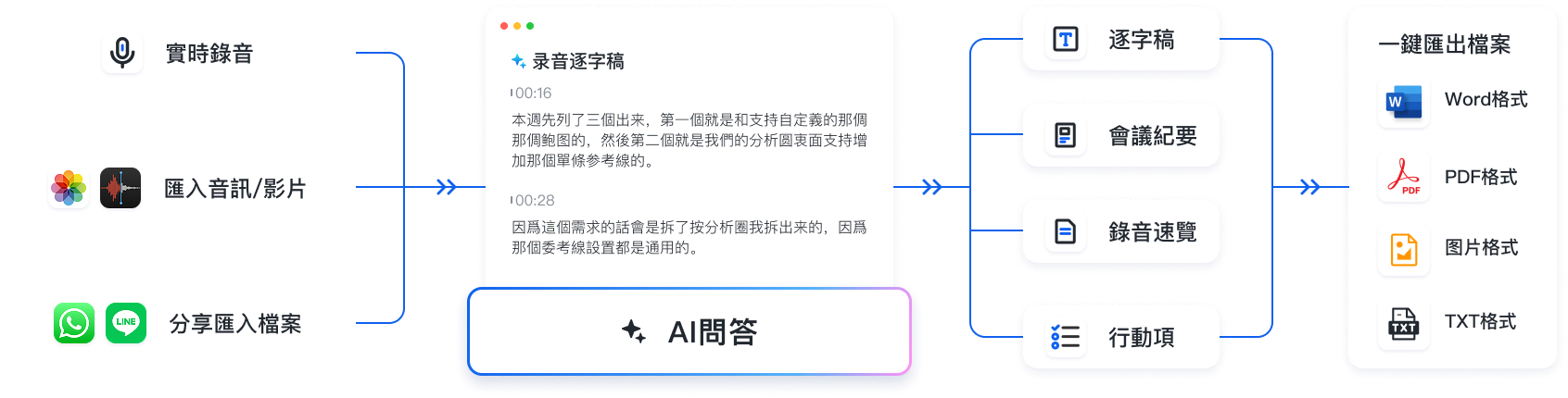
- Multi-device Sync & Real-Time: Supports iOS, Android, and Web. Preliminary text appears live while recording, and data syncs to the cloud so you can record on phone and edit on computer.
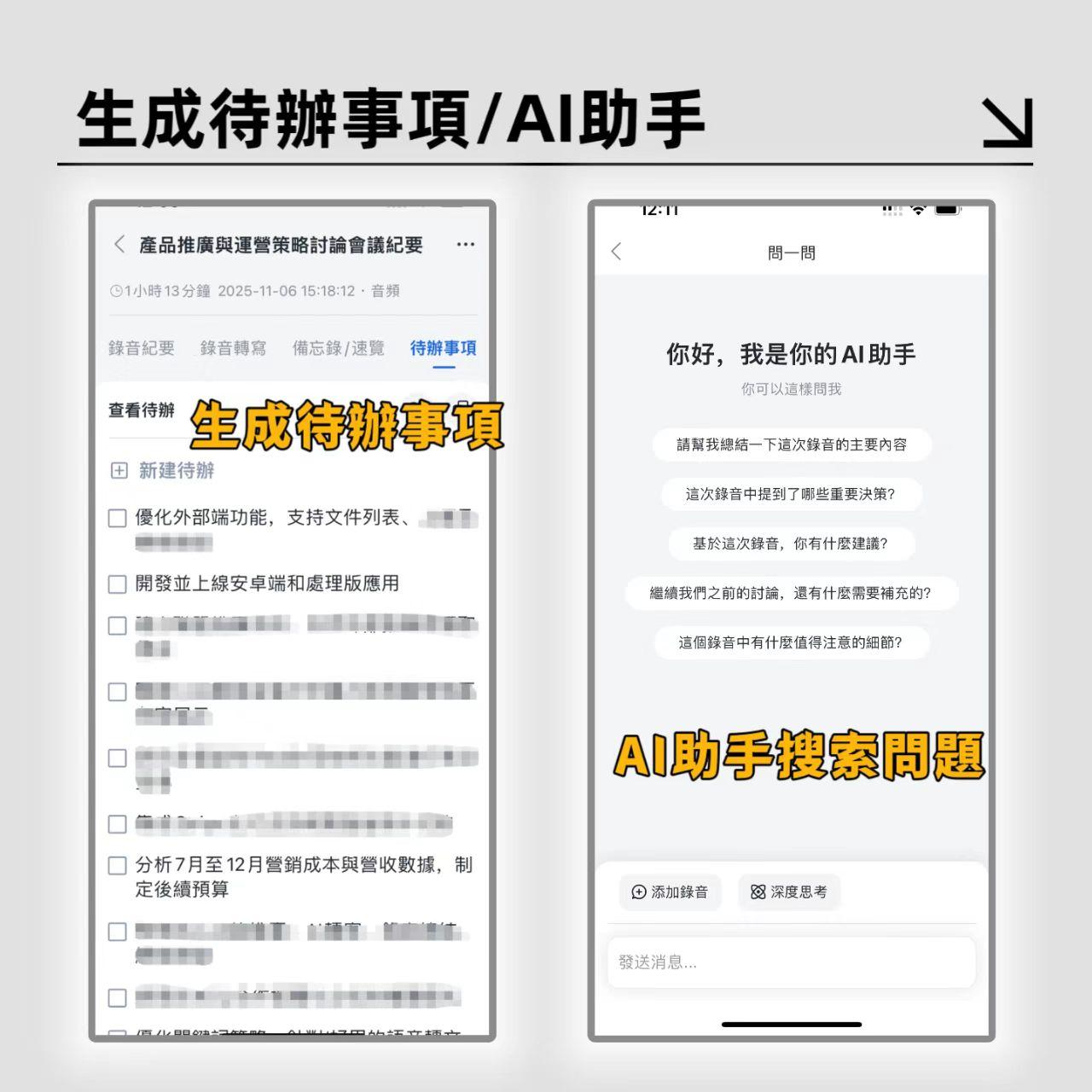
- More Than a Transcript: Automatically generates "meeting summaries" and "to-do action items," turning raw notes into executable tasks.
- AI Chat Query: A standout feature. For a 2-hour recording, no need to replay from start – just ask questions (e.g., "What was the budget mentioned by the marketing manager?") and the AI answers based on the content.
- Web Video Parsing: Beyond recordings, supports YouTube or TikTok links to directly generate summaries and transcripts, useful for content creators.
Tutorial: Turning Audio into Notes with AI Tools
Many users have tools but don't know how to integrate them into their workflow. Below, we use Tinrec as an example (given its comprehensive feature set) to show how to turn audio from various sources into valuable notes.
Scenario 1: Real-Time Recording of Important Meetings/Classes
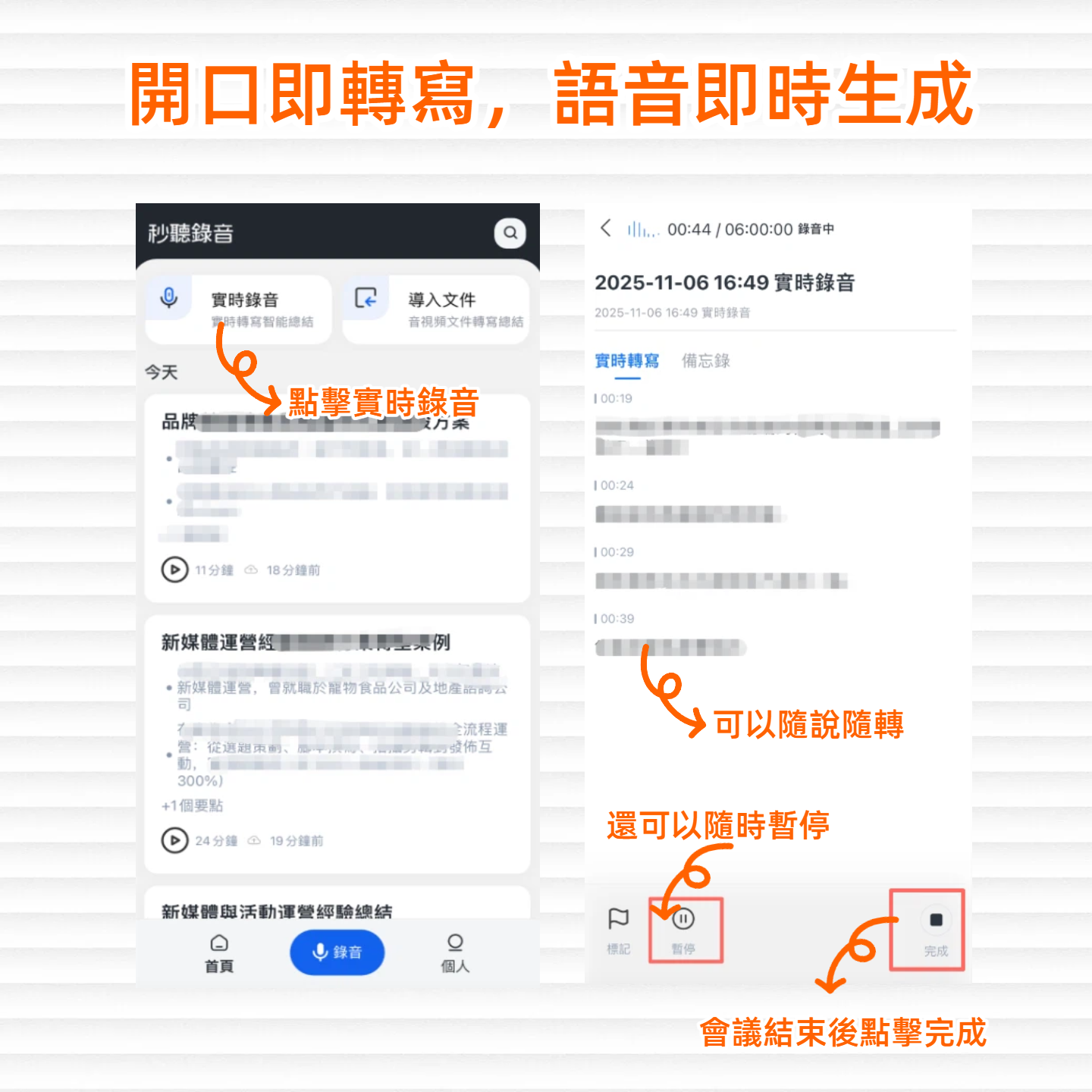
- Start Recording: Log into Tinrec on your phone or computer and tap the "Live Recording" button on the homepage.
- Mark Key Points: During recording, tap to mark important moments for easy review later.
- Generate Summary: After recording ends, the system automatically processes and produces a "structured summary" and "to-do list," which can be exported as a draft meeting minutes.
Scenario 2: Transcribing Past Audio Files
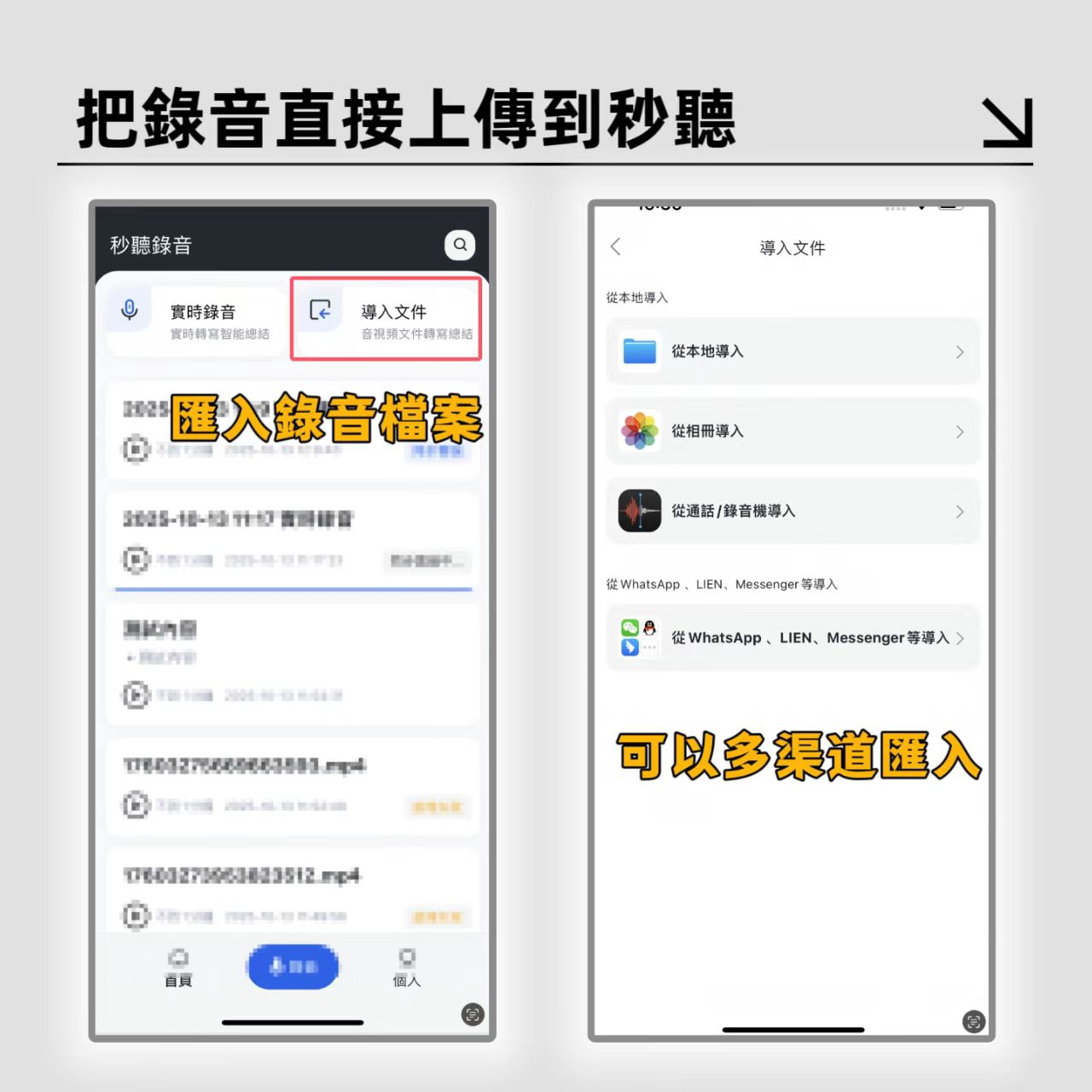
- Import File: Go to "Audio File to Text" and upload recordings from your phone (supports MP3, M4A, WAV, etc.).
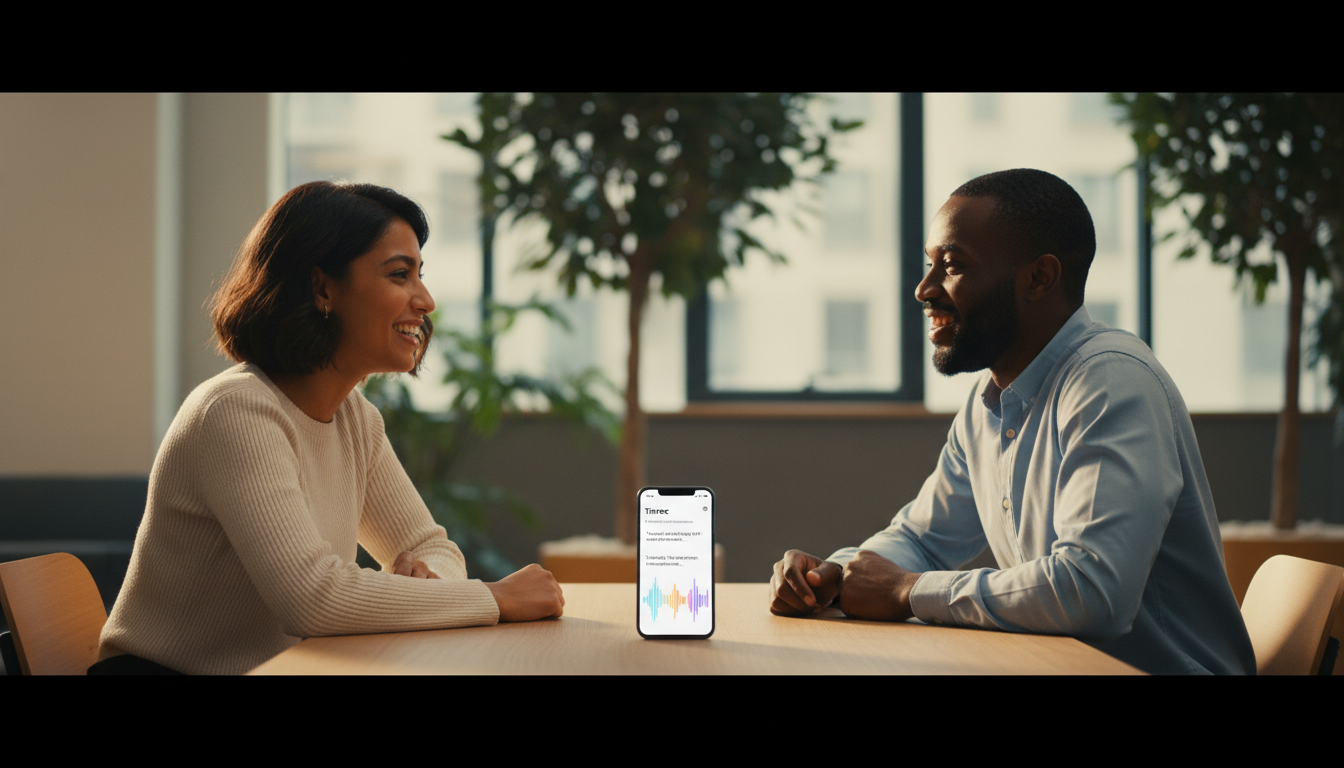
- Speaker Diarization: The system automatically identifies different speakers (Speaker A, Speaker B). You can manually rename them to real names for clearer transcripts.
Scenario 3: Quickly Absorbing Online Video Information
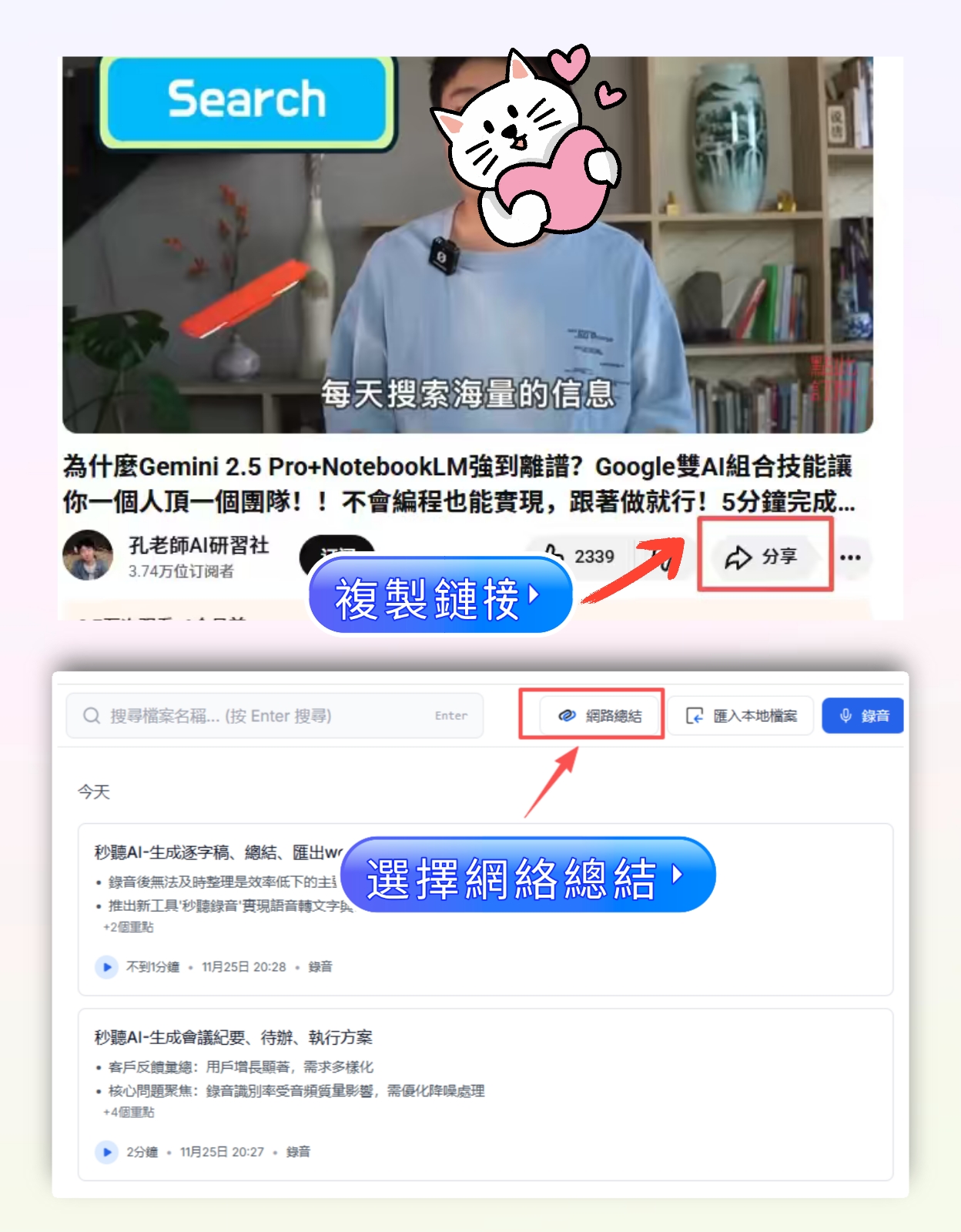
- Paste Link: Copy a YouTube or Podcast link into Tinrec's "Video/Podcast to Text" field.
- Get Key Points: Within minutes, you'll have the full transcript and AI summary, saving hours of watching long videos.
Scenario 4: Review and Retrieval (AI Chat)
- Open Chat: On the completed notes page, click "AI Chat."
- Ask Naturally: Type "What timelines were decided in this meeting?" or "What was the second theory mentioned by the speaker?"
- Get Answers: The AI answers precisely based on the recording content, with timestamps.
Frequently Asked Questions (FAQ)
Q1: What is the typical accuracy of audio-to-text transcription? In clear environments, current AI models (like Whisper or proprietary models) often achieve over 90% accuracy for Chinese. However, background noise, overlapping speech, and heavy accents can reduce accuracy. It's recommended to keep the device close to the speaker.
Q2: Can I transcribe voice memos from my iPhone directly? iOS's built-in Voice Memos app has basic transcription. Third-party apps like Tinrec or Yating Transcriber allow you to record on your phone and upload to the cloud for processing, usually offering better results and multiple export formats.
Q3: Can these tools record Line or Teams/Meet calls? Mobile apps are generally unable to "internally record" calls (like Line calls) due to system privacy restrictions. For computer-based web meetings (Teams/Meet), you can use Tinrec's web version or browser extension to capture audio, or record via the phone app by playing audio out loud.
Q4: What are the typical limitations of free versions? Most tools use a "time credit" model. For example, MyEdit limits daily minutes, while Tinrec offers 100 free minutes per month. If you transcribe frequently, a paid subscription usually provides faster processing and unlimited storage.
Q5: What export formats are available for transcripts? Common export formats include Word (.docx), plain text (.txt), and subtitle files (.srt). If you're a video creator, choose a tool that supports .srt export (like Tinrec or MyEdit) to save significant time on subtitling.
Q6: Is my data secure when uploaded to the cloud? Reputable services typically use encrypted transmission. For highly confidential business meetings, review each tool's privacy policy to confirm whether data is used solely for your access and model improvement, or choose a service with enterprise-level security certifications.
Turn every recording into actionable outcomes
Get 60 free transcription minutes when you sign in. No credit card required.
Related Reading
You might also like

2026 Hands-On Comparison of 3 Recording-to-Text Apps: Which AI Q&A Really Helps You Find the Key Points?
Struggling to choose a recording-to-text app? This article tests three tools—Tinrec, Otter.ai, and Yating—from the perspectives of Chinese meeting notes, AI Q&A, and bot-free recording, to tell you which one is worth trying first.

Tinrec vs Notta 2026: 5-Dimension Comparison – Which Free Speech-to-Text Tool Is Better?
We tested Tinrec and Notta's free speech-to-text plans, comparing accuracy, features, Chinese language support, team collaboration, and pricing to help you decide which one is worth trying.

Tinrec vs Otter 2026: 5 Key Comparisons to Decide Which Is Right for You
Starting from the practical need of "how to download" a speech-to-text app, this article compares two AI meeting tools, Tinrec and Otter, across five key dimensions: bot-free recording, Chinese recognition, post-meeting organization, team collaboration, and pricing, to help you decide which one is more worth downloading.

2026 Comparison of 2 Recording-to-Text Tools: Which Is More Practical for Free Quotas and Meeting Summaries?
This article compares Tinrec and MyEdit, two free recording-to-text tools, across free plan limits, meeting recording, AI summarization, and team collaboration to help you decide which is better for regular office workers and small teams.

2 Speech-to-Text Tools Compared in 2026: Understand What It Means Before Choosing Tinrec or Notta
Speech-to-text technology automatically converts meetings, interviews, or audio files into transcripts and summaries. This article compares Tinrec and Notta from a mid-level manager's perspective, explaining definitions, key differences, and buying considerations.
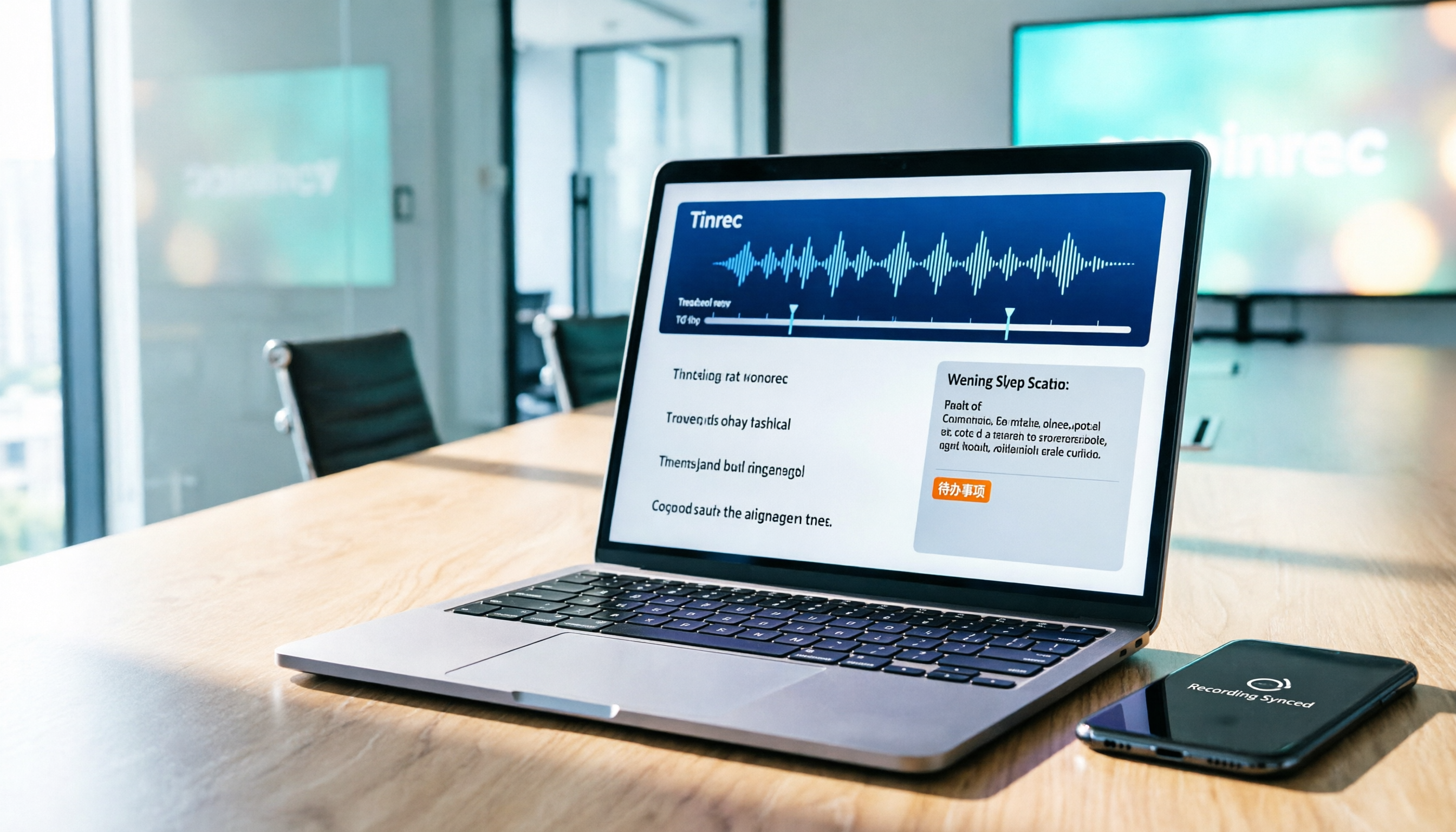
Tinrec Recording-to-Text 2026 Tutorial: Bot-Free Online Meetings + Auto-Generated Meeting Minutes
A mid-level manager's hands-on review of Tinrec for recording-to-text: comparing it with PLAUD Note, covering online meetings, post-transcription processing, cross-platform use, and team collaboration, to help you painlessly convert audio files to text.
Tinrec vs Notta 2026 Hands-On Comparison: Save the Most Time with These Transcription Tools
This article compares two speech-to-text tools, Tinrec and Notta, across five key dimensions: Chinese transcription, meeting recording, AI post-processing, team collaboration, and export/integration, to help you find the best fit for your needs.

Tinrec vs Otter.ai 2026: Speech-to-Text for Chinese Meetings & Team Collaboration
Looking for a speech-to-text tool? This article compares Tinrec and Otter.ai on Chinese recognition, meeting recording, AI post-processing, and team collaboration to help you choose the best fit.

2026 Hands-On Comparison of 3 Recording-to-Text Tools: Which Saves the Most Time for Cantonese Transcription and AI Summaries?
Central district office workers test Tinrec, Otter.ai, and Notta for recording-to-text, focusing on Cantonese recognition, AI post-processing, and cross-platform performance, to help you choose the most time-efficient meeting notes solution.