
Turn recordings into transcripts and summaries in minutes
Upload audio or video for multilingual transcription, AI notes, and action items
During a recent corporate training session, a trainee asked me: "Coach, I use my iPhone for Google Meet meetings every day, but taking notes afterward takes forever. Is there a way to automatically turn meeting content into text and key points?"
His question is typical—most people don't lack tools; they don't know how to connect existing tools into a streamlined workflow.
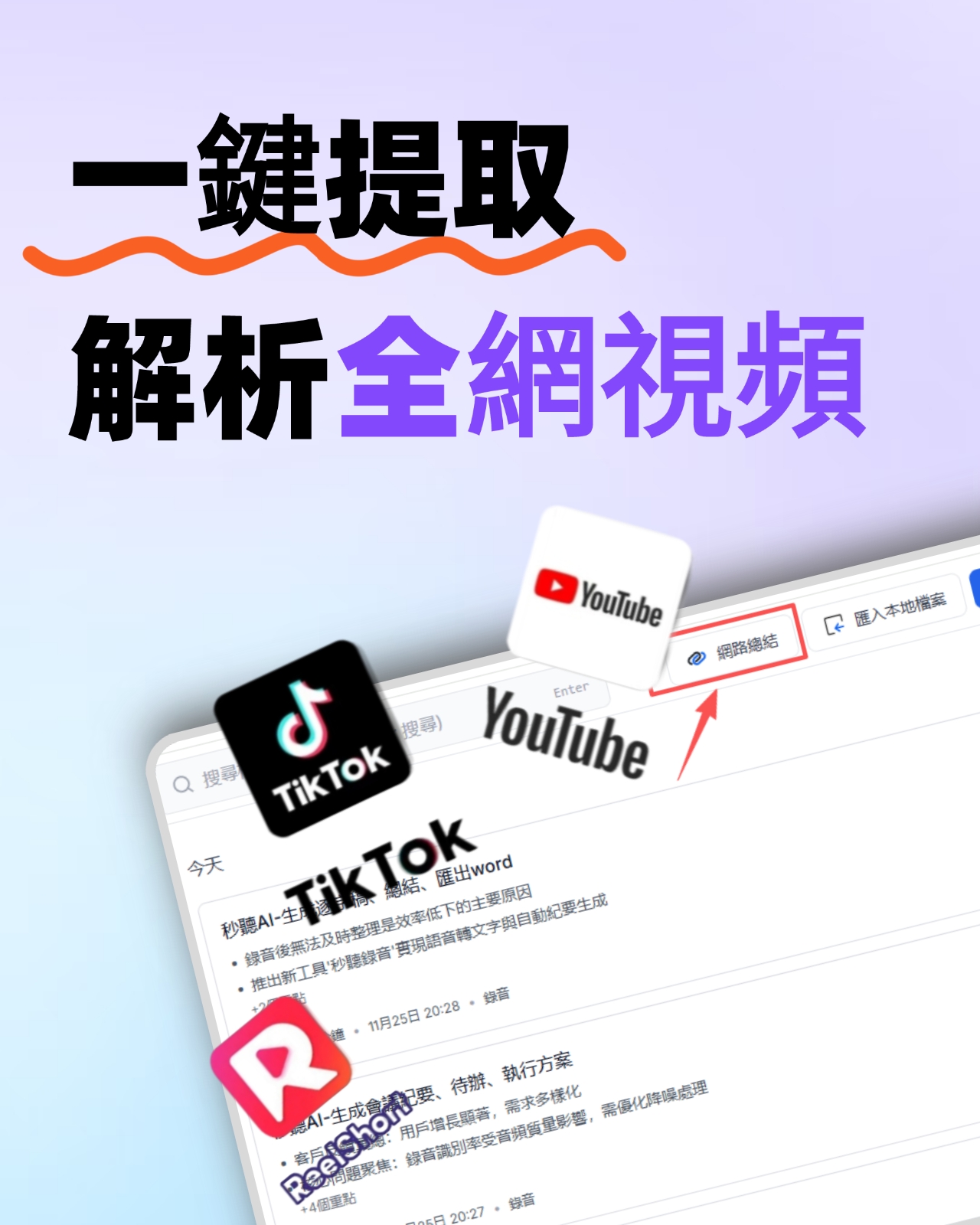
So in this article, I'll walk you through the method I've tested myself: using an iPhone to record Google Meet content and then leveraging Tinrec to organize it into usable materials.
This guide uses Tinrec (also known as "Miao Ting Lu Yin") as an example—it's an AI-powered recording and audio/video organizing tool, perfect for meetings, studying, interviews, and content creation.
Before You Start: What You'll Need
• An iPhone (iOS 14 or later; Tinrec is free on the App Store)
• Download the Tinrec app and sign up quickly with your Google or Apple ID
• Install the Google Meet app (log in with your existing account)
• A stable internet connection (real-time transcription requires internet; download language packs for offline use)
• A quiet environment (or wear headphones to reduce echo)
Step 1: Record the Full Google Meet Content with Your iPhone
The goal of this step is to capture a clear meeting recording—the foundation for everything that follows.
My approach: open Tinrec before joining the Google Meet meeting.
Tap the record button on the main screen, then switch back to Google Meet and turn off your iPhone's "Do Not Disturb" mode to avoid notifications interrupting the recording.
Keep your phone close to you during recording, or place it on a stable surface. The closer it is, the clearer the audio.
For group discussions, I put the phone in the center of the conference table; for one-on-one, between me and the other person.
Why pay special attention to audio quality? Because AI transcription accuracy depends directly on audio quality—if the sound is muddy, even the best engine won't help.
After the meeting, return to Tinrec and tap Stop. The recording will appear on the main screen with its duration and file size displayed.
(Illustration: a person sitting at a desk, iPhone on a stand recording, screen shows Google Meet meeting, while Tinrec runs in the background)
Step 2: Let AI Transcribe for You
The goal here is to turn the audio file into searchable, editable text.
In Tinrec, tap the recording you just made, then select "Transcribe." The app will start processing.
Usually, a few minutes of meeting recording transcribes quickly; you don't need to watch the screen.
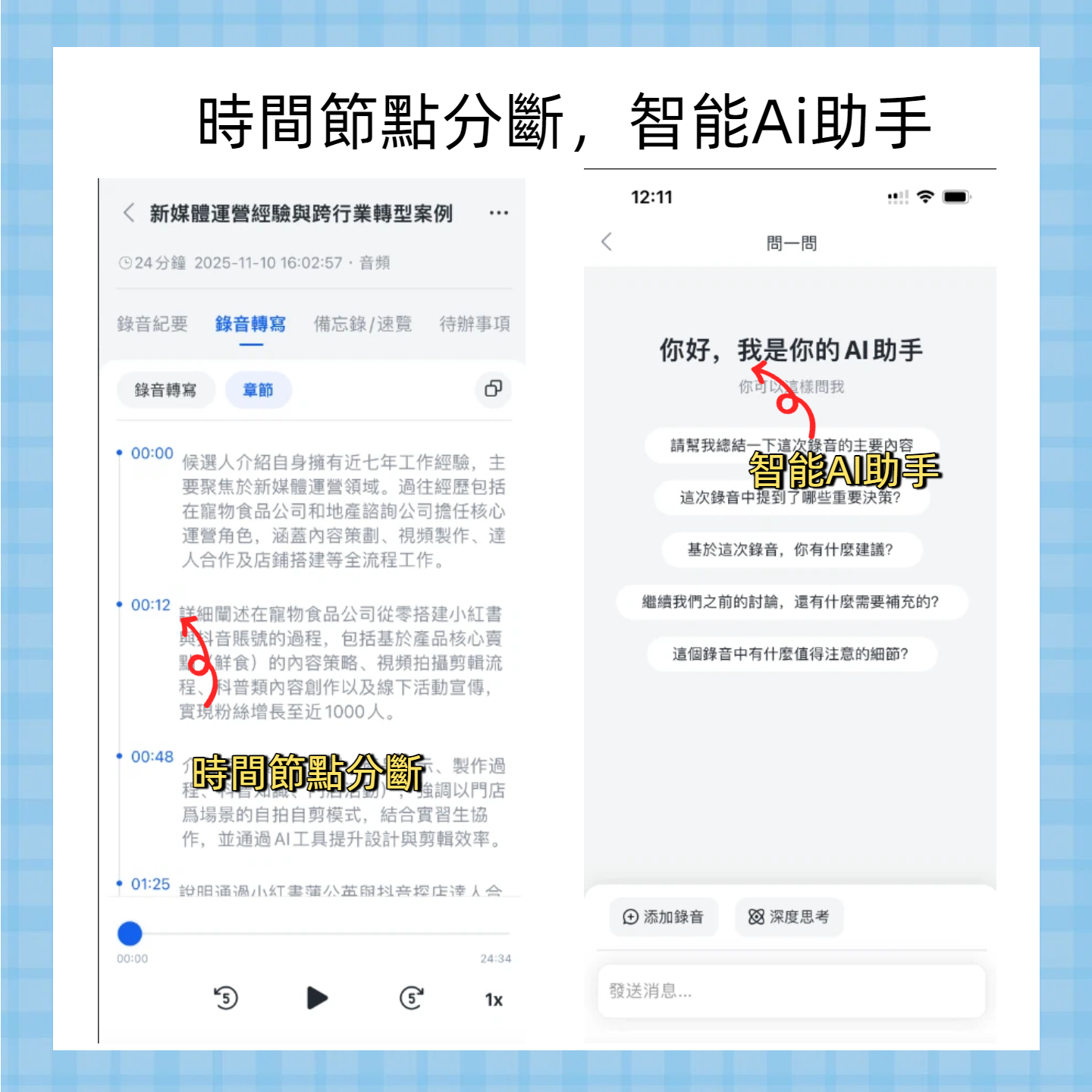
Once done, you'll see a transcript with time stamps and clear paragraphs.
What I particularly like about Tinrec is that it doesn't just output text—it also auto-segments and labels chapters, going beyond simple transcription tools.
(Illustration: phone screen showing a transcript with time markers, clear text, chapter markers on the right, with a modern office desktop background)
Step 3: Quickly Proofread the Transcript
The goal is to ensure key content is error-free and prevent inaccuracies in the summary.
I don't proofread word by word; I quickly scan important sections.
Check names, numbers, and decision points against the original recording.
Stop organizing recordings by hand
Upload audio or video and automatically get a transcript, summary, and action items
Tinrec has built-in smart noise reduction, so error rates are low in most cases. But multiple people speaking simultaneously or technical terms may still be misrecognized.
Rather than spending a lot of time proofreading later, spend an extra 30 seconds optimizing the recording position.
(Illustration: a person in front of a laptop, holding a phone showing the transcript, taking notes on the laptop, with a small checkmark icon indicating proofreading complete)
Step 4: Let AI Generate Meeting Minutes
The goal is to condense the long transcript into structured key points that can be shared directly as a document.
On the transcript page, tap "AI Summary." Tinrec will automatically produce a meeting summary, to-do items, and action lists.
You can also use the "AI Chat" feature to ask follow-up questions like: "What decisions were made in this meeting?" or "What action items were assigned to whom?"
It's like having a meeting assistant that extracts key info immediately after the session.
Why is this better than manual note-taking? Because the human brain can miss details, but AI scans every line and misses nothing.
Still, I quickly double-check the summary to ensure no misunderstandings.
(Illustration: phone screen showing meeting summary with bullet points on the left and to-do items on the right, set in a bright office environment for a productive feel)
Step 5: Export and Share
The goal is to move the organized material where you actually work—for example, email to the team or save into a note-taking app.
Tinrec supports multiple export formats: TXT, PDF, Word, and even direct sync to Notion or Google Docs.
My habit: export the meeting minutes as PDF and email to all attendees; save the transcript to Notion as a knowledge base.
If your company uses Slack or Teams, you can also share a link directly.
(Illustration: phone screen showing export menu with icons for different formats, plus a "Share" button; laptop screen shows received email)
FAQ and Troubleshooting
Q: The transcription has many errors. What should I do?
Usually caused by a noisy environment or being too far from the phone. Tinrec has built-in smart noise reduction—turn it on in settings before recording. If you're using an already recorded file, you can manually select "High Noise Environment" mode after importing—something many transcription tools lack.
Q: Google Meet audio is not being recorded?
iPhone records microphone input by default, but speaker output may be low. I recommend wearing headphones, or alternatively, log into Google Meet on iPad/computer and use your iPhone to record the external sound.
Q: Is the free version enough?
The free version of Tinrec provides basic monthly transcription credits, sufficient for typical meetings. If you have multiple meetings per week, consider the Pro plan.
Pro Tips: 3 Ways to Double Your Efficiency with Tinrec
1. Use AI Chat to Uncover Hidden Insights
After transcription, simply ask Tinrec: "Which part mentioned the budget?" or "What are the client's needs?"—this is a unique feature of Tinrec that general transcription tools can't do.
2. Cross-Platform Sync for Seamless Workflow
Record on your iPhone, then open the web version of Tinrec on your computer—everything syncs automatically. This is more convenient than hardware devices like PLAUD because you don't need to carry extra gear.
3. Directly Parse Google Meet Online Recordings
If you've recorded the meeting and stored it in the cloud, paste the video link into Tinrec—it can directly parse and transcribe it, saving you even manual recording.
If You Don't Use Tinrec, Here Are Alternatives
• Otter.ai: Great for teams with frequent online meetings, but weaker in Chinese transcription; mainly for English business meetings.
• Notta: Similar features, higher transcription credits, but lacks AI chat query and online video parsing.
In most cases, Tinrec better suits Chinese users and diverse source material processing.
Conclusion
You now know how to record a Google Meet meeting with your iPhone, then use Tinrec to turn the recording into a searchable transcript, a structured summary, and an action list—finally exporting it to your daily tools.
Next step: download the free version of Tinrec and try it on one of your meeting recordings. You'll find that the time spent on meeting notes can shrink from one hour to just ten minutes.
Test it step by step, and you'll gradually master this method.
Turn every recording into actionable outcomes
Get 60 free transcription minutes when you sign in. No credit card required.
Related Reading
You might also like
Google Meet vs Discord in 2026: Which to Choose? 5 Steps to Boost Meeting Notes Efficiency with Tinrec
Which is better for your team, Google Meet or Discord? This article not only compares the two platforms but also highlights the limitations of built-in recording features and tests how Tinrec fills the gaps in transcription, summarization, and follow-up organization, turning meeting recordings into actionable data in 5 steps.

Is Google Meet a Video Call Service in 2026? Record Meetings with These 5 Tools: Tinrec is the Most Complete
Google Meet is a video call service provided by Google, suitable for remote meetings and online education. This article answers questions about Google Meet's features and recommends 5 meeting recording tools, including live transcription, AI summaries, and to-do lists, to help you fully preserve meeting highlights.

2026 Hands-On Comparison of 3 Google Meet Meeting Note Tools: Where's the Chat Box? One-Click Meeting Summaries
Google Meet is one of the most widely used video conferencing platforms, but many users struggle to locate the chat box or quickly turn meeting discussions into text. This article compares three meeting note tools for Google Meet—from free to professional—and explains where to find the Meet chat box and how to use it.
2026 Free Google Meet Recording and Transcription: 2 Tools Compared
Looking to record and transcribe Google Meet meetings for free? This article compares Tinrec and Google Meet’s built-in transcription feature across recording flexibility, transcription quality, post-meeting organization, and pricing to help you choose the right tool.
2026 Comparison of 3 Google Meet Virtual Background Methods: From Built-in to Professional
Want to change your Google Meet background without the hassle? This article compares three options—built-in features, free virtual cameras, and professional hardware—to help you find the best fit for your meeting scenario.
Tutorial: How to Turn Off Video in Google Meet in 2026 and Use Tinrec for Audio-to-Text Transcription & Automatic Meeting Minutes
This tutorial shows how to turn off your video in Google Meet meetings while using Tinrec to record, transcribe, generate meeting minutes, and export them. Perfect for professionals who want to keep their camera off but still have a complete record. Free trial available.
![[Tutorial] How to Use Google Meet Without an Account in 2026: Real-time Audio Transcription + Auto Meeting Minutes](https://record-img.tos-accelerate.volces.com/images/2026/07/18/1784377657091046075.png)
[Tutorial] How to Use Google Meet Without an Account in 2026: Real-time Audio Transcription + Auto Meeting Minutes
Join Google Meet without a Google account, and use Tinrec for real-time recording, transcription, and automatic meeting minutes. This tutorial walks you through step by step so you never miss a thing.

The Complete Guide to Google Meet Friend Gatherings in 2026: Automatically Record and Organize Chats with Tinrec
Tired of forgetting what you talked about in your Google Meet friend gatherings? This guide shows you how to use Tinrec to transcribe audio, generate AI summaries, and extract to-dos, turning every laugh and plan into searchable, memorable content. From real-time recording to post-meeting Q&A, make your friend gatherings more than just 'meeting up' — truly preserve valuable records.
The Ultimate 2026 Guide to AI Meeting Notes: The Essential Tinrec Alternative for Google Meet Users
This article shows how to break free from Google Meet's built-in limitations, using Tinrec to turn meeting recordings into searchable, organizable, and exportable actionable knowledge, ideal for professionals who want to truly improve post-meeting efficiency.