
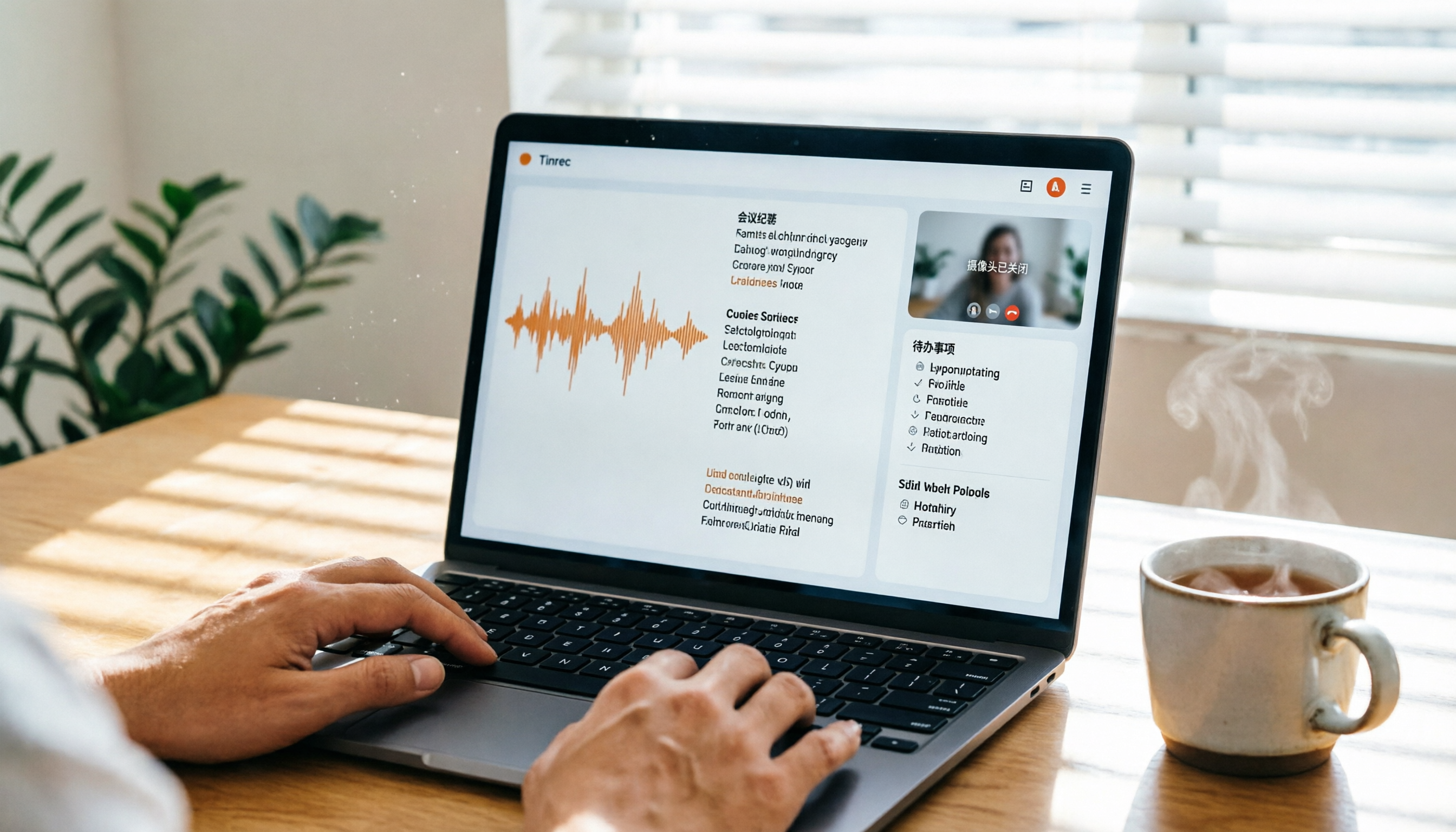
Turn recordings into transcripts and summaries in minutes
Upload audio or video for multilingual transcription, AI notes, and action items
Google Meet is a top choice for many companies for remote meetings, but occasionally you may want to keep your camera off—maybe your environment is messy, you want to save bandwidth, or you simply want some privacy. Turning off your video is easy, but the key is: after turning off the camera, how do you fully capture the meeting content? This article uses Tinrec (Miaoting Recording) as an example to walk you through setting up Google Meet without video and using Tinrec to convert meeting conversations into high-quality transcripts and automatically generate meeting minutes. Tinrec supports iOS, Android, and a web version, with a free tier that offers basic transcription credits each month, making it suitable for general office workers and small-to-medium business employees.
Before You Start | What You'll Need
• A Google Meet meeting link: Whether it's a scheduled weekly meeting, project meeting, or an impromptu discussion. • A phone or computer (phone recommended): A separate recording device works better than a built-in computer microphone and avoids picking up system notification sounds. • Download the Tinrec App: Search for "Tinrec Miaoting Recording" on the App Store or Google Play, or use the web version at tinrec.com. • Create an account: Supports Google or Apple ID one-click login—no lengthy forms to fill out. • Confirm Google Meet camera permissions: Before joining a meeting, the browser or app will ask for camera permission; just click "Block" or disable it in the settings beforehand.

Step 1 | Record the Meeting—Replace Your Microphone with Tinrec
The goal of this step is to get a complete, clear recording of the meeting, which is the foundation for all subsequent processing.
Open Tinrec and tap the large round button at the bottom of the main screen to start recording. Then, go back to Google Meet. On the preview screen, make sure the camera icon has a line through it (off), and click "Join Meeting." Place your phone near your computer speaker or simply on the conference table—the closer it is, the clearer the audio, and the higher Tinrec's AI transcription accuracy.
Why not use Google Meet's built-in recording? Because Meet's recording notifies all participants, requires host permission, and only produces a single audio file with no transcription or organization features. Using Tinrec to record independently is not only discreet but also generates transcripts and meeting minutes afterward.
When finished, you'll see the new recording in Tinrec's list, showing duration and file size.
(Illustration: Phone placed next to laptop during a Google Meet meeting; phone screen shows Tinrec's real-time recording waveform and preliminary Chinese text recognition.)
Step 2 | Let AI Create a Transcript for You
The goal of this step is to turn the audio into searchable, editable text for quick browsing or quoting.
In Tinrec, tap the recording you just made. The system will automatically start transcribing; if it doesn't, manually click "Transcribe." Depending on the recording length, it takes about 1 minute to transcribe 10 minutes of audio. While waiting, you can turn off the screen or switch to another app—Tinrec works in the background.
Why not transcribe manually? Transcribing a 1-hour meeting by listening would take at least 3 hours. Tinrec's AI transcription is not only fast but also correctly identifies Chinese punctuation and paragraphs, making it especially suitable for meetings that mix Chinese and English (many international competitors have limited support for Chinese).
Once transcription is complete, a timestamped transcript is generated, with each sentence corresponding to a point in the audio.
(Illustration: Computer screen showing the completed transcript with timestamps on the left and speech content on the right; the top shows the recording file name and duration.)
Step 3 | Quickly Proofread the Transcript and Highlight Key Points
The goal of this step is to correct any minor errors and mark important points, making the subsequent meeting minutes more precise.
Play the recording while editing the transcript; if you hear an important decision, long-press that segment to add a "highlight." Tinrec also supports adding memo notes directly, such as "Q3 budget confirmed" or "To-do: Contact vendor."
Stop organizing recordings by hand
Upload audio or video and automatically get a transcript, summary, and action items
Why proofread? AI may occasionally misinterpret proper nouns, names, or non-standard accents. Spending 5 minutes to quickly review can significantly improve the quality of the AI summary later. Rather than producing error-filled meeting notes, it's worth the extra time to proofread.
After proofreading, your transcript becomes clean and highlights are clear—it can even serve as a backup meeting record.
(Illustration: Phone or tablet editing a transcript; some text is highlighted in yellow as key points, with a memo window popping up.)
Step 4 | Generate Meeting Minutes with One Click
The goal of this step is to extract key information from the lengthy conversation and turn it into a meeting record that can be sent directly to the team.
On the transcript page, click "AI Summary" or "Meeting Minutes" (depending on the version). Tinrec will extract discussion topics, decisions, and action items within seconds. Even better, you can tap "AI Q&A" and ask questions directly, such as "What is the deadline for this discussion?" The AI will accurately answer based on the recording content.
Why not write it by hand? Traditional meeting notes are prone to omissions, and different people may have different conclusions. Having AI organize everything, then you confirm, saves time and adds credibility.
Once done, you'll have a structured meeting summary with action items that can be posted directly to your work group.
(Illustration: A meeting summary titled "Weekly Meeting 2026/07/04" with three sections: Discussion Items, Decisions, and Action Items, each with assignees and deadlines.)
Step 5 | Export and Share with the Team
The goal of this step is to seamlessly integrate the organized results into your team's existing workflow.
Tinrec supports exporting to Word, PDF, plain text, subtitle files, and more. It also offers sharing links or direct sync to Notion, Google Docs, Dropbox, and other common services. Click "Share" or "Export," choose your team's preferred format, and it's done in seconds.
Why export? If the record stays only in your app, it loses its collaborative value. After exporting to Word or Google Docs, colleagues without Tinrec can also edit and add feedback.
Now, meeting notes are no longer just your personal notes but a knowledge asset for the entire team.
(Illustration: Export menu showing icons for Word, PDF, TXT, etc., with arrows pointing to Notion and Google Docs logos.)
FAQ and Troubleshooting
Q: After turning off video in Google Meet, can others still see my screen? A: No. As long as you click the camera icon so it shows a red line, others will not see your video at all—they will only see your profile photo or name initials. Q: Will recording with my phone pick up ambient noise? A: It might, but Tinrec has built-in smart noise cancellation that can be enabled in settings to filter out stable background sounds like fans or air conditioning. Compared to using the phone's built-in recorder, Tinrec's audio processing before transcription improves transcript quality. Q: If multiple people speak, can Tinrec distinguish who said what? A: Yes. Tinrec has speaker separation and will label speakers as "Speaker 1," "Speaker 2," etc. Although it cannot automatically identify names, you can manually rename them for easier tracking later. Q: Is the free transcription credit enough? A: The free plan provides basic monthly credits, typically sufficient for 2–3 meetings per week (each about 1 hour). If you have frequent meetings or need to process long recordings, consider the weekly pass or Pro plan. Q: Do I need to inform participants before recording? A: According to Taiwan's Communications Protection and Surveillance Act and the Personal Data Protection Act, it is recommended to verbally inform participants at the start of the meeting that "this meeting will be recorded for note-taking purposes" or obtain their consent to avoid disputes.
Pro Tips | 3 Ways to Boost Tinrec Efficiency
1. Use AI Q&A to Find Key Meeting Information Instantly
Can't recall a number or decision after a meeting? Open Tinrec's AI chat and ask "What was the marketing budget discussed last time?" or "Who is responsible for following up with Client A?" The AI will answer based on the entire recording, even highlighting the time stamp. Most transcription tools only give you a static transcript; Tinrec lets you query meetings like a search engine, which is especially useful for historical databases.
2. Cross-Platform Sync—Seamless Transition Between Mobile and Desktop
Record on your phone, then open Tinrec's web version at the office—all recordings and transcripts are synced. You can quickly proofread using a keyboard, copy and paste, which is much more efficient than editing on a phone. This is something app-only recording tools can't do.
3. Turn Google Meet Recording Videos into Text Reports
If your meeting used Google Meet's auto-recording feature (with participant notification), you can download the mp4 and upload it to Tinrec. It will transcribe the video and generate meeting minutes of the same quality, capturing everything discussed. This way, you don't have to rewatch the video; just skim the text to grasp the key points.
If You're Not Using Tinrec, Here Are Alternatives
Of course, there are other tools on the market: Otter.ai can automatically join English meetings and summarize, but its Chinese transcription is weaker; Notta also offers good transcription quality but lacks Tinrec's online video analysis and deep AI Q&A. If you primarily handle Chinese meetings and want to manage recording and organization in one go, Tinrec is a more balanced choice.
Summary
With these 5 steps, you can now confidently turn off your camera in any Google Meet meeting while using Tinrec to turn the entire conversation into a searchable transcript, automatically generate meeting minutes, and even query key points with AI. Next step: download the free version of Tinrec and try it with your next weekly meeting. The monthly basic credits are enough for you to experience the full process without having to pay upfront.
Turn every recording into actionable outcomes
Get 60 free transcription minutes when you sign in. No credit card required.
Related Reading
You might also like
Google Meet vs Discord in 2026: Which to Choose? 5 Steps to Boost Meeting Notes Efficiency with Tinrec
Which is better for your team, Google Meet or Discord? This article not only compares the two platforms but also highlights the limitations of built-in recording features and tests how Tinrec fills the gaps in transcription, summarization, and follow-up organization, turning meeting recordings into actionable data in 5 steps.

Is Google Meet a Video Call Service in 2026? Record Meetings with These 5 Tools: Tinrec is the Most Complete
Google Meet is a video call service provided by Google, suitable for remote meetings and online education. This article answers questions about Google Meet's features and recommends 5 meeting recording tools, including live transcription, AI summaries, and to-do lists, to help you fully preserve meeting highlights.

2026 Hands-On Comparison of 3 Google Meet Meeting Note Tools: Where's the Chat Box? One-Click Meeting Summaries
Google Meet is one of the most widely used video conferencing platforms, but many users struggle to locate the chat box or quickly turn meeting discussions into text. This article compares three meeting note tools for Google Meet—from free to professional—and explains where to find the Meet chat box and how to use it.
2026 Free Google Meet Recording and Transcription: 2 Tools Compared
Looking to record and transcribe Google Meet meetings for free? This article compares Tinrec and Google Meet’s built-in transcription feature across recording flexibility, transcription quality, post-meeting organization, and pricing to help you choose the right tool.
2026 Comparison of 3 Google Meet Virtual Background Methods: From Built-in to Professional
Want to change your Google Meet background without the hassle? This article compares three options—built-in features, free virtual cameras, and professional hardware—to help you find the best fit for your meeting scenario.
![[Tutorial] How to Use Google Meet Without an Account in 2026: Real-time Audio Transcription + Auto Meeting Minutes](https://record-img.tos-accelerate.volces.com/images/2026/07/18/1784377657091046075.png)
[Tutorial] How to Use Google Meet Without an Account in 2026: Real-time Audio Transcription + Auto Meeting Minutes
Join Google Meet without a Google account, and use Tinrec for real-time recording, transcription, and automatic meeting minutes. This tutorial walks you through step by step so you never miss a thing.
2026 Google Meet Meeting Notes: 5-Step Guide to Transcribe with iPhone
Learn how I record Google Meet meetings on my iPhone, use Tinrec to transcribe audio into text, and automatically generate meeting summaries—turning audio files into actionable data.

The Complete Guide to Google Meet Friend Gatherings in 2026: Automatically Record and Organize Chats with Tinrec
Tired of forgetting what you talked about in your Google Meet friend gatherings? This guide shows you how to use Tinrec to transcribe audio, generate AI summaries, and extract to-dos, turning every laugh and plan into searchable, memorable content. From real-time recording to post-meeting Q&A, make your friend gatherings more than just 'meeting up' — truly preserve valuable records.
The Ultimate 2026 Guide to AI Meeting Notes: The Essential Tinrec Alternative for Google Meet Users
This article shows how to break free from Google Meet's built-in limitations, using Tinrec to turn meeting recordings into searchable, organizable, and exportable actionable knowledge, ideal for professionals who want to truly improve post-meeting efficiency.