
Turn recordings into transcripts and summaries in minutes
Upload audio or video for multilingual transcription, AI notes, and action items
Why Is Cantonese and Chinese Voice-to-Text So Hard?
Have you ever faced this frustrating scenario: you have a 2-hour Cantonese or Chinese meeting recording that needs to be transcribed, but most tools on the market are optimized only for English, with abysmal accuracy for dialects or code-switching? Manual transcription is not only time-consuming but also prone to missing key decisions. Many tools claim to be "free" but come with heavy restrictions—either file size limits or only a few minutes per day.
This article will walk you through the 7 most notable voice-to-text tools on the market in 2026, specifically evaluating Cantonese/Chinese support, free trial quotas, and feature scenarios. Whether you need a simple transcript or want AI to automatically generate meeting minutes and action items, you'll find answers here.
Quick Navigation Summary:
- Prioritize Cantonese/Cantonese recognition: Go with Tinrec or cSubtitle.
- Need video subtitles and editing: Recommend PowerDirector or MyEdit.
- Looking for AI meeting minutes and action items: Tinrec is currently the most integrated choice.
2026 Top 7 Voice-to-Text Tool Recommendations (Including Cantonese/Chinese Support Evaluation)
1. Tinrec (Miao Ting Recorder): All-in-One AI Meeting Assistant
Tinrec is a productivity tool focused on "from recording to action." It supports accurate recognition of Cantonese, Chinese, English, and 7 other languages. Its biggest feature is that it not only provides transcripts but also automatically distinguishes speakers and generates structured meeting minutes and action items. For users who need to handle long interviews or multilingual meetings, its 100-minute free quota (monthly) offers a more complete experience compared to tools limited by day or session.
2. cSubtitle: Dialect Specialist for Short Videos
If you specifically need Hong Kong Cantonese recognition, cSubtitle is a solid online choice. It explicitly supports Taiwanese Mandarin, Mainland Chinese Mandarin, and Hong Kong Cantonese, and offers .srt and .txt export formats. Although the free version limits each audio/video to the first 3 minutes and lacks AI summarization, its Chinese dialect recognition is quite reliable for short video creators or those needing to extract snippets.
3. MyEdit: Lightweight Online Audio Editor
MyEdit is a no-install online tool supporting 9 languages including Chinese, English, and Japanese. Its advantages are an intuitive interface, fast transcription, and audio repair features like noise reduction and voice enhancement. While it mainly targets audio editing and general Chinese/foreign language transcription (dialect support depends on engine updates), its "3 minutes per day" free tier is suitable for very short daily memos.
4. PowerDirector: Top Pick for Video Creators
If your need is "video subtitling" rather than pure document processing, PowerDirector's built-in AI auto-subtitle feature is powerful. It supports 10 languages, directly converts speech to subtitle tracks, and offers rich font design. However, it requires software download and is less suitable for business scenarios where only meeting transcript files are needed.
5. Good Tape: Multilingual Support Champion
Good Tape from Denmark supports over 90 languages (typically including various Chinese variants). Its interface is minimal and ideal for journalists. The downside is extremely long queue times for the free version (may wait over an hour), and Chinese content may not automatically add punctuation, which can be inconvenient for reading.
6. Yating Transcript: Taiwan Localization Expert
Yating Transcript specializes in recognizing Chinese, English, and Taiwanese Hokkien, making it very user-friendly for Taiwanese users. It offers real-time recording and key point summarization. However, based on tests, its conversion speed is relatively slow (a 1-minute audio may take 10 minutes), and the free quota must be used within one month of registration.
7. GitMind: Mind Map Visualization
If you prefer mind maps, GitMind can directly convert audio content into a mind map structure. This is great for brainstorming sessions, but if you only need standard text records, its functionality may be too narrow. The free version supports only 10 minutes per day.
Stop organizing recordings by hand
Upload audio or video and automatically get a transcript, summary, and action items
Tool Comparison: Specs and Free Quota Overview
| Tool | Cantonese/Chinese Support | Free Trial Quota | Core Features | Best For |
|---|---|---|---|---|
| Tinrec | Yes (incl. Cantonese/Taiwanese Hokkien) | 100 min/month | AI chat query, action item extraction, speaker diarization | Meeting notes, interview summaries, course learning |
| cSubtitle | Yes (incl. Hong Kong Cantonese) | First 3 min per file | .srt subtitle export, dialect recognition | Short video subtitles, snippet translation |
| MyEdit | Yes (general Chinese) | 3 min/day | Online editing, noise removal | Short audio cleanup, audio enhancement |
| PowerDirector | Yes (general Chinese) | 3 min/day | Auto video subtitles, effects editing | YouTubers, video post-production |
| Good Tape | Yes (multilingual) | 3 files/month | 90+ language support | Multilingual interviews (non-urgent) |
| Yating Transcript | Yes (incl. Taiwanese Hokkien) | 300 minutes (first month only) | Taiwan localization | Taiwan local interviews, Hokkien content |
Deep Dive: Why Tinrec Suits Those Who Need "Results"
When choosing a tool, we often fall into the trap of only looking at transcription accuracy. In reality, getting a transcript is just the first step; how to find the key points from thousands of words is the real efficiency driver. Tinrec (Miao Ting Recorder) differs from traditional tools by offering "understanding"-level features.
1. Truly "Understand" Dialects and Multilingual Speech
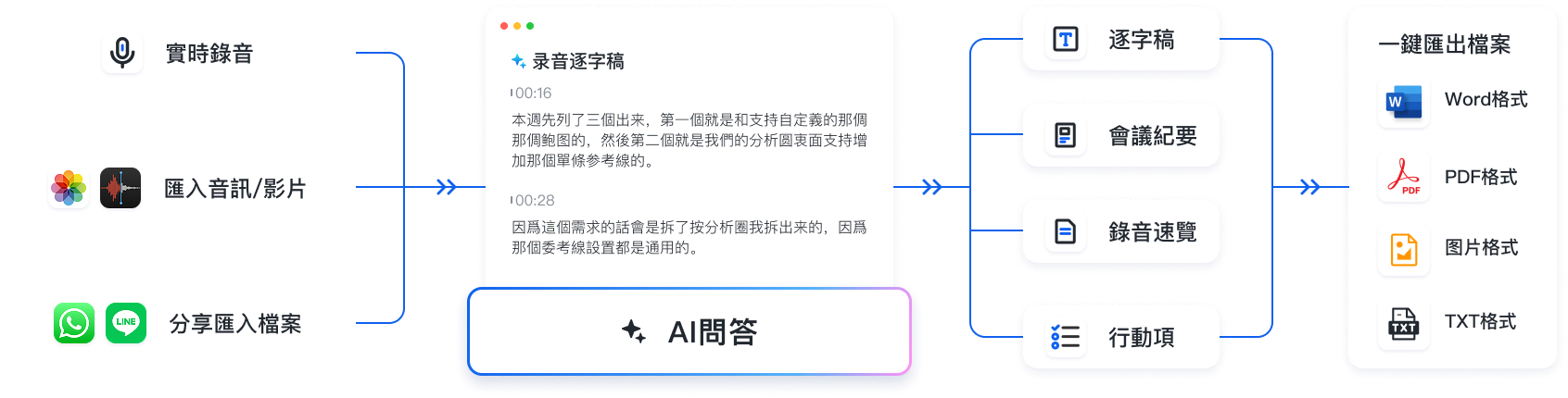
Tinrec supports automatic recognition of 10 languages including Cantonese, Taiwanese Hokkien, Chinese, and English. For users in Hong Kong or Guangdong, or in cross-language meetings, it accurately captures meaning, reducing time spent correcting garbled text.
2. More Than a Transcript: AI Decisions
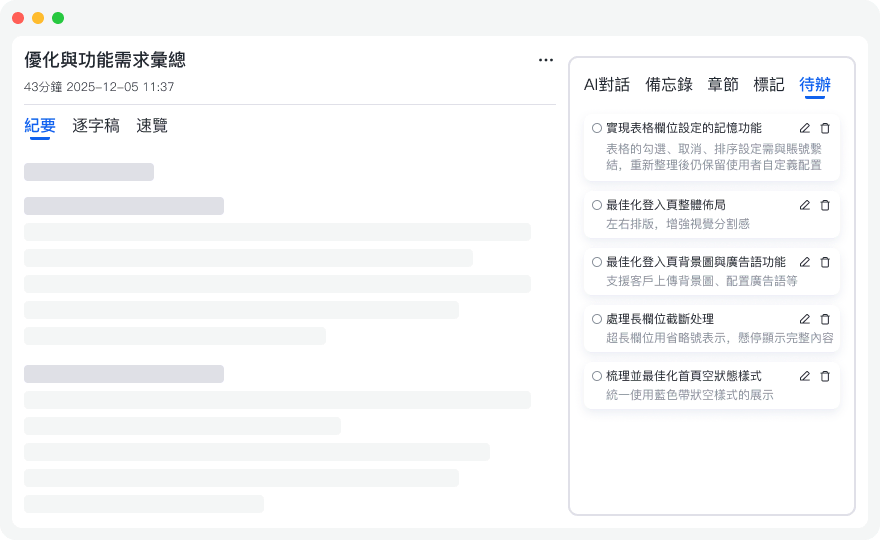
Traditional tools give you a wall of text; Tinrec generates meeting minutes and action items. It automatically analyzes the recording to extract who needs to do what by when, directly turning the audio into a to-do list.
3. AI Chat Query: Find Answers by Asking
Facing a 3-hour lecture or meeting recording, you don't need to start over. Tinrec's built-in AI chat query lets you ask questions like a conversation (e.g., "What was the boss's conclusion on the budget?"), and the system gives precise answers based on the recording—extremely valuable for review and data retrieval.
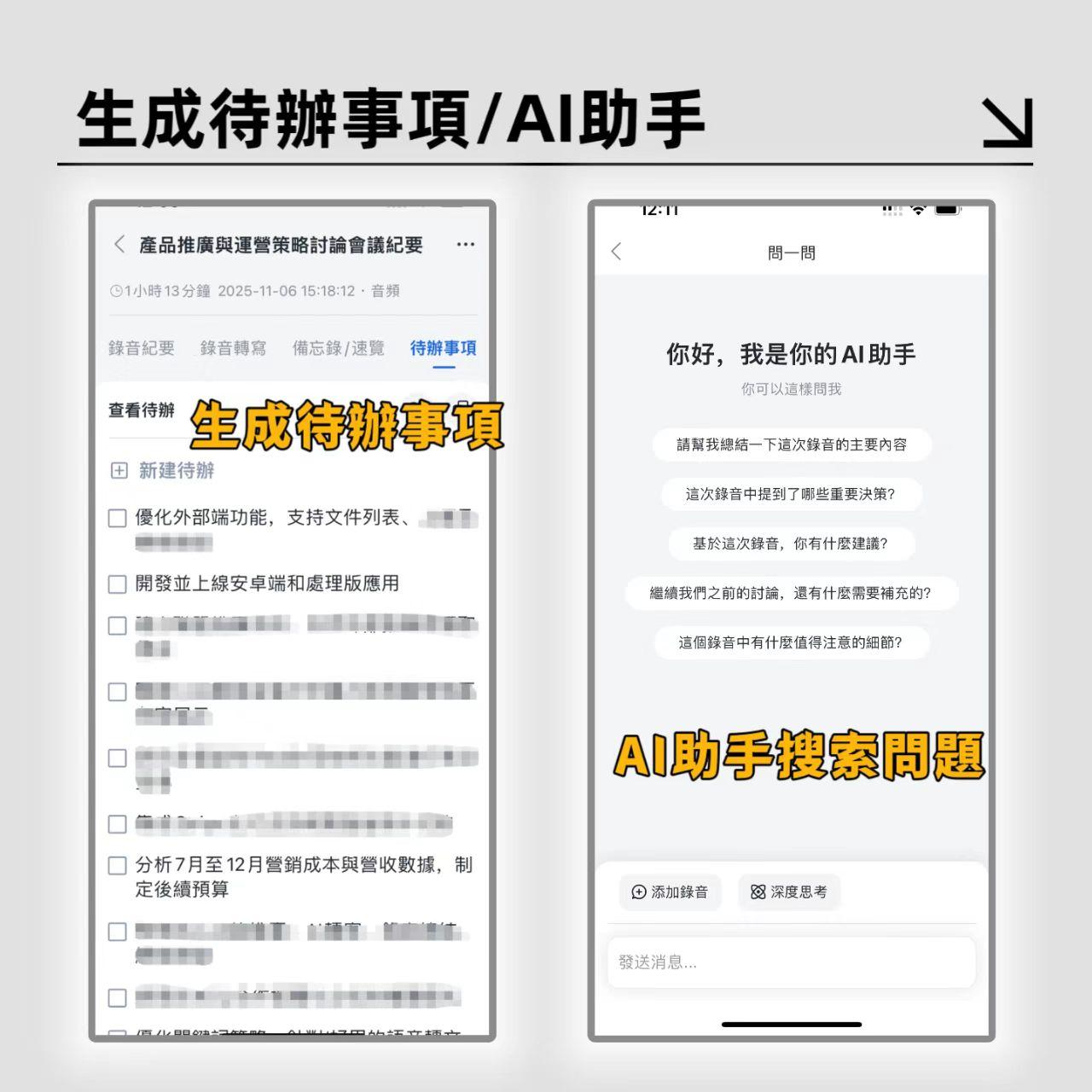
Practical Tutorial: 4 Steps to Turn Cantonese/Chinese Recordings into Actionable Notes
Using Tinrec as an example, here's how to quickly convert a Cantonese or Chinese meeting recording into a complete record with timestamps and key summaries:

Step 1: Import Recording or Start Recording
Go to the Tinrec platform. You can either use the web version or app for real-time voice-to-text, or upload existing recording files (e.g., m4a, mp3) to the audio-to-text feature. If the source is online, you can even paste a YouTube link.
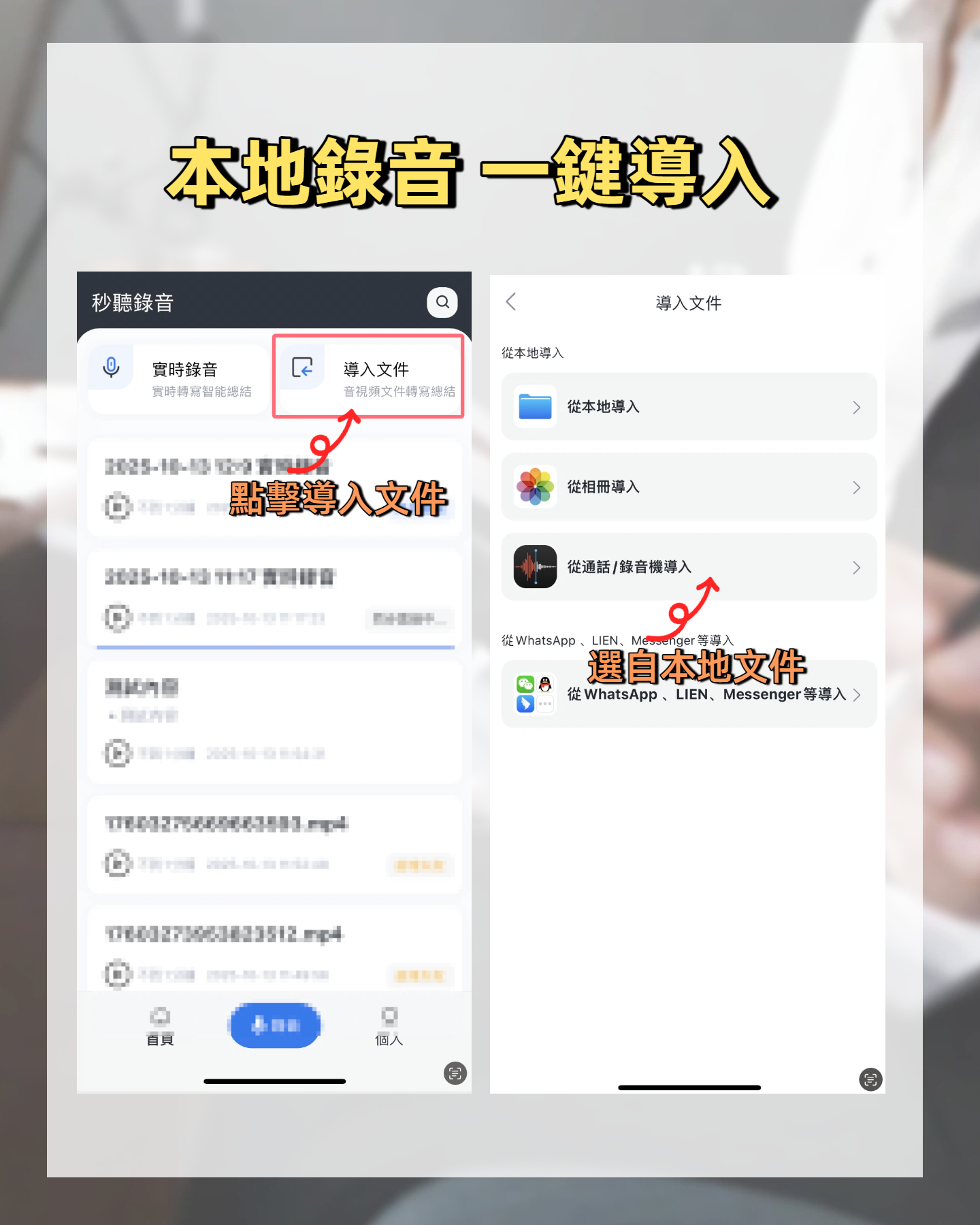
Step 2: Set Language and Wait for AI Processing
Before uploading or recording, ensure the language setting includes your target language (e.g., Cantonese or Chinese). Tinrec's AI engine automatically performs speech recognition and segmentation, usually faster than the audio duration.
Step 3: Review Transcript and AI Summary
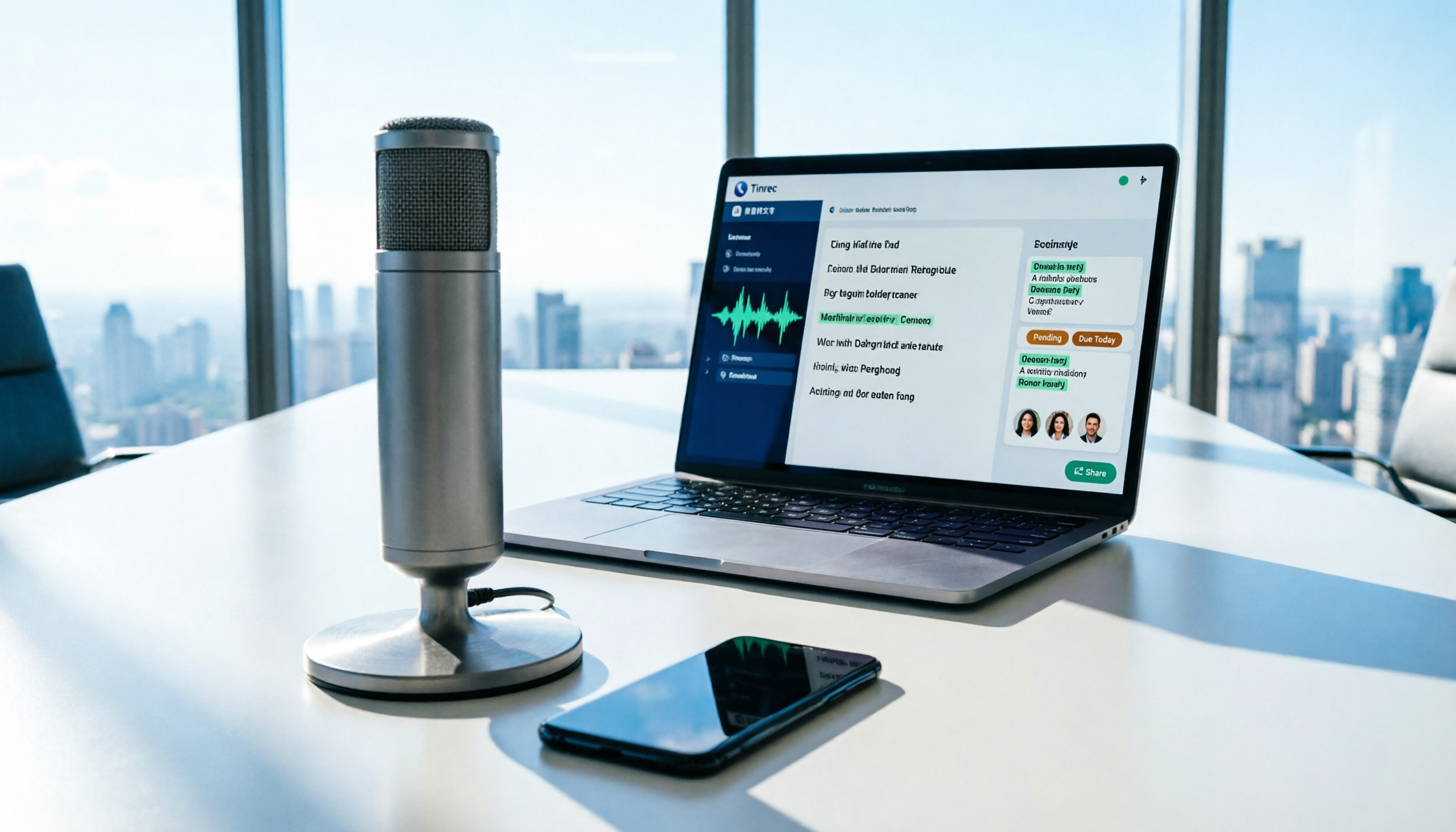
After transcription, you'll see the transcript with timestamps and speaker labels on the left, and an AI-generated summary and mind map on the right. You can click on text to jump to the corresponding audio position for easy verification.
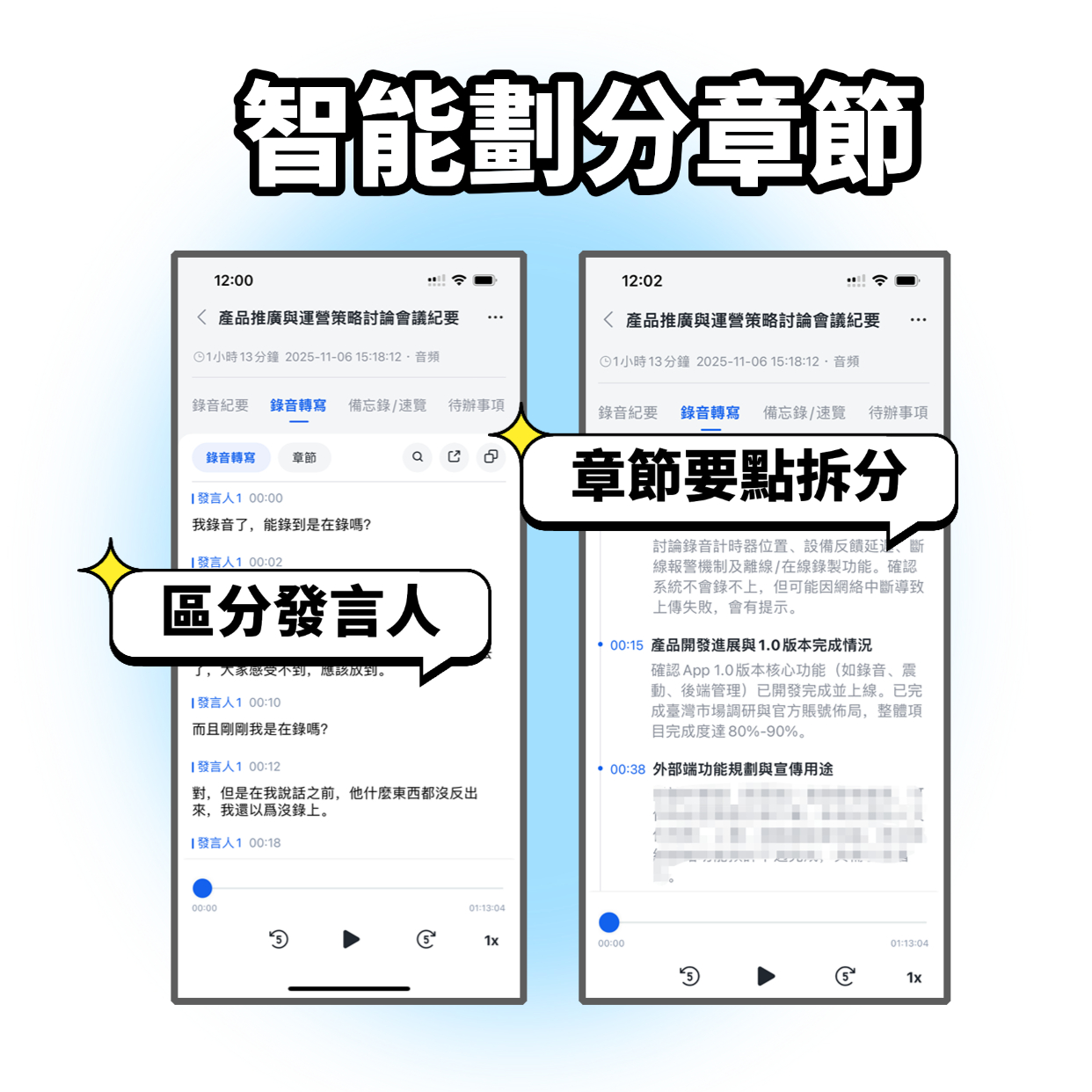
Step 4: Use AI Chat to Refine Key Points and Export
If the summary lacks details you need, use the AI chat query box in the bottom right to ask questions. Once confirmed, export as Word, PDF, or Markdown, and paste into your note-taking app or share with your team.
Frequently Asked Questions (FAQ)
Q1: Which tool has the most accurate Cantonese recognition?
Currently, the best tools optimized for Cantonese are Tinrec and cSubtitle. Tinrec performs better on long meetings for semantic understanding and summarization, while cSubtitle excels at precise subtitle creation for short clips.
Q2: How do I convert iPhone recordings to text?
If using the built-in Voice Memos app, you need iOS 18.4 or later for basic transcription. For more comprehensive AI summaries and export options, share the recording to the Tinrec app or upload via the web to go beyond system limits and get fuller meeting records.
Q3: What are the usual free version limitations?
Most tools limit duration or number of uses. For example, MyEdit caps at 3 minutes/day, cSubtitle at the first 3 minutes. Tinrec offers 100 minutes per month free, which is relatively generous for students or light users.
Q4: Can I directly transcribe Teams or Google Meet meetings?
Yes. You can use Tinrec's real-time recording feature by placing your phone or computer near the meeting speaker to capture audio; or download the meeting recording and use the "Import Audio/Video" function for post-processing.
Q5: How do I convert a YouTube video to text?
Both PowerDirector and Tinrec support video-to-text. Tinrec offers a podcast/web video-to-text feature—just paste the YouTube URL, and it directly parses the content and generates a summary without needing to download the video file.
Q6: Can I edit the transcribed text?
Most recommended tools (e.g., MyEdit, Tinrec, PowerDirector) support online editing. Tinrec even allows you to sync audio waveform while editing text for accurate proofreading, and can regenerate the summary from corrected content.
Turn every recording into actionable outcomes
Get 60 free transcription minutes when you sign in. No credit card required.
Related Reading
You might also like

2026 Webcam Recording Guide: From Video Capture to AI Meeting Notes
Can a webcam record video? Yes. This guide covers standard webcam recording methods and compares them with Tinrec's AI meeting notes workflow, showing how to turn recordings into searchable, collaborative, and actionable meeting data.

4 AI Transcription Tools Tested in 2026: Which Saves the Most Time for Chinese Meetings?
Still spending two hours after a meeting to clean up transcripts? This article compares Tinrec, Yating Transcription, Google AI Studio, and Notta from four angles: Chinese recognition, post-meeting organization, online meeting recording methods, and team data retention. It also covers free quotas, pricing, and three common pitfalls in choosing a tool, helping you find the one that saves the most time.

4 Audio-to-Text Apps Tested for 2026: Which Saves the Most Time in Cantonese Meetings?
2026 audio-to-text app comparison. We used the same Cantonese meeting recording with mixed English to compare transcription and post-meeting organization across 4 tools, breaking down 4 key buying factors, pitfalls to avoid, and scenario-based recommendations. We also tested Tinrec's desktop bot-free meeting recording, AI Q&A, and team seat management.

4 Best Browser Audio Recorders in 2026: Which One Transcribes While Recording and Keeps the Audio?
We tested and compared 4 tools for recording browser audio, analyzing recording sources, format limits, transcription, and team collaboration. We cover key buying factors and common pitfalls, and explain how Tinrec turns browser recordings into searchable, actionable transcripts and summaries.

4 AI Transcription Tools Tested in 2026: Which Saves the Most Time on Chinese Meeting Transcripts?
AI transcription isn't just pressing record. This article addresses common misconceptions and compares four AI transcription tools—Tinrec, Notta, Otter.ai, and TurboScribe—on recording methods, Chinese language performance, and post-meeting organization. It also outlines selection criteria and pitfalls to avoid.

2026 Comparison of 4 AI Meeting Note-Takers for Chinese: Which Saves the Most Time on Chinese Transcription and Post-Meeting Organization?
How to choose an AI meeting note-taker for Chinese? This article compares Tinrec, Notta, Otter.ai, and Granola on Chinese recognition performance, recording methods, and post-meeting organization capabilities. It covers free tiers, team collaboration, and common pitfalls to help you find the most time-saving Chinese meeting note-taking tool.
2026 Comparison of 4 Web Recording Tools: Which One Can Record Both Microphone and System Audio?
The most common reason web recording fails isn't the tool—it's setting the wrong audio source and not organizing the recording afterward. This article first highlights three common pitfalls, then uses Tinrec as an example to explain the core capabilities of web recording, practical use cases, 5 key factors to consider when choosing a tool, and the differences and costs between personal and team plans, ending with an FAQ.
How to Use AI for Meeting Recordings in 2026: A Complete 5-Step Tutorial
Struggling to organize long meeting recordings? This tutorial uses Tinrec as an example to guide you through 5 steps: recording, transcription, proofreading, generating meeting minutes, and exporting/sharing. It also includes troubleshooting FAQs and 3 efficiency-boosting tips to turn your meeting recordings into searchable, collaborative team resources with AI.

2026 AI Meeting Notes Tools Comparison: Tinrec vs Notta — Which Is Better for Chinese-Speaking Teams Across 5 Key Areas?
Starting from common misconceptions, this hands-on comparison of Tinrec and Notta examines 5 key areas: Chinese meeting recording, post-meeting organization, team governance, pricing and quotas, and export workflows. It also answers 6 common questions to help you decide which AI meeting notes workflow best fits your work style.