
Turn recordings into transcripts and summaries in minutes
Upload audio or video for multilingual transcription, AI notes, and action items
Last month, I attended a three-day international academic conference.
One keynote after another, parallel sessions, poster presentations – just deciding which talks to attend was a headache.
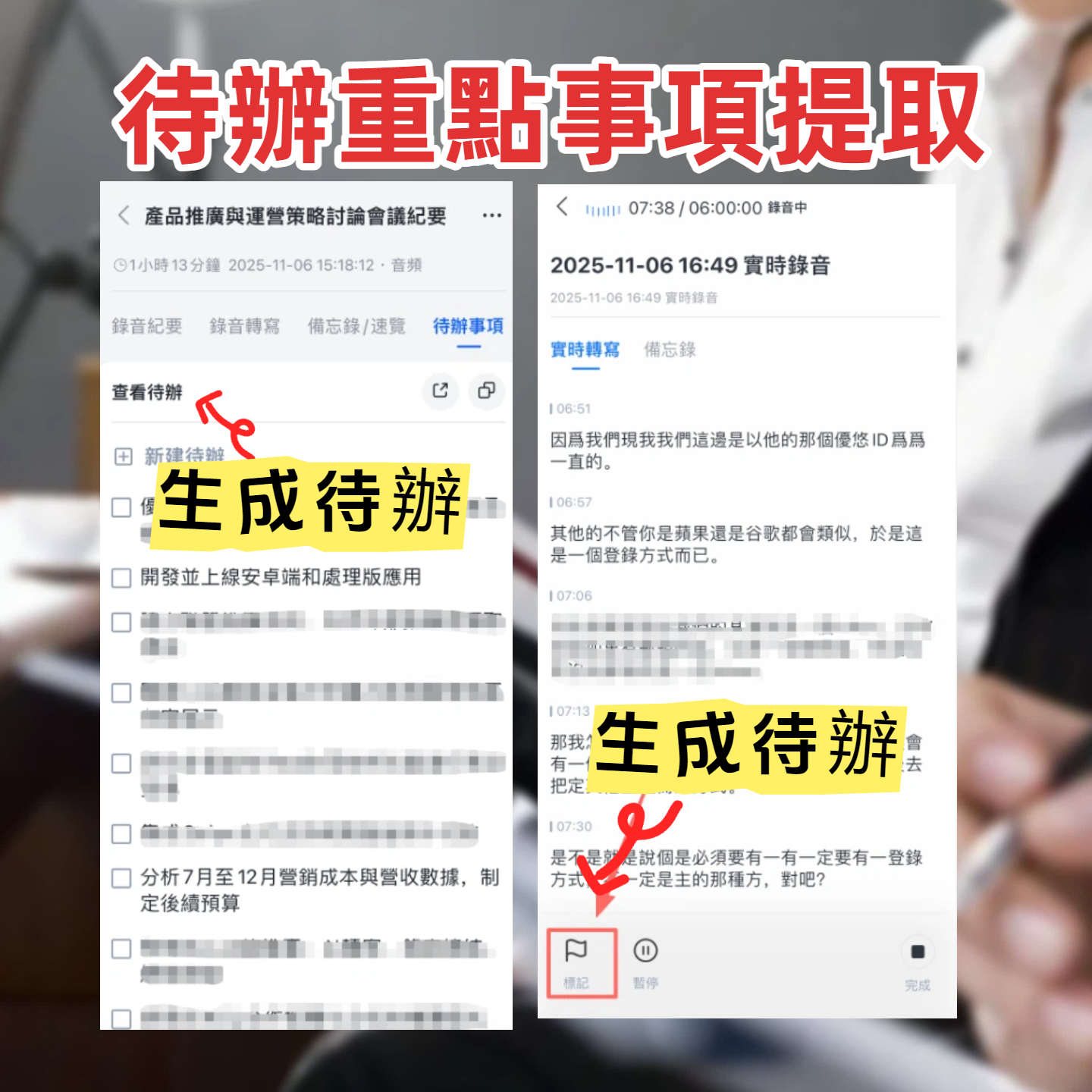
Even more frustrating: no matter how attentively you listen, without writing things down on the spot, you'll be left with only vague memories a week later.
My old habit was to bring a laptop or tablet and type quick summaries in OneNote.
But typing while listening makes it easy to miss important points when speakers suddenly mention them; no matter how fast you type, you can't keep up with the presentation pace, especially when the speaker talks quickly or has an accent.
This time, I decided to try a different approach.
I pulled out my phone, opened Tinrec, and hit record at the start of every talk.
Three days later, my phone had more than twenty recordings.
In the past, I would have handed these files to an assistant to transcribe. But this time, I handled everything myself – and finished organizing all the content in one afternoon.
(Screenshot: Tinrec main screen showing a list of multiple conference recordings, with an arrow pointing to an item labeled "International Conference Day1-Keynote")
The key is that Tinrec doesn't just transcribe my recordings – it also helps me "understand" the content.
Why Academic Conference Notes Need AI Assistance
Academic conferences are very different from regular meetings.
A one-hour keynote is incredibly information-dense. In just 15 minutes, a speaker might cite five papers, introduce three new concepts, and throw in two sets of experimental data.
Your brain is busy grasping the structure, leaving no time for note-taking.
Even if you record, re-listening to an hour of audio just to find the crucial five minutes is too time-consuming.
Over the years, I've tried several methods: using a voice recorder, typing on a laptop, and even hiring an assistant to transcribe.
But each method has its drawbacks.
A recorder only captures audio, not text; typing causes distraction; transcribing requires time for communication, and assistants may not understand specialized terms.
So I started looking for a tool that could "generate structured notes directly from recordings."
Tinrec perfectly fills this gap.
How Tinrec Turns Academic Recordings into a Knowledge Base
My on-site approach was simple:
1. Real-time transcription, confirm while listening
Before each talk, I opened Tinrec's real-time recording feature.
(Screenshot: Tinrec real-time recording interface, microphone icon active, text appearing below in real-time, arrow pointing to the constantly updating text area)
The text appeared almost simultaneously as I recorded. This had two benefits:
First, I could quickly glance to ensure the recording was capturing audio properly, avoiding the disappointment of discovering muffled audio after a whole session.
Second, if the speaker mentioned something I needed to note immediately, I could tap the "Memo" feature on that segment to quickly mark it, making it easy to find later.
(Screenshot: Tinrec recording screen with "Mark Key Point" feature, arrow pointing to color-coded markers after user tap)
2. Centralized management of multiple recordings, no confusion switching
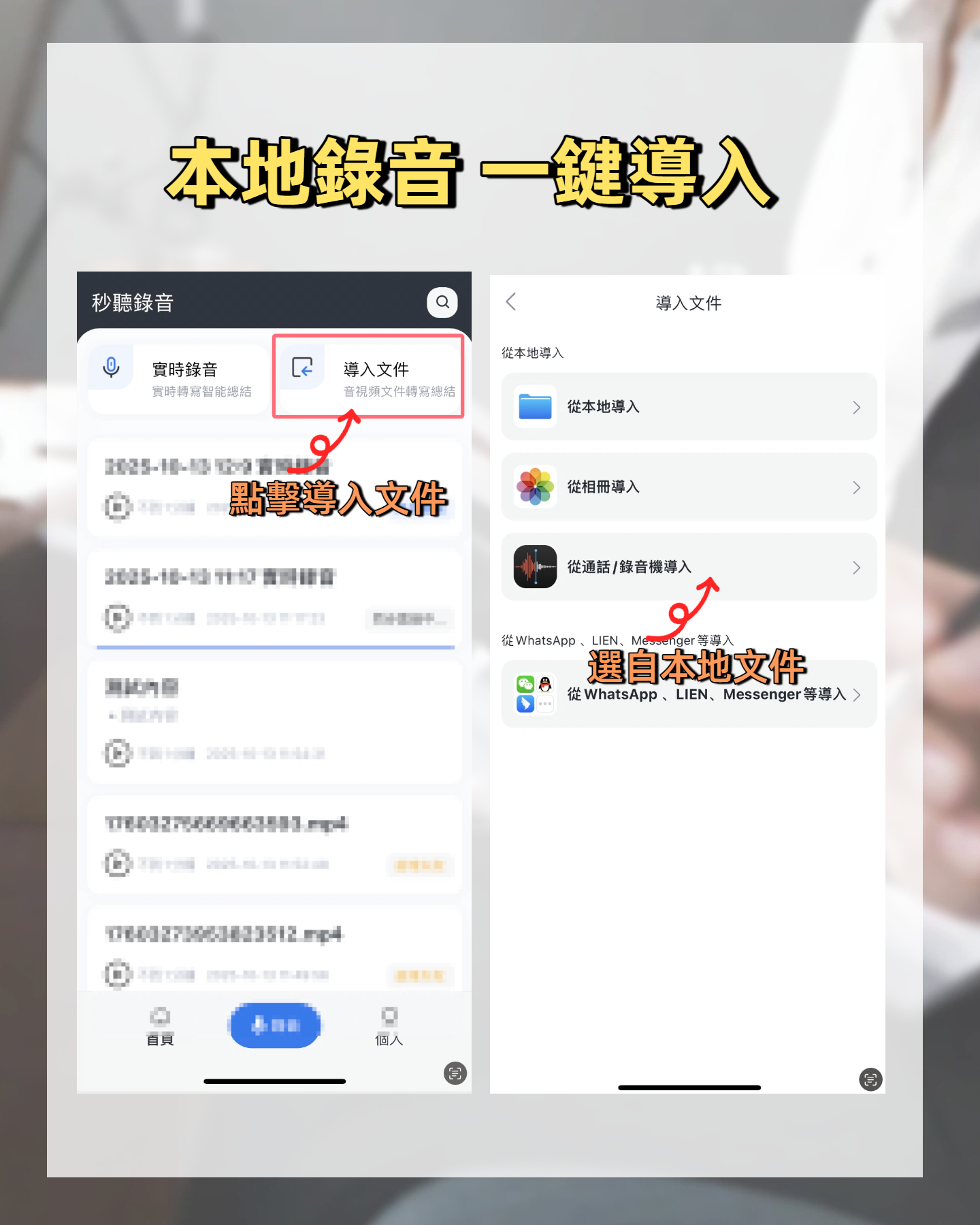
Over three days, I accumulated more than twenty recordings, each automatically transcribed and arranged chronologically.
I just tapped one to see the full transcript, summary, and key points.
(Screenshot: Tinrec recording list showing name, date, and auto-generated summary snippets for each session)
3. AI summaries and chapters – grasp a talk in five minutes
This was my favorite feature.
Opening any recording, Tinrec had already generated a summary and chapter titles.
(Screenshot: A completed talk page with transcript on the left and AI summary card on the right; arrow points to "Main Arguments" and "Research Findings" sections in the summary)
For example, for a talk on "Generative AI in Medical Imaging," the summary told me directly: the speaker believed GANs had clear breakthroughs in MRI reconstruction, but diffusion models showed more potential for ultra-high resolution.
That was far more accurate than my own recall after listening.
Moreover, the chapter feature split a 90-minute talk into six topics. To review a specific part, I just clicked the chapter title, and the transcript jumped to that section.
Stop organizing recordings by hand
Upload audio or video and automatically get a transcript, summary, and action items
4. AI chat queries – like asking an assistant who knows the content
When I needed to write conference reports or compare different speakers' views on the same topic, this feature was a lifesaver.
I opened "AI Q&A" in Tinrec and asked questions conversationally.
(Screenshot: Tinrec AI Q&A screen showing user input "What three views did the speaker present on regulatory restrictions for medical AI?" and AI listing three points with corresponding transcript excerpts)
For instance, I asked, "What specific radiology cases were mentioned in this talk?"
The AI answered directly based on the recording and provided transcript references, so I could verify the original text.
This was far smarter than a traditional Ctrl+F keyword search because it understood semantics, not just literal words.
5. Automatic to-do extraction – clearer next steps after the conference
At academic conferences, you often hear about papers worth following up, researchers to contact, or potential collaboration directions.
Previously, I'd jot them on sticky notes, half of which would get lost.
Now Tinrec's automatic to-do extraction pulls action items from recordings.
(Screenshot: Tinrec to-do page listing actions extracted from recordings, such as "Follow up on Dr. Huang's Nature 2025 paper" and "Email XX lab about collaboration interest")
Although sometimes it extracted too broadly (treating the speaker's suggestions as my to-dos), quickly editing and deleting still saved enormous time compared to creating a list from scratch.
Real Usage Scenarios: My Three-Day Conference Organization Workflow
Here's my actual process – feel free to adapt:
Scenario 1: Keynote speeches (need full context retention)
I used real-time transcription throughout and tapped "Mark Key Point" whenever I heard something important or unclear.
Afterwards, I first read the AI summary to quickly recall the gist; then I clicked into chapters to review specific topic transcripts.
Finally, I used AI Q&A to ask for things like "List five future research directions proposed in this talk."
Scenario 2: Parallel sessions (quick information filtering)
With many parallel sessions, I couldn't attend all. I selected a few interesting ones, used transcription, and only reviewed the AI summaries and chapter titles.
If the summary showed little overlap with my research, I skipped it; if highly relevant, I dived into the transcript.
This way, I could digest content from four or five parallel sessions in one hour.
Scenario 3: Poster sessions (capture key contacts)
At the poster area, I had brief conversations with researchers while keeping Tinrec recording on my phone (after informing them, of course).
A three-minute conversation, when transcribed, allowed me to use the to-do extraction feature to automatically capture the researcher's topic and contact info.
(Screenshot: To-do list from a short recording showing "Contact Dr. Zhang about deep learning model optimization" and "Download the open-source toolkit he mentioned")
Back at the office, these items went straight into my task management system.
Key Points When Choosing an AI Recording Tool for Academic Use
If you're considering a similar tool for academic conference notes, here are the aspects I found most important:
1. Real-time transcription stability
On-site recording is frustrating when it disconnects or lags. During my three-day use, Tinrec only stuttered a few times in a basement venue with weak network; otherwise, it was very real-time.
2. Recognition of specialized terms
Academic conferences are full of jargon. Tinrec recognized common AI, medical, and biology terms well, but rare terms might still be mis-transcribed. However, since the transcript is linked to the audio timeline, I could quickly find and listen to the original.
3. Reliability of summaries and Q&A
AI summaries and Q&A are very convenient, but I found that if recording quality was poor (e.g., background noise), the summary might misinterpret the speaker. So I always cross-checked important interpretations with the transcript.
4. Cross-device convenience
I recorded on my phone at the venue, reviewed transcripts on my iPad at the hotel, and later exported reports on my laptop via the web version. Tinrec's iOS, Android, and Web sync was smooth – a big plus.
(Screenshot: Multi-device sync illustration showing the same recording project on phone, tablet, and computer)
5. Export format variety
After organizing, I needed to add content to my knowledge base. Tinrec exports to Word, PDF, TXT, and can send directly to Evernote or Notion. This kept my conference materials from scattering across different apps.
Summary: Try Turning Recordings into Your Academic Assistant
Over three days at an international conference, I used more than twenty recordings to generate over forty pages of key takeaways, a to-follow paper list, three emails to international scholars, and two internal team meeting reports – something that would have taken me a full week before.
Of course, AI tools aren't magic; they require you to adjust your note-taking habits a bit and do a final manual review.
But if you attend one or two such academic conferences each year, or as a student you need to process many lecture recordings, a tool like Tinrec that can "think after transcribing" will help you turn audio files into valuable knowledge far better than a simple recorder or traditional transcription.
I recommend starting with the free version and testing it with your own conference recordings.
Go through the entire workflow once, and you'll likely discover that organizing academic conference notes can be this easy.
Quick Start Checklist:
- Download Tinrec before the conference and register a free account.
- Find a spot with good audio pickup in the venue.
- When the talk begins, open the app and start real-time recording.
- Tap "Mark" when you hear a key point for easy reference later.
- After the talk, read the AI summary and chapters first to get the big picture.
- Use AI Q&A to dive into specific topics or viewpoints.
- Export key points and to-dos into your note or task management tool.
Test it step by step, and you'll soon master this method.
Turn every recording into actionable outcomes
Get 60 free transcription minutes when you sign in. No credit card required.
Related Reading
You might also like

How to Choose an Interview Recorder in 2026? 5 Steps from Recording to AI Summary - Recommended List
Interview recorders are not just hardware; AI transcription tools help you quickly organize transcripts and summaries. This article reviews 5 recommended solutions, from free to professional, from a middle manager's testing perspective, guiding you to choose the right interview organization tool, saving time for decision-making.
2026 Tinrec vs Notta: 5-Dimension Showdown: Which is Better for Chinese Speech-to-Text?
Compare two major speech-to-text tools, Tinrec and Notta, in a deep 5-dimensional analysis covering core features, input sources, organization, Chinese experience, and pricing. Also includes Otter.ai, Fireflies.ai, TurboScribe, and more to help you find the best speech-to-text tool.

2026 Comparison of 3 Must-Have Interview Transcription Tools for Journalists: From Recording to Publishing in One Go
Still manually transcribing interviews? This article compares different transcription solutions, using Tinrec as an example, showing how to quickly turn interview recordings into searchable, quotable text material—from recording to publishing in one go.
![[Tutorial] 2026 Screenwriter Recording to Text: AI Chat Search + Auto-Organize Interview Materials](https://record-img.tos-accelerate.volces.com/images/2026/07/24/1784906635885412776.png)
[Tutorial] 2026 Screenwriter Recording to Text: AI Chat Search + Auto-Organize Interview Materials
Quickly organize screenwriter interviews, fieldwork recordings, and inspiration materials. A hands-on test of 5 recording-to-text tools, from free to professional solutions.

2026 Voice-to-Text App Comparison: Capture Ideas Accurately and Quickly
Tired of scrambling for a pen during meetings, lectures, or when inspiration strikes? This article tests 4 voice-to-text tools on accuracy, AI features, and efficiency to help you find the best assistant for recording ideas.
![[Tutorial] Tinrec Interview Transcription 2026: Real-Time Transcription, AI Summaries & Q&A](https://record-img.tos-accelerate.volces.com/images/2026/07/24/1784906660573545479.png)
[Tutorial] Tinrec Interview Transcription 2026: Real-Time Transcription, AI Summaries & Q&A
This article compares Tinrec and Plaud Note for interview recording management, covering recording sources, transcription capabilities, organization features, and pricing plans, helping you choose the right interview tool.

Tinrec Audio to Text Tutorial 2026: Supports Cantonese, AI Auto-Organizes Medical Meeting Notes
Hong Kong healthcare professionals often deal with a large number of audio recordings? This Tinrec tutorial teaches you how to use your phone or computer to quickly transcribe medical recordings and meeting discussions into text, with AI automatically organizing summaries and key points, saving you plenty of time.
Which Speech-to-Text App is Best? 2026 Hands-on Test of 4 Apps – This One is Perfect for Bloggers
As a blogger, you often need to edit videos and organize interview recordings, so finding an accurate and convenient speech-to-text app is crucial. After testing 4 tools, I found that Tinrec not only transcribes but also offers AI summaries and task extraction, perfect for content creation. Find out why it's the top choice for bloggers!
Tinrec vs Notta in 2026: A 4-Dimensional Comparison, the Best Tool for Clinical Notes
Physicians face lengthy dialogues daily, and manual or post-visit note-taking is time-consuming. This article tests two AI speech-to-text tools, Tinrec and Notta, comparing accuracy, AI post-processing, privacy, and cross-platform usability to help you find the best solution for clinical documentation.