

Turn recordings into transcripts and summaries in minutes
Upload audio or video for multilingual transcription, AI notes, and action items
Before You Start | What You Need
Preparation is key for smooth transcription of medical audio with Tinrec. Here's what you'll need:
- A smartphone or computer (iPhone, Android phone, Windows or Mac – Tinrec has an app and web version, both sync seamlessly)
- Download the Tinrec app and create an account (free download from App Store or Google Play, one-click login with Google or Apple ID)
- Prepare a medical recording (e.g., case discussion audio, doctor dictation, cross-department meeting recording, or an existing audio file)
- Stable internet connection (real-time transcription requires internet; if your hospital network is unstable, you can download offline language packs in the app settings beforehand)
Step 1 | Record What You Want to Transcribe
The goal of this step is to get a clear recording – audio quality directly determines transcription accuracy.
Open Tinrec, tap the record button on the main screen to start recording. Place your phone near the speaker – the closer, the clearer the audio. For multi-person discussions, place it in the center of the table. If it's a doctor dictating solo, a distance of about 30 cm (12 inches) is sufficient.
Why emphasize the recording environment? Because AI transcription accuracy heavily depends on audio quality – excessive background noise or distant speakers will result in more errors in the transcript. It's better to spend an extra 30 seconds positioning the phone than to spend time proofreading later.
Once done, you'll see the recording on Tinrec's main screen with its duration and file size, indicating it's ready for the next step.
(Illustration: A healthcare professional in a meeting room, phone placed on the table recording, surrounded by colleagues discussing a case – professional and natural scene)
Step 2 | Let AI Transcribe into Text
After recording, Tinrec automatically starts transcription without manual intervention. You can also import existing audio or video files, supporting common formats like mp3, wav, mp4.
During transcription, the screen displays the real-time transcript, with text appearing as you record. Medical recordings often include English drug names and technical terms – Tinrec handles Chinese-English mixed speech well, which is important for the Hong Kong medical context.
Once complete, you'll have a full transcript ready for proofreading.
(Illustration: Phone screen showing real-time transcription text, background is a hospital office, clean and clear)
Step 3 | Quickly Proofread the Transcript
AI-generated text still needs a review. Tinrec's editing interface offers several helpful features:
- Highlight key points: Use a highlighter to mark critical info, such as diagnosis conclusions or medication dosages.
- Notes feature: Add your own notes anytime, e.g., "Need to double-check here."
- Speaker differentiation: If the recording has multiple speakers, Tinrec automatically splits paragraphs and labels them as Speaker A, B, so you can quickly identify who said what.
During proofreading, you don't have to listen from start to finish – open the AI summary to review key points, then jump to relevant paragraphs. This is much more efficient.
(Illustration: Transcript editing screen, different speakers color-coded, key points highlighted)
Step 4 | Let AI Generate Medical Meeting Notes
This is Tinrec's standout feature – it doesn't just transcribe; it also organizes content.
After proofreading, tap "AI Summary" and Tinrec will automatically generate a structured summary including:
- Meeting highlights (e.g., "Confirmed transfer of Patient A to Queen Mary Hospital", "New drug trial starts next week")
- Action items (e.g., "Dr. Zhang to submit report by March 7", "Pharmacy to confirm drug inventory")
- Decisions recorded (e.g., "Agreed to adjust antibiotic regimen")
Stop organizing recordings by hand
Upload audio or video and automatically get a transcript, summary, and action items
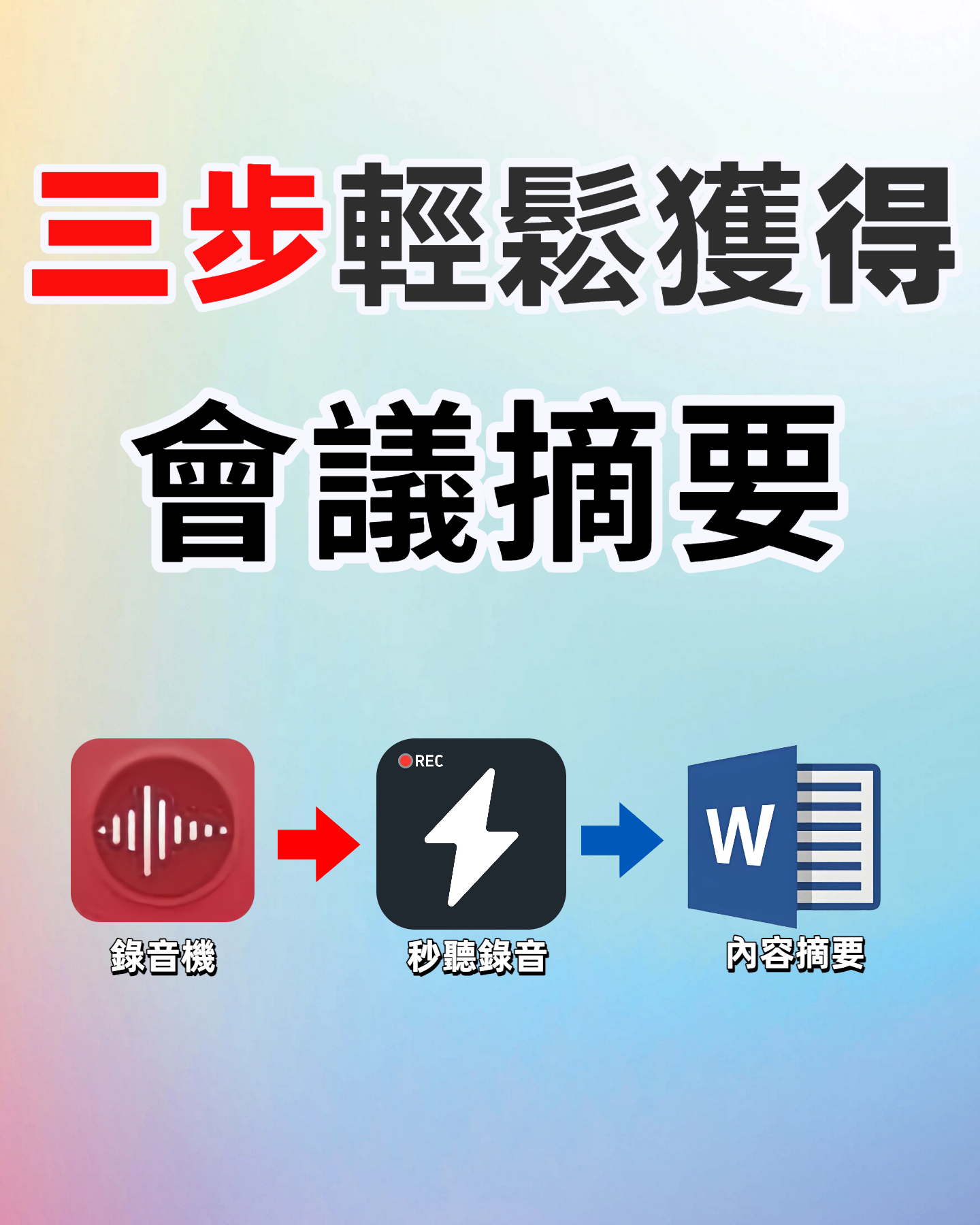
These summaries can serve as preliminary medical meeting notes, saving a lot of typing time.
(Illustration: AI-generated summary screen listing key points and action items, clean and easy to read)
Step 5 | Export and Share
Once organized, you'll want to share the notes with colleagues. Tinrec supports multiple export formats:
- Text files (TXT, DOCX): For further editing in Word or Google Docs.
- PDF: Suitable for formal archiving or sending to supervisors.
- Cloud sync (Google Drive, Notion, OneDrive, etc.): Save notes directly to a shared team folder.
You can also share a link with one click – colleagues without Tinrec can still view the transcript and summary, with password protection available to safeguard patient privacy.
(Illustration: Export options screen showing multiple formats and cloud service icons, intuitive interface)
FAQ and Troubleshooting
Q: The recording environment is noisy, resulting in many errors in the transcript. What should I do? Usually, this is due to excessive background noise or the speaker being too far away. Tinrec has a built-in smart noise reduction feature – turn it on in settings before recording to filter out ambient noise like air conditioning or street sounds. If you're using an already recorded file, you can manually select the "High Noise Environment" mode after importing – a thoughtful option not found in many transcription tools.
Q: Will medical terms be misrecognized? Common Chinese and English drug names and disease names are recognized, but very obscure terms may be incorrect. In such cases, use the "Custom Vocabulary" feature during proofreading to pre-add frequently used terms, improving accuracy.
Q: The recording is too long, and it's hard to find a specific section? Tinrec's AI Q&A feature can help. You can ask, "Which part mentions penicillin allergy?" and the system will search the transcript and highlight the relevant paragraphs – much faster than scrolling manually.
Q: When multiple people speak, can the AI distinguish who is who? Tinrec's speaker separation feature automatically labels Speaker 1, Speaker 2, etc. You can rename them during proofreading. For best results, use individual microphones for each speaker during recording.
Advanced Tips | 3 Ways to Double Tinrec's Efficiency
1. AI Dialogue Queries: Turn Historical Recordings into a Knowledge Base
Tinrec's AI dialogue function lets you ask questions about the recording content, such as: "Summarize key points from diabetes case discussions over the past three months" or "What decisions were made in this meeting?" This feature works not only within a single recording but also across recordings – all recordings in your account become a searchable database. While typical transcription tools only let you view transcripts, Tinrec transforms recordings into an interactive knowledge base.
(Illustration: AI dialogue interface, user enters a question, system responds with a summary and cited paragraphs)
2. Web Video Transcription: Organize Medical Conference Live Streams
Besides live recording, Tinrec can also paste public video links from YouTube or Bilibili and directly transcribe them into text and summaries. If you're watching an online medical seminar live stream, just copy the link, and Tinrec will automatically extract the audio for analysis – no need to record your screen and upload. This is a unique selling point not found in many competitors.
3. Cross-Platform Sync: Record on Phone, Continue Editing on Computer
Record on your iPhone, then open Tinrec's web version on your Windows computer at the office – all recordings and transcripts are synced, ready for immediate proofreading or export. No need to email yourself or use a USB drive; this seamless experience is really impressive.
If You Don't Use Tinrec, Here Are Alternatives
- Otter.ai: Excellent for English meeting notes, but Chinese (especially Cantonese) recognition is average, and it's primarily an online meeting bot without web video transcription. If your team mainly holds meetings in English, Otter is a good choice; for Cantonese medical recordings, Tinrec is more suitable.
- Notta: Features similar to Tinrec, with more transcription minutes in the monthly plan, but its AI summary and Q&A depth are not as strong as Tinrec's, and Hong Kong localization support is less comprehensive.
Overall, if you need a tool that handles Cantonese, Chinese-English mixed speech, and has powerful AI organization features, Tinrec offers great value.
Summary
Now that you've learned these 5 steps, you can use Tinrec to turn any medical recording or meeting discussion into a transcript, then use AI to automatically generate summaries, action items, and even search and ask questions across recordings. Next step: download the free version of Tinrec, import one of your own medical recordings and try it. You get 100 minutes of free transcription per month, enough to handle two or three meetings – try it and see how much time it saves.
Turn every recording into actionable outcomes
Get 60 free transcription minutes when you sign in. No credit card required.
Related Reading
You might also like

How to Choose an Interview Recorder in 2026? 5 Steps from Recording to AI Summary - Recommended List
Interview recorders are not just hardware; AI transcription tools help you quickly organize transcripts and summaries. This article reviews 5 recommended solutions, from free to professional, from a middle manager's testing perspective, guiding you to choose the right interview organization tool, saving time for decision-making.

2026 Tinrec vs Notta: 5-Dimension Showdown: Which is Better for Chinese Speech-to-Text?
Compare two major speech-to-text tools, Tinrec and Notta, in a deep 5-dimensional analysis covering core features, input sources, organization, Chinese experience, and pricing. Also includes Otter.ai, Fireflies.ai, TurboScribe, and more to help you find the best speech-to-text tool.

2026 Comparison of 3 Must-Have Interview Transcription Tools for Journalists: From Recording to Publishing in One Go
Still manually transcribing interviews? This article compares different transcription solutions, using Tinrec as an example, showing how to quickly turn interview recordings into searchable, quotable text material—from recording to publishing in one go.
![[Tutorial] 2026 Screenwriter Recording to Text: AI Chat Search + Auto-Organize Interview Materials](https://record-img.tos-accelerate.volces.com/images/2026/07/24/1784906635885412776.png)
[Tutorial] 2026 Screenwriter Recording to Text: AI Chat Search + Auto-Organize Interview Materials
Quickly organize screenwriter interviews, fieldwork recordings, and inspiration materials. A hands-on test of 5 recording-to-text tools, from free to professional solutions.

2026 Voice-to-Text App Comparison: Capture Ideas Accurately and Quickly
Tired of scrambling for a pen during meetings, lectures, or when inspiration strikes? This article tests 4 voice-to-text tools on accuracy, AI features, and efficiency to help you find the best assistant for recording ideas.
![[Tutorial] Tinrec Interview Transcription 2026: Real-Time Transcription, AI Summaries & Q&A](https://record-img.tos-accelerate.volces.com/images/2026/07/24/1784906660573545479.png)
[Tutorial] Tinrec Interview Transcription 2026: Real-Time Transcription, AI Summaries & Q&A
This article compares Tinrec and Plaud Note for interview recording management, covering recording sources, transcription capabilities, organization features, and pricing plans, helping you choose the right interview tool.

Which Speech-to-Text App is Best? 2026 Hands-on Test of 4 Apps – This One is Perfect for Bloggers
As a blogger, you often need to edit videos and organize interview recordings, so finding an accurate and convenient speech-to-text app is crucial. After testing 4 tools, I found that Tinrec not only transcribes but also offers AI summaries and task extraction, perfect for content creation. Find out why it's the top choice for bloggers!

Tutorial: Use Tinrec in 2026 to Efficiently Organize Academic Conference Notes – Real-time Transcription, AI-Generated Summaries & To-Dos
The biggest pain about academic conferences isn't understanding the talks – it's failing to take notes and not wanting to re-listen to recordings. With Tinrec, I turned three days of international conference recordings into structured summaries, searchable transcripts, and actionable checklists. This article shares how I used one app to transform audio files into truly usable data.
Tinrec vs Notta in 2026: A 4-Dimensional Comparison, the Best Tool for Clinical Notes
Physicians face lengthy dialogues daily, and manual or post-visit note-taking is time-consuming. This article tests two AI speech-to-text tools, Tinrec and Notta, comparing accuracy, AI post-processing, privacy, and cross-platform usability to help you find the best solution for clinical documentation.