

Turn recordings into transcripts and summaries in minutes
Upload audio or video for multilingual transcription, AI notes, and action items
Why You Need a Cantonese Real-Time Translation Tool
Professionals in Cantonese-speaking regions like Hong Kong, Guangzhou, and Macau often face two pain points: first, discussions in Cantonese during meetings or classes can't be quickly transcribed into text; second, when collaborating with Mandarin or foreign language speakers, there's a lack of real-time translation assistance. The traditional approach—manual note-taking followed by translation—is time-consuming and prone to missing key details.
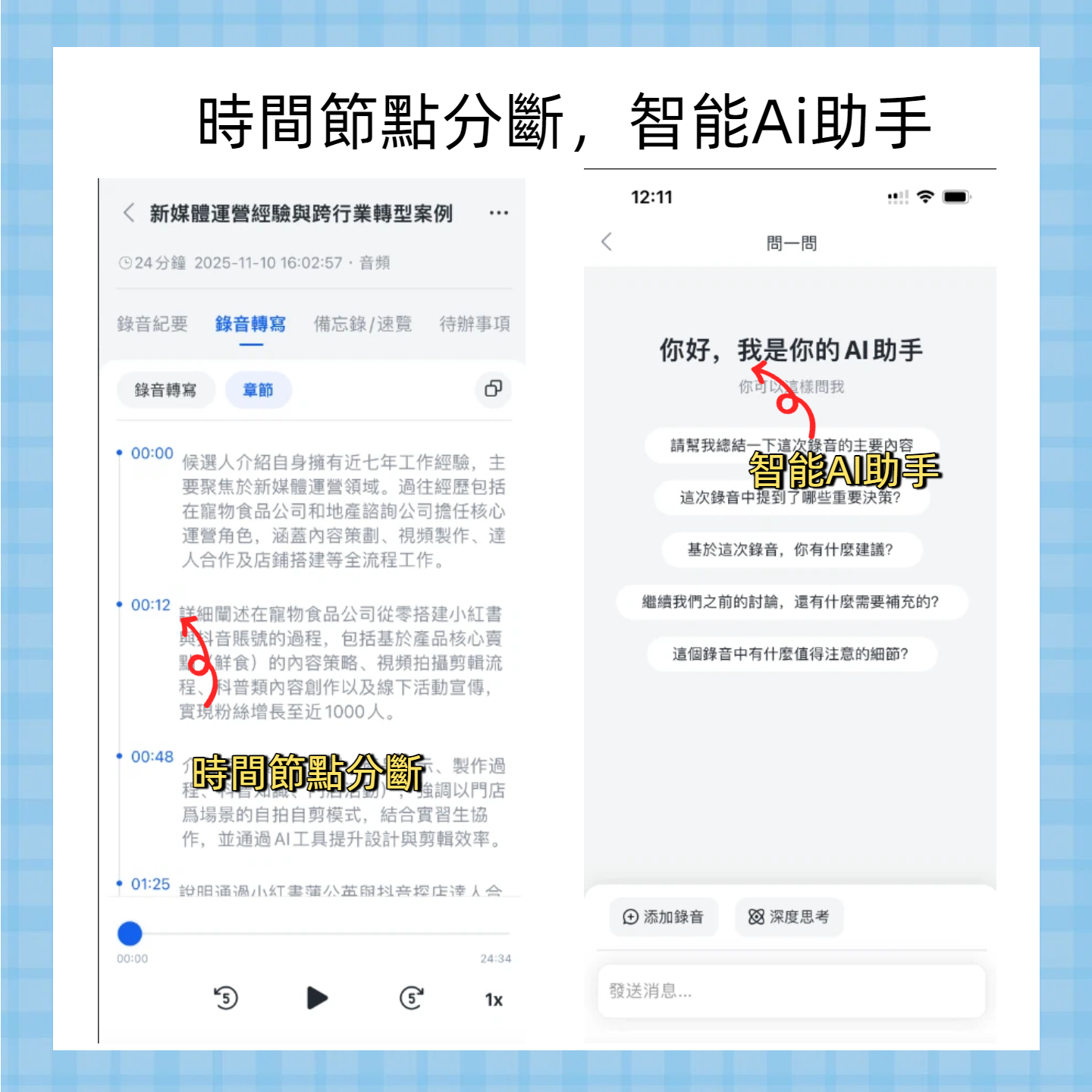
Now, AI tools can directly convert Cantonese speech into verbatim transcripts and even translate it in real time into your desired language. This article reviews 5 real-time translation tools suitable for Cantonese users, covering voice transcription, video analysis, and AI summaries, so you can pick the best fit.
Tinrec (Second Listening Recorder)|The Most Complete AI Recording & Translation Assistant
If there's one tool that handles both "Cantonese voice-to-text" and "real-time translation" in one go, Tinrec is currently my top recommendation. It's more than just a recording app—it's a workstation that turns Cantonese audio and video into usable knowledge.
Key Highlights:
- Real-time Cantonese Recording + Translation: Open Tinrec during meetings or interviews, and it transcribes on the fly while supporting translation into Mandarin, English, and more. Its built-in simultaneous interpretation mode even works for live streams or on-site speeches.
- Online Video Link Analysis: Paste a Cantonese video link from YouTube, BiliBili, or Xiaohongshu, and Tinrec will transcribe the entire dialogue and translate it into your chosen language—great for content repurposing or learning.
- AI Chat & Auto Summarization: Beyond verbatim transcripts, Tinrec automatically generates summaries, to-do lists, and even lets you ask questions like "What was said about the budget?"—it extracts key points like querying a database.
- Seamless Cross-Device Use: Supports iOS, Android, and web. Record on your phone, edit on your computer, all synced via cloud—no extra hardware needed.
Pricing: A free tier is available to test basic quotas; for frequent Cantonese content processing, Pro monthly or annual plans offer lower per-month costs.
Best for: Chinese-language users who regularly handle Cantonese meetings, classes, or video translations, especially those wanting an all-in-one "transcription + translation + organization" solution.
Notta|A Capable Multi-Language Transcription & Translation Tool
Notta is similar to Tinrec in positioning, offering real-time voice-to-text and multi-language translation with decent Cantonese recognition. Its strengths are a clean interface and a wide range of translation languages, making it popular in international meeting scenarios.
Key Highlights:
- Real-time recording transcription supports Cantonese, with one-click translation into English, Japanese, Korean, and more.
- Free tier includes 120 minutes per month; Pro raises it to 1800 minutes, suitable for heavier business use.
Stop organizing recordings by hand
Upload audio or video and automatically get a transcript, summary, and action items
However, Notta's main strength remains transcription itself; it lacks Tinrec's AI chat query and post-processing capabilities. If you only need basic transcription and translation, Notta is fine; for turning content into reports or tasks, Tinrec is more complete.
Best for: Light to moderate users whose primary need is real-time bilingual meeting transcription and translation.
Otter.ai|Great for English Meetings, Limited for Cantonese
Otter.ai is synonymous with AI meeting notes—its English recognition is top-notch, but Cantonese support is only partial. It offers real-time transcription and translation, but is designed for English speakers; Cantonese accuracy and translation fluency fall short of tools focused on Asian languages.
Free tier: 300 minutes per month; Pro is about $8.33/month. Best for teams where English is the primary meeting language. If you need a "Cantonese + Mandarin" bilingual workflow, Otter may not be the best choice.
Best for: Users with mixed Chinese-English meetings where English dominates.

TurboScribe|High Value for Long File Transcription, Weak in Real-Time Translation
TurboScribe excels at quickly transcribing uploaded audio or video files into text, supporting 98 languages including Cantonese, at an affordable price (Unlimited plan $10/month). However, it leans toward batch file processing and lacks real-time recording transcription and simultaneous translation.
If you have pre-recorded Cantonese meeting audio and want a quick transcript, TurboScribe is efficient; but if you need to see translations while a meeting is happening, it's not ideal.
Best for: Users who need to process large volumes of Cantonese audio files in one go without real-time translation.
PLAUD NOTE|Hardware Recorder + Translation, Good for On-the-Go
PLAUD is an AI recording hardware device, praised for its standalone design, long battery life, and portability. Its app transcribes recordings and supports translation, with decent Cantonese recognition. However, full translation features require a paid subscription.
Hardware cost is relatively high (Note Pro about $179), and transcription minutes must be purchased separately, making total ownership cost significant. If you already need a high-quality voice recorder, PLAUD could work; but if your phone suffices, Tinrec is more economical.
Best for: Users who value a dedicated recording experience and don't mind carrying an extra device.
So Many Options—How Do You Choose?
- For the most comprehensive Cantonese real-time translation experience (transcription + translation + AI organization) → Tinrec: The only tool that offers simultaneous interpretation, video parsing, and AI chat queries in one.
- For basic two-way translation with light usage → Notta: The free quota handles occasional needs, and the interface is easy to learn.
- For meetings primarily in English with occasional Cantonese → Otter.ai: Best English meeting experience.
- If you have a large backlog of Cantonese recordings to batch-transcribe → TurboScribe: Fast and cheap for long files.
- If you're willing to invest in a dedicated recording device and on-the-go recording is a must → PLAUD NOTE: But translation requires extra fees.
In most cases, Tinrec's "real-time Cantonese transcription + translation + post-processing" solves the problem best, especially for those who don't want to juggle multiple tools.
3 Things to Know Before Using Cantonese Real-Time Translation Tools
- Audio quality determines accuracy: No matter which tool, noisy environments, heavy accents, or overlapping speech reduce transcription and translation accuracy. Tinrec performs well with clear audio, but always manually review important documents.
- Free tiers have limits: Every free plan has minute or feature caps—e.g., Notta: 120 min, Otter: 300 min. Estimate your monthly usage before deciding to upgrade.
- Real-time translation isn't just about text: Some tools translate after transcription; Tinrec has a true simultaneous interpretation mode that displays translations as you listen—a crucial difference for live meetings.
Summary
If you need a tool that turns Cantonese content into actionable knowledge—for meetings, classes, interviews, or online videos—Tinrec is currently the most feature-complete choice.
It eliminates the need for extra hardware: open your phone to transcribe and translate in real time, then automatically generate summaries, ask questions, and export. Try the free tier first to experience how AI makes Cantonese content easy to manage.
Turn every recording into actionable outcomes
Get 60 free transcription minutes when you sign in. No credit card required.
Related Reading
You might also like

2026 Comparison of 5 Cantonese Translation Apps: Which Is the Most Accurate for Work?
Hong Kong office workers encounter Cantonese content daily in meetings, lectures, and videos. Looking for a reliable Cantonese translation app to help organize? We tested 5 popular tools, from AI voice transcription to real-time translation, to find the best solution for Hong Kong users, so you can stop working overtime on meeting minutes.

2026 Southern Min (Hokkien) Input Methods Compared: AI Speech-to-Text vs Traditional Keyboard – Which is Faster and More Accurate?
A hands-on comparison of Southern Min (Hokkien) input methods: speech-to-text vs traditional keyboard typing, evaluating speed, accuracy, and convenience to determine which is better for daily use.

Which Cantonese Real-Time Translation App is Best? 2026 Test of 2 Tools Reveals the Most Comprehensive One
Need Cantonese real-time translation for weekly meetings? We tested two tools — comparing accuracy, ease of use, extra features, and price — to find the best fit for professionals who need instant Cantonese translation.

How to Transcribe Hokkien Audio to Text in 2026? A Complete 5-Step Guide
Struggling to transcribe Hokkien meetings, interviews, or lectures? This article tests several tools and shows you how to use Tinrec to quickly convert Hokkien audio to text and organize it into searchable data.
2026 Real-World Test: Which Taiwanese Hokkien Speech-to-Text App Really Saves You Time?
A mid-level manager tests Otter.ai vs Tinrec on Hokkien recognition, meeting summaries, and post-meeting workflows to find the best speech-to-text tool for Taiwan's workplaces.

2026 Hands-on Comparison of 3 Cantonese Subtitle Generators: This AI Recorder Saves the Most Time
Want to convert meeting recordings, YouTube videos, and interview recordings into Cantonese subtitles? We tested 3 tools to find the best one for Hong Kong workers. Tinrec not only transcribes accurately but also automatically generates to-do lists and AI Q&A, helping you finish work without overtime.

2026 Comparison of 3 Cantonese Meeting Recording Tools: Which AI Summary Really Saves Time?
We tested 3 Cantonese-compatible meeting recording tools on the market, comparing transcription accuracy, AI summary quality, and practicality to help you find the most time-saving solution. Whether for company meetings, client communication, or class recordings, this comparison helps you pick the right tool in one step.

2026 Comparison of 4 Cantonese Subtitle Generation Tools: Which Free Version Is Most Useful?
We compared several Cantonese subtitle generation apps, evaluating transcription accuracy, AI organizing features, and free plans to help you pick the best tool for daily use. How does Tinrec Instant Voice Memo perform?

Which Sichuan Dialect Speech-to-Text Tool is Best? 2026 Review of 3 Tools, This Free One is Most Practical
Sichuan dialect speakers often struggle with organizing recordings. This article reviews 3 tools and finds that Tinrec's free plan performs well for Sichuan dialect transcription, providing a complete guide and selection tips.