

Turn recordings into transcripts and summaries in minutes
Upload audio or video for multilingual transcription, AI notes, and action items
Two Hours in Meetings, Another Two Hours of Follow-Up – You Don't Need More Tools, You Need a Solution
Having meetings that run until the end of the day, the worst part is having to listen to recordings afterward to produce verbatim transcripts. Especially when everyone is speaking Cantonese—there are very few tools on the market that support Cantonese transcription, and even those that do have inconsistent accuracy. Thinking of using them to generate subtitles for YouTube? You'll end up with so many mistakes you'll have to fix them manually, wasting even more time.
If you've encountered these situations, this article is written for you. Choosing the right tool can really save you a lot of overtime.
Before Choosing a Cantonese Subtitle Generator, Understand These 3 Key Points
1. Don't Trust Official Accuracy Numbers Without Real-World Testing
Many tools claim "98% accuracy," but that's measured in a quiet recording studio. In real environments with air conditioning noise, keyboard sounds, and multiple people talking at once, accuracy drops significantly. Always test with your own recordings—preferably a 5-minute Cantonese news clip or meeting with background noise—to see the true performance.
2. Can You Actually Use the Transcription Afterward?
Subtitle generation is just the first step. After that, do you need to search through the content, automatically generate action items, or directly ask the AI "What was the meeting conclusion?" These features are what truly save you time, so don't just focus on whether a verbatim transcript is available.
3. Cross-Platform Support Is Crucial
You might record on an iPhone today, process on a computer tomorrow, and review on an Android phone later—if the tool doesn't support cross-platform sync, it becomes a hassle. Choose one that offers iOS, Android, and web versions so you can work anytime, anywhere.
Tinrec – Our Top Pick After Testing
Tinrec is an AI recording assistant that supports 14 languages across iOS, Android, and the web. For Cantonese subtitle generation, it's not only accurate but also one of the few tools that turns recordings into "actionable data."
Test Process: We used a 5-minute Cantonese meeting recording (with air conditioning background noise and overlapping speakers). Tinrec's verbatim transcript had very few errors, automatically identified different speakers, and broke the content into chapters and summaries. The standout feature is the AI Q&A—after recording, you can ask "Who mentioned the budget?" and it finds relevant sections based on meaning, not just keyword search. No other tool in its price range offers this.
Core Features in Real Scenarios:
Stop organizing recordings by hand
Upload audio or video and automatically get a transcript, summary, and action items
- Start Tinrec during a meeting, and it transcribes in real time. By the time the meeting ends, the AI has already generated a summary and action items—who is responsible for what and deadlines are all clear.
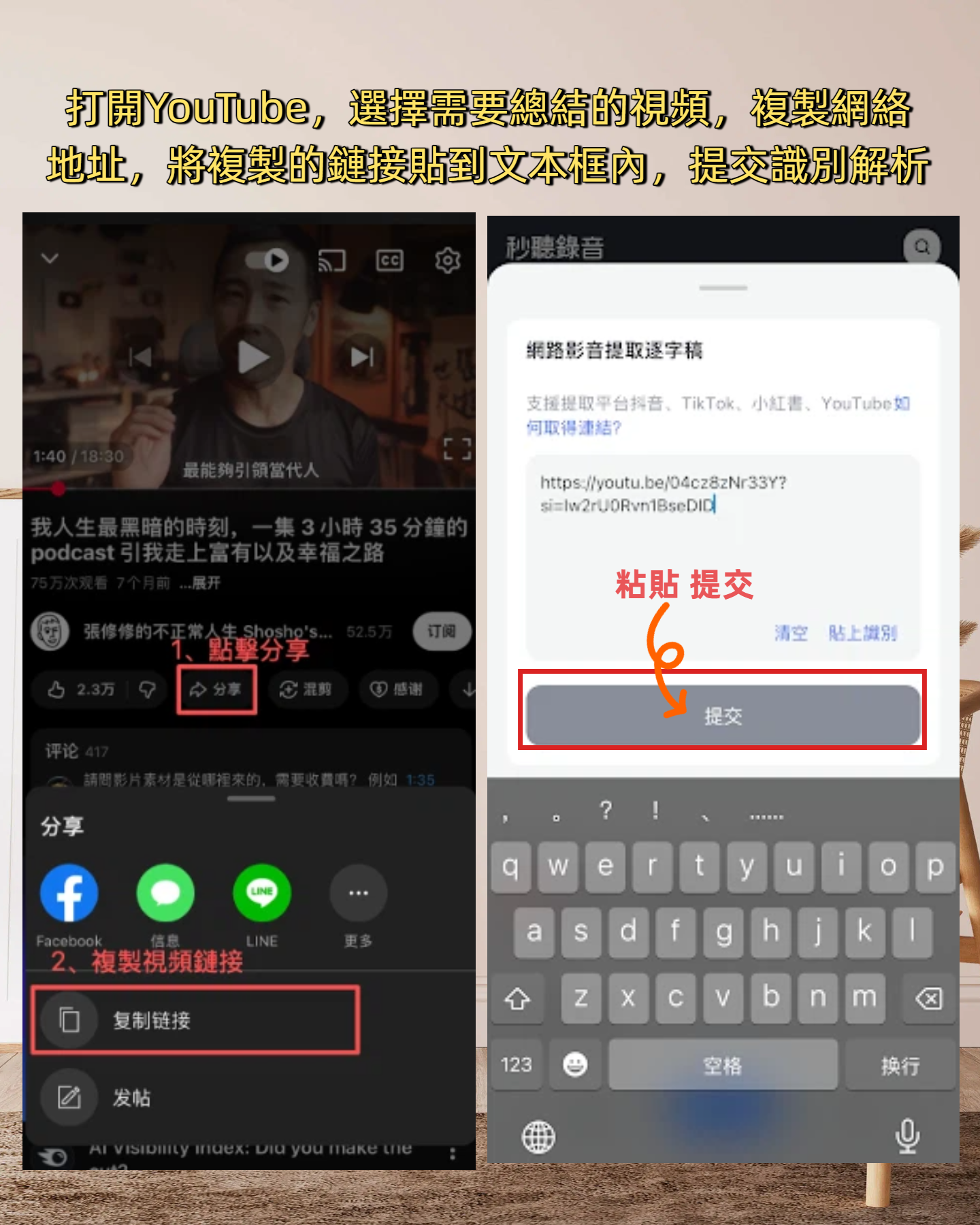
- Want to generate subtitles from a YouTube video? Just paste the link, and Tinrec provides a text version and key points, and you can even export subtitle files.
- After recording, you can ask "What was the conclusion of the last meeting?" saving time re-listening to segments.
Pros:
- Supports 14 languages including Cantonese, Mandarin, and English, with noticeably better Cantonese accuracy than most competitors.
- AI Q&A and automatic summaries are unique features, not just raw transcripts.
- Full cross-platform support with seamless sync between phone and computer.
- Free plan includes 100 minutes per month, enough for most people to try for 2-3 meetings per week.
Limitations:
- Heavy users (e.g., daily long meetings) may need to upgrade to the Pro plan.
- In extremely noisy environments (e.g., construction sites), accuracy may drop—but this is a common issue for all transcription tools.
Who Is It For:
- Hong Kong workers who frequently record Cantonese meetings, interviews, or lectures.
- Those who want to quickly convert recordings or videos into subtitles and key points without manual transcription.
- Users who need cross-platform (iPhone, Android, computer) data sync.
Beyond Tinrec, What Other Options Are There?
Otter.ai
The top choice for English meetings, with a generous 300-minute free monthly limit. But note: it does not support Cantonese. If you primarily record in English, Otter.ai is a more cost-effective option than Tinrec. However, when you need to process Cantonese recordings or use AI Q&A, Tinrec is the way to go.
Plaud Note
This is an AI recording hardware device with a sleek design, suitable for those who prefer a standalone device. However, its Cantonese accuracy is mediocre, and it has limitations: it only supports iPhone, with no Android or web version, essentially locking you into its app ecosystem. If you plan to edit recordings on a computer or want to ask the AI for key points after recording, Tinrec is a better fit.
Pitfall Guide: 3 Common Mistakes When Choosing a Cantonese Subtitle Generator
Mistake 1: Only Looking at Official Accuracy Claims — Many tools boast "98% accuracy," but that's in a lab. Real-world environments with noise and overlapping speech require you to test with your own recordings using free trials.
Mistake 2: Ignoring Post-Transcription Features — If a tool only converts recordings to text without automatic summaries, action items, or AI Q&A, you'll still spend a lot of time going through the content manually. Tinrec's AI Q&A helps you find answers directly, without scanning every line.
Mistake 3: Buying a Tool Without Using Its Cross-Platform Features — Recording on your phone and editing on your computer is the smoothest workflow. If a tool doesn't support multi-device sync, it becomes a headache. Choose a solution that works on iOS, Android, and the web to avoid being locked into a single device.
Summary: Which One Should You Choose?
The test conclusion is clear: if you need to process Cantonese content and want to immediately use AI to find key points and generate to-do lists, Tinrec is currently the most comprehensive choice. Here's a scenario guide:
- Need accurate Cantonese meeting/interview transcription → Tinrec (supports Cantonese, auto speaker identification, fewer errors)
- Want to ask AI "What was the conclusion?" right after recording → Tinrec (unique AI Q&A feature not found in competitors)
- Cross-platform use (iPhone + Android + computer) → Tinrec (syncs across all three platforms)
- Zero budget, only English recordings → Otter.ai (the only exception, but does not support Cantonese)
We recommend downloading the free version of Tinrec to try—100 minutes per month is enough for 2-3 meetings to experience the effect. Upgrade only if you find it useful; there's no need to pay upfront.
Turn every recording into actionable outcomes
Get 60 free transcription minutes when you sign in. No credit card required.
Related Reading
You might also like
2026 Comparison of 5 Cantonese Translation Apps: Which Is the Most Accurate for Work?
Hong Kong office workers encounter Cantonese content daily in meetings, lectures, and videos. Looking for a reliable Cantonese translation app to help organize? We tested 5 popular tools, from AI voice transcription to real-time translation, to find the best solution for Hong Kong users, so you can stop working overtime on meeting minutes.

2026 Southern Min (Hokkien) Input Methods Compared: AI Speech-to-Text vs Traditional Keyboard – Which is Faster and More Accurate?
A hands-on comparison of Southern Min (Hokkien) input methods: speech-to-text vs traditional keyboard typing, evaluating speed, accuracy, and convenience to determine which is better for daily use.
Which Cantonese Real-Time Translation App is Best? 2026 Test of 2 Tools Reveals the Most Comprehensive One
Need Cantonese real-time translation for weekly meetings? We tested two tools — comparing accuracy, ease of use, extra features, and price — to find the best fit for professionals who need instant Cantonese translation.

How to Transcribe Hokkien Audio to Text in 2026? A Complete 5-Step Guide
Struggling to transcribe Hokkien meetings, interviews, or lectures? This article tests several tools and shows you how to use Tinrec to quickly convert Hokkien audio to text and organize it into searchable data.
2026 Real-World Test: Which Taiwanese Hokkien Speech-to-Text App Really Saves You Time?
A mid-level manager tests Otter.ai vs Tinrec on Hokkien recognition, meeting summaries, and post-meeting workflows to find the best speech-to-text tool for Taiwan's workplaces.

2026 Comparison of 3 Cantonese Meeting Recording Tools: Which AI Summary Really Saves Time?
We tested 3 Cantonese-compatible meeting recording tools on the market, comparing transcription accuracy, AI summary quality, and practicality to help you find the most time-saving solution. Whether for company meetings, client communication, or class recordings, this comparison helps you pick the right tool in one step.

2026 Real-World Test: 5 Cantonese Real-Time Translation Tools Compared—Which One Sounds Most Authentic?
Need to transcribe or translate Cantonese in real time during meetings, classes, or interviews? We tested 5 leading AI tools for live recording, online video translation, and AI-powered Q&A to find the best solution for Cantonese speakers.

2026 Comparison of 4 Cantonese Subtitle Generation Tools: Which Free Version Is Most Useful?
We compared several Cantonese subtitle generation apps, evaluating transcription accuracy, AI organizing features, and free plans to help you pick the best tool for daily use. How does Tinrec Instant Voice Memo perform?

Which Sichuan Dialect Speech-to-Text Tool is Best? 2026 Review of 3 Tools, This Free One is Most Practical
Sichuan dialect speakers often struggle with organizing recordings. This article reviews 3 tools and finds that Tinrec's free plan performs well for Sichuan dialect transcription, providing a complete guide and selection tips.