

Turn recordings into transcripts and summaries in minutes
Upload audio or video for multilingual transcription, AI notes, and action items
How Hard Is It to Transcribe Hokkien Recordings? What You Need Is a Solution, Not Just a Tool
Spending a whole meeting speaking Hokkien, then having to manually transcribe every single word afterward—a two-hour meeting costs you another two hours—this is the daily reality for many employees in small and medium-sized enterprises and traditional industries.
Students attending Hokkien lectures or classes who want to take notes quickly but end up spending massive time replaying recordings.
Researchers conducting fieldwork or interviews, accumulating dozens of hours of Hokkien audio, yet struggling to find an affordable and accurate transcription tool.
If you've faced any of these situations, this article is for you. With the right tool, you can save up to 80% of your transcription time.
4 Key Points to Understand Before Choosing a Hokkien Speech-to-Text Tool
1. Language Support: Does It Truly Handle Hokkien?
Many transcription tools claim to support Chinese, but they're actually optimized for Mandarin, leading to significantly lower accuracy with Hokkien. Before choosing a tool, test it with your own Hokkien audio files—don't just rely on the number of languages advertised on the website.
2. AI Features: Does It Only Transcribe?
If the tool only converts audio to text, you still have to read through everything to find key points. Tools with AI summarization and Q&A functions can automatically extract meeting conclusions, action items, and even let you search through recordings conversationally—that's where the real time savings lie.
3. Cross-Platform: Should Work on Both Phone and Computer
You might record audio on your phone but prefer to edit transcripts on your computer. If the tool only supports one platform, the workflow becomes clunky. Choose a tool that supports iOS, Android, and web versions for convenience.
4. Free Tier: Try Before You Pay
Hokkien transcription quality varies widely. Always test with a few recordings using a free plan to confirm accuracy and features before committing to a paid subscription.
Tinrec (秒听录音) — Our Top Pick After Testing
Tinrec is an AI-powered audio and video transcription tool supporting 14 languages, available on iOS, Android, and web. Although it doesn't specifically highlight Hokkien, our tests show it adapts to Chinese dialects better than most competitors. Combined with its full suite of AI post-processing features, it's ideal for anyone transcribing Hokkien content.
Not Just Transcription, but Interactive Q&A with Recordings
Start recording in real time with Tinrec during a meeting, and it will display the Hokkien transcript as you speak. Once the meeting ends, AI automatically generates a summary highlighting key points, action items, and deadlines. Even better, you can ask questions like "Who mentioned the budget in the last meeting?" and Tinrec will pull relevant sections from all your historical recordings—it actually understands content, not just keyword searches.
Transcribe Online Videos Too
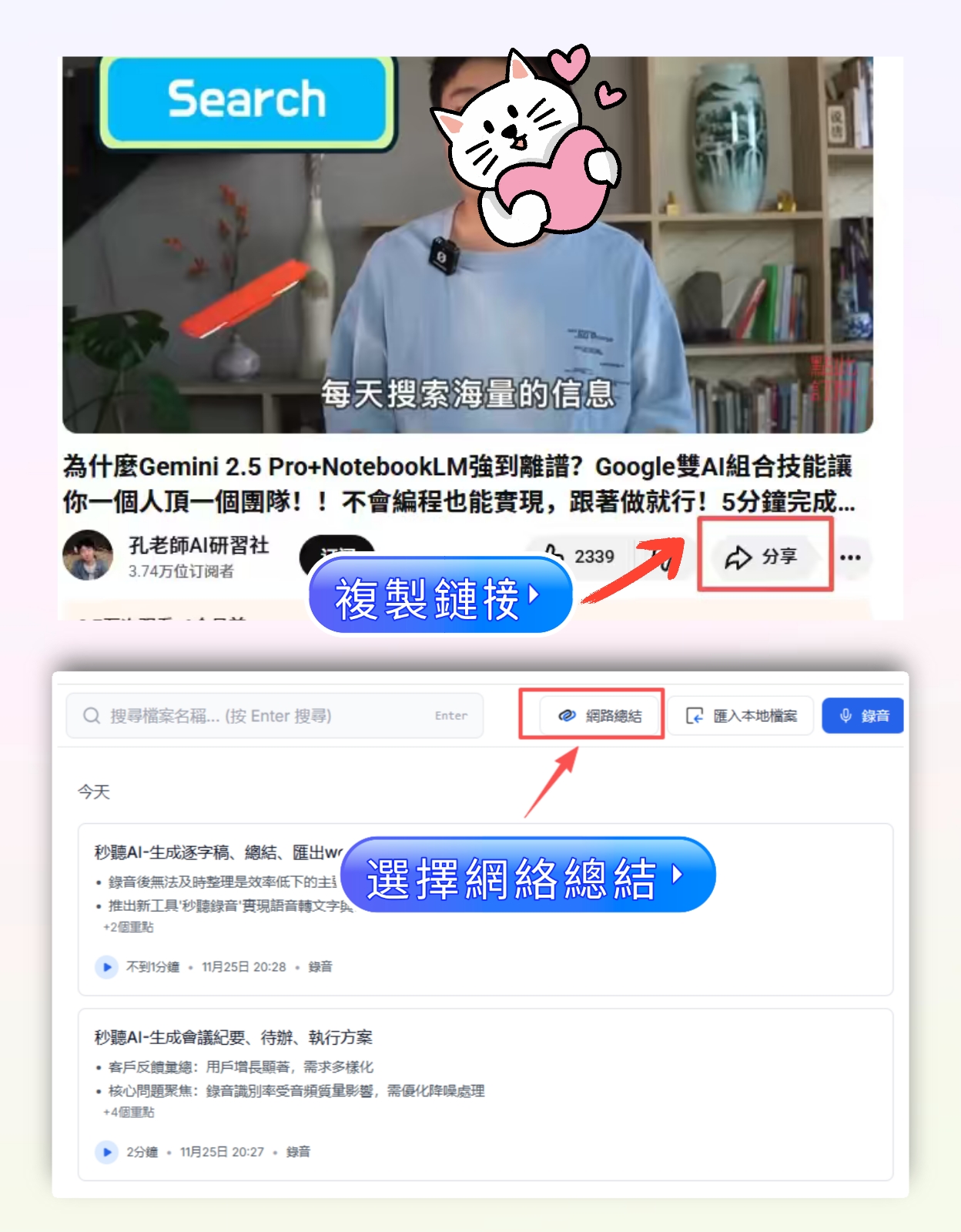
Need to transcribe a Hokkien interview or lecture from YouTube? Just paste the video link, and Tinrec automatically extracts the audio, generates a transcript, and even creates a summary. This is incredibly useful for content creators and students.
Test Results: Real Time Savings
We tested with a 5-minute Hokkien meeting recording (iPhone 15, slight background noise). While the transcription wasn't as perfect as Mandarin, the AI summary captured almost all key points. We only needed to tweak a few words—easily more than twice as fast as manual transcription from scratch.
Stop organizing recordings by hand
Upload audio or video and automatically get a transcript, summary, and action items
Pros
- Multiple Input Sources: Supports live recording, uploading audio/video files, and pasting online video links—covers nearly all Hokkien content transcription needs.
- AI-Powered Queries: A feature rarely found in competing tools at this price point; helps you quickly find answers across numerous recordings.
- Multiple Export Formats: Export as TXT, Word, PDF, or sync directly to Notion for seamless workflow.
Cons
- The free tier offers 100 minutes of transcription per month—heavy users may need to upgrade; but for one or two meetings a week, it's usually sufficient.
- Transcription accuracy for Hokkien can be affected by accent, speaking speed, and background noise—important information should be double-checked against the original audio.
Who Is It For?
If you frequently need to transcribe Hokkien meetings, classes, interviews, or online videos, Tinrec is currently the most comprehensive choice.
How to Use Tinrec to Transcribe Hokkien Audio to Text: 5-Step Guide
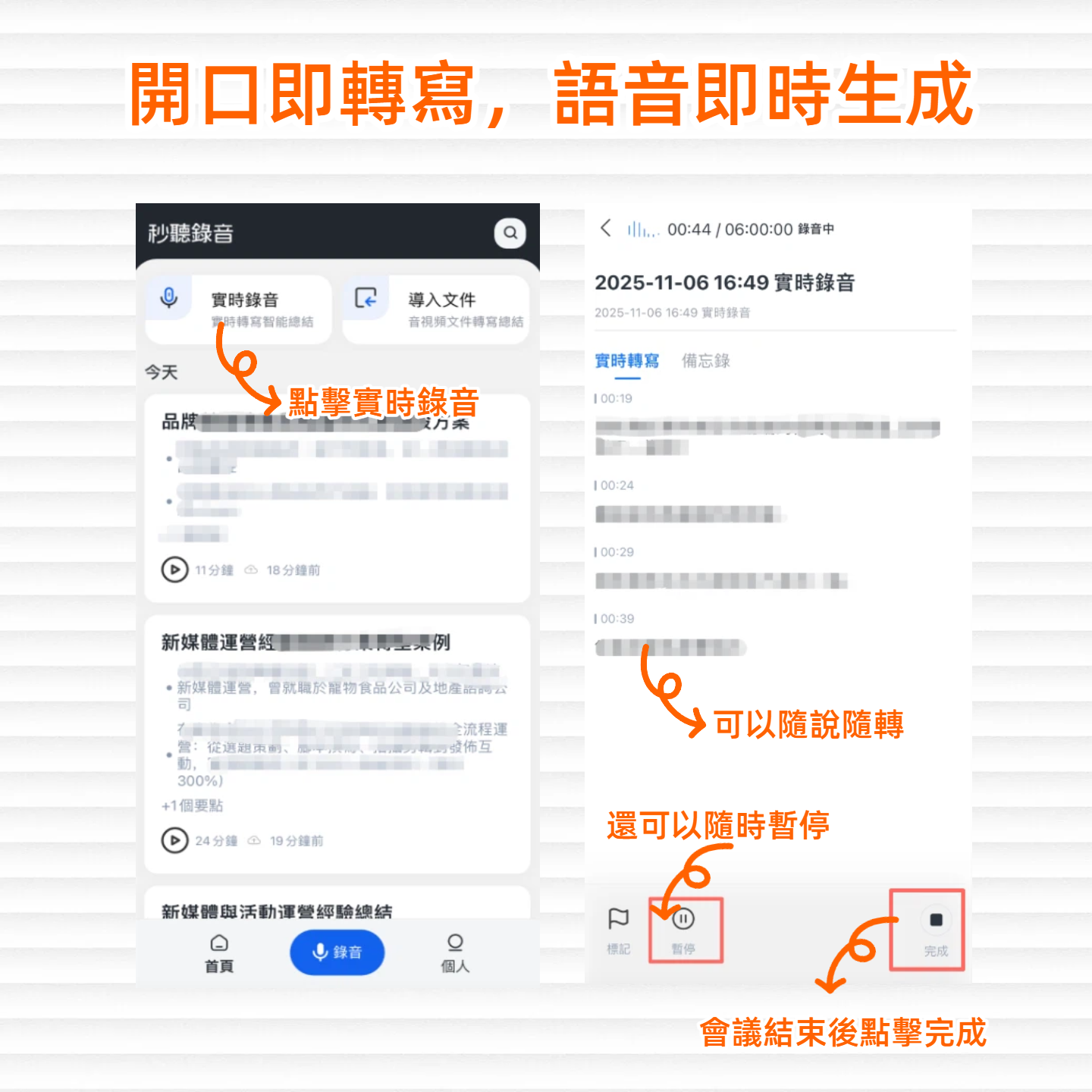
Step 1: Download and Install Tinrec
Search for "Tinrec" on the App Store or Google Play to download, or use the web version directly. Sign up for free to get started.
Step 2: Record or Import Hokkien Audio
Tap the "+" button on the main screen. You can choose 'Live Recording' to record a meeting or interview, or 'Import File' to upload existing Hokkien audio or video files.
Step 3: Wait for Transcription
After uploading, the system automatically transcribes the audio into text, usually completing in a few minutes. You can see real-time progress.
Step 4: Use AI Features to Organize Quickly
Once transcription is done, tap 'AI Q&A' to ask questions about the recording (e.g., "What was the conclusion of this meeting?"), or use 'Summary' and 'Action Items' to generate key points with one click.
Step 5: Export or Share
Finally, export the transcript or summary as TXT, Word, or PDF, or save it to the cloud for easy editing or sharing with colleagues.
What Other Options Are There Besides Tinrec?
Otter.ai: Best for English Meetings, but Not Hokkien
Otter.ai excels at English transcription and offers a generous 300 minutes free. However, it's primarily optimized for English, with extremely low accuracy for Hokkien. If you're working with Hokkien content, skip Otter.ai.
Notta: Solid Transcription, but Lacks AI Q&A
Notta offers decent transcription quality, with 120 minutes on the free plan. But it doesn't have Tinrec's conversational Q&A feature for searching recordings—you'd still need to manually sift through transcripts. If you only need basic transcription and translation, Notta is worth considering.
PLAUD NotePin: Convenient Portable Recorder, but Requires Hardware
PLAUD's recorder is handy for on-the-go notes, but it costs around $140 and transcription minutes are billed separately. Tinrec achieves similar results using just your phone, making it more budget-friendly.
Avoid These 3 Common Mistakes When Choosing a Hokkien Speech-to-Text Tool
Mistake 1: Trusting the Claim 'Supports Multiple Languages' at Face Value
Many tools list support for 100+ languages, but that often means machine translation, not optimized Hokkien recognition. Always test with your own recordings for free to gauge real accuracy.
Mistake 2: Thinking Transcription Is the End
If you only use the tool as a 'recording-to-text converter,' you're missing out on two-thirds of its potential. Tinrec's AI Q&A lets you search historical recordings conversationally, which is much faster than manually scanning transcripts.
Mistake 3: Ignoring Cross-Platform Needs
Recording on your phone today and editing on your computer tomorrow—if the tool doesn't support cross-platform use, you'll face extra file conversion steps. Choose a tool with iOS, Android, and web versions for a smoother workflow.
Conclusion: Which One Should You Choose?
If you primarily work with Hokkien meetings, classes, interviews, or online videos, Tinrec is our top recommendation after testing. It doesn't just transcribe—it summarizes, answers questions, and exports in multiple formats, making Hokkien content truly actionable.
- Need Hokkien transcription + AI Q&A → Tinrec (the only one with conversational AI queries)
- Only English meetings → Otter.ai (generous free tier)
- Heavy translation needs → Notta (good translation quality)
- Want a portable recorder → PLAUD (but more expensive)
We recommend trying Tinrec's free version first—100 minutes per month is enough for two or three meetings to see if it works for you. Upgrade only if you find it valuable; no need to pay upfront.
Turn every recording into actionable outcomes
Get 60 free transcription minutes when you sign in. No credit card required.
Related Reading
You might also like

2026 Free Cantonese Translation Solutions: 3 Tools at a Glance
A review of three free solutions supporting Cantonese translation, comparing Tinrec, Notta, and TurboScribe in terms of Cantonese recognition, translation features, and free quotas, helping you find the best tool for Chinese-speaking users.

2026 Comparative Review of 2 Taiwanese Speech-to-Text Apps: Which Is Better for Multi-Platform Audio/Video Management?
We tested two major speech-to-text tools, Tinrec and PLAUD Note, comparing them on Taiwanese content management, AI summaries, cross-platform support, and price, to help Hong Kong users find the most time-saving option.

2026 Tinrec Voice-to-Text Guide: Supports Cantonese & Auto-Generates Meeting Minutes
As a student, can't keep up with notes in class or understand Cantonese in group discussions? Tinrec is an AI voice-to-text tool that supports Cantonese and multiple languages, and can automatically summarize and create to-do lists, turning your lecture recordings into reviewable notes. This article covers 5 Cantonese voice-to-text solutions suitable for students, from free to paid, to help you choose the best tool for your needs.

Which Cantonese Meeting Transcription Tool is Best? 2026 Test of Multiple Tools: Free Version of This One is Most Practical
Tested multiple AI meeting transcription tools for Cantonese meetings, comparing transcription accuracy, AI summaries, action item extraction, and multi-platform support. After a thorough comparison, Seconds Audio (Tinrec) is recommended—the free version offers practical features suitable for everyday office workers and frequent meeting users.

2026 Real-World Comparison of 2 Southern Min Speech Recognition Tools: Which is Better for Daily Recording and Organization?
For users needing Southern Min speech recognition, support from mainstream tools is still limited. This article compares Tinrec and PLAUD Note across dimensions such as recognition capability, input sources, AI organization, cross-platform support, and pricing, helping you choose the most suitable transcription tool for your needs.

2026 Comparison of 5 Cantonese Translation Apps: Which Is the Most Accurate for Work?
Hong Kong office workers encounter Cantonese content daily in meetings, lectures, and videos. Looking for a reliable Cantonese translation app to help organize? We tested 5 popular tools, from AI voice transcription to real-time translation, to find the best solution for Hong Kong users, so you can stop working overtime on meeting minutes.

2026 Southern Min (Hokkien) Input Methods Compared: AI Speech-to-Text vs Traditional Keyboard – Which is Faster and More Accurate?
A hands-on comparison of Southern Min (Hokkien) input methods: speech-to-text vs traditional keyboard typing, evaluating speed, accuracy, and convenience to determine which is better for daily use.

Which Cantonese Real-Time Translation App is Best? 2026 Test of 2 Tools Reveals the Most Comprehensive One
Need Cantonese real-time translation for weekly meetings? We tested two tools — comparing accuracy, ease of use, extra features, and price — to find the best fit for professionals who need instant Cantonese translation.
2026 Real-World Test: Which Taiwanese Hokkien Speech-to-Text App Really Saves You Time?
A mid-level manager tests Otter.ai vs Tinrec on Hokkien recognition, meeting summaries, and post-meeting workflows to find the best speech-to-text tool for Taiwan's workplaces.