

Turn recordings into transcripts and summaries in minutes
Upload audio or video for multilingual transcription, AI notes, and action items
I attend many cross-regional meetings every week, and about half involve colleagues or clients who speak Cantonese. In the past, hearing Cantonese meant I had to mentally translate on the fly, often missing key points and needing extra time after meetings to fill in notes. Later, I started looking for tools that could transcribe Cantonese in real time or even translate it into Mandarin. I tried a few, and now I regularly use Tinrec. Another option I considered is the hardware device Plaud Note. Based on my team's actual experience, this article compares these two to see which better suits the need for Cantonese real-time translation.
Tinrec vs Plaud Note: Quick Overview
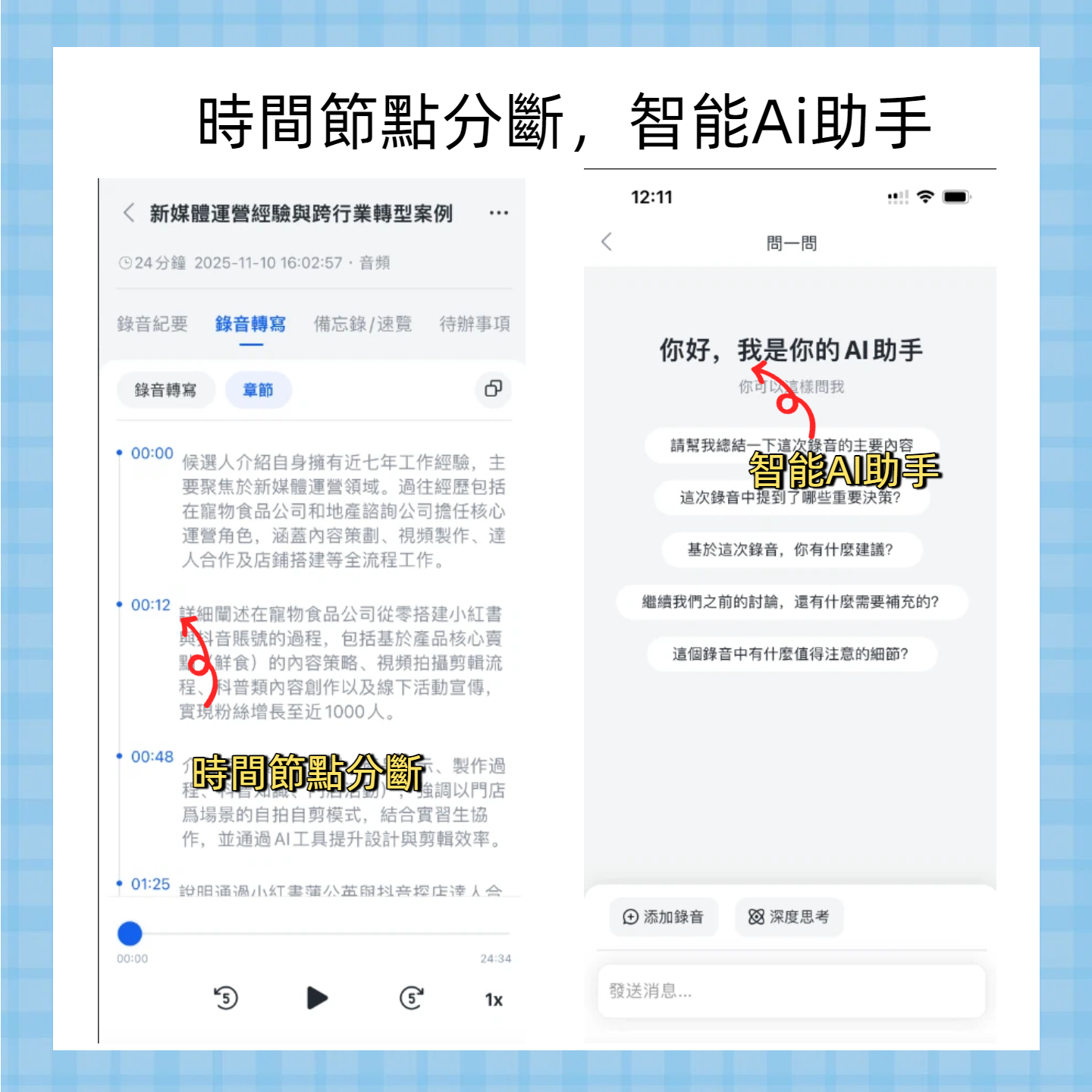
The two tools have completely different positioning: Tinrec is an AI recording and audio/video processing tool, focusing on "multi-source audio/video data processing"; Plaud Note is a standalone AI recording hardware device, convenient for on-the-go use. In the context of Cantonese real-time translation, their performance differs significantly.
| Tinrec | Plaud Note | |
|---|---|---|
| Positioning | Software platform, available on phone and web | Standalone recording hardware |
| Price | Free tier with basic quota; Pro monthly plan costs about one cup of coffee | Hardware from approx. US$179; separate annual subscription fee |
| Language Support | Multi-language translation, including Cantonese | Transcription supports multiple languages, but translation feature not found |
| Key Difference | Real-time translation + AI post-processing + cross-platform | One-tap recording, long battery life, can work offline from phone |
This article compares the two from five dimensions: Cantonese real-time translation accuracy, real-time capability and ease of use, extra features, cross-platform ability, and price/CP value.
Dimension 1: Cantonese Real-Time Translation Accuracy
Plaud Note's website and public materials mainly emphasize "recording to text" and "AI summary," but I found no mention of real-time translation, especially any support for Cantonese translation. In actual testing, its app only outputs the original language transcript and cannot directly convert Cantonese into Mandarin or other languages in real time.
Tinrec, on the other hand, has built-in "language translation" and "simultaneous interpretation" features (see product screenshots). During meetings, I opened the app, selected Cantonese input and Mandarin output, and it roughly displayed the translation text in real time. Although there are occasional hiccups when colloquial speech or mixed Cantonese-English is used, overall it captures over 90% of the key points, sufficient for general business communication.
→ This dimension: Tinrec clearly wins.
Dimension 2: Real-Time Capability and Ease of Use
Plaud Note's workflow: press the hardware button to start recording → after recording, transfer to the phone app via Bluetooth → wait for transcription to complete to see the text. This process does not produce real-time translation, let alone the need to "read the translation while listening."
Stop organizing recordings by hand
Upload audio or video and automatically get a transcript, summary, and action items
With Tinrec, simply open the mobile app or web version, start recording, and you can see the real-time transcription on the screen. Then tap translation mode to see the translation results with almost zero delay. During meetings, I can directly ask questions based on the translation without waiting until after the meeting.
→ This dimension: Tinrec fully meets the real-time translation scenario; Plaud Note cannot deliver.
Dimension 3: Extra Features and Post-Processing
Plaud Note provides a transcript, summary, and a few templates after recording, but the content processing ends there, and secondary processing after translation is lacking.
Tinrec not only achieves real-time translation but also offers: AI chat to follow up on meeting highlights, automatic extraction of action items, generation of meeting minutes, and the ability to export translated text as documents, spreadsheets, or sync to Notion and Google Docs. For middle managers who need to report upwards and delegate downwards, this saves a lot of sorting time.

→ This dimension: Tinrec provides a more complete knowledge organization loop.
Dimension 4: Cross-Platform and Sharing
Plaud Note's hardware cannot be shared directly; it must go through the phone app, and there is no web or desktop version. If you want to view the translation in real time on a laptop in a meeting room, it's nearly impossible.
Tinrec supports iOS, Android, and web versions. I can open the web page on my office computer to translate meeting content in real time, and my phone syncs with the same account. Team members can also directly view shared summaries, with zero friction across devices.
→ This dimension: Tinrec's cross-platform experience is decisively superior.
Dimension 5: Price and Value for Money
Plaud Note's hardware itself costs about US$179 (approx. NT$5,500), plus an annual subscription to unlock higher transcription quotas (e.g., US$99/year for 1200 minutes per month). If you just want to try Cantonese translation, the hardware investment is already a cost, and you may find it doesn't even have translation features.
Tinrec's free tier already includes basic recording and transcription quotas. The Pro monthly plan costs about US$6 (approx. NT$200), which is less than two drinks at a coffee shop. There is almost no learning cost, and no extra hardware is needed.
→ This dimension: More features, lower cost — Tinrec offers far better value for money.
What Are Their Unique Advantages?
Tinrec’s Unique Advantages
- Multi-source audio/video processing: Besides real-time recording translation, you can paste links from YouTube, Bilibili, or upload local files to process Cantonese video content directly.
- AI chat query: After translation, you can ask follow-up questions like "What was the budget figure mentioned earlier?" or "What are the action items?" This greatly improves review efficiency.
- No hardware threshold: Accessible anytime via phone, computer, or tablet, so you don't need to carry an extra device on business trips.
Plaud Note’s Unique Advantages
- One-tap recording, independent offline: For those who prefer not to use their phone for recording, or in situations where phones are restricted due to security policies, a standalone hardware device offers convenience.
- Long battery life: Can record continuously for dozens of hours on a full charge, suitable for all-day classes or marathon meetings.
Conclusion: Which Should You Choose?
- If you regularly need Cantonese real-time translation and want to organize, search, and export the translation after meetings → Tinrec is the only reasonable choice.
- If you only occasionally need a recording memo, don't mind post-processing, and prefer the tactile feel of a hardware button → Plaud Note is sufficient, but be aware that it does not offer real-time translation.
In a nutshell: For most professionals who need to grasp Cantonese content in real time, Tinrec offers more complete features, a faster setup, and lower cost. I suggest starting with the free tier, recording a Cantonese meeting to test its effectiveness, and then deciding whether to upgrade to Pro.
Turn every recording into actionable outcomes
Get 60 free transcription minutes when you sign in. No credit card required.
Related Reading
You might also like

2026 Free Cantonese Translation Solutions: 3 Tools at a Glance
A review of three free solutions supporting Cantonese translation, comparing Tinrec, Notta, and TurboScribe in terms of Cantonese recognition, translation features, and free quotas, helping you find the best tool for Chinese-speaking users.

2026 Comparative Review of 2 Taiwanese Speech-to-Text Apps: Which Is Better for Multi-Platform Audio/Video Management?
We tested two major speech-to-text tools, Tinrec and PLAUD Note, comparing them on Taiwanese content management, AI summaries, cross-platform support, and price, to help Hong Kong users find the most time-saving option.

2026 Tinrec Voice-to-Text Guide: Supports Cantonese & Auto-Generates Meeting Minutes
As a student, can't keep up with notes in class or understand Cantonese in group discussions? Tinrec is an AI voice-to-text tool that supports Cantonese and multiple languages, and can automatically summarize and create to-do lists, turning your lecture recordings into reviewable notes. This article covers 5 Cantonese voice-to-text solutions suitable for students, from free to paid, to help you choose the best tool for your needs.

Which Cantonese Meeting Transcription Tool is Best? 2026 Test of Multiple Tools: Free Version of This One is Most Practical
Tested multiple AI meeting transcription tools for Cantonese meetings, comparing transcription accuracy, AI summaries, action item extraction, and multi-platform support. After a thorough comparison, Seconds Audio (Tinrec) is recommended—the free version offers practical features suitable for everyday office workers and frequent meeting users.

2026 Real-World Comparison of 2 Southern Min Speech Recognition Tools: Which is Better for Daily Recording and Organization?
For users needing Southern Min speech recognition, support from mainstream tools is still limited. This article compares Tinrec and PLAUD Note across dimensions such as recognition capability, input sources, AI organization, cross-platform support, and pricing, helping you choose the most suitable transcription tool for your needs.

2026 Comparison of 5 Cantonese Translation Apps: Which Is the Most Accurate for Work?
Hong Kong office workers encounter Cantonese content daily in meetings, lectures, and videos. Looking for a reliable Cantonese translation app to help organize? We tested 5 popular tools, from AI voice transcription to real-time translation, to find the best solution for Hong Kong users, so you can stop working overtime on meeting minutes.

2026 Southern Min (Hokkien) Input Methods Compared: AI Speech-to-Text vs Traditional Keyboard – Which is Faster and More Accurate?
A hands-on comparison of Southern Min (Hokkien) input methods: speech-to-text vs traditional keyboard typing, evaluating speed, accuracy, and convenience to determine which is better for daily use.

How to Transcribe Hokkien Audio to Text in 2026? A Complete 5-Step Guide
Struggling to transcribe Hokkien meetings, interviews, or lectures? This article tests several tools and shows you how to use Tinrec to quickly convert Hokkien audio to text and organize it into searchable data.
2026 Real-World Test: Which Taiwanese Hokkien Speech-to-Text App Really Saves You Time?
A mid-level manager tests Otter.ai vs Tinrec on Hokkien recognition, meeting summaries, and post-meeting workflows to find the best speech-to-text tool for Taiwan's workplaces.