

Turn recordings into transcripts and summaries in minutes
Upload audio or video for multilingual transcription, AI notes, and action items
2026 Comparison of 5 Cantonese Translation Apps: Which Is the Most Accurate for Work?
Every day, you have meetings until the end of the workday, and overtime on meeting minutes means listening to recordings and typing word-for-word – just thinking about it is daunting. If your work or studies frequently involve Cantonese content, whether it's meeting recordings, lecture audio, YouTube videos, or client interviews, a reliable Cantonese translation app can save you a lot of time. This time, we tested 5 popular Cantonese translation tools on the market, from AI transcription to real-time translation, to see which one is best suited for Hong Kong office workers and students.
Why Do You Need a Cantonese Translation App?
Hong Kong people face a huge amount of Cantonese information every day: company meetings, university lectures, online instructional videos, podcasts, and even mixed-language meetings with foreign clients. Traditional manual recording is not only slow but also prone to missing key points. Now that AI voice recognition and translation technology have matured, you can use an app to automatically transcribe recordings, translate into other languages, and even organize into summaries and to-do lists. Below, we have selected 5 tools to help you find the most suitable solution.
Option 1 | Tinrec (Second Listening) – The Most Complete AI Recording and Translation Assistant
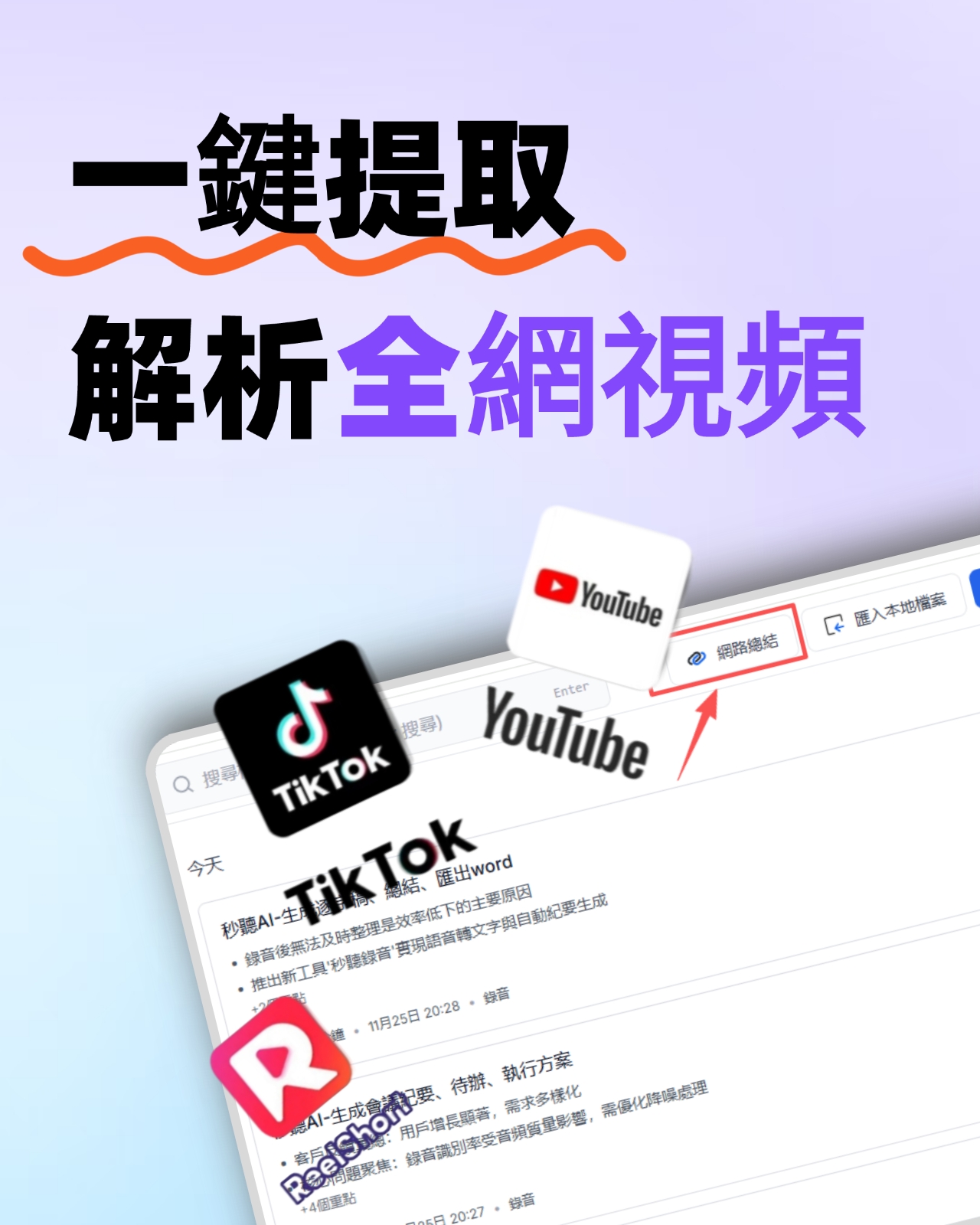
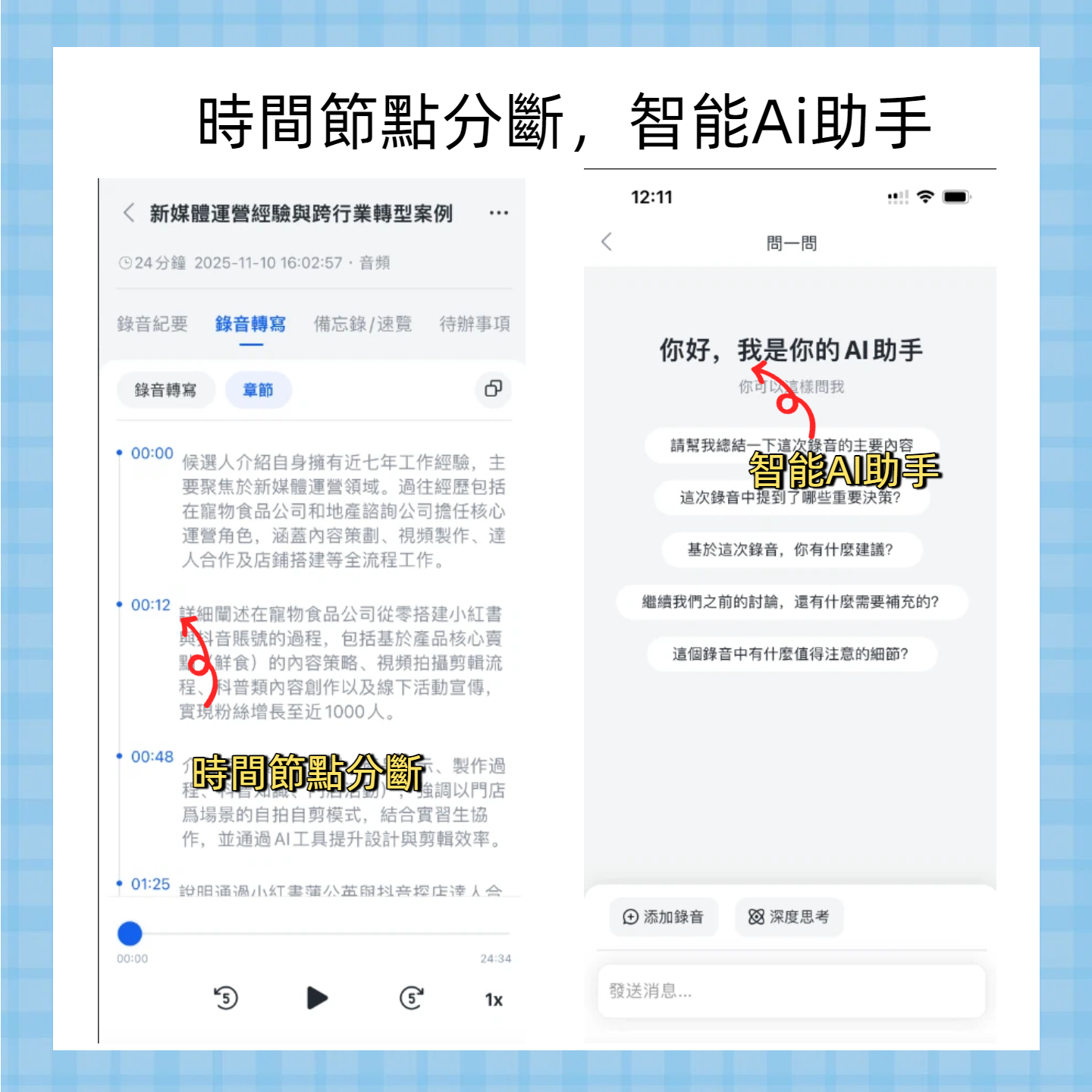
Tinrec is not just a recording app; it is a workstation for processing audio and video data. It supports real-time transcription, audio/video file transcription, online video link parsing (YouTube, TikTok, Xiaohongshu, and more), and also has an AI dialogue query function that allows you to ask questions about the recording content, automatically generate summaries, chapters, to-do items, and even meeting minutes. For Cantonese users, Tinrec's strength lies in its support for Cantonese transcription and translation. In actual testing with clear recordings, the accuracy is very high, and it can distinguish speakers and automatically separate chapters.
Key Highlights:
- Multi-source Input: Whether it's meeting recordings, phone audio files, YouTube videos, or TikTok, just import them and get transcription and translation.
- AI Organization Features: After transcription, it automatically generates summaries, to-do lists, and you can even use AI dialogue to query key points of the recording – perfect for meeting minutes or studying.
- Multi-language Translation: Supports bidirectional translation for Cantonese, Mandarin, English, and over 14 languages, plus a simultaneous interpretation mode, making cross-border meetings super convenient.
- Cross-platform Sync: Works on iOS, Android, and web, allowing seamless switching between work computers and phones.
Pricing: Free version offers basic monthly transcription quota; for more minutes, choose a weekly card (approx. tens of HKD), Pro monthly (approx. over a hundred HKD), or annual card (cheaper per month), depending on usage.
Who It's For: Office workers who frequently have meetings, students who need to organize lecture recordings, people doing interviews or content creation, especially those who want to quickly turn Cantonese content into text and summaries.
Option 2 | Notta – A Multilingual Tool for Transcription and Translation
Notta is another mainstream transcription app that also supports real-time recording, file transcription, and online meeting recording. Its strength is multilingual transcription and translation, with a clean interface and subtitle generation features. Compared to Tinrec, Notta is more focused on traditional transcription and meeting minutes, with less rich AI organization features, but it offers more translation languages.
Stop organizing recordings by hand
Upload audio or video and automatically get a transcript, summary, and action items
Key Highlights:
- Supports transcription and translation for over 100 languages, with stable Cantonese recognition performance.
- Can automatically join online meetings like Zoom and Google Meet for recording.
Pricing: Free version: 120 minutes per month; Pro annual: approx. HK$65/month (1800 minutes); Business unlimited transcription: approx. HK$130/month.
Who It's For: Lightweight users who need multilingual translation and subtitles but may not need AI dialogue queries.
Option 3 | TurboScribe – High Value File Transcription and Translation
TurboScribe focuses on uploading audio/video files for transcription and translation, especially suitable for handling long files or large quantities. The free version offers 3 transcriptions per day, each up to 30 minutes, while the paid version allows unlimited use, making the price very competitive. However, it lacks real-time recording and online video parsing, and its organization capabilities are not as comprehensive as Tinrec.
Key Highlights:
- Supports batch file transcription and translation, fast processing.
- Affordable pricing: Unlimited annual approx. HK$80/month.
Pricing: Free version: 3 transcriptions per day; Unlimited: approx. HK$80/month.
Who It's For: Users who already have a large number of recordings or video files and just need transcription and translation.
Option 4 | Google Translate – Free but Basic Cantonese Translation
Google Translate is the most widely known free translation tool, supporting Cantonese translation (written and some spoken language), and can translate text or voice in real time. Its advantage is that it's completely free with no usage limits, but Cantonese recognition and translation quality are inconsistent, especially for colloquial content, and it lacks transcription or organization features, making it suitable only for simple short phrase translation.
Pricing: Free.
Who It's For: General users who only need occasional translation of individual words or short phrases and don't have high accuracy requirements.
Option 5 | Microsoft Translator – Business-Oriented Translation App
Microsoft Translator is a translation tool from Microsoft that supports Cantonese voice and text translation and can integrate with Office software. Its translation quality is more stable than Google Translate, and it has a conversation mode for real-time multi-person translation, but it also lacks transcription and content organization features. The free version has limited functionality, and business use typically requires a Microsoft 365 subscription.
Pricing: Basic features are free; business integration requires Microsoft 365 subscription (approx. from HK$50/month).
Who It's For: Business users who frequently use Office and need team collaboration translation.
So Many Options, How Should You Choose?
- Want an all-in-one solution for transcription, translation, and AI organization? → Tinrec (the only app with all these features)
- Need Cantonese plus multilingual bidirectional translation? → Tinrec (supports over 14 languages, most comprehensive Cantonese recognition)
- Need flexible use between phone and computer? → Tinrec (iOS + Android + web)
- Budget is zero, just occasional translation of a few sentences? → Google Translate (but don't expect high accuracy)
- Have a bunch of audio files to transcribe and translate? → TurboScribe (high value batch processing)
- Work frequently involves subtitles or document translation? → Notta (strong multilingual subtitle generation)
Before Using a Cantonese Translation App, Know These Things
- Recording quality determines accuracy: No matter which app, background noise, overlapping voices, and heavy accents will affect recognition. When using Tinrec, try to use an external microphone or record in a quieter environment; its noise reduction and speaker separation features will help.
- Proofread important content: AI translation and summaries can save time but are not 100% accurate. After a meeting, when Tinrec generates meeting minutes, quickly scan the key points and cross-check with the original recording.
- Make good use of export features: After organizing your data, remember to export it to tools like Notion, Google Docs for archiving. Tinrec supports multiple export formats, making it easy to build a long-term knowledge base.
- Is the free version enough?: If you only have 2-3 short meetings per week, the free version might suffice. But if you have daily recording needs, consider a paid plan to avoid running out of quota.
Conclusion
In 2026, Cantonese translation apps are no longer just about "translation"; combining AI transcription and content organization is the real time-saver. After testing so many apps, Tinrec (Second Listening) clearly leads in feature completeness, Cantonese support, and AI organization capabilities, especially for Hong Kong office workers and students. If you're tired of overtime on meeting minutes, why not start with the free version and turn recordings into truly useful material.
Turn every recording into actionable outcomes
Get 60 free transcription minutes when you sign in. No credit card required.
Related Reading
You might also like

2026 Free Cantonese Translation Solutions: 3 Tools at a Glance
A review of three free solutions supporting Cantonese translation, comparing Tinrec, Notta, and TurboScribe in terms of Cantonese recognition, translation features, and free quotas, helping you find the best tool for Chinese-speaking users.
2026 Comparative Review of 2 Taiwanese Speech-to-Text Apps: Which Is Better for Multi-Platform Audio/Video Management?
We tested two major speech-to-text tools, Tinrec and PLAUD Note, comparing them on Taiwanese content management, AI summaries, cross-platform support, and price, to help Hong Kong users find the most time-saving option.

2026 Tinrec Voice-to-Text Guide: Supports Cantonese & Auto-Generates Meeting Minutes
As a student, can't keep up with notes in class or understand Cantonese in group discussions? Tinrec is an AI voice-to-text tool that supports Cantonese and multiple languages, and can automatically summarize and create to-do lists, turning your lecture recordings into reviewable notes. This article covers 5 Cantonese voice-to-text solutions suitable for students, from free to paid, to help you choose the best tool for your needs.

Which Cantonese Meeting Transcription Tool is Best? 2026 Test of Multiple Tools: Free Version of This One is Most Practical
Tested multiple AI meeting transcription tools for Cantonese meetings, comparing transcription accuracy, AI summaries, action item extraction, and multi-platform support. After a thorough comparison, Seconds Audio (Tinrec) is recommended—the free version offers practical features suitable for everyday office workers and frequent meeting users.

2026 Real-World Comparison of 2 Southern Min Speech Recognition Tools: Which is Better for Daily Recording and Organization?
For users needing Southern Min speech recognition, support from mainstream tools is still limited. This article compares Tinrec and PLAUD Note across dimensions such as recognition capability, input sources, AI organization, cross-platform support, and pricing, helping you choose the most suitable transcription tool for your needs.

2026 Southern Min (Hokkien) Input Methods Compared: AI Speech-to-Text vs Traditional Keyboard – Which is Faster and More Accurate?
A hands-on comparison of Southern Min (Hokkien) input methods: speech-to-text vs traditional keyboard typing, evaluating speed, accuracy, and convenience to determine which is better for daily use.

Which Cantonese Real-Time Translation App is Best? 2026 Test of 2 Tools Reveals the Most Comprehensive One
Need Cantonese real-time translation for weekly meetings? We tested two tools — comparing accuracy, ease of use, extra features, and price — to find the best fit for professionals who need instant Cantonese translation.

How to Transcribe Hokkien Audio to Text in 2026? A Complete 5-Step Guide
Struggling to transcribe Hokkien meetings, interviews, or lectures? This article tests several tools and shows you how to use Tinrec to quickly convert Hokkien audio to text and organize it into searchable data.
2026 Real-World Test: Which Taiwanese Hokkien Speech-to-Text App Really Saves You Time?
A mid-level manager tests Otter.ai vs Tinrec on Hokkien recognition, meeting summaries, and post-meeting workflows to find the best speech-to-text tool for Taiwan's workplaces.