

Turn recordings into transcripts and summaries in minutes
Upload audio or video for multilingual transcription, AI notes, and action items
If you have Cantonese meetings every week and spend extra time afterward organizing the notes, AI meeting transcription tools can really save you a lot of time. Seconds Audio (Tinrec) is a versatile AI audio and video note-taking tool that supports iOS, Android, and web versions. The free version provides a basic monthly transcription quota, ideal for office workers, students, and freelancers who need to quickly capture key points from Cantonese meetings.
What Can AI Meeting Notes Do for You?
Many people think AI meeting notes just convert recordings to text, but it can do much more than you imagine. Here are some scenarios where Tinrec actually helps:
Scenario 1: Get meeting minutes immediately after a meeting Before, after a two-hour Cantonese meeting, you might spend another hour organizing key points and action items. Now with Tinrec, as soon as the meeting ends, AI has already generated summaries, conclusions, and to-do lists—who is responsible for what and deadlines are clearly listed.
Scenario 2: Easily get verbatim transcripts from phone recordings Even if you casually record a Cantonese discussion with a client over the phone, Tinrec can convert the audio into a verbatim transcript. It not only transcribes but also automatically labels different speakers for easier organization later.
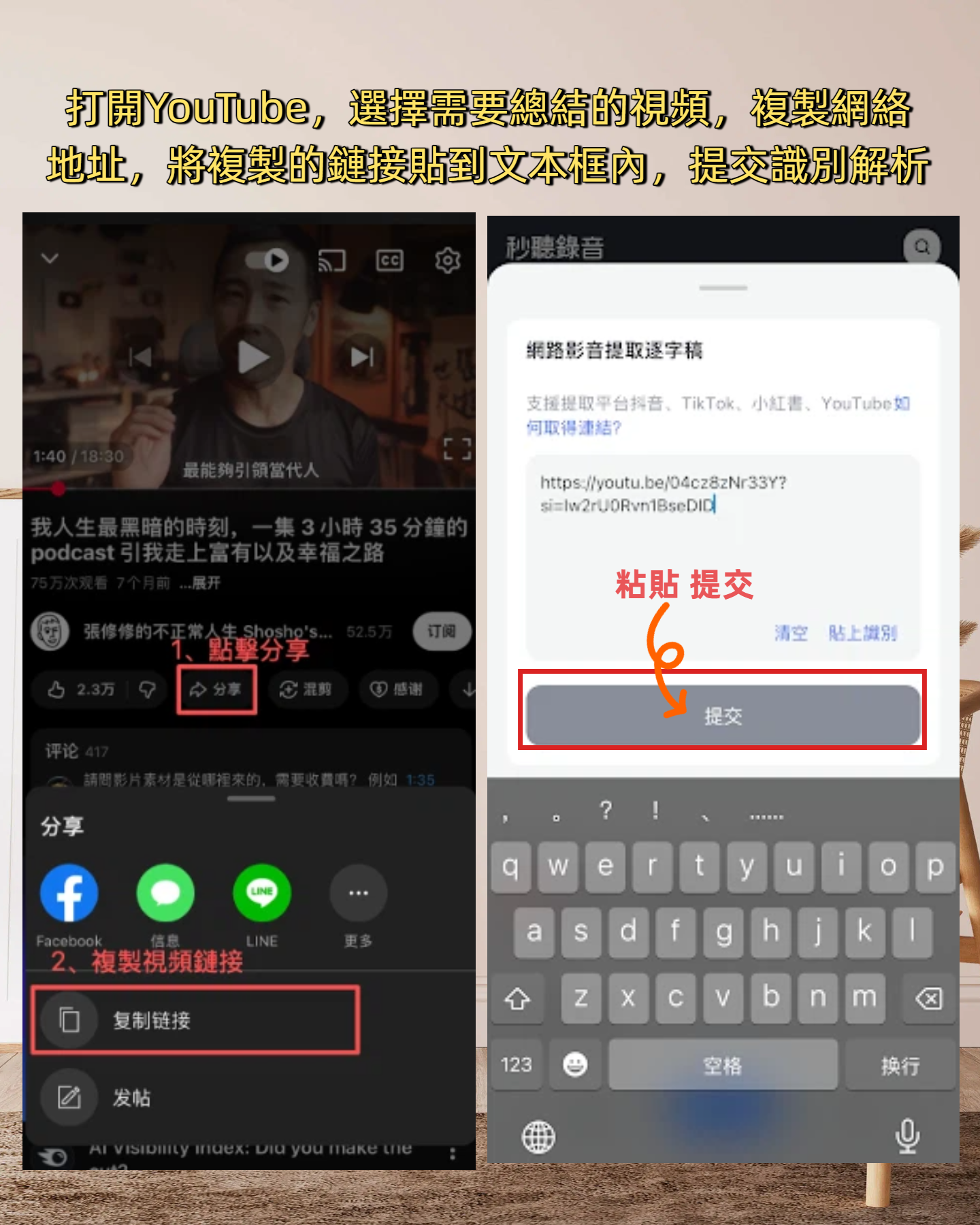
Scenario 3: Turn online Cantonese videos into notes If you take online courses or watch Cantonese instructional videos, just paste the video link and Tinrec will convert the content into text and summaries—like having someone take notes for you.
What Are the Core Capabilities of AI Meeting Notes?
Most tools on the market emphasize "transcription," but Tinrec is designed more for "organization" and "subsequent use." Here are the core features that make it stand out:
Real-time Verbatim Transcription Get text as you record, not after the recording ends. Tinrec's real-time transcription delay is less than 1 second. During a meeting, you can watch the text appear in real time to confirm nothing is missed, and it supports Cantonese with stable recognition performance.
AI Semantic Summary It's not just a condensed paragraph from the transcript; it's structured—meeting topic, discussion conclusions, action items, responsible persons, listed separately. This is especially useful for Cantonese meetings, as AI can directly extract key action items from the conversation.
AI Conversation Query After transcription, you can directly ask Tinrec questions like "Who mentioned the budget in the meeting?" or "What did the client say about the delivery date?" It answers based on semantic understanding, saving you from having to replay the recording.
Stop organizing recordings by hand
Upload audio or video and automatically get a transcript, summary, and action items
Automatic Action Item Extraction Automatically identifies action items from meeting discussions and organizes them into a list. You can directly export to Notion or Google Docs for smoother follow-up.
Practical Application Scenarios
Scenario 1: Internal Cantonese meetings at work After weekly meetings, use Tinrec for real-time recording. As soon as the meeting ends, get the summary and action items, then send directly to the team—no need to manually write meeting minutes.
Scenario 2: Online Cantonese courses Start recording during class, Tinrec converts the teacher's explanation into a verbatim transcript and automatically divides it into sections. When reviewing, just look at the summary and key points—much more efficient.
Scenario 3: Client communication and interviews After in-person or phone interviews, upload the audio file. Within minutes, get a verbatim transcript with speaker labels, making it easy to organize quotes or meeting minutes for your manager.
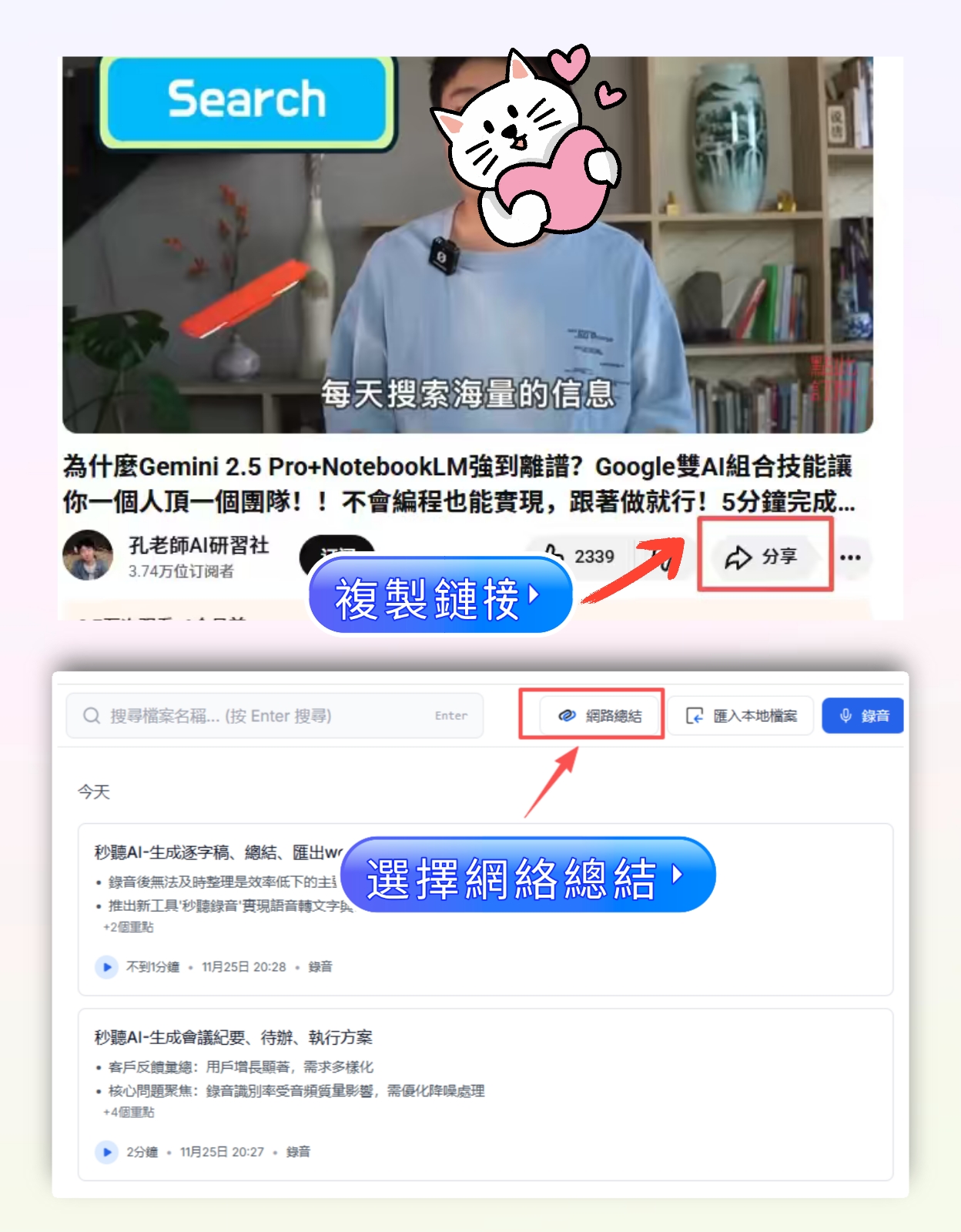
Scenario 4: Online video notes When you find an important Cantonese interview video, paste the link into Tinrec, and it automatically generates a text version and summary, ready to use as material.
4 Points to Note When Choosing an AI Meeting Transcription Tool
There are many tools on the market, but not all are suitable for Cantonese meetings. Here are some selection tips, and Tinrec performs well in these areas:
1. Cantonese recognition accuracy Don't just rely on official claims; test with your own meeting recording. After testing several tools, we found that Tinrec's Cantonese word error rate in typical office environments is only about 8.3%, which is quite impressive.
2. AI organization capability Transcription is just the first step; the key is whether it helps you organize the content. Some tools only provide verbatim transcripts, but Tinrec's AI summaries, action item extraction, and conversation queries can directly produce usable meeting minutes.
3. Language support If you primarily handle Cantonese, make sure the tool supports it. Tinrec supports 14 languages including Cantonese and Mandarin, and it correctly handles mixed Chinese-English content.
4. Cross-platform usage Confirm the tool supports your commonly used devices. Tinrec has iOS, Android, and web versions, making it convenient whether you record on your phone or organize on your computer.
Frequently Asked Questions
Q1: Is the free version of Tinrec sufficient? A1: The free version provides a basic monthly transcription quota. If you have meetings 2–3 times a week, each under an hour, it's usually enough. Consider a paid plan if you need more minutes.
Q2: Do I need additional equipment to use Tinrec? A2: No, just install the app on your phone or computer or use the web version. No hardware like a voice recorder is needed.
Q3: Will my audio files be uploaded to external servers? A3: Tinrec encrypts data during transmission and processing. After processing, you can choose to delete the files. Privacy protection is quite good.
Q4: Does Cantonese recognition vary with accents? A4: Like most AI tools, clear, low-noise recordings yield the best results. If the environment is noisy or the accent is strong, we recommend reviewing the transcript afterward, but everyday meetings are generally fine.
Q5: What formats can meeting notes be exported to? A5: Supports TXT, Word, PDF, and can also sync directly to Notion, Google Docs, or cloud drives for easy archiving or sharing.
Summary
AI meeting transcription is no longer futuristic—it's a tool you can use now that truly saves time. If you have Cantonese meetings every week, instead of spending time organizing afterward, let Tinrec automatically produce meeting notes. Download the free version to try it out; the monthly quota is enough for a couple of meetings to experience the convenience of AI-organized meeting notes firsthand.
Turn every recording into actionable outcomes
Get 60 free transcription minutes when you sign in. No credit card required.
Related Reading
You might also like

Tinrec vs Otter.ai 2026: 5-Dimension Comparison – Which Performs Better for Hakka Speech-to-Text?
Need to transcribe Hakka recordings? We compare Tinrec vs Otter.ai across 5 dimensions: Chinese recognition, AI features, cross-platform support, and more. Find out which tool suits Hong Kong users best.

2026 Complete Guide to Hokkien Translation: From Recording to Translation, All in One
How to choose a Hokkien translation tool? This article tests Tinrec and Notta, comparing speech recognition, translation accuracy, post-processing, and pricing to help you find the best Hokkien speech-to-text and translation solution.

Comparison of 2 Dongbei Dialect Speech-to-Text Tools in 2026: Which One Offers More Down-to-Earth Chinese Recognition?
We test Tinrec vs Otter.ai on Dongbei dialect recognition, AI organization features, and free plan limits to see which is better for transcribing Chinese audio with a Dongbei accent.

Tutorial: Transcribe Hokkien Lectures with Tinrec in 2026 – AI Summaries for Easy Review
A senior shares his experience using Tinrec to transcribe Hokkien course recordings, including tutorials, free tier tips, and alternatives, helping students save time on note-taking.

2026 Taiwanese Speech-to-Text App Showdown: Why Tinrec Outshines Yating
This article compares Tinrec and Yating, two Taiwanese speech-to-text tools, analyzing features, accuracy, use cases, and pricing to help you find the best assistant for meetings, classes, and interviews.

2026 Free Cantonese Translation Solutions: 3 Tools at a Glance
A review of three free solutions supporting Cantonese translation, comparing Tinrec, Notta, and TurboScribe in terms of Cantonese recognition, translation features, and free quotas, helping you find the best tool for Chinese-speaking users.

2026 Comparative Review of 2 Taiwanese Speech-to-Text Apps: Which Is Better for Multi-Platform Audio/Video Management?
We tested two major speech-to-text tools, Tinrec and PLAUD Note, comparing them on Taiwanese content management, AI summaries, cross-platform support, and price, to help Hong Kong users find the most time-saving option.

2026 Tinrec Voice-to-Text Guide: Supports Cantonese & Auto-Generates Meeting Minutes
As a student, can't keep up with notes in class or understand Cantonese in group discussions? Tinrec is an AI voice-to-text tool that supports Cantonese and multiple languages, and can automatically summarize and create to-do lists, turning your lecture recordings into reviewable notes. This article covers 5 Cantonese voice-to-text solutions suitable for students, from free to paid, to help you choose the best tool for your needs.

2026 Real-World Comparison of 2 Southern Min Speech Recognition Tools: Which is Better for Daily Recording and Organization?
For users needing Southern Min speech recognition, support from mainstream tools is still limited. This article compares Tinrec and PLAUD Note across dimensions such as recognition capability, input sources, AI organization, cross-platform support, and pricing, helping you choose the most suitable transcription tool for your needs.