

Turn recordings into transcripts and summaries in minutes
Upload audio or video for multilingual transcription, AI notes, and action items
Why You Need a Cantonese Voice-to-Text Tool
At the start of this semester, I took a general education course taught entirely in Cantonese. The professor spoke so fast, throwing in tons of local slang, and my Cantonese is only so-so—I couldn't keep up with note-taking at all. Before the midterm, I borrowed a classmate's notes, only to find abbreviations I couldn't decipher. I barely passed that exam. Later, a senior recommended trying a voice-to-text tool, and I realized there are now apps that can transcribe Cantonese conversations word-for-word, and even automatically extract key points and organize them into sections.
According to statistics, over 60% of college students have had their study efficiency affected by incomplete notes. In this article, I'll share 5 tools that support Cantonese transcription that I've personally used, from the most feature-rich AI tool, Tinrec, to hardware-based options like PLAUD, along with several cloud-only solutions, so you can choose the best one based on your class habits and budget.
Option 1: Tinrec (Instant Recording)—Not Just Transcription, But Also Helps You Understand Cantonese Content
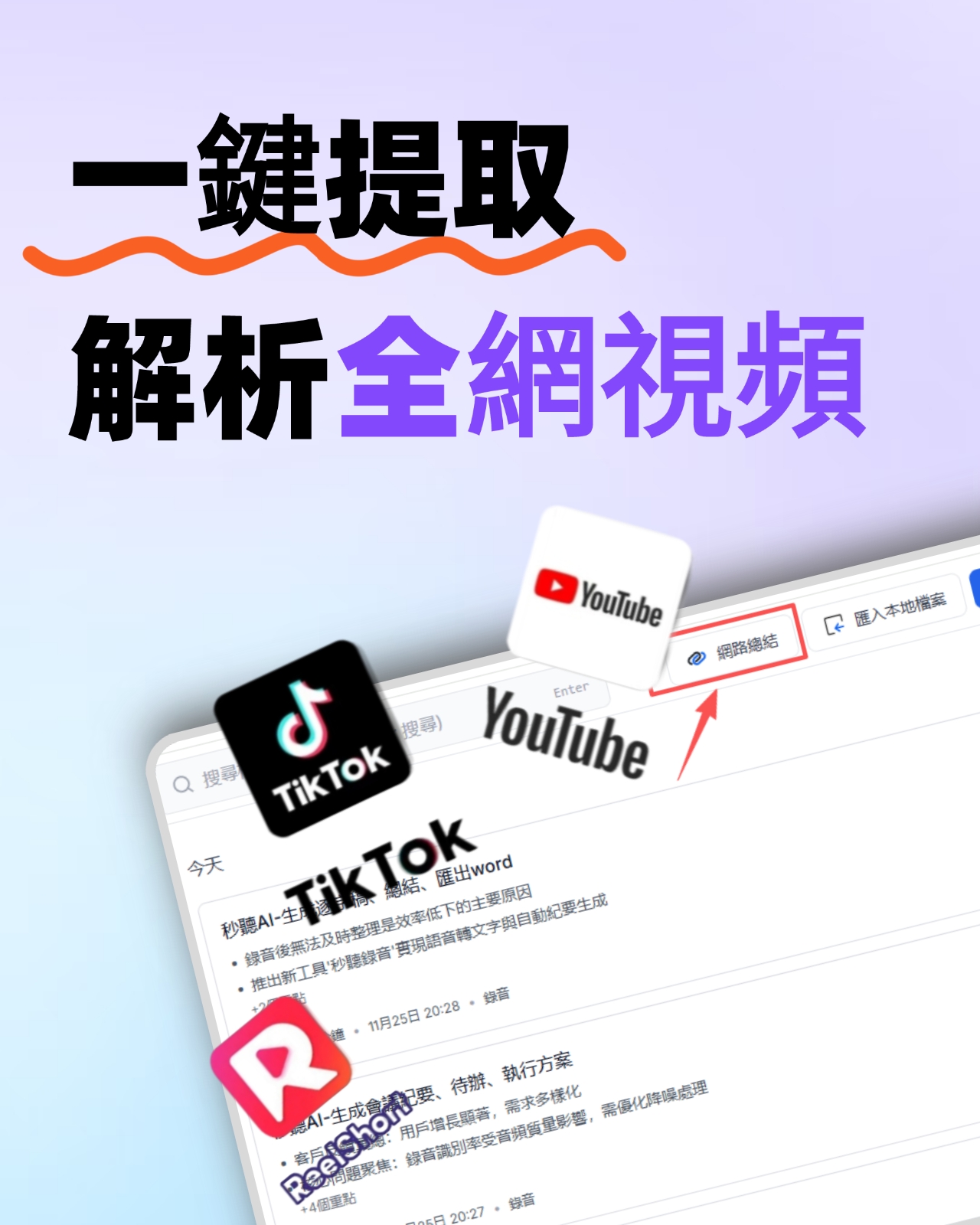
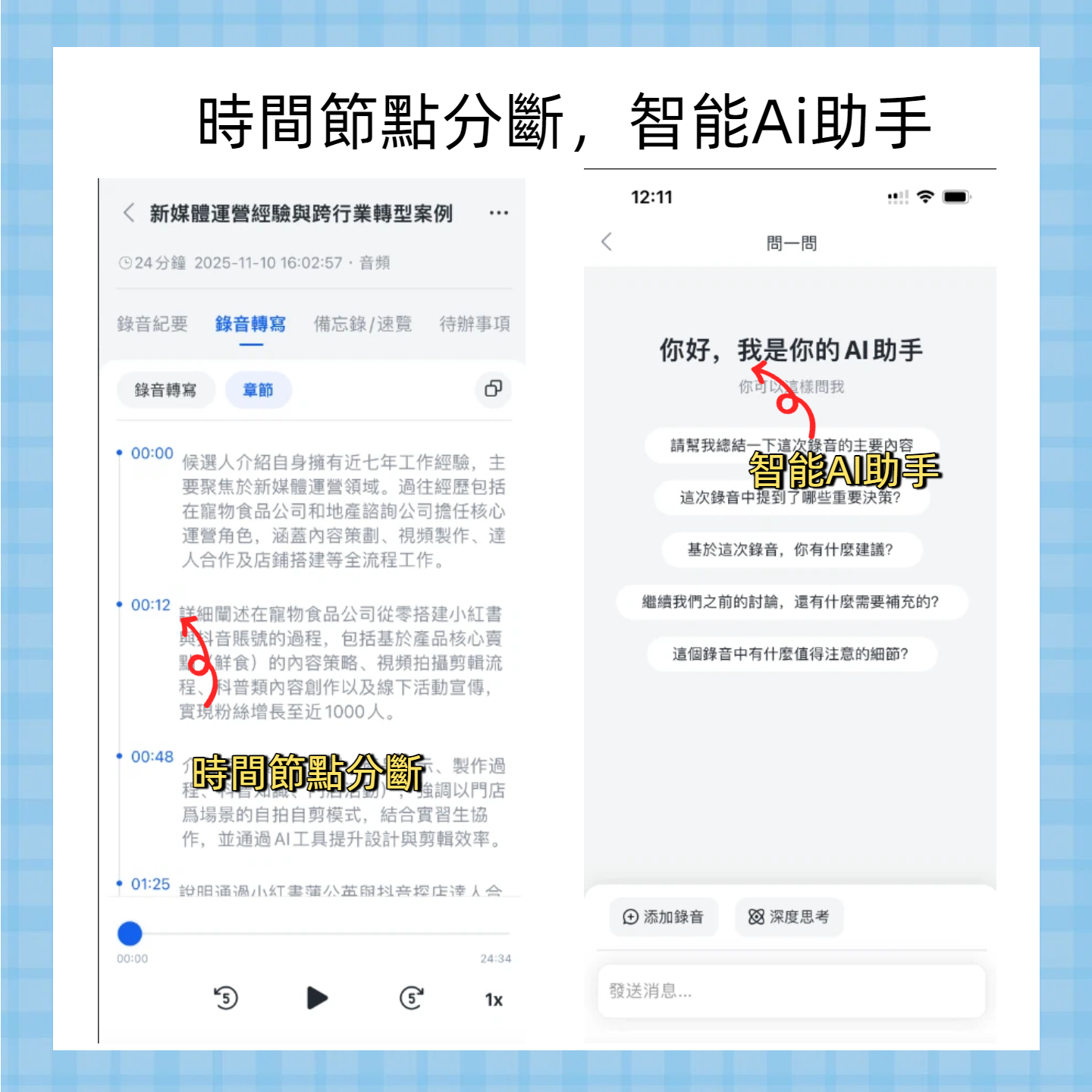
Tinrec has been my go-to this semester. It doesn't just convert Cantonese recordings to text; it's like having a personal AI study buddy. In class, I just open the app and start recording. It transcribes in real time—the professor's Cantonese becomes searchable transcript text within seconds. The most impressive feature is its "AI Conversation Query." During finals review, I simply asked the recording: "What are the key exam points for this class?" and it pulled out key sections from the two-hour recording, complete with timestamps so I could jump back and verify.
It's also great for group discussions. Our group includes Hong Kong students who often mix Cantonese and Mandarin, but Tinrec transcribes accurately. After the meeting, it automatically generates to-do items and conclusions, so you don't have to rely on memory. When a professor shares a Cantonese supplementary video on YouTube, I just paste the link and get the transcript and summary in minutes. My review efficiency has doubled.
The pricing is student-friendly: the free version provides a monthly transcription quota that's enough for key subjects. If you need more, the Pro monthly plan costs about the price of a Starbucks coffee, unlocking longer hours and full features. I upgrade a month before midterms and finals, then downgrade afterward—super cost-effective.
Best for: Students who need systematic organization of Cantonese lectures, interviews, or online videos, especially those who value post-class review and quick key point retrieval.
Option 2: Otter.ai—Great for English Meetings, Decent Cantonese Transcription but Shallow Summaries
Otter.ai is a popular AI meeting notes tool, and its English transcription and summarization are top-notch. I used it for a while in my freshman year. Cantonese transcription accuracy is okay, but it's more geared toward real-time meetings and lacks features like uploading local recordings or pasting video links (which Tinrec offers). Its standout feature is speaker separation, which is helpful in group discussions to identify who said what. The free version gives 300 minutes per month, which may be enough for a few classes. The Pro annual plan costs about NT$250/month, which is suitable for team collaboration. But if your focus is Cantonese lecture organization, its AI post-processing isn't as deep as Tinrec's.
Stop organizing recordings by hand
Upload audio or video and automatically get a transcript, summary, and action items
Option 3: Notta—Great Multilingual Transcription, but Lacks AI Conversation Query
Notta is a direct competitor to Tinrec. It supports multiple languages, Cantonese transcription is smooth, and it can even translate transcripts into other languages. A friend of mine used Notta to organize his Cantonese interview assignment and found the transcription very clean. However, it's more of a "transcription + translation" tool—it lacks Tinrec's AI conversation query and automatic to-do list generation. For a two-hour recording, you still have to read through the entire transcript yourself. The free version offers 120 minutes per month, and the Pro annual plan (about NT$250/month) gives 1800 minutes. It's suitable for those who need heavy transcription volume but don't need AI to process the content.
Option 4: TurboScribe—Batch Processing Powerhouse for Long Files, Not for Real-Time Classroom Recording
TurboScribe is a beast for uploading audio and video files for transcription. It handles large files and batch processing—if you have a full semester's recordings to transcribe at once, it's fast. Cantonese recognition is decent, but it's not designed for live in-class recording and lacks AI summarization or Q&A features. The free version allows only 3 files per day, each up to 30 minutes. It's best for scenarios where you already have recordings and just need transcripts. The unlimited plan costs about NT$300 per month, which is okay for long-term research material processing. But for daily class use, the lack of real-time transcription and AI organization makes it less convenient.
Option 5: PLAUD Note—Great Hardware Recording Quality, But Requires Carrying an Extra Device
PLAUD is a dedicated recording device—small, clips onto your collar, and offers much better audio quality than a phone. It's ideal for large lecture halls or auditoriums. It comes with an app for transcription that supports Cantonese, with a monthly free allowance of 300 minutes. But I put it away after half a semester because I always had to remember to bring it, charge it, and clip it on properly—a hassle for someone forgetful like me. The hardware itself isn't cheap (the Note Pro pre-order price is around NT$5,500), and expanding transcription hours requires an additional annual fee, which can be a burden for students. If you really care about audio quality or frequently record long interviews, it might be worth it. Otherwise, just use Tinrec on your phone.
So Many Options—How to Choose?
Choosing a tool is like choosing a class—there's no absolute best, only the one that fits you best. Here are my recommendations based on different learning scenarios:
- Want the most complete AI features (transcription + AI conversation query + auto summaries + to-do lists)? → Tinrec (currently the only option with all these features, an all-in-one for Cantonese transcription and organization)
- Need mixed Cantonese and Mandarin transcription, plus quick post-class querying? → Tinrec (supports multi-language mixed recognition, AI Q&A pulls out key points directly)
- Just want plain Cantonese transcripts with zero budget? → Start with Otter.ai free version (300 minutes/month is enough for a few classes), but you'll have to organize the content yourself later.
- Need heavy Cantonese file or interview transcription without AI organization? → Notta or TurboScribe: Notta has a lower monthly fee, while TurboScribe is better for batch processing.
- Care about audio quality and don't mind carrying an extra device? → PLAUD, but remember to include hardware and annual fees in your budget.
For most students (including me), daily needs are: recording lectures, group discussions, and watching online videos. Just install Tinrec—one app handles everything from recording to generating review notes. Instead of juggling two tools and piecing things together, let AI do it all in one go.
3 Things to Know Before Using Cantonese Voice-to-Text Tools
- Recording quality determines transcription accuracy: No matter which tool you use, if the recording is noisy or you're far from the speaker, the transcript will suffer. When using Tinrec, I sit in the front-middle of the classroom, place my phone flat on the desk, and Cantonese recognition works almost flawlessly.
- AI summaries are powerful but can't fully replace listening: Tinrec can highlight key points and to-do items, but if the professor tells a joke or gives an example, the AI might misclassify it as important. For important classes, I still quickly cross-check the recording timeline to ensure key definitions or formulas are correct.
- Make good use of free versions; don't rush to pay: Almost every tool offers a free quota. Try the free version for the first two weeks of the semester to gauge your usage. Tinrec's free version can handle one or two key subjects' recordings. Upgrade to a weekly or monthly plan only when demand increases around midterms and finals. Being thrifty is a student's superpower.
Conclusion
As a senior who has struggled with Cantonese-taught courses, I genuinely believe voice-to-text tools are essential for students. Tinrec not only solved my problem of "can't understand, can't keep up" but also turned review into an efficient "conversation with AI." If you have Cantonese courses this semester or need to organize large amounts of audio files, start with Tinrec's free version and play around. Once it saves you your first all-night study session, you'll be just like me—happily recommending it to the whole class.
Turn every recording into actionable outcomes
Get 60 free transcription minutes when you sign in. No credit card required.
Related Reading
You might also like

Tinrec vs Otter.ai 2026: 5-Dimension Comparison – Which Performs Better for Hakka Speech-to-Text?
Need to transcribe Hakka recordings? We compare Tinrec vs Otter.ai across 5 dimensions: Chinese recognition, AI features, cross-platform support, and more. Find out which tool suits Hong Kong users best.
2026 Complete Guide to Hokkien Translation: From Recording to Translation, All in One
How to choose a Hokkien translation tool? This article tests Tinrec and Notta, comparing speech recognition, translation accuracy, post-processing, and pricing to help you find the best Hokkien speech-to-text and translation solution.

Comparison of 2 Dongbei Dialect Speech-to-Text Tools in 2026: Which One Offers More Down-to-Earth Chinese Recognition?
We test Tinrec vs Otter.ai on Dongbei dialect recognition, AI organization features, and free plan limits to see which is better for transcribing Chinese audio with a Dongbei accent.

Tutorial: Transcribe Hokkien Lectures with Tinrec in 2026 – AI Summaries for Easy Review
A senior shares his experience using Tinrec to transcribe Hokkien course recordings, including tutorials, free tier tips, and alternatives, helping students save time on note-taking.

2026 Taiwanese Speech-to-Text App Showdown: Why Tinrec Outshines Yating
This article compares Tinrec and Yating, two Taiwanese speech-to-text tools, analyzing features, accuracy, use cases, and pricing to help you find the best assistant for meetings, classes, and interviews.

2026 Free Cantonese Translation Solutions: 3 Tools at a Glance
A review of three free solutions supporting Cantonese translation, comparing Tinrec, Notta, and TurboScribe in terms of Cantonese recognition, translation features, and free quotas, helping you find the best tool for Chinese-speaking users.

2026 Comparative Review of 2 Taiwanese Speech-to-Text Apps: Which Is Better for Multi-Platform Audio/Video Management?
We tested two major speech-to-text tools, Tinrec and PLAUD Note, comparing them on Taiwanese content management, AI summaries, cross-platform support, and price, to help Hong Kong users find the most time-saving option.

Which Cantonese Meeting Transcription Tool is Best? 2026 Test of Multiple Tools: Free Version of This One is Most Practical
Tested multiple AI meeting transcription tools for Cantonese meetings, comparing transcription accuracy, AI summaries, action item extraction, and multi-platform support. After a thorough comparison, Seconds Audio (Tinrec) is recommended—the free version offers practical features suitable for everyday office workers and frequent meeting users.

2026 Real-World Comparison of 2 Southern Min Speech Recognition Tools: Which is Better for Daily Recording and Organization?
For users needing Southern Min speech recognition, support from mainstream tools is still limited. This article compares Tinrec and PLAUD Note across dimensions such as recognition capability, input sources, AI organization, cross-platform support, and pricing, helping you choose the most suitable transcription tool for your needs.