

Turn recordings into transcripts and summaries in minutes
Upload audio or video for multilingual transcription, AI notes, and action items
Tinrec vs PLAUD Note|Quick Overview
If you often need to process Taiwanese meeting recordings, lecture recordings, or even transcribe Taiwanese videos from YouTube, you've likely heard of "speech-to-text apps." This time, we selected two tools that are most discussed in Hong Kong: Tinrec (Instant Recording) and PLAUD Note, and conducted a detailed comparison based on real-world usage scenarios.
- Tinrec: An AI recording and audio/video organization workspace that supports mobile, desktop, and web versions. No additional hardware needed—one app handles recording, transcription, AI summaries, task extraction, and data export.
- PLAUD Note: Focuses on a standalone AI recording hardware device—press a button to start recording, ideal for on-the-go use. Recordings sync to the mobile app for transcription and organization.
Below, we compare five dimensions: input source diversity, AI organization capabilities, cross-platform support, price, and portability, to see which one truly saves time.
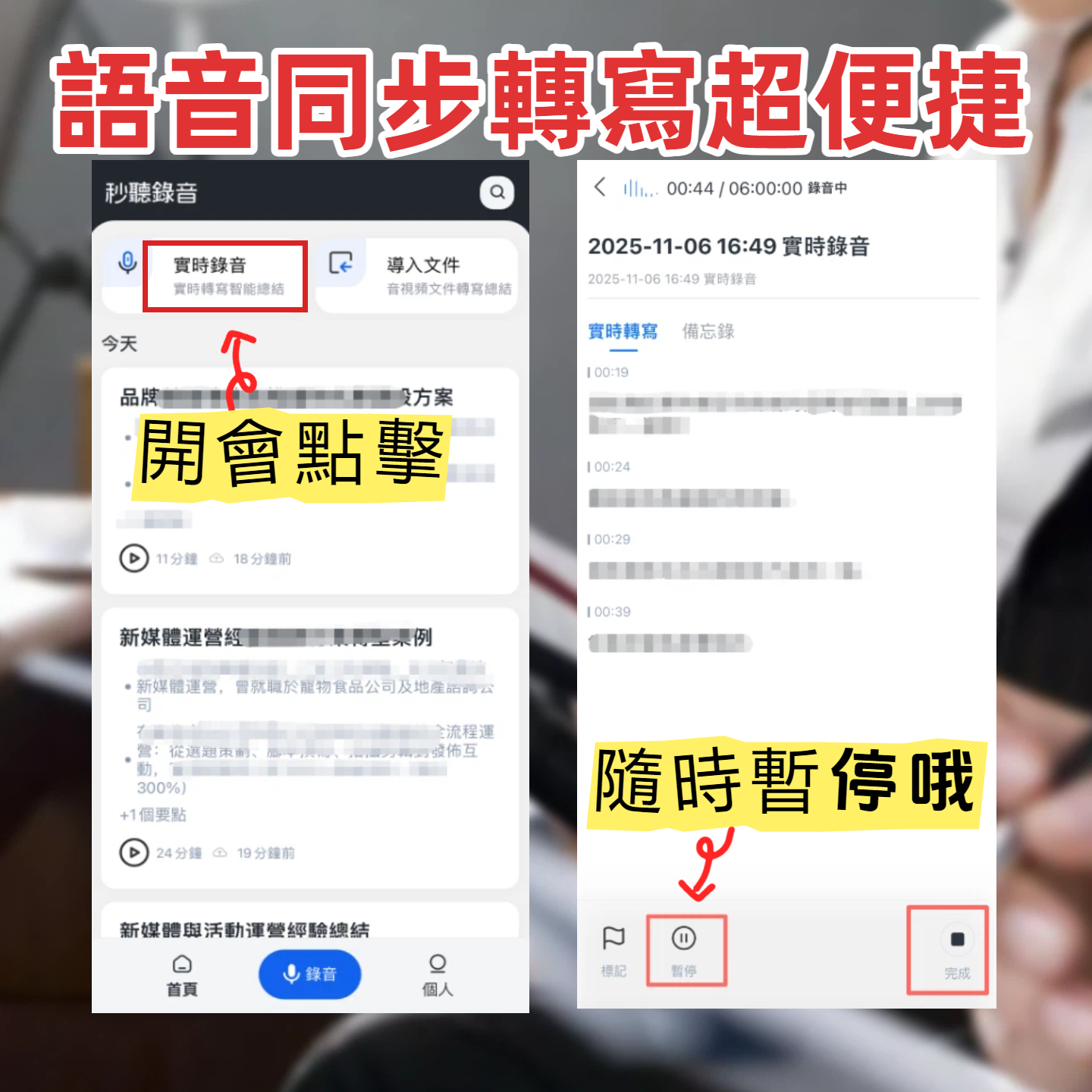
Dimension 1|Input Source Diversity
PLAUD Note's recording method is straightforward—press the hardware button to record, then sync to your phone via Bluetooth. This design suits pure recording scenarios like meetings, classes, or interviews. But if you need to process content beyond live recordings—such as existing audio files, YouTube videos, or even TikTok clips—PLAUD Note falls short.
Tinrec offers significantly more input sources: live recording, importing audio/video files from your phone or computer, and pasting links from YouTube, Bilibili, Xiaohongshu, or even TikTok—all can be transcribed. Even a two-year-old Taiwanese podcast audio file can be handled by Tinrec.
→ This dimension: Tinrec clearly wins.
Dimension 2|AI Organization Features
PLAUD Note's official app provides AI summaries, templates, and basic Q&A. After transcription, you can see highlights, sufficient for basic meeting minutes. However, if you need to turn recordings into actionable data—such as automatically extracting tasks, splitting into chapters, generating mind maps, or continuing to ask questions about the recording—PLAUD Note is relatively limited.
Tinrec's AI organization is its standout feature: it not only provides summaries and chapters but also automatically extracts action items from meeting discussions. You can even use AI to ask questions like "Who is responsible for following up on this client?" or "Did the Taiwanese parts mention any deadlines?" You can then export results to Notion, Google Docs, or plain text, seamlessly integrating into your workflow.
→ This dimension: Tinrec wins again.
Stop organizing recordings by hand
Upload audio or video and automatically get a transcript, summary, and action items
Dimension 3|Cross-Platform Support
PLAUD Note's hardware is independent for recording, but transcription and organization rely on the mobile app (iOS/Android). If you want to organize recordings or export files on your work computer, you first need to sync recordings to your phone and then transfer them via cloud or manual methods—a relatively cumbersome process.
Tinrec supports iOS, Android, and a web version. You can even log in via a desktop browser, upload files or paste video links to start transcription. For office workers who frequently switch between phone and computer, this full-platform sync is much more convenient.
→ This dimension: Tinrec is clearly more convenient.
Dimension 4|Price & Long-Term Cost
PLAUD Note requires upfront hardware costs: the NotePin pre-order price is around US$169, and the Note Pro is around US$179. The included free transcription quota is typically 300 minutes per month. If you need more minutes, you must subscribe (e.g., US$99.9/year for 1200 minutes, or US$239.9/year for unlimited). For occasional users, this entry barrier is high.
Tinrec offers a free version with a basic monthly transcription quota, allowing you to try it out. If you have a short-term need to process many meetings or courses, you can buy a weekly card. Long-term users can choose a Pro monthly or annual subscription, with a much lower monthly cost than the "hardware + subscription" combination. Plus, there's no worry about losing hardware, device failure, or battery degradation.
→ This dimension: Tinrec is more flexible and cost-effective overall.
Dimension 5|Portability for Recording
This dimension is a tie. PLAUD Note's strength is standalone recording without needing your phone—just place it on the table during meetings or classes, and battery life is decent.
However, Tinrec's mobile app already supports one-tap recording, background recording, and pause/resume. Combined with AirPods or Bluetooth earphones, it can achieve high-quality audio capture. For most people, their phone is already a recording device they carry everywhere, eliminating the need for extra hardware.
→ This dimension: Tie. If you highly value standalone recording, PLAUD Note suits you; otherwise, Tinrec's mobile recording is more than sufficient.
Unique Advantages of Each?
Tinrec's Unique Advantages
- Multi-source organization: Handles not only live recordings but also existing audio files and online video links—ideal for users organizing large amounts of Taiwanese learning materials or historical recordings.
- AI workflow: After transcription, continue to ask questions, generate tasks, and export to various formats, truly turning recordings into usable data.
- Zero hardware barrier: Works on phones, tablets, and computers with no extra investment. The free version already lets you experience most core features.
PLAUD Note's Unique Advantages
- Standalone recording experience: No need to rely on your phone—press a button to start recording, suitable for long meetings or situations where pulling out your phone is inconvenient.
- Hardware feel and battery life: Physical buttons and long battery life appeal to users who appreciate a "recording ritual."
Conclusion: Which One Should You Choose?
- If you need to organize Taiwanese meetings, courses, podcasts, or online videos and want a single app to handle recording, transcription, AI organization, and export → Tinrec (most feature-rich and cross-platform convenient).
- If you frequently do long recordings and don't want to touch your phone at all, and don't mind spending more on hardware → PLAUD Note suits you for standalone recording.
- If you are a student or only occasionally need to transcribe Taiwanese recordings, Tinrec's free version is more than enough—no need to spend money upfront.
In short, for the vast majority of Hong Kong users, Tinrec is the more complete and cost-effective choice. We recommend trying the free version to transcribe one of your Taiwanese recordings or videos to experience the convenience of AI organization firsthand.
Turn every recording into actionable outcomes
Get 60 free transcription minutes when you sign in. No credit card required.
Related Reading
You might also like

Tinrec vs Otter.ai 2026: 5-Dimension Comparison – Which Performs Better for Hakka Speech-to-Text?
Need to transcribe Hakka recordings? We compare Tinrec vs Otter.ai across 5 dimensions: Chinese recognition, AI features, cross-platform support, and more. Find out which tool suits Hong Kong users best.

2026 Complete Guide to Hokkien Translation: From Recording to Translation, All in One
How to choose a Hokkien translation tool? This article tests Tinrec and Notta, comparing speech recognition, translation accuracy, post-processing, and pricing to help you find the best Hokkien speech-to-text and translation solution.

Comparison of 2 Dongbei Dialect Speech-to-Text Tools in 2026: Which One Offers More Down-to-Earth Chinese Recognition?
We test Tinrec vs Otter.ai on Dongbei dialect recognition, AI organization features, and free plan limits to see which is better for transcribing Chinese audio with a Dongbei accent.

Tutorial: Transcribe Hokkien Lectures with Tinrec in 2026 – AI Summaries for Easy Review
A senior shares his experience using Tinrec to transcribe Hokkien course recordings, including tutorials, free tier tips, and alternatives, helping students save time on note-taking.

2026 Taiwanese Speech-to-Text App Showdown: Why Tinrec Outshines Yating
This article compares Tinrec and Yating, two Taiwanese speech-to-text tools, analyzing features, accuracy, use cases, and pricing to help you find the best assistant for meetings, classes, and interviews.

2026 Free Cantonese Translation Solutions: 3 Tools at a Glance
A review of three free solutions supporting Cantonese translation, comparing Tinrec, Notta, and TurboScribe in terms of Cantonese recognition, translation features, and free quotas, helping you find the best tool for Chinese-speaking users.

2026 Tinrec Voice-to-Text Guide: Supports Cantonese & Auto-Generates Meeting Minutes
As a student, can't keep up with notes in class or understand Cantonese in group discussions? Tinrec is an AI voice-to-text tool that supports Cantonese and multiple languages, and can automatically summarize and create to-do lists, turning your lecture recordings into reviewable notes. This article covers 5 Cantonese voice-to-text solutions suitable for students, from free to paid, to help you choose the best tool for your needs.

Which Cantonese Meeting Transcription Tool is Best? 2026 Test of Multiple Tools: Free Version of This One is Most Practical
Tested multiple AI meeting transcription tools for Cantonese meetings, comparing transcription accuracy, AI summaries, action item extraction, and multi-platform support. After a thorough comparison, Seconds Audio (Tinrec) is recommended—the free version offers practical features suitable for everyday office workers and frequent meeting users.

2026 Real-World Comparison of 2 Southern Min Speech Recognition Tools: Which is Better for Daily Recording and Organization?
For users needing Southern Min speech recognition, support from mainstream tools is still limited. This article compares Tinrec and PLAUD Note across dimensions such as recognition capability, input sources, AI organization, cross-platform support, and pricing, helping you choose the most suitable transcription tool for your needs.