
Turn recordings into transcripts and summaries in minutes
Upload audio or video for multilingual transcription, AI notes, and action items
Why Are Your Meeting Notes Always Unfinished?
“Please organize today’s two-hour interview by end of day.” “The boss needs the decision summary first thing tomorrow morning.”
For administrative staff, project managers, or writers, these scenarios are a time management nightmare. Traditional voice recorders can save audio, but the information density is extremely low—listening to an hour-long recording often takes more than double the time to transcribe. In 2026, AI speech-to-text technology has evolved from simple “transcription” to “understanding.”
This article compiles the popular AI meeting note tools on the market, referencing Meeting Ink’s 2026 benchmark data, and compares them across dimensions such as processing speed, summary quality, language support, and cross-platform integration. Whether you prioritize blazing-fast transcription, localized Taiwanese recognition, or an end-to-end solution like Tinrec that emphasizes “real-time recording to text + AI chat query,” this article will help you make the best choice.
Quick Navigation Conclusion:
- Localization & Speed: Consider Meeting Ink or Yating Transcript (supports Taiwanese).
- Hardware Recording Needs: Plaud integrates a physical recording card, suitable for call recording.
- Full AI Assistant (Recording + Q&A): Tinrec offers a complete workflow from recording to AI chat query.
- Mainly English Meetings: Otter.ai remains a strong performer for English.
2026 Popular AI Meeting Note Tools: Reviews & Feature Analysis
Based on the latest benchmark data and feature inventory, the following tools are analyzed in three categories:
1. Overall Performance & Localization Recommendations
Meeting Ink In benchmarks, Meeting Ink shows balanced performance. It supports “real-time captions” and “speaker diarization,” and is one of the few tools supporting Taiwanese/Hakka recognition. Tests show upload of an audio file takes about 55 seconds, and transcription about 2 minutes (for a 26-minute audio file), demonstrating excellent speed. Suitable for users who need to handle mixed languages and the Google Workspace ecosystem.
Yating Transcript Excels in localized language processing. Audio upload is extremely fast (only 17 seconds), but the summary generation feature is occasionally unstable and may require queuing. Suitable for users with a strong need for Mandarin/Taiwanese recognition but lower demand for real-time captions.
2. Specific Scenarios & Hardware Integration
Plaud A product combining a physical recording card with an app. Its strength lies in “mobile recording” and “call recording,” not limited by software environment. However, tests show it does not support speaker diarization and lacks real-time captions, making it more suitable for one-on-one interviews or personal memos.
SeaMeet Specializes in online meeting scenarios, integrating with Microsoft Teams and Google Meet via browser extension. Tests show decent speaker diarization, suitable for enterprise environments heavily reliant on online meeting software.
3. All-in-One AI Note-Taking & Knowledge Management
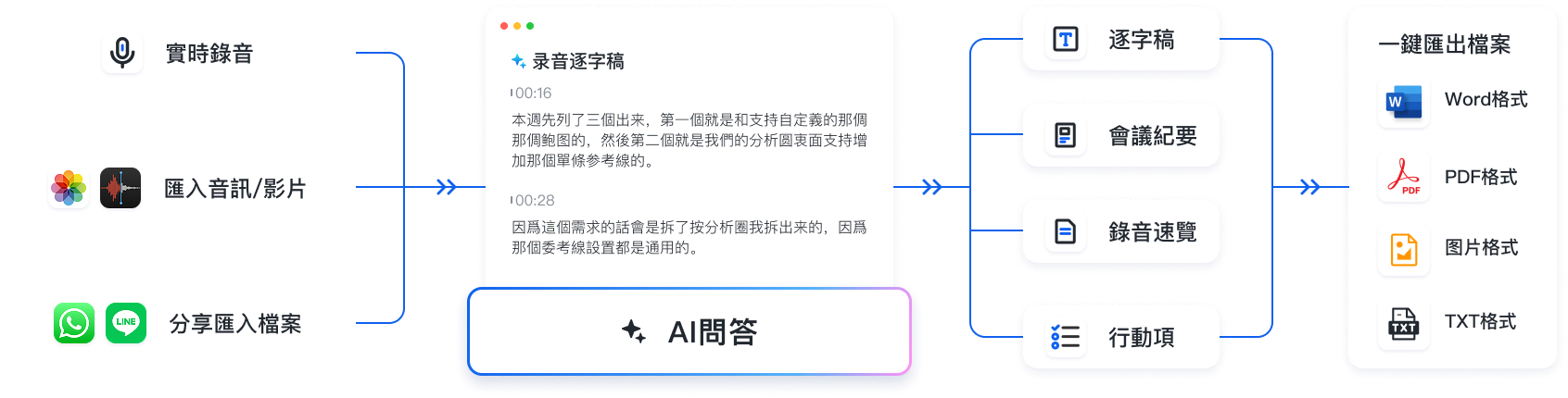
Tinrec (Instant Recording to Text) Tinrec is more than just a transcription tool; it emphasizes a complete workflow “from recording to action.” It supports iOS, Android, and web multi-device sync. Its standout feature is “real-time transcription” while recording, and auto-generating structured meeting minutes and action items after the meeting.
Unlike traditional tools that only allow keyword search, Tinrec has an AI chat query function. You can ask in natural language: “What was the budget constraint John mentioned during the meeting?” The AI answers based on the recording content, saving you from re-reading the transcript.
Head-to-Head Comparison: Specs Table of 9 Meeting Note Apps
For a more intuitive comparison, we compiled benchmark data from the source (based on a 26-minute English podcast audio file) and feature specs of each tool:
Stop organizing recordings by hand
Upload audio or video and automatically get a transcript, summary, and action items
| Tool Name | Speech-to-Text Speed | Summary Generation Speed | Real-Time Captions | Speaker Diarization | AI Chat Query | Key Highlights |
|---|---|---|---|---|---|---|
| Meeting Ink | 1 min 58 sec | 26 sec | ✔ | ✔ | - | Supports Taiwanese/Hakka, Google Calendar integration |
| Tinrec | Real-time/Very fast | Auto-generated | ✔ | ✔ | ✔ | Multi-device sync, AI Q&A retrieval, video to text |
| Otter.ai | 3 min 35 sec | 2 min 38 sec | ✔ | ✔ | ✔ | Strong English recognition, auto-join scheduled meetings |
| Vocol.ai | 3 min 29 sec | 1 min 23 sec | ✘ | ✔ | - | Suitable for batch post-meeting processing, project collaboration |
| Plaud | 49 sec | 1 min 03 sec | ✘ | ✘ | - | Hardware recording card, suitable for call recording |
| Yating Transcript | 4 min 34 sec | 50 sec | ✘ | ✔ | - | Developed in Taiwan, good Taiwanese recognition |
| SeaMeet | 3 min 46 sec (total) | Included in total | ✔ | ✔ | - | Deep Teams/Meet integration |
| Vurbo.ai | 12 min 51 sec (total) | 18 sec | ✔ | ✘ | - | Supports real-time translation, but process is time-consuming |
| Good Tape | >1 hour (free plan) | None (free plan) | ✘ | ✘ | - | Simple to use, but free plan has many limitations |
Key observation: For real-time and interactivity, Meeting Ink and Tinrec perform better; for simple backup, Plaud or Good Tape are options.
Deep Dive: How Tinrec Solves the “Recorded But Never Listened” Pain Point
Many tools only solve the first step of “turning audio into text,” but the real pain point is “how to find the key points from thousands of words.” Tinrec offers a more information-rich solution.
1. Real-Time Recording to Text, Multi-Device Sync
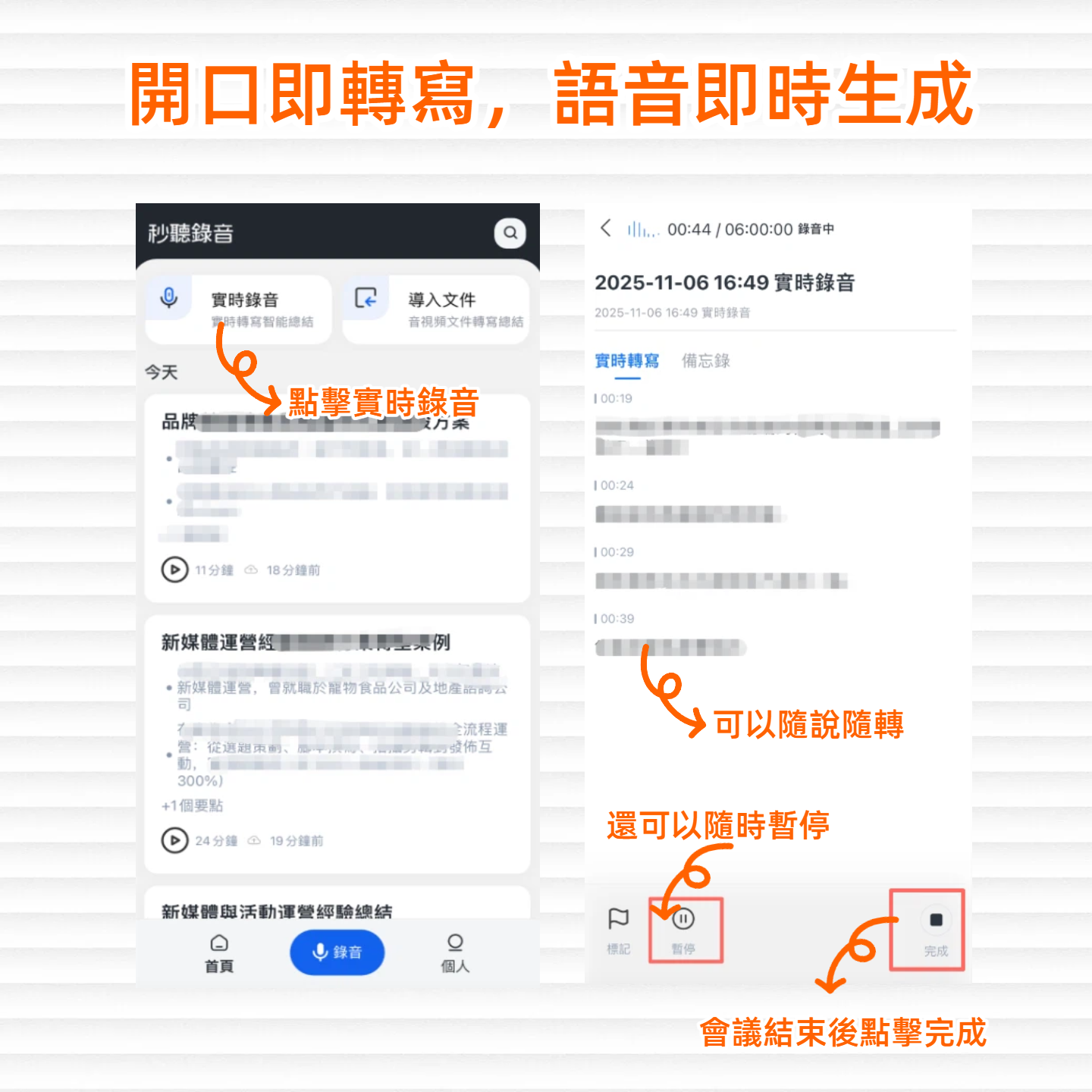
Tinrec supports Web, iOS, and Android, meaning you can record with your phone in a physical meeting, and the transcript is already synced on the web version when you get back to your computer. Its “real-time recording to text” feature lets you see the text output while recording, without waiting for file upload and conversion.
2. Not Just Summaries, but “AI Chat Query”
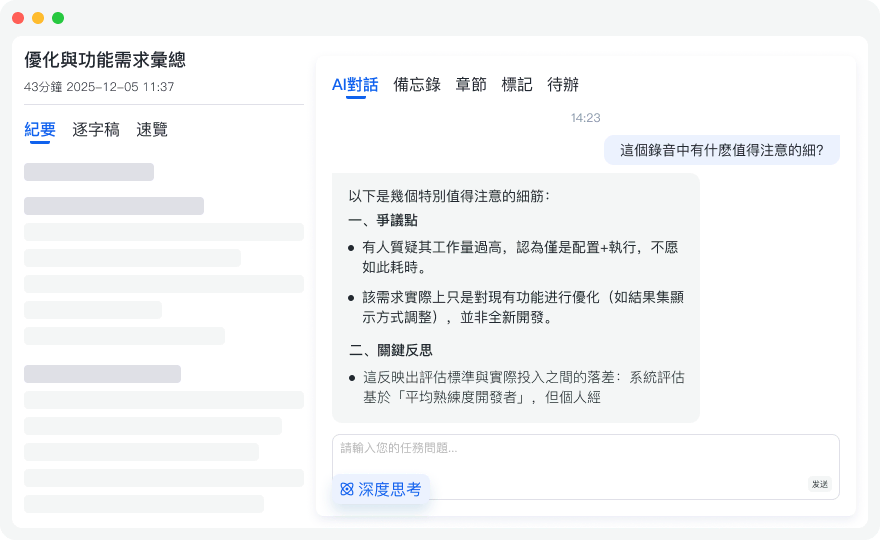
This is the biggest difference between Tinrec and traditional tools. For a two-hour meeting recording, you don’t need to scroll through the transcript yourself. Using the AI Chat feature, you can treat the recording as a “person” to ask questions. For example, enter: “Summarize the marketing team’s KPIs for next month,” and the system will precisely extract relevant segments and answer. This upgrades “search” to “consultation.”
3. Handles All Audio/Video: Even Online Video Links
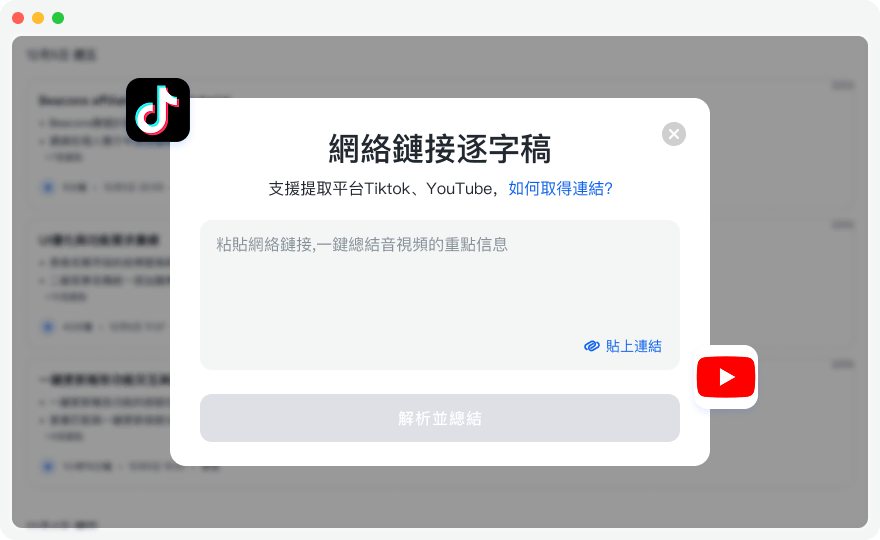
In addition to meeting recordings, Tinrec also supports importing audio/video files and even parsing links from YouTube, TikTok, etc. This is a boon for users who need to organize competitive analysis, study online courses, or create content.
Practical Tutorial: 4 Steps to Generate High-Quality Meeting Notes with AI

Regardless of which tool you choose, following the correct workflow can significantly improve output quality. Below, using Tinrec’s interface logic as an example, we demonstrate how to efficiently complete meeting notes.
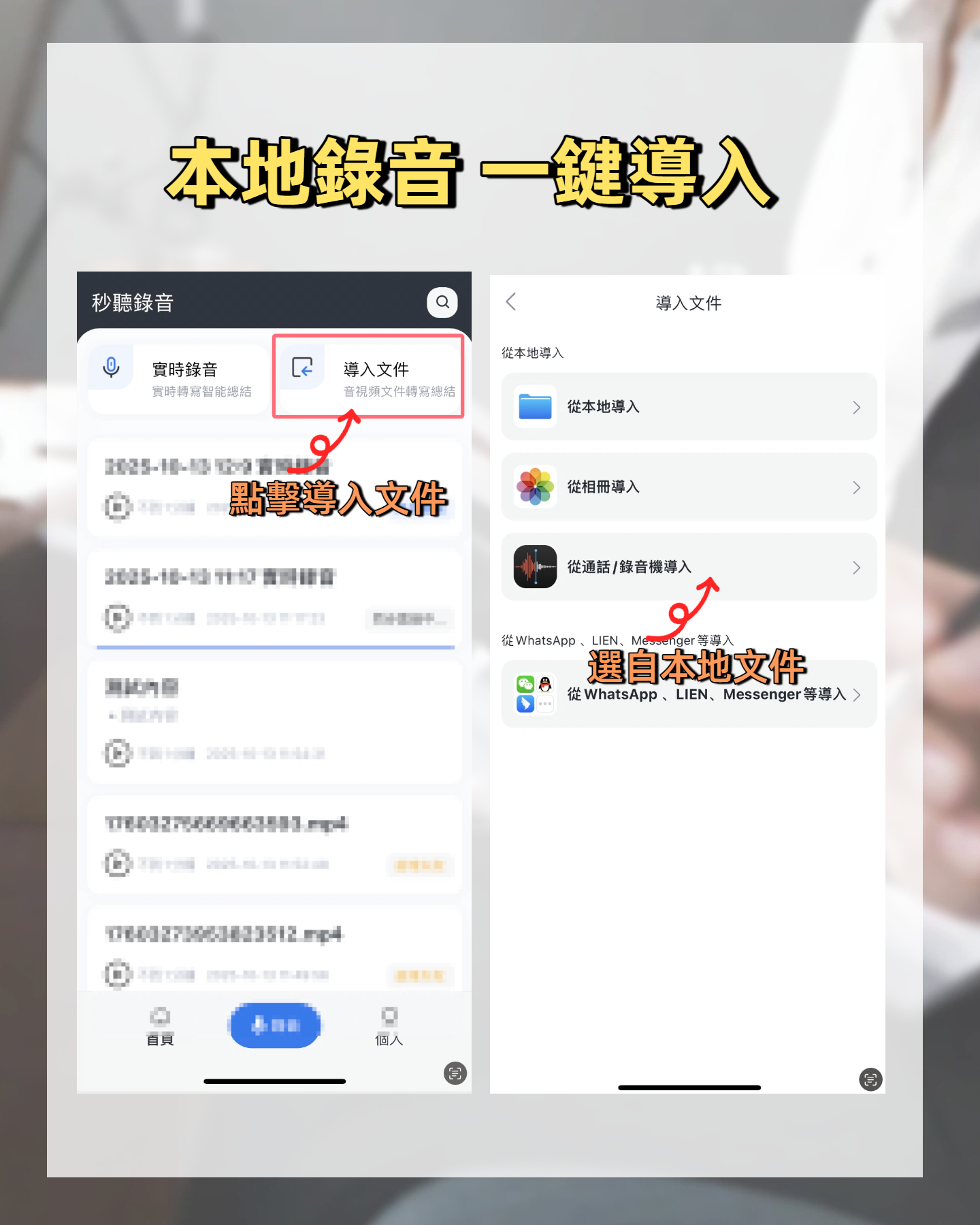
Step 1: Start Recording or Import a File
- Physical meetings: Open the app or web version, click “Start Recording.” It is recommended to place the device in the center of the conference table for best audio pickup.
- Online meetings/files: If using Teams or Zoom, you can record with your computer’s built-in recorder and then drag the file to the “Import Audio/Video” area. For existing YouTube videos, simply paste the URL.
Step 2: Real-Time Review and Mark
- During recording, Tinrec generates the transcript in real time. If you hear an important decision, click the “Mark” button on the interface to quickly locate it later.
- The system automatically performs speaker diarization to distinguish different speakers.
Step 3: One-Click Generate Structured Summary
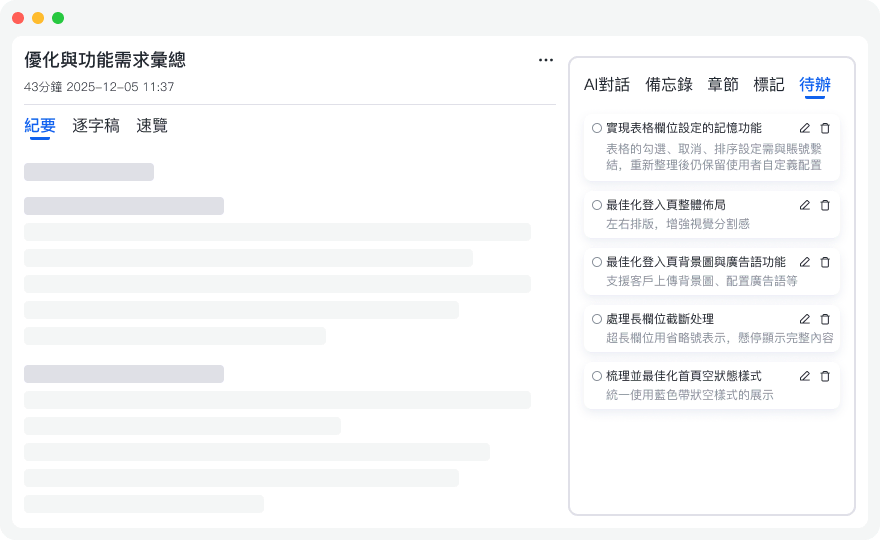
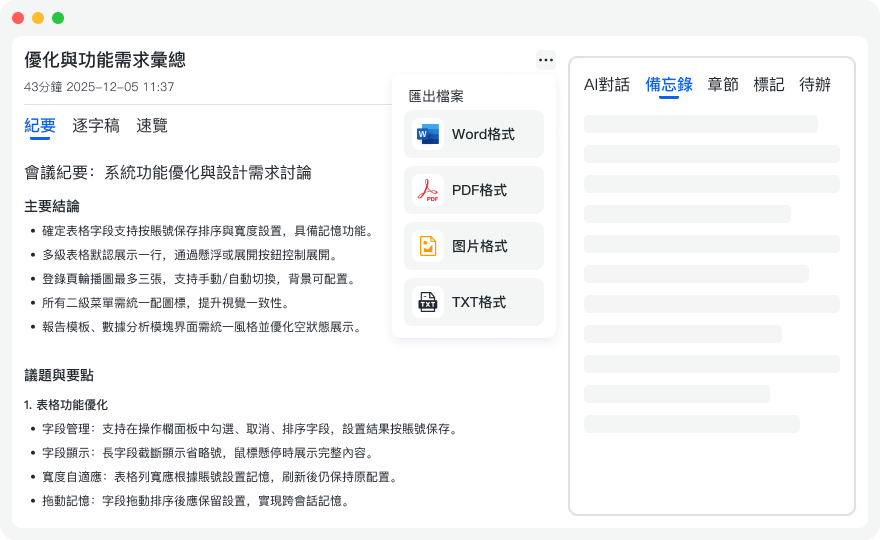
- After recording ends, click AI Analysis. The system automatically produces “Meeting Minutes,” “Key Takeaways,” and most importantly, “Action Items (To-Do List).”
- This summary can be directly copied to Notion, Google Docs, or company emails for distribution.
Step 4: Use AI Assistant for Detail Confirmation
- If specific data is missing from the summary, no need to re-listen to the recording.
- Go to the “AI Chat” page, type your question (e.g., “What was the reason for the product launch delay?”), confirm the answer, and supplement the final meeting notes.
FAQ
Q1: Do these tools have free versions? How much credit?
Most tools offer free trials. For example, Meeting Ink provides trial credit; Tinrec offers a monthly free quota of 100 minutes of recording transcription, sufficient for occasional meetings. If you need more hours (e.g., 600 or 1200 minutes), consider upgrading to the Basic or Pro plan.
Q2: How accurate is the audio-to-text conversion?
Accuracy depends on recording quality and model capability. Currently, mainstream tools like Meeting Ink and Tinrec can achieve Chinese recognition rates of over 90% in clear recording environments. Tinrec supports 10 languages including Chinese, Japanese, English, Korean, Taiwanese, Cantonese, etc., suitable for international meetings.
Q3: Can I use it on iPhone?
Yes. Tinrec, Otter, etc., all have iOS apps. Note that due to iOS system privacy restrictions, mobile apps cannot directly record “in-call audio” (e.g., LINE calls). It is recommended to use speakerphone or record on a computer for online meetings.
Q4: Are these tools safe? Will meeting data leak?
Enterprise-grade tools usually prioritize data privacy. Choose services that support encrypted transmission and have clear privacy policies. For highly confidential meetings, confirm the tool’s data retention policy.
Q5: What if the meeting mixes Chinese and English?
Choosing a tool that supports “multi-language mixed recognition” or “automatic language detection” is crucial. Meeting Ink and Tinrec both have the ability to handle multilingual environments, reducing the hassle of switching settings.
Q6: What export formats are available?
Commonly supported formats include TXT, Word, PDF, or subtitle files (SRT/VTT). Tinrec supports multi-format export for easy video subtitle editing or archiving.
Turn every recording into actionable outcomes
Get 60 free transcription minutes when you sign in. No credit card required.
Related Reading
You might also like
5 Best Speech-to-Text Tools in 2026: From Free to Team Collaboration, Tinrec Is the Top Pick
How do you choose a speech-to-text tool? This article compares 5 tools including Tinrec, Otter.ai, and Notta, covering free quotas, bot-free meeting recording, AI summaries and Q&A, and team spaces, to help you find the best meeting notes and transcription solution.

Tinrec vs Notta in 2026: A 5-Dimension Comparison to Help You Choose
How to choose an online audio-to-text tool? This article compares Tinrec and Notta across 5 key dimensions, from meeting capture, post-processing, team management to Chinese language experience, helping you find the best AI transcription solution.

Tinrec vs Notta 2026: 4-Dimension Comparison for Online Meeting Transcription
A middle manager's hands-on test: How to choose an online meeting transcription tool? From bot-free recording, AI summaries, Chinese accuracy to team collaboration, real meeting scenarios show why Tinrec is better suited for professionals.

2026 Free Speech-to-Text Solutions: 5 Tools Compared
This article tests 5 free speech-to-text tools, from Tinrec to MyEdit and NotebookLM, comparing free quotas, transcription quality, and post-processing features to help you find the truly worthwhile option.

2026 Free AI Speech-to-Text Tools Compared: Why Tinrec Is the Best Fit for You?
After testing several free AI speech-to-text tools, we found that not all free versions are sufficient. This article focuses on Tinrec, examining its free tier limits, features, and real-world experience to help you choose the most time-saving solution.

5 Best Recording-to-Text Software in 2026: Is the Free Version Enough? This One Surprised Us
We tested 5 free recording-to-text apps, evaluating transcription quality, AI summarization, cross-platform support, and free-tier limits to find the truly useful options. Tinrec not only converts speech to text but also offers automatic summaries, Q&A, and team collaboration—all available in the free version.

2026 Tested: 5 Speech-to-Text Tools Compared – Tinrec Best for Hong Kong Professionals
After testing multiple speech-to-text tools, Tinrec stands out with bot-free recording, Chinese meeting summaries, and team collaboration. See why it's the best time-saver for Hong Kong professionals.

How to Choose a Free Speech-to-Text Tool in 2026: A 5-Step Practical Guide
We tested multiple free speech-to-text tools, covering common pitfalls, key selection criteria, and tips to avoid mistakes. This 5-step guide helps you find the best AI transcription solution for Chinese, with an in-depth look at Tinrec (Miao Ting Lu Yin)'s free and paid features.

4 iPhone Voice-to-Text Apps Tested in 2026: Is Apple's Free Built-in Enough?
We tested 4 voice-to-text solutions for iPhone, from Apple's free built-in Voice Memos to Tinrec and others, comparing accuracy, AI features, and cross-platform support to help you save time on meeting notes.