

Turn recordings into transcripts and summaries in minutes
Upload audio or video for multilingual transcription, AI notes, and action items
Two Hours of Lecture, Can't Keep Up with Notes—You Need a "Record and Auto-Summarize" Solution
Last semester I took an elective. The professor talked faster than a bullet train and flipped through slides even faster. I tried taking handwritten notes, but when I opened my notebook before midterms, I couldn't even read my own writing. So I borrowed notes from a classmate, but his were even messier.
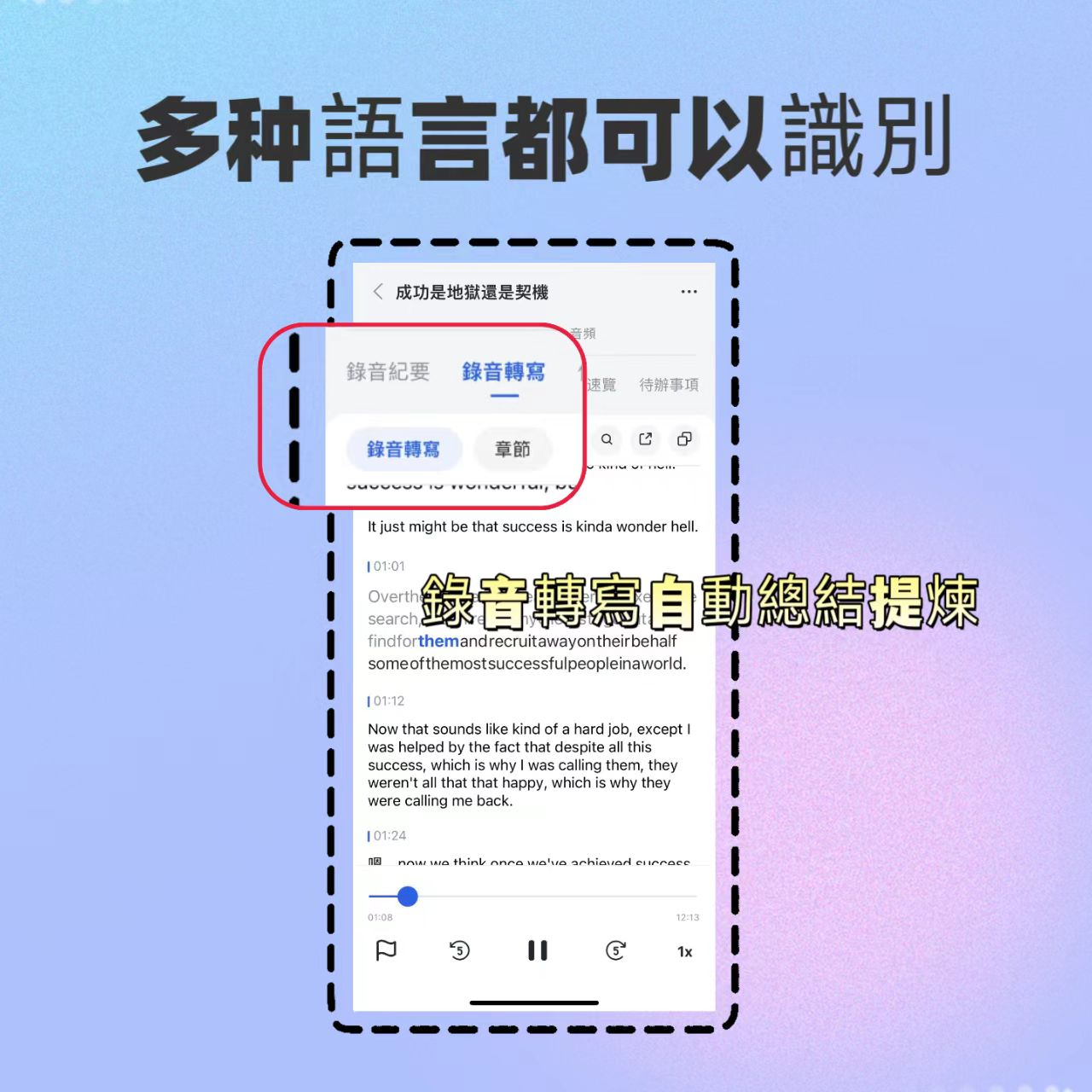
Later, a senior showed me a trick: start a Google Meet recording in class (or use iOS's built-in screen recording), then drop the audio file into an app to get a transcript and auto-extracted key points. I did this for every class that semester. Before finals, I didn't need to borrow anyone's notes—I just sent the AI-summarized PDF to the group chat, and everyone thought I was a straight-A student.
If you often face these situations:
- Your typing speed can't keep up with the professor's speech
- Group discussions are chaotic, and no one remembers the conclusions afterward
- You want to save key points from online lectures or YouTube tutorials
Then this article is for you. I tested four iOS recording-to-text apps in real student scenarios to tell you which one offers the best value and is best for assignments and exam prep.
Before Choosing a Recording-to-Text App, Understand These 3 Key Points
1. Transcription Accuracy: Don't Trust Official Numbers, Look at Real Classroom Conditions
Official "98% accuracy" is usually measured in a quiet recording studio. Your real scenario: the professor talks while writing on the board, classmates eat breakfast, and the AC hums. I tested with the same 5-minute English liberal arts lecture recording (with background noise and accented speaker), and the differences were immediate.
2. AI Organization: It's Not Just About Getting a Transcript—It's About Saving Time After Class
Transcription is just the first step. What really affects your review efficiency is: can the app auto-detect chapters, highlight key points, and compile action items? Even better, can you ask it something like "What are the exam topics for this class?" like you would ask a top student? That's the key to never failing again.
3. Free Quota and Cross-Platform: Students Have Limited Budgets but Often Use Multiple Devices
You'll likely record on your phone but want to edit the transcript on your computer. So whether the app has a web version and how many minutes the free plan gives you matters more than anything. I'd rather skip one late-night snack for a month of smooth usage than have a permanently free crippled version.
Tinrec (秒聽錄音) — My Top Pick After Testing, a Lifesaver for Students
Tinrec is an AI recording and audio/video processing tool supporting 14 languages, available on iOS, Android, and web. It doesn't just convert speech to text; it turns lecture recordings, group discussions, and YouTube tutorials into searchable, actionable notes.
After Using It for a Whole Semester, These Three Features Are Most Useful:
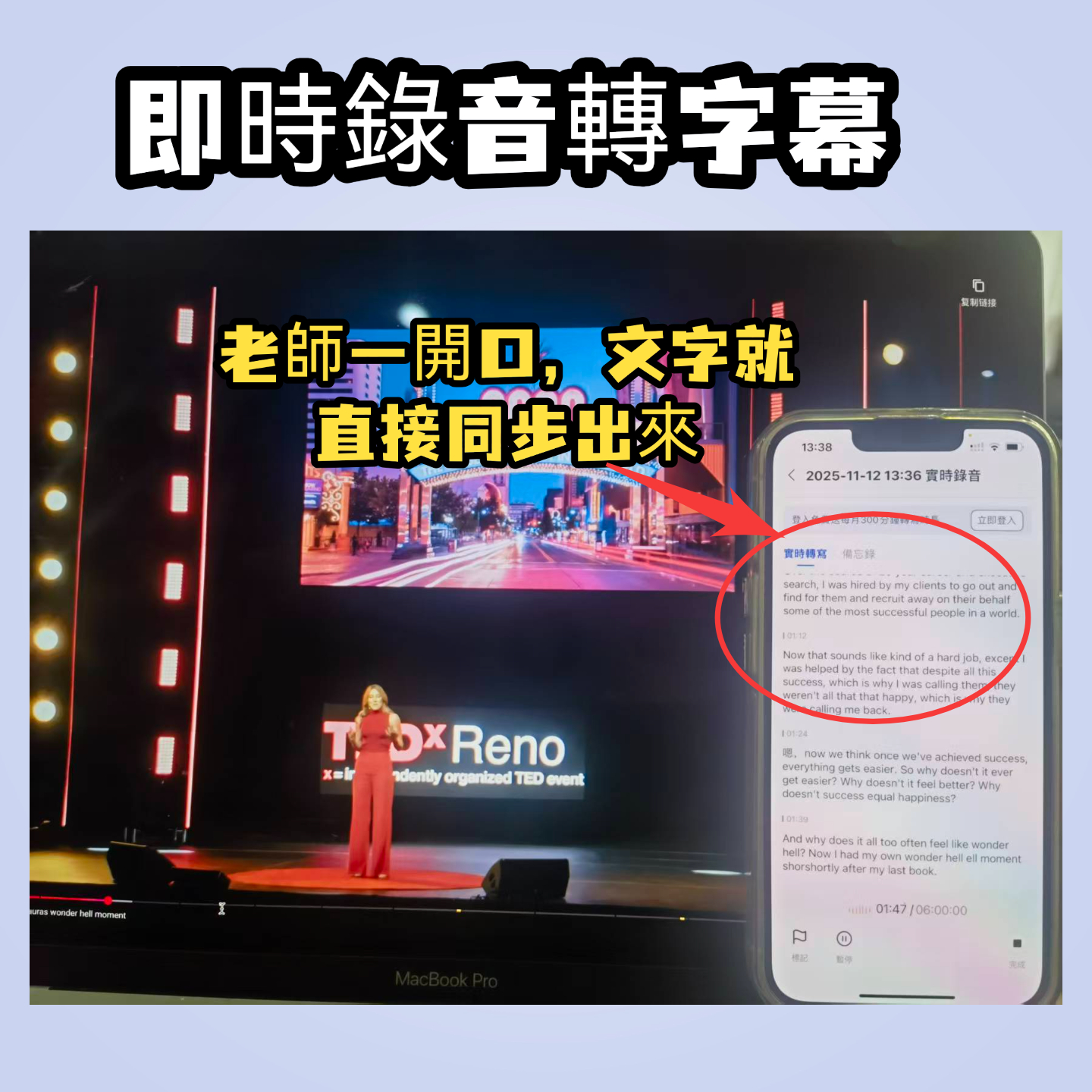
1. Record and Transcribe in Real Time, Get Key Points Right After Class Open Tinrec during class, and it shows a live transcript. After a two-hour lecture, you get not only the full text but also auto-generated chapters, summaries, and action items (e.g., "Next quiz covers Chapter 3"). Before exams, I export it as a PDF and share it with classmates.
2. Turn Online Videos into Study Notes—YouTube, Bilibili, etc. Some liberal arts professors just read from the textbook, so I find supplementary videos on YouTube. Just paste the link, and Tinrec not only transcribes but also organizes the video's structure and key points. For final reports, this trick gets me halfway through the literature review.
Stop organizing recordings by hand
Upload audio or video and automatically get a transcript, summary, and action items
3. AI Q&A: Ask It "What Are the Must-Know Topics from This Lecture?" This feels like having a study buddy. After uploading a recording, you can chat with Tinrec about the content, and it answers based on meaning. Unlike other tools that only search keywords, Tinrec understands what you're asking. Before midterms, I asked, "Did the professor hint at which chapters are important?" It summarized from multiple recordings, saving me 8 hours of re-listening.
Test Data (Especially Relevant for Students)
I recorded a 5-minute English literature lecture on an iPhone 15 in a 50-person classroom (with slight AC noise). Tinrec had a word error rate of about 5.2%, which is good enough for noisy environments. The free plan gives 100 minutes per month—enough for 2-3 key classes per week. If you record every class like I do, the Pro plan costs NT$150 per month, less than two Frappuccinos.
Pros
- Not just transcription—it also provides summaries, chapters, and action items
- AI Q&A is like a personal TA; no need to re-listen for key points
- Supports online video links, making it easy to organize digital resources
Cons
- Free plan only has 100 minutes per month; heavy users need to upgrade (but sufficient for most students)
- No automatic meeting join feature (you need to start recording manually, but that's fine for classes)
Who It's For
If you mainly use iOS to record lectures, supplement with YouTube or online courses, and want AI to extract key points instead of manually scanning transcripts—Tinrec is the best student choice.
What Are the Alternatives to Tinrec?
Otter.ai: Great for English Classes, but Useless for Chinese
Otter.ai is a powerhouse for English meetings. The free plan offers 300 minutes per month, with decent transcripts and summaries. However, it doesn't support Chinese transcription or online video parsing. If you only record English-taught classes, Otter.ai is more cost-effective than Tinrec. But for liberal arts or Chinese lectures, it's a no-go.
Notta: Good Transcription Quality, but No AI Q&A
Notta's transcription accuracy is high, and it has decent summarization. But it lacks Tinrec's conversational Q&A, so you have to manually search transcripts. The free plan gives 120 minutes per month—slightly more than Tinrec—but without the key Q&A feature, it's less helpful for exam review.
Yating Transcription: A Local Taiwanese Choice, but No Free Trial
Yating Transcription is good at recognizing Taiwanese Mandarin and Chinese, but its free plan offers no transcription quota—you either pay or don't use it. For broke students, no free trial is hard to swallow. It also lacks AI Q&A and online video parsing, making it less versatile.
Pitfall Guide: 3 Common Mistakes When Choosing a Recording-to-Text App
Pitfall 1: Only Looking at Accuracy, Ignoring Organization Features Many apps claim 98% accuracy, but if you have to spend three hours highlighting key points after a one-hour recording, it's useless. What matters is whether the AI can save you organizing time. Tinrec's auto-chapters and Q&A are where it truly stands out.
Pitfall 2: Overlooking Cross-Platform Needs You'll likely view transcripts on an iPad, record on an iPhone, and write reports on a computer. If the app only supports one device, transferring files becomes a nightmare. Tinrec has a web version, which is crucial for students with both phones and laptops.
Pitfall 3: Assuming the Free Plan Is Enough, Then Getting Blocked by Paywalls Some apps heavily restrict the free version, forcing you into a paid plan after a three-day trial. Check the free minutes and feature limits first. Look for apps like Tinrec that offer a "100-minute full-feature trial" so you don't waste time installing and deleting.
Conclusion: Which One Should Students Choose?
I've used all four for at least a semester. Here's my verdict:
- Lecture recording + YouTube learning + need AI to extract key points → Tinrec (100 free minutes, affordable Pro, best cross-platform support)
- Only recording English classes and care about free minutes → Otter.ai (300 minutes/month, but no Chinese or Q&A)
- Need pure transcription with a bigger budget → Notta (high-quality transcription, but no AI Q&A)
- Heavily prioritize Taiwanese Mandarin recognition and willing to pay upfront → Yating Transcription (but limited features)
Simply put, if you're like me and want to turn lecture recordings and online resources into exam-ready notes, start with Tinrec's free trial. 100 minutes per month is enough for 2-3 key classes. After one class, you'll experience the joy of "no need to re-listen." Upgrade only if you find it useful—don't pay upfront.
I've already convinced three roommates. Now we all use Tinrec for group discussions: we just share the summary in the group chat right after. No one can pretend they didn't hear the conclusion anymore.
Turn every recording into actionable outcomes
Get 60 free transcription minutes when you sign in. No credit card required.
Related Reading
You might also like

Free Google Meet Meeting Notes Tools 2026: A Look at 3 Options
Tired of spending hours transcribing Google Meet recordings? We tested 3 free AI meeting note tools, analyzing accuracy, AI summaries, cross-platform support, and language compatibility to help you find the best free solution that turns meeting recordings into searchable, actionable knowledge.

5 Google Meet Meeting Note Tools Tested in 2026: Which Free Plan Is Best?
Struggling to turn Google Meet recordings into text and summaries? This article tests 5 tools including Tinrec, Otter.ai, Fireflies.ai, comparing free plans, AI summaries, and Chinese support to help you find the perfect meeting note taker.

How to Record and Organize Google Meet Interviews in 2026: Tinrec Auto-Generates Transcripts, Summaries & Action Items
How to fully record and quickly organize Google Meet interviews? This article compares built-in transcription with Tinrec, testing 5 dimensions: real-time transcription, accuracy, post-meeting organization, cost, and cross-platform. Learn to save 80% of your note-taking time and never miss key points.

The Ultimate Guide to Google Meet Meeting Notes in 2026: Auto-Generate Summaries and Tasks with Tinrec
This guide teaches you how to use Tinrec to instantly transcribe Google Meet recordings, automatically generate summaries, to-do lists, and AI-powered Q&A, streamlining your workflow from invitation to post-meeting organization.

2026 Google Meet Built-in Transcription vs Tinrec: A 5-Dimension Comparison – Which Saves Hong Kong Professionals More Time?
Tired of manually taking meeting notes during Google Meet calls? Google Meet's built-in transcription is free, but is it enough? This article compares Google Meet and Tinrec across five dimensions: Cantonese recognition, AI summaries, cross-platform support, offline file processing, and export features. Find out why Tinrec is the real AI recording tool that saves time.

2026 Test: 3 Google Meet Backup Recording Tools Compared – Never Miss Meeting Content Again
This article tests 3 recording-to-text tools for Google Meet failures: Tinrec, Otter.ai, and Notta. Compare free plans, accuracy, and AI features to keep important content even when meetings drop.

2026 Hands-On Comparison of 4 Google Meet Recording-to-Text Tools: Are Free Plans Enough for Windows Users?
This article tests 4 recording-to-text tools for Google Meet on Windows: Tinrec, Otter.ai, Fireflies.ai, and one more. It compares accuracy, AI summaries, free plans, and cross-platform support to help you find the best meeting note solution.

2026 Real-World Comparison: Tinrec vs Google Meet Transcription – Which Is More Practical?
How to take notes in Google Meet? This article compares Tinrec and Google Meet's built-in transcription across 5 dimensions including transcription accuracy, post-meeting organization, cross-platform support, and Chinese language scenarios, helping you find the best meeting note solution for your needs.
2026 Google Meet Grid View Fix: Solve Display Issues & Use AI Meeting Assistant to Make Meetings More Valuable
What to do when Google Meet grid view breaks? Instead of manual fixes, rethink the true value of meetings: post-meeting records and action items. This guide shows you how to use Tinrec to turn meetings into searchable, summarizable, exportable knowledge—fueling your work forward.