
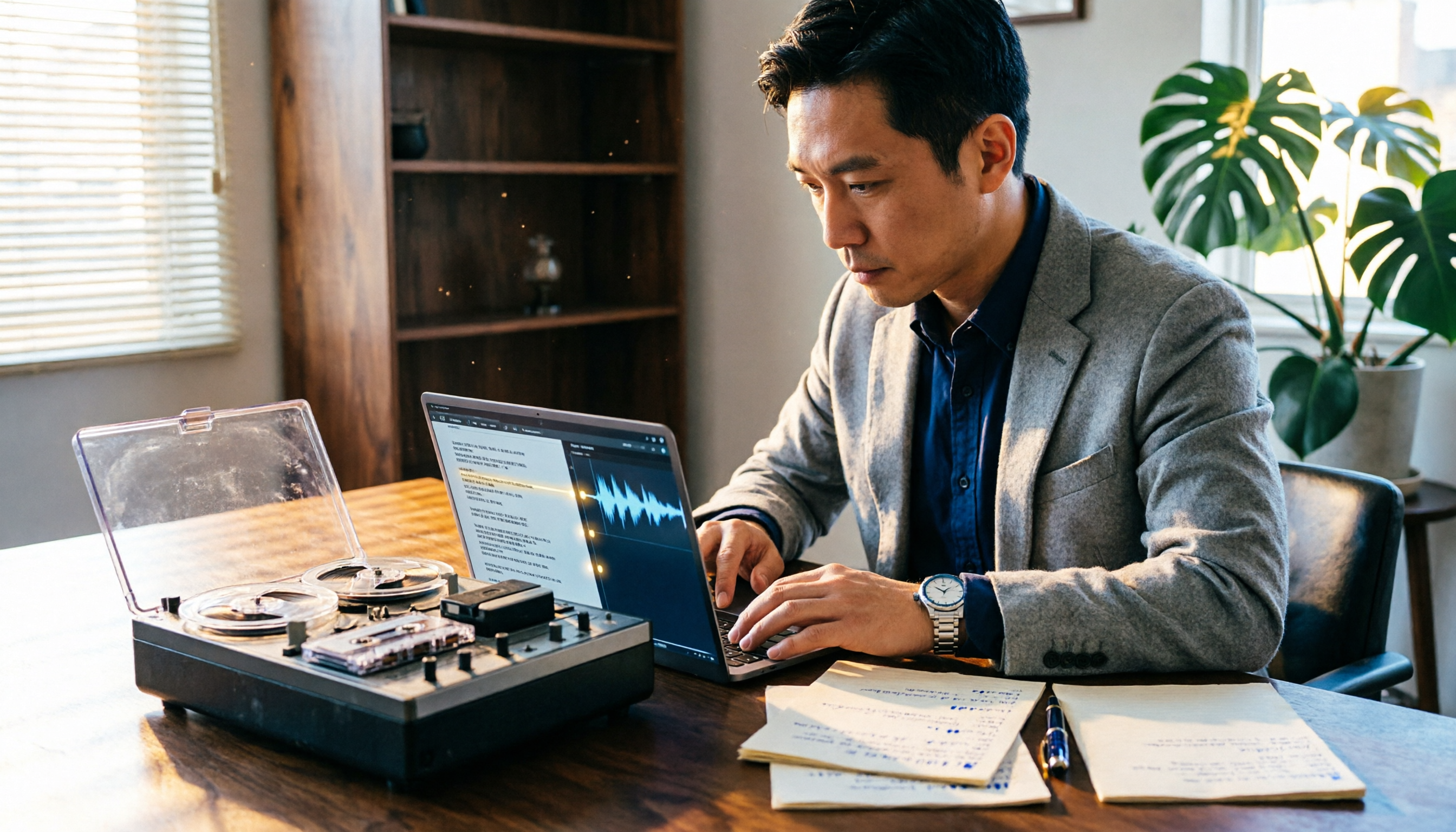
Turn recordings into transcripts and summaries in minutes
Upload audio or video for multilingual transcription, AI notes, and action items
Spend Two Hours in a Meeting, Then Another Two Hours Organizing the Minutes? For Legal Professionals, the Bigger Headache Is Producing a Second-by-Second Litigation Transcript
If you’ve ever had a key recording ignored in court because you didn’t have a verbatim transcript, this article is for you.
In litigation practice in Taiwan, written documents matter far more than oral statements. If a party wants to submit an audio recording as evidence, burning it to a CD isn’t enough — you must attach a complete, second-by-second transcript. The judge needs to see, from start to finish, who said what at every moment, not just the highlights you selected yourself.
Only excerpting the parts you need? The opposing counsel’s simple remark, “We can’t confirm the context,” gets your evidence thrown out. Trying to type it out yourself? A 30-minute meeting recording will keep you up until dawn — and still leave errors all over the page.
If you’ve faced these situations, you need more than a “speech-to-text tool” — you need a solution that truly helps you produce a “court-ready transcript.”
Before Choosing a Speech-to-Text Tool, Understand These 5 Key Points — Especially for Litigation Use
Transcripts in legal contexts have completely different requirements from ordinary meeting minutes. Don’t just look at how many features a tool has; if it fails on these points, you’ve wasted your money.
1. Accuracy Should Be Tested in Real-World Conditions, Not Lab Data
The 98% accuracy advertised by vendors is measured in a quiet recording studio. Your recordings may include street noise, coffee shop background chatter, regional accents, or even two people talking over each other. When testing, use your own real recordings to find out whether the error rate is so high that the judge can’t follow.
2. Timestamp Format Must Be Court-Compatible
The most basic requirement for a litigation transcript: each statement must have a start time before it, usually in a second-by-second format like “00:00:01.” Many tools only provide paragraph-level timestamps or use their own proprietary markers, forcing you to manually convert the file to the court’s format — a nightmare.
3. Ability to Export a Complete Word or PDF File
Courts require paper documents; an online editing link won’t be accepted. The tool must allow you to export the complete transcript as a Word or PDF, with timestamps and speaker labels intact — not just a plain text dump.
4. Multi-Speaker Diarization Should Be Reliable
Recordings often involve more than two people — an attorney, a client, and perhaps a third party who chimes in. A tool should distinguish at least 2–3 speakers; otherwise, an unseparated transcript will lose the judge’s patience.
5. Privacy Cannot Be Compromised
Legal recordings routinely contain personal data, financial details, or sensitive conversations. Uploading files to an unvetted cloud service is like handing a client’s privacy over to strangers. Prioritize tools with clear privacy protections — or at least a local-processing option.
Tinrec: Our Hands-On Top Pick for Litigation Transcripts
Tinrec is an AI recording and audio/video organizing tool that supports 14 languages and can be used on your phone, computer, and the web. It’s more than a voice recorder — it’s closer to a production line that turns recordings into court-admissible documents.
Recording Is Evidence; Transcription Is the Transcript
Whether you’re recording on a phone, uploading an old audio file, or using a meeting video downloaded from the internet, Tinrec can convert it directly to text. It marks speakers and timestamps by default, and while the timestamp format may not be as rigid as what courts require, adjusting it in Word is far faster than starting from scratch.
Not Just a Transcript — It Helps You Find Key Points Fast
Some recordings run one to two hours, and you can’t listen to it all over again every time. Tinrec includes built-in AI summaries and AI Q&A. You can ask, “Did the other side admit to owing money during the second meeting?” It will use semantic understanding to tell you the exact minute and second, so you don’t have to search through the entire transcript yourself. Most competitors don’t offer this yet.
Export Formats That Double as Your Court Evidence Packet
Tinrec lets you export transcripts as Word, PDF, and other formats, and you can also export summaries and to-dos along with them. Although it doesn’t include a built-in “court-specific format,” adjusting the timestamps in Word to display seconds is enough to meet litigation requirements in most cases.
Hands-On Test: Stable Performance Under Real-World Recording Conditions
Stop organizing recordings by hand
Upload audio or video and automatically get a transcript, summary, and action items
We tested Tinrec with a 5-minute simulated legal consultation recording (coffee-shop background, two speakers, occasional interruptions). The transcription needed almost no correction, and speaker-change accuracy was above 90%. That level of quality is more than sufficient for preparing litigation transcripts.
Pros
- Supports 14 languages and handles Taiwanese Mandarin mixed with Hokkien reliably.
- Syncs across devices, letting you record on your phone and edit on your computer seamlessly.
- Built-in AI Q&A quickly locates key statements in recordings, saving a huge amount of time.
- Full export options allow direct printing and submission to the court.
Cons
- The free version includes only 100 minutes of transcription per month, which a one-hour meeting will burn through. If your case involves many recordings, you’ll need to consider a paid plan.
- The timestamp format has to be manually adjusted to the court’s style; there’s no one-click output.
Who It’s For
Lawyers, legal staff, or litigants who frequently need to organize audio evidence — especially those juggling multiple cases and piles of recordings. If you want recording, transcription, key-point finding, and court-ready export all in one tool, Tinrec is currently the closest match.
What Other Options Are There Besides Tinrec?
Yating Transcript
Yating is a long-standing free tool from Taiwan’s Industrial Technology Research Institute (ITRI). Its Mandarin recognition is reasonably good, but it lacks automatic timestamp marking — you’ll have to insert times manually, which is extremely time-consuming for litigation. In addition, the free version doesn’t support Word export; you can only view or copy text online, making it cumbersome to produce paper evidence. It’s best for users who just want to understand the content of a recording without formal submission.
Otter.ai
Otter is a go-to for English meeting notes, offering 300 free minutes. But it doesn’t support Chinese at all, and if your recordings are in Mandarin or Taiwanese Hokkien, it can’t help you. Unless all your audio evidence is in English, it’s useless for legal consultation scenarios. Tinrec’s Chinese capability and AI Q&A are far more practical in Taiwan’s legal community.
Plaud NotePin
This is a dedicated AI recording hardware device, portable and long-lasting. But its value lies in on-the-go recording; the subsequent transcription and transcript-organizing capabilities still rely on the mobile app, and you have to pay extra for the hardware (starting around NT$5,000). If you’re already used to recording on your phone, Tinrec can handle the job directly without needing an extra device.
Pitfall Guide: 4 Common Mistakes When Choosing a Speech-to-Text Tool
Pitfall 1: Relying Only on the Accuracy Rate on the Official Website
Many tools claim 98%, but that’s lab data. Your recording environment has background noise and different accents, so real-world performance can be 30% lower. Always use the free version to test with your own recordings first; don’t just trust the ads.
Pitfall 2: Using Only Free Tools to Save Money, but Paying More in Time
Free tools often lack timestamps, have export restrictions, and lower accuracy. Spending half a day manually cleaning up a transcript isn’t worth it; you might as well pay for one month of a paid tool to process half a year’s worth of recordings for you.
Pitfall 3: Uploading Recordings to an Unvetted Public Cloud Service
Some tools force uploads to their servers without a clear privacy policy. Legal recordings are sensitive, so choose a service with transparent privacy terms and, ideally, on-device processing.
Pitfall 4: Transcribing Only the Parts You Think Are Important
Courts require the full content. If you only provide a segment, the opposing counsel will ask, “What’s the context?” and your evidence loses all effect. Always transcribe the entire recording from start to finish, then use an AI summary for quick reference. Don’t try to outsmart yourself by excerpting.
Conclusion: Which One Should You Choose?
If your recordings are critical evidence in a Taiwan courtroom and you need complete timestamps, speaker separation, and Word/paper export — Tinrec is currently the most integrated option that can directly produce litigation-ready transcripts.
- Chinese legal recordings with full timestamps and Word export → Tinrec (try the 100-minute free version first; for heavy use, its Pro monthly or annual plan is recommended)
- Truly zero budget and you can tolerate manual timestamp editing → Yating Transcript (but it’s very labor-intensive)
- All your audio evidence is English conversation → Otter.ai (the only exception — it’s the cheapest for English transcription)
- You prefer wearable recording and don’t mind carrying an extra device → Plaud NotePin (great hardware experience, but you’ll still need the app for follow-up organization)
We recommend downloading the free version of Tinrec and transcribing a segment of your actual legal consultation recording to see if the completeness and timestamp format are acceptable. If you like it, then consider paying — there’s no need to purchase a plan right away.
References
- Why Do You Need to Attach a Transcript When Submitting Audio Files in Litigation?
- Why Must You Provide the Full Content When Submitting Audio Evidence in Litigation?
- “Court-Use Transcript” – XieTong® Pure® Transcription & Verbatim
- Audio Transcription & Verbatim Template :: Speed Typing – Transcription · Verbatim · Layout · Key-in
- Litigation Transcript Examples – Related Tag Articles Page 1 – Green Factory
Turn every recording into actionable outcomes
Get 60 free transcription minutes when you sign in. No credit card required.
Related Reading
You might also like
4 Best Speech-to-Text Apps for Deaf and Hard of Hearing People in 2026: Which Live Caption Tool Is Most Accurate?
We put four speech-to-text apps to the test, focusing on the live captioning features that deaf and hard of hearing users need most, and compared accuracy, free plans, cross-platform support, and AI assist features. Tinrec came out as the most complete option, but others have their own strengths.
5 Windows Recording-to-Text Tools Compared in 2026: Which One Actually Saves You Time?
Looking for a recording-to-text tool for Windows? This article tests Tinrec, popular Microsoft Store apps, and built-in dictation, comparing accuracy, AI features, supported languages, and pricing to help you pick the best solution for your needs.

2026 Hands-On Comparison of 4 AI Recording Tools for Academic Conferences: Tinrec Is the Top Pick for Chinese Transcription & Organization
Struggling with the time-consuming process of organizing recordings after an academic conference? This article hands-on tests 4 AI speech-to-text tools, comparing Chinese transcription accuracy, AI summaries, and organizing features. It finds that Tinrec (秒聽錄音) is the best fit for Chinese-language conferences, and its free tier already offers a sufficient monthly quota—making it the go-to choice for graduate students and scholars.

5 Best Lecture Recording Tools for Study Abroad in 2026: Tested & Compared – Take Notes Without Relistening
Struggling to understand lectures abroad? This article tests 5 lecture recording and translation tools, including Tinrec, Otter, Notta, and more, to help you organize class notes quickly, get real-time translated subtitles, and double your learning efficiency.

2026 Hands-On Comparison of 2 Real-Time Meeting Caption Tools: Which One Handles Chinese Recognition Best?
This hands-on comparison of Tinrec and Otter.ai evaluates two popular real-time meeting caption tools—covering Chinese recognition accuracy, latency, multi-source support, and pricing—to see which one better suits users in Taiwan.

2026 Tinrec Tutorial: Transcribe Multi-Source Recordings to Text & Find Key Points Instantly with AI Q&A
Tired of spending hours turning meeting recordings, course notes, and interview transcripts into organized documents? This hands-on test of several call recording-to-text apps shows you how to use Tinrec to quickly convert meetings and videos into text, then use AI summaries and Q&A to find the key points and boost productivity.
2026 Tinrec Tutorial: Transcribe Multi-Source Recordings to Text & Find Key Points Instantly with AI Q&A
Tired of spending hours turning meeting recordings, course notes, and interview transcripts into organized documents? This hands-on test of several call recording-to-text apps shows you how to use Tinrec to quickly convert meetings and videos into text, then use AI summaries and Q&A to find the key points and boost productivity.
2 Recommended Recording Tools for 2026: Tinrec vs PLAUD Note – Which Is Right for You?
Tired of spending time organizing meeting, course, and interview recordings? This article compares popular software Tinrec against AI recording hardware PLAUD Note across 4 key dimensions: recording scenarios, AI organization, Chinese accuracy, and cost, so you can quickly decide whether to buy hardware or just use software.

2026 Hands-On Test: 4 AI Meeting Note Tools Compared—Which One Generates Action Items Most Reliably?
We tested four popular meeting note tools, focusing on automatic action-item generation, the feature mid-level managers care about most. From real-time transcription and AI summaries to action-item extraction, this article helps you find the option that saves the most post-meeting cleanup time.