
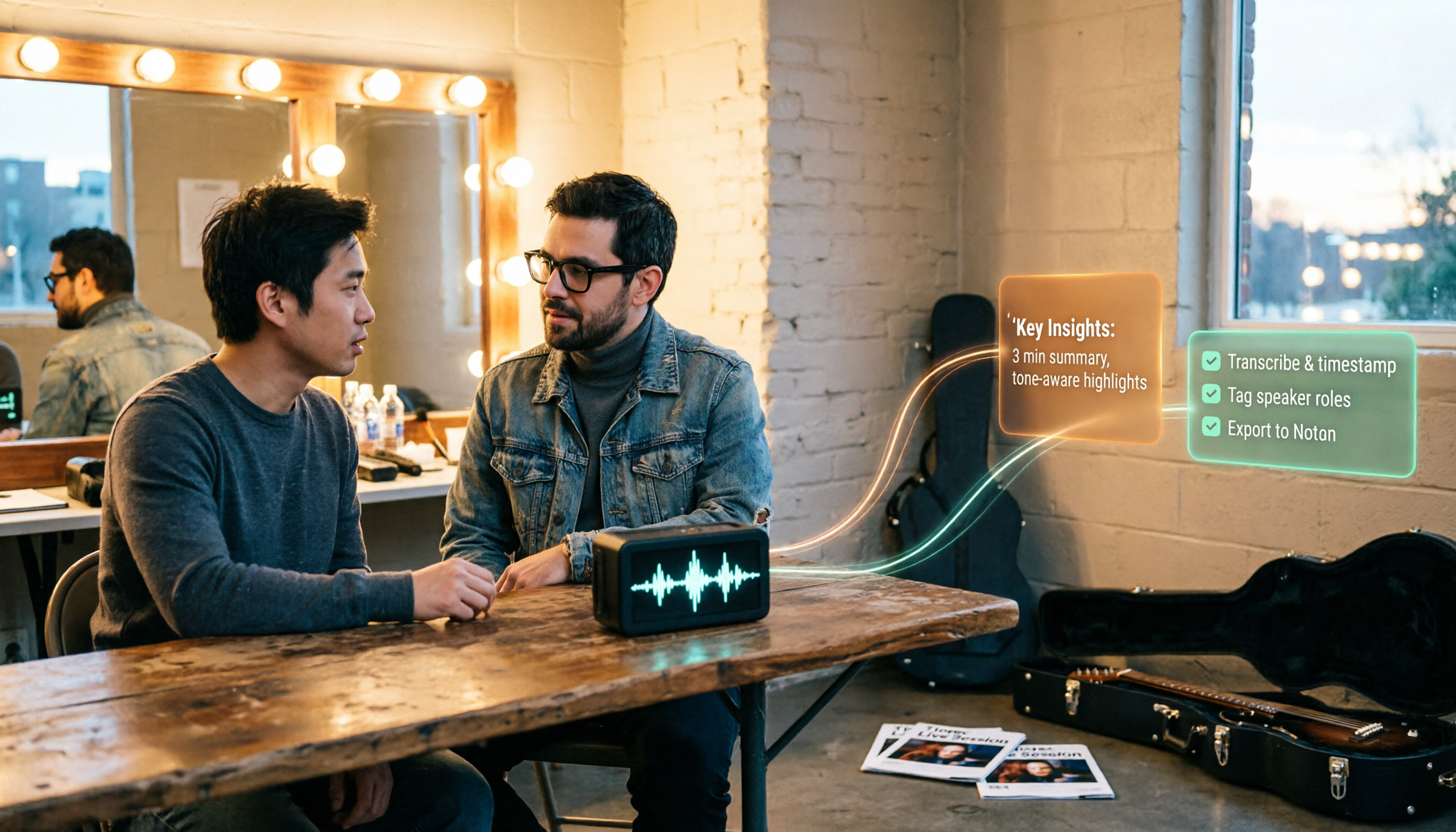
Turn recordings into transcripts and summaries in minutes
Upload audio or video for multilingual transcription, AI notes, and action items
Many people think that going to a Red Rocks show like Tape B and recording audio and a few videos on your phone means you've "documented" the night.
The reality is usually the opposite. When you get home and open your gallery, you find 30 fragmented videos, 2 hours of ambient audio, and a folder you'll never open again.
This is the most common pitfall for content creators: mistaking "recorded" for "organized." The real time sink isn't the recording—it's what comes after: turning scattered material back into a quotable sentence, a finished article, or a deliverable record.
Take Tinrec as an example. It handles the second half: turning audio into searchable, summarizable, queryable text, and then into the final product you actually need to deliver.
Tinrec is an AI meeting notes and collaboration tool for individuals and teams. It supports live audio-to-text transcription, bot-free desktop recording of online meetings, audio/video file import, and live translation, and can automatically generate summaries, chapters, and action items. The free version offers a basic quota so you can try recording, importing, and summarizing—for anyone who deals with voice material every week, that's where the difference lies.
Why Tape B's Red Rocks Shows Are a Classic Case of "Material Overload"
According to public information, Tape B brought his first Red Rocks headlining show to Red Rocks Amphitheatre on October 10, 2025, with guests including Cool Customer, MPH, STVSH, Know Good, and Richard Finger. On October 8–9, 2026, he will return to the same venue for a two-night "Hallow Rocks" run, with one night featuring a "Driptapes" set and the other his signature "OSxNS" (old school × new school).
How much voice material does a show of this scale generate? Pre-event interviews, planning meetings, and script discussions; post-event reactions, review recordings, and interview clips. All of it is "spoken," and all of it needs to become text to be usable.
Please refer to the official ticketing page for event dates and lineup; this article is about what happens after the recordings come in.
What Can Audio-to-Text Do for You? 4 Practical Scenarios
Scenario 1: A Transcript 10 Minutes After the Interview Ends
In the past, after finishing an interview, the first thing you'd do back at the office was put on headphones and re-listen to a 60-minute recording, typing as you go. Now you drop the file into Tinrec, and once transcription is done, you can read the transcript directly and find the passages you need to quote with a keyword search.
Scenario 2: Turn a Night's Observations into an Article
After seeing a whole show, your mind is full of thoughts but they're scattered. You can talk into your phone for 5 minutes, speaking out all your observations, impressions, and angles you want to write about, then import it into Tinrec to convert to text and use AI summaries to organize it into paragraph structure—much faster than staring at a blank page.
Scenario 3: Cross-Language Interviews Are No Longer a Barrier
When interviewing foreign artists or teams, language barriers often mean relying on live interpretation. Tinrec supports live translation, allowing you to switch between original text, translation, or bilingual view during recording, and afterward both languages remain in one transcript.
Scenario 4: The Whole Editorial Team Shares the Same Material
The biggest pain point for content teams is material scattered across everyone's phones. The team version provides independent team spaces where Audio, Folder, and TODO are centrally stored, so data doesn't leave with members when they do.
Tinrec's Core Capabilities: The Real Value Is After Transcription
Live transcription: Transcribe while recording. During an interview, you can see text appear in sync, so you can immediately follow up on missed questions.
Bot-free desktop recording: No need to invite an extra bot into online meetings. The Tinrec desktop app directly captures computer system audio and works with Zoom, Google Meet, Microsoft Teams, and Webex. This is crucial for interviews—having an extra bot attendee changes the atmosphere.
AI summaries and chapters: It doesn't just compress the transcript into a paragraph; it structures it. Long interviews are divided into chapters with key points listed separately.
Action item extraction: Pulls out "who needs to do what" from discussions. Especially useful for show planning meetings.
AI Q&A: After transcription, you can directly ask—"Which songs from the new album did the interviewee mention?" "Did they talk about the Red Rocks show?" It answers based on the content, so you don't have to re-listen.
Translation and bilingual view: Handles mixed Chinese-English interviews, and you can switch between original, translation, or bilingual during recording.
Export and Agent post-processing: Supports export to Notion, Google Docs, OneNote, Dropbox, and other tools for further editing, and you can use Agent to generate reports, tables, or documents from the content.
Team space: Members, roles, seats, usage analytics, audit logs, audio recycle bin, and team hotwords. Hotwords are especially useful for music coverage—pre-build artist names, song titles, and label names, and recognition of specialized terms improves significantly.
Practical Applications: From the Venue to Publication
Artist Interviews for Music Media
A 40-minute interview can be transcribed immediately after recording, then AI summaries can extract three sections: "new work," "tour plans," and "creative motivation." When writing, you don't need to re-listen—just search keywords to find the original text. Note that important quotes should still be verified against timestamps and audio, as AI may miss words or mishear.
Stop organizing recordings by hand
Upload audio or video and automatically get a transcript, summary, and action items
Podcasts and Music Review Shows
Show planning is usually discussed verbally by a group. Use Tinrec for live transcription during meetings, and action items are automatically listed afterward—who contacts the guest, who edits which segment. Finished recordings can also be imported for transcription, conveniently producing show transcripts and summaries, which helps with SEO.
Cross-Event Database for Content Teams
If an editorial team covers multiple events simultaneously, the value of the team version becomes clear: create team spaces, invite members via join links, set owner/admin/member roles, and assign seats to those who actually need to record and upload. All events' Audio and TODO are centralized, and new members can browse historical data.
The Solo Creator's Second Brain
For freelance writers or independent media, many ideas come out while walking. Record a segment on your phone, import it into Tinrec to convert to text, and let AI organize it into readable notes—after three months, you'll have a searchable idea bank.
5 Things to Consider When Choosing an Audio Organization Tool
1. First, confirm it handles "human speech"
Tinrec's strength is interviews, meetings, podcasts, and other speech-based recordings. If you need to identify songs or automatically capture setlists, that's a different type of tool. Throwing in distorted, noisy live ambient audio will yield transcripts of limited reference value—be clear about this first.
2. Is the free quota enough to try a full cycle?
The Tinrec free version offers a basic quota so you can experience recording, importing, summarizing, and transcription. I usually recommend testing with a real interview rather than the official sample audio, because your own recording conditions are the real conditions.
3. Can you organize after transcription?
A tool with only transcripts just trades "typing time" for "reading time." Tinrec's summaries, chapters, action items, and AI Q&A are where the real time savings are—factor this into your tool selection.
4. Performance with Chinese and mixed Chinese-English
Interviews in Taiwan often mix Chinese and English, along with artist names, song titles, and label names. Tinrec covers Chinese, Traditional Chinese, and multilingual scenarios, and supports live translation; the team version also maintains team hotwords. Actual performance is affected by recording quality, accents, and overlapping speakers, so don't assume a fixed accuracy rate.
5. For team use, look at roles and seats
The team version separates "roles" (who can manage the team, members, audit, and team settings) from "seats" (who can record, upload, edit, import/export). Note that active members without seats can only view, play, and read team data—they cannot edit. This is a common misunderstanding during pricing inquiries and the biggest difference between the team version and "multiple people sharing one account."
Plans and Pricing: Start with the Free Version
The personal version includes Free, Weekly Pass, Pro Monthly, and Pro Annual. Prices are subject to the official website. The logic is simple: for occasional recording organization, the free version suffices; for short-term intensive interviews or projects, the weekly pass is enough; for steady weekly output, Pro Monthly; for long-term accumulation of a recording database, the annual pass is more cost-effective.
The current team version terms are: eligible teams get a 7-day free trial, 1 free seat, and 300 minutes of shared team import quota; monthly USD 29.80 per paid seat per month, annual USD 199 per paid seat per year (about USD 16.58/month); each paid seat provides 2,000 minutes of shared team import quota per month. Live recording is currently not deducted by minutes under active plans and active seats, while file and web imports consume shared team quota. Prices, currency, and promotions are subject to the official purchase page.
FAQ
Can Tinrec record live concerts?
It can record, but that's not its best use case. It handles "speech"—interviews, meetings, podcasts. Music, cheering, and ambient noise during performances degrade transcription quality, and transcripts have limited reference value. It's truly useful for pre- and post-show interviews and planning discussions.
Do I need to invite a meeting bot into Zoom or Meet?
No. The Tinrec desktop app directly captures computer system audio; just open the desktop app and start recording before your interview. Note that this does not mean "automatically join all meetings on your calendar"—recording requires you to start it manually. Also, please confirm you have the other party's consent before recording.
How does transcription perform for Chinese interviews?
Tinrec covers Chinese, Traditional Chinese, and multilingual scenarios, and supports mixed Chinese-English and live translation. Actual performance is affected by recording quality, accents, overlapping speakers, and specialized terminology, and a fixed accuracy rate cannot be guaranteed; for important quotes, verify against the audio timestamp.
What's the difference between the team version and personal Pro?
Mainly data ownership and governance. In the team version, meeting data belongs to the team; you can create multiple team spaces, invite members via join links, set owner/admin/member roles, assign and revoke seats, and it provides usage analytics, audit logs, and an audio recycle bin (currently retained for 30 days). In the personal version, data is managed by the individual account.
If a member leaves, will their previous recordings disappear?
They won't automatically leave with the person. Team resources belong to the team; when a member exits, is removed, or loses their seat, their team resources need to be handed over to other active members.
Can transcribed content be taken to other tools?
Yes. Tinrec supports multi-format export to Notion, Google Docs, OneNote, Dropbox, and other tools for continued use, and you can use Agent to generate reports, tables, or documents from the content.
Conclusion
Back to the original question: after seeing a Tape B Red Rocks show, are you left with a pile of unopenable files or a usable set of data?
The difference isn't how much you recorded, but whether you've separated "recording" from "organizing." Take Tinrec as an example—it turns speech-based recordings from interviews, meetings, and show discussions into searchable, summarizable, queryable text, and then into articles, scripts, and team databases.
The free version has a basic quota, enough for you to run through one or two real interviews—testing with your own material is more accurate than any review.
Final reminder: recording and transcription involve others' privacy; please comply with local laws and obtain necessary consent before proceeding.
References
Turn every recording into actionable outcomes
Get 60 free transcription minutes when you sign in. No credit card required.
Related Reading
You might also like

Is Notta's Free Plan Enough in 2026? 4 Steps to Decide If You Need to Upgrade
Notta's free plan offers 120 minutes per month with a 3-minute cap per recording—is that actually enough? This article walks you through 4 steps to figure it out, comparing free tier limits, meeting capture, post-meeting output, Chinese-language experience, and team governance across five dimensions against Tinrec, helping you decide whether to stay on the free plan or switch tools.
2026 AI Subtitle Tool Buying Guide: 5 Tested Criteria + 3 Pitfalls to Avoid
Starting from two needs—'adding subtitles to videos' and 'meeting transcripts'—this guide outlines 5 key criteria for choosing AI subtitle tools in 2026. It includes hands-on testing of Tinrec's performance in meeting organization, AI Q&A, and team collaboration, compares use cases for CapCut, FlexClip, Taption, and WayinVideo, and concludes with pitfalls and selection advice.

2026 Comparison of 3 Speech-to-Text Tools: Good Tape vs. Tinrec — Which Is Better for Chinese Meetings?
What is Good Tape and is it any good? This article starts from real meeting scenarios and compares Good Tape, Tinrec, and Otter.ai in a hands-on test, covering Chinese transcription, bot-free meeting recording, post-meeting summaries and action items, team collaboration, and pricing to help you decide which tool fits your workflow.

Notta AI Pricing 2026: 3 Plans Explained + How to Calculate Real Costs
How is Notta AI priced? What are the limits of the free 120 minutes, why is Pro's US$8.17 only a monthly equivalent for annual billing, and how do Business's per-seat fees and AI Credits affect your budget? We break it down item by item and compare the cost structures of Tinrec, Otter.ai, and TurboScribe to help you choose the plan that's truly worth it.

3 AI Meeting Note Tools Tested: What to Know Before Paying Monthly for Notta Pro in 2026
Notta Pro costs about USD 13.99/month billed monthly, or about USD 8.17/month billed annually—a difference of over 40%. Switching from annual to monthly requires canceling and resubscribing. This article compares Tinrec, Notta, and Otter.ai across billing cycles, quota calculations, post-meeting workflows, and team seats, highlighting common pitfalls when switching from monthly to annual, adding features, and seat pricing.

2026 AI Meeting Recorder Comparison: Is Dcard's Favorite Meeting Ink Worth It?
Is Meeting Ink, the tool buzzing on Dcard, actually worth using? This article compares four AI meeting recorder tools using the same criteria, from language recognition and meeting recording methods to post-meeting summaries and team permissions. It also breaks down Tinrec's bot-free recording, AI follow-up questions, and team governance features to help you pick the one that truly saves time.

2026 AI Meeting Notes Tools Compared: Meeting Ink vs. Tinrec and More
This guide tackles three common misconceptions about choosing an AI meeting notes tool and compares Meeting Ink, Notta, Otter.ai, and Tinrec on audio capture methods, post-meeting organization, Chinese language support, and team collaboration. It concludes with recommendations based on different use cases.
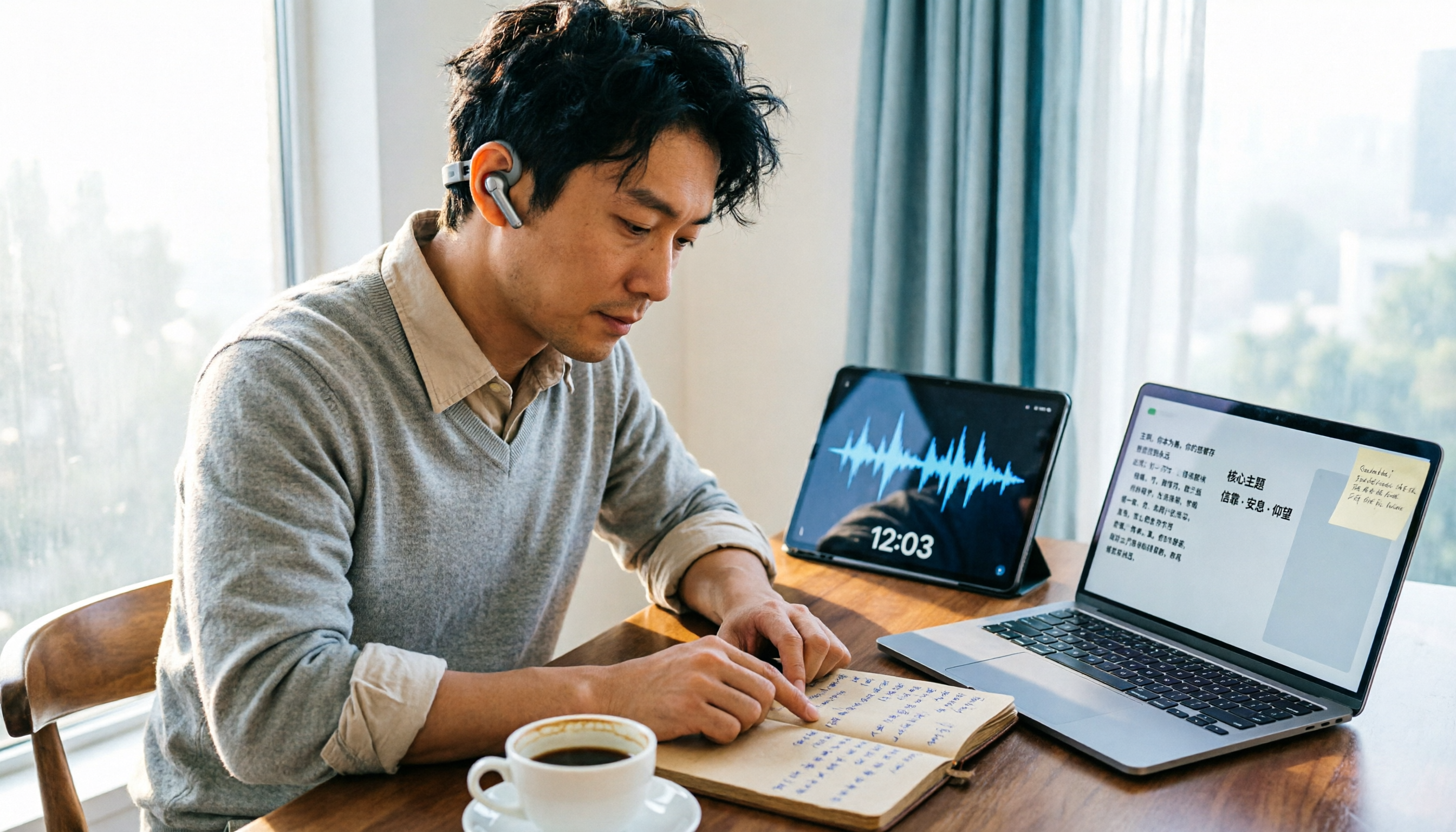
How to Organize Worship Audio in 2026: Before Your Throne Transcript + AI Summary
Before Your Throne is a 12-minute worship EP released by Mattie Nottage in 2024. Starting from the real pain of organizing long audio files, this guide explains how to turn worship and sermon recordings into citable transcripts, summaries, and notes, and compares Tinrec, Otter.ai, TurboScribe, and Granola in terms of differences and use cases.

2026 AI Meeting Recorder Comparison: Notta vs. Tinrec — Which Handles Chinese Meetings Faster?
Tired of replaying recordings after meetings? This comparison puts Tinrec, Notta, Otter.ai, and Granola head-to-head, breaking down online meeting capture methods, Chinese and mixed-language recognition, post-meeting summaries and AI Q&A, plus free tiers and team licensing. Find out if Notta is enough or when to switch to Tinrec.