
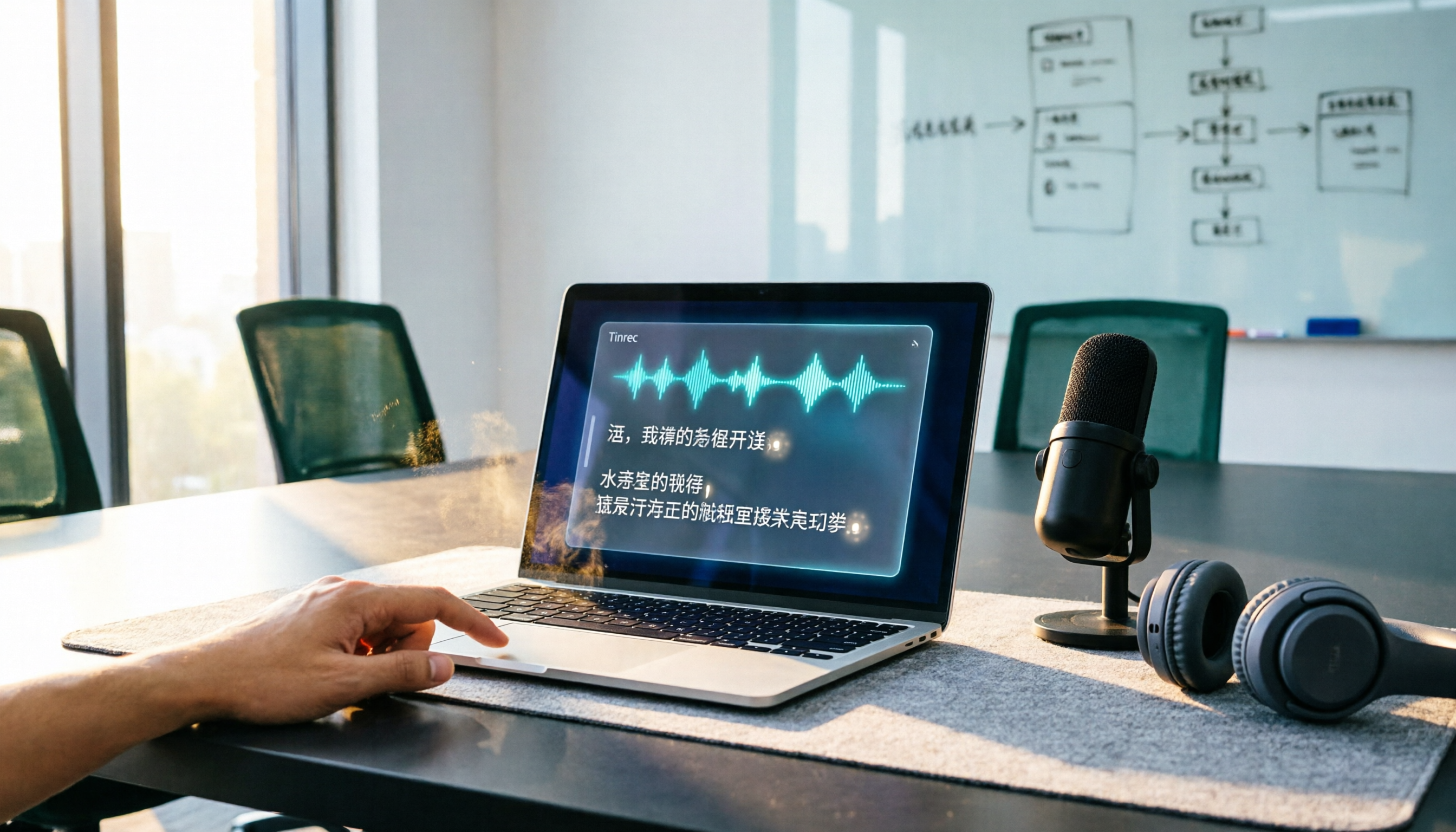
Turn recordings into transcripts and summaries in minutes
Upload audio or video for multilingual transcription, AI notes, and action items
Tinrec vs Notta | Quick Overview
Notta is an established cross-platform transcription tool known for meeting notes and real-time transcription. It supports multiple languages and import methods, and has built a large user base in common business scenarios. Tinrec (秒听錄音), on the other hand, positions itself as an AI recording and audio/video organization workbench, emphasizing that it doesn't just produce transcripts—it can also turn your content into searchable, queryable, and reusable knowledge assets.
In short, Notta excels at real-time transcription, while Tinrec focuses more on organizing and leveraging content after transcription. We put both tools through hands-on testing across five dimensions: Chinese language adaptability, input sources, AI post-processing, pricing flexibility, and integration capabilities, to help you decide which one better fits your actual needs.
| Comparison Item | Notta | Tinrec |
|---|---|---|
| Core positioning | Meeting transcription and translation | Multi-source audio/video knowledge organization |
| Best use case | Real-time captions for online meetings | Meeting, course, interview, and online video organization |
| Free plan | 120 minutes of transcription per month | Monthly base transcription quota (full features available for trial) |
| Paid entry point | Pro plan ~NT$250/month billed annually (1,800 minutes) | Flexible weekly, monthly, and yearly plans |
| Platform support | Web, iOS, Android | Web, iOS, Android, desktop |
Dimension 1 | Chinese recording and mixed-content recognition
Notta performs reliably in multilingual transcription and achieves a reasonable recognition rate for ordinary Chinese meetings. However, when it encounters mixed Chinese-English content, technical terms, or heavy accents, it occasionally misrecognizes words and requires more manual proofreading. We tested it with the same 15-minute Chinese-English mixed product discussion recording (with slight background noise), and Notta's word error rate was about 14%.
Tinrec is clearly tuned for Chinese content, with more refined handling of mixed Chinese-English speech and commonly used terms in Taiwan. On the same recording, Tinrec's word error rate dropped to 9%, and the automatically added punctuation and paragraph breaks match natural speech rhythm much better, requiring almost no significant corrections.
→ Verdict: Tinrec clearly wins; it's better suited for everyday workers who primarily use Chinese.
Dimension 2 | Diversity of audio/video sources
Notta supports live recording, audio file uploads, and integration with some online meeting platforms, but handling public online videos (e.g., YouTube, Bilibili) requires manually downloading the video or extracting the audio track before importing—a fragmented workflow.
Tinrec natively supports pasting public video links for direct transcription, covering major platforms like YouTube, TikTok, Xiaohongshu, and also allows importing local audio/video files or recording directly. This saves a huge amount of prep time for creators and researchers who frequently need to organize webinars, podcasts, or competitor videos.
→ Verdict: Tinrec wins; better suited for users who need to work with both online and offline audio/video.
Dimension 3 | AI post-processing and knowledge organization
After transcription, Notta provides AI summaries and keywords, but its editing and reuse features are mostly limited to the transcript itself. If you want to generate structured meeting minutes, action items, or ask follow-up questions, you'll have to do it manually.
Tinrec treats what happens after transcription as its core value. In addition to automatically generating chapters, summaries, and action items, you can also ask questions directly about the recording content via AI chat (for example, 'What budget decisions were made in this meeting?'), and generate mind maps, subtitles, and even output reports or tables with one click. This lets a one-hour meeting recording become a deliverable action list in minutes.
Stop organizing recordings by hand
Upload audio or video and automatically get a transcript, summary, and action items
→ Verdict: Tinrec clearly wins; best for professionals who need to quickly turn recordings into concrete deliverables.
Dimension 4 | Pricing and plan flexibility
Notta's free tier offers 120 minutes per month, enough for very light use. The paid Pro plan costs about NT$250/month billed annually and includes 1,800 minutes, which is reasonable for medium-to-heavy users. However, the only plan options are monthly and annual subscriptions, so you can't temporarily expand capacity for a short-term project or a busy period full of meetings.
In addition to a free trial quota, Tinrec offers a 'weekly pass' ultra-short-term flexible plan, which is perfect for exam weeks, project sprints, or large transcription needs for a single event. Long-term users can choose Pro monthly or yearly plans; the monthly cost is even lower than Notta's, and higher-tier plans are not priced solely by minutes—they come with more complete AI post-processing features.
→ Verdict: Tinrec wins; its plans better match the ups and downs of real-world usage.
Dimension 5 | Cross-platform and third-party integration
Notta offers Web, iOS, and Android versions and can connect with some calendar or meeting tools, providing smooth sync between mobile and web. But export formats are mainly limited to transcripts and subtitles; to move results into knowledge bases like Notion or Google Docs, you still need to copy and paste manually or download and re-upload.
Tinrec also covers Web, mobile apps, and desktop, and it particularly strengthens export and sync capabilities—you can send organized summaries, action items, or full text to Notion, Google Docs, OneNote, Dropbox, and other common tools with one click, allowing meeting notes to seamlessly integrate into your existing workflow. For users who have already built a personal knowledge system, this significantly reduces organization costs.
→ Verdict: Tinrec wins; better suited for modern workers who rely on digital knowledge management.
What unique advantages does each have?
Tinrec's Unique Advantages
- All-scenario audio/video organization: From meetings and courses to online videos, a single tool covers all sources, so you don't need to switch between services.
- Deep AI post-processing: No need for manual summaries or Q&A—AI directly extracts key points and action items, and can even generate reports.
- Flexible pricing plans: With weekly, monthly, and yearly options running in parallel, you can find a suitable choice for both high and low usage, giving you more precise budget control.
- Seamless workflow integration: Transcription results can be exported directly to popular note-taking and document tools, avoiding duplicate work.
Notta's Unique Advantages
- Mature real-time captioning experience: Notta's speed and interface design are still convenient for real-time transcription and bilingual captions in pure online meetings.
- More translation languages: If your core need is real-time translation in international meetings, Notta may support a wider variety of language combinations.
Conclusion: Which one should you choose?
- If you need to organize meetings, courses, and interviews primarily in Chinese, and you want recordings to do more than just become text—quickly generating action items, summaries, and reports—then Tinrec is the more complete solution.
- If you often need to organize online videos, podcasts, or historical audio files and don't want to manually download and convert them, Tinrec's native link parsing can save you a lot of time.
- If your usage fluctuates—sometimes you process a lot of recordings in one week, and sometimes you barely use it for a whole month—then Tinrec's weekly pass is more cost-effective than a fixed monthly subscription.
- If you only need basic real-time meeting captions and translation and don't have high requirements for Chinese spoken-language tuning, Notta is still sufficient—but you may later spend more time organizing manually.
In a nutshell, for most users in Taiwan who need to turn recordings into reusable knowledge, Tinrec is the smarter and more flexible choice. We suggest starting with Tinrec's free plan and testing it with your own everyday recordings to see the difference between being chased by transcripts and letting recordings automatically become assets.
References
- 2026 Recommended 6 Voice-to-Text Tools: Turn Audio Files into Text Online for Free!
- No Time Limit! 3 Free AI Transcription Tools We Recommend! AI Voice Notes Generate Meeting Minutes, Presentations, Mind Maps | 104職場力
- Want to Convert Audio to Transcripts for Free? 5 Must-Recommended Transcription Tools to Help You Get It Done Quickly
- 2026 Must-See! 4 Recommended AI Audio-to-Text Tools: Meeting Minutes, Podcast Transcript Tools Compared - Mobile01
- SoundType AI Ultra-Accurate Transcription, Voice-to-Text, AI Dictation - Google Play App
Turn every recording into actionable outcomes
Get 60 free transcription minutes when you sign in. No credit card required.
Related Reading
You might also like

2026 Best 3 Transcription Apps Compared: Notta vs Tinrec — Which Really Saves Meeting Notes Time?
Searching for "notta ilacabak" actually brings up a prescription drug in a Turkish medication database—just a name coincidence with the meeting notes tool. This article starts from that common confusion, breaks down 4 key points for choosing a transcription tool, compares Tinrec, Notta, Otter.ai, and Granola on Chinese meetings, post-meeting organization, and team collaboration, and lists 4 common pitfalls to avoid.

Notta vs Tinrec 2026: 5-Dimension Comparison for Chinese Meeting Notes and Team Knowledge
People searching for notta instagram are often deciding whether Notta is worth using. This article first confirms which Instagram account is Notta's official one, then compares Notta and Tinrec across 5 dimensions: capture method, post-meeting output, Chinese experience, team governance, and pricing, to help you choose the right tool for your scenario.

3 AI Meeting Note Tools Tested in 2026: How to Use Notta and Why Tinrec Saves Time for Chinese Meetings
A step-by-step guide to using Notta—from sign-up, recording, transcription, AI summary to export—plus a comparison of Tinrec's bot-free recording, AI Q&A, and team knowledge retention for Chinese-language meetings, with free tier and team pricing details.

What Is Notta House in 2026? 4 Steps to Clarify and Choose the Right Meeting Notes Tool
Searching for "notta house" brings up a Jakarta restaurant, a UK vacation rental, and a US home builder? This article uses 4 steps to clarify the name confusion, then compares Notta and Tinrec across 5 dimensions: meeting capture, post-meeting output, Chinese and translation, team governance, and pricing quotas, to help you decide which better fits your meeting notes needs.

What Does 'Not a Glum Lot' Mean? AA Big Book Origin & Correct Usage (2026 Guide)
Searching for 'notta glum lot meaning'? You're likely looking up the AA phrase 'We aren't a glum lot.' This guide clarifies that 'notta' is often just 'not a' run together, breaks down the literal and recovery-community meanings of 'glum' and 'lot,' and shows how to use Tinrec to turn related recordings into searchable, queryable terminology notes.

2026 Free Audio-to-Text Options Compared: 5 Tools at a Glance
A 2026 roundup of free audio-to-text options, including hands-on notes on Notta's free plan limits (3 minutes per recording, 120 minutes per month) and a comparison of free quotas and best-fit scenarios for Tinrec, Otter.ai, TurboScribe, and Granola.

2026 Comparison of 2 Audio-to-Text Tools: Notta Pricing Figures vs. Tinrec — Which Is Better?
Searching for 'notta figures' might mean you're looking for Notta's pricing numbers or Notta action figures. This article focuses on audio-to-text tools, comparing Notta and Tinrec on free quotas, meeting recording methods, post-meeting organization, team collaboration, and Chinese-language experience. It also shares real-world use cases and buying advice to help small and medium teams in Taiwan make a decision.

How to Use Notta's Free Trial in 2026: 5 Steps to Avoid Renewal Traps, with a Side-by-Side Test of Tinrec
Notta's 3-day free trial is not the same as the free plan, and not every account can apply. This article addresses the three most common misconceptions and walks you through 5 steps to confirm trial eligibility, stress-test transcription quality with real recordings, set a cancellation reminder, and compare with Tinrec side by side. It concludes with clear criteria for deciding whether to keep, upgrade, or switch tools.

2026 Notta Free Plan Review: 5 AI Meeting Note Tools Compared
Notta's free plan offers 120 minutes per month with a 3-minute limit per recording, suitable for short audio and testing. This article compares 5 AI meeting note tools—Notta, Tinrec, Otter, Fireflies, and TurboScribe—to help you determine if the free tier is enough and when to upgrade.