
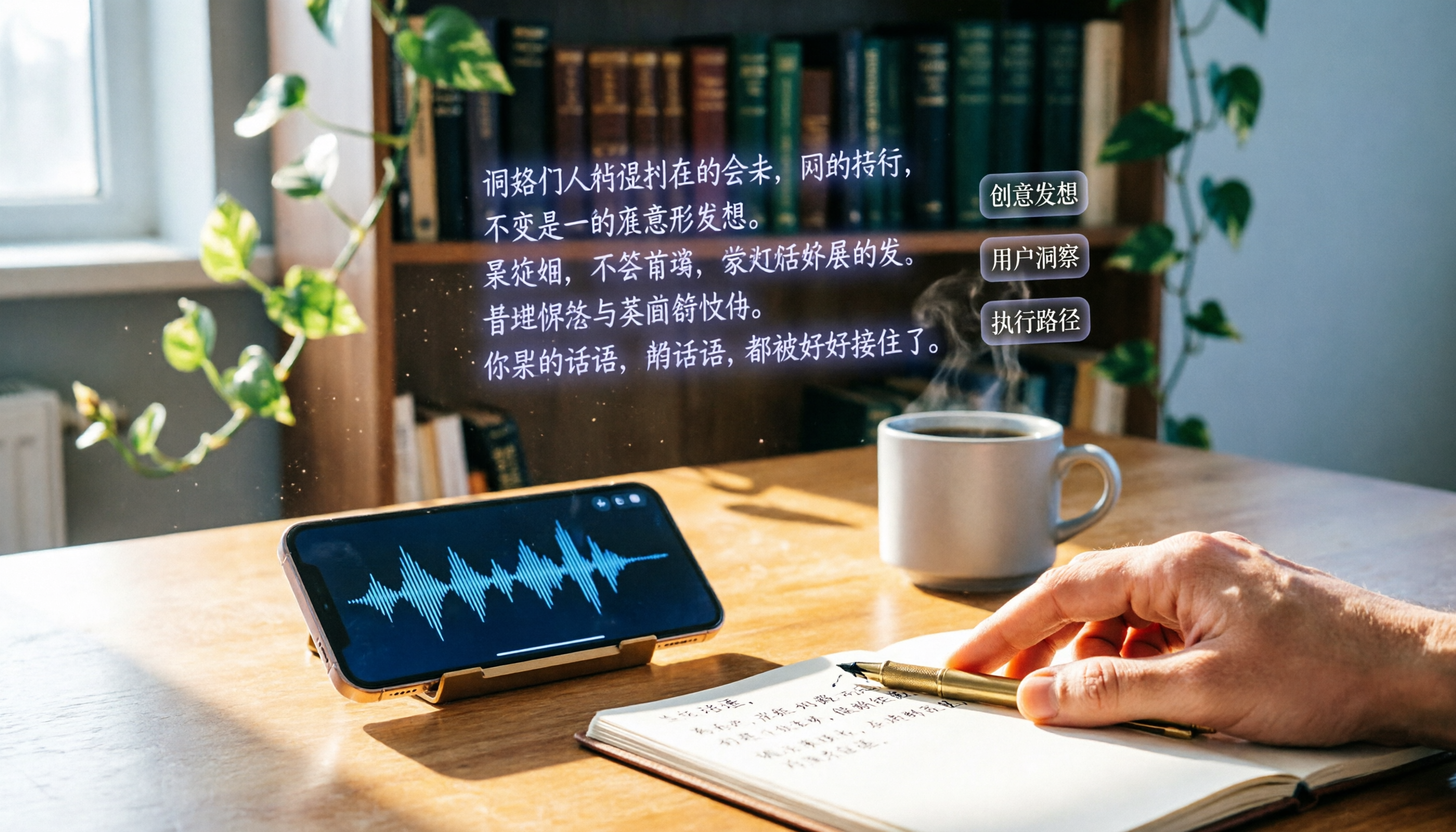
Turn recordings into transcripts and summaries in minutes
Upload audio or video for multilingual transcription, AI notes, and action items
Meetings over, classes done, recordings captured — but the thought of going back to relisten and typing up transcripts makes you procrastinate? Your iPhone actually already has a built-in voice-to-text feature, and it’s gotten smarter since iOS 18. On the other hand, AI recording tools like Tinrec automate the entire “recording organization” process, even generating summaries and to-do lists for you.
Should you just use the built-in Voice Memos app on your iPhone, or add Tinrec as a separate tool? This article compares both from real-world usage scenarios, using 5 key dimensions to help you decide.
Tinrec vs. iPhone Built-in Voice Memos | Quick Overview
Starting with iOS 18, Apple added transcription capabilities to Voice Memos, letting your iPhone generate text transcripts from recordings. It’s free on iPhone 12 and later models and supports multiple languages including Traditional Chinese. You can view the text in real time while recording or afterward.
Tinrec (MiaoTing Voice Recorder) is a cross-platform AI recording and audio organization tool. It not only transcribes live recordings to text, uploads old audio files, and converts YouTube links to text, but it also automatically generates summaries, splits recordings into chapters, extracts to-do items, and even lets you ask questions to review the recording content.
| Comparison Item | iPhone Built-in Voice Memos | Tinrec |
|---|---|---|
| Price | Free (built into iOS) | Free tier includes monthly allowance; Pro monthly/yearly subscription |
| Platform | iPhone, iPad, Mac only | iOS, Android, Web |
| Transcription Languages | 10 languages including Traditional Chinese, Simplified Chinese, English | Multilingual, especially good at organizing Chinese content |
| Features Beyond Transcription | None; can only copy the transcript | AI summaries, chapters, to-dos, Q&A, export |
This article compares across five dimensions: “Accuracy and Speed,” “Post-Transcription Organization,” “Supported Audio Sources,” “Cross-Platform and Export,” and “AI-Assisted Features.” It also clarifies who can stick with the built-in feature and who should give Tinrec a try.
Dimension 1 | Transcription Accuracy and Speed
Apple’s built-in Voice Memos transcribes Traditional Chinese quite accurately in good recording conditions. Especially in versions after iOS 18.6, a 50-minute meeting recording transcribes almost instantly, and accuracy is on par with services like Yating Transcript.
However, its Achilles’ heel is obvious: if the recording has background noise, multiple people talking at once, or mixed Chinese-English speech, the error rate rises. Plus, it gives you a continuous transcript without automatic paragraph breaks or punctuation (though later versions have improved).
Tinrec’s core transcription quality is similar to the built-in feature, but it does two extra things. First, it automatically detects chapters and breaks the transcript into sections, making long recordings easier to browse. Second, it treats transcription as a starting point for further “organization,” not the end. So even though accuracy may be comparable, Tinrec’s output is easier to actually use.
→ This dimension: For simply “turning speech into text,” there’s not much difference; but if you care about “can I use the transcript right away,” Tinrec is clearly more practical.
Dimension 2 | Post-Transcription Content Organization
With the built-in Voice Memos, after you get the transcript, you can only do two things: select all and copy, or read line by line. No summaries, no highlights, and it won’t turn meeting discussions into a to-do list. For occasional users, that might be enough, but if you have more than two meetings a week, you’ll feel the lack of features.
Tinrec integrates “organization” directly into the workflow. After transcription finishes, it automatically generates an AI summary that tells you what the recording is about. It also splits long content into chapters — tap to jump to the relevant section. If it’s a meeting, to-do items are extracted separately. In short, you don’t need to listen from start to finish.
→ This dimension: The built-in feature only solves “sound to text.” Tinrec further solves “understanding the content” and “using the content.” Tinrec wins this round decisively.
Dimension 3 | Supported Audio Sources
iPhone Voice Memos is essentially a mobile recorder — whatever you record is what it transcribes. Want to upload a previously recorded .m4a file from your phone? You can, but you’ll need to convert it on a Mac and sync it first. As for organizing a YouTube interview by pasting a link and converting it to text? It can’t do that.
Tinrec supports many more input sources: live recording obviously works, but you can also upload audio or video files directly from your phone. Even better, you can paste a public online video link (YouTube, Bilibili, Xiaohongshu) and Tinrec will turn the content into text, summaries, and chapters. This is especially handy for students and content creators collecting materials.
Stop organizing recordings by hand
Upload audio or video and automatically get a transcript, summary, and action items
→ This dimension: If you only record your own meetings or classes, the built-in feature is sufficient. But if you occasionally need to process content that wasn’t recorded on your phone, Tinrec’s flexibility truly sets it apart.
Dimension 4 | Cross-Platform and Export Flexibility
With the built-in Voice Memos, transcripts can only be viewed on Apple devices. You can manually copy and paste into Notes or Mail, but there’s no one-click export to common tools like Notion or Google Docs. And if you have an Android tablet or Windows laptop, you can’t directly view these text records at all.
Tinrec is available on iOS, Android, and the web. Your recordings and transcription data are tied to your account, so you can record on your phone and then continue reviewing summaries or asking questions on your computer. Its export options are also comprehensive: plain text, Word, PDF, and even direct syncing to your note-taking apps.
→ This dimension: For users who stay entirely within the Apple ecosystem, the built-in feature is convenient. But for cross-device workflows or sharing content with others, Tinrec’s cross-platform and export flexibility is what truly matters.
Dimension 5 | AI-Assisted Features
Although the built-in Voice Memos later integrated a bit of Apple Intelligence, allowing you to use Writing Tools on transcripts to generate summaries, that only works if your device, region, and language are all supported. Plus, the feature is limited to “rephrasing the text” — it doesn’t really understand the recording content.
Tinrec’s AI features focus directly on the “recording content.” You can ask the app questions about your recording, such as, “What were the three action items decided at the end of that meeting?” or “What concerns did the interviewee have about pricing?” It answers based on the transcript and context, just like searching your own audio archive. For someone who has accumulated a lot of meeting and course recordings, this is a completely different level of assistance.
→ This dimension: If you only need transcription, AI may not matter much. But if you’ve ever replayed 30 minutes of audio just to find one line, Tinrec’s Q&A feature will be hard to live without.
What Unique Advantages Does Each Option Offer?
Tinrec’s Unique Advantages
- All-in-One Organization: From transcription to summaries, chapters, and to-dos, everything is automated — you can use it right after recording.
- Direct Online Video Transcription: Paste a YouTube or Bilibili link and instantly get the transcript and key points, perfect for learning and content creation.
- AI Conversation Search: Review recordings like asking questions — no need to listen from start to finish, just find the answers.
- Cross-Platform Sync: Record on your phone, view on your computer — data follows your account, not tied to a single device.
iPhone Built-in Voice Memos’ Unique Advantages
- Completely Free: As long as you have an iPhone 12 or later running iOS 18 or later, the transcription feature costs nothing.
- Zero Learning Curve: The app is already there — open it, hit record, tap once, and you see the transcript. No downloads or sign-ups required.
Summary: Which One Should You Choose?
- If you only occasionally need to convert a sentence or a short recording into text and don’t want to install another app → The built-in iPhone Voice Memos is enough.
- If you have meetings, classes, or interviews to organize every week and need summaries, to-dos, or want to switch between phone and computer → Tinrec is a better fit.
- If you often collect online video material, have a lot of old audio files to organize, or want to build your own recording archive → Tinrec will save you significant time.
In one sentence: The built-in feature is like a free Swiss Army knife — fine for simple tasks. Tinrec is a full audio workbench that truly turns recordings into usable knowledge. We suggest downloading Tinrec’s free version and testing it with your own recordings, files, or video links to experience the difference of “more than just transcription — it organizes everything for you.”
FAQ
Q1: What languages does the built-in iPhone Voice Memos support for transcription? A: Currently it supports English (all variants), Spanish, Portuguese, Italian, French, German, Japanese, Korean, Simplified Chinese, or Traditional Chinese. The available languages may vary slightly depending on the iOS version and region settings.
Q2: Do I have to pay to use Tinrec? A: Tinrec offers a free version with a monthly base transcription allowance, so you can experience its core features. You only need to subscribe to the Pro plan if you require higher usage or advanced features.
Q3: I already have the built-in iPhone feature, so why would I need Tinrec? A: The built-in feature is suitable for light, “only transcription” needs. If you need automatic summaries, sectioning, to-dos, AI Q&A, or want to organize online videos, old audio files, and use across platforms, Tinrec provides far more value than simple transcription.
Q4: What’s the difference between Tinrec and services like Yating Transcript or Good Tape? A: Yating Transcript and Good Tape are more like one-off transcription tools, while Tinrec goes beyond transcription by integrating summaries, chapters, to-dos, Q&A, and export — it’s more like an audio organization workbench.
Q5: Is there a big difference in transcription accuracy? A: In quiet environments with clear speech, both produce good results. But Tinrec automatically adds paragraph breaks and highlights key points, making the transcript easier to read and reuse.
Q6: Does Tinrec support Traditional Chinese? A: Yes, Tinrec’s interface and transcription services both support Traditional Chinese, and its organization of Chinese content (including Traditional Chinese meetings, classes, and interviews) is quite mature.
References
- View Voice Memos transcripts on iPhone - Apple Support
- iPhone Voice-to-Text Tips: 5 Ways to Turn Recordings into Text - Mr. Mad
- Complete Guide: 3 Ways to Transcribe iPhone Voice Memos — Built-in iOS, Apps, Recorders: Which Is Best?
- iPhone Voice Recognition: Voice Memos with Auto Punctuation and Paragraphs - AI - Let's Write
- Free iPhone Recording-to-Text Transcription: iOS 18 Supports 10 Languages | Quality Life | 500 Times
Turn every recording into actionable outcomes
Get 60 free transcription minutes when you sign in. No credit card required.
Related Reading
You might also like

2026 Cantonese Speech-to-Text AI Tools Compared: Which Is the Best for Transcription and AI Summarization?
We compared 4 AI speech-to-text tools that support Cantonese, evaluating accuracy, AI summaries, free plans, and cross-platform support, to help you pick the best solution for transcribing meetings, interviews, and course recordings.

2026 Cantonese Translator Assistant vs. Cantonese Translator Pro: 4-Dimension Showdown – Which Is More Reliable for Cantonese-to-Mandarin Translation?
We put two Cantonese-to-Mandarin translation apps to the test, comparing translation accuracy, voice recognition, extra features, and ease of use to help Hong Kong professionals and Taiwan office workers choose the best Cantonese translation tool.

3 Free Speech-to-Text Apps Tested in 2026: Not Just Transcription—Ask Your Recording for Key Points
After testing three free speech-to-text apps in real scenarios, I found that Tinrec does more than transcribe—it lets you ask questions about the recording and auto-generates summaries, saving real time. This article walks through authentic use cases and helps you avoid the common pitfalls when choosing a voice-to-text tool.

iPhone WhatsApp Voice to Text in 2026: Official Method vs Tinrec – A 3-Point Comparison to See Which Is More Practical
Uncomfortable listening to WhatsApp voice messages? iPhone users have two options: WhatsApp’s built-in transcription feature or the third-party AI tool Tinrec. This article compares them through real tests across three dimensions—accuracy, additional features, and flexibility—to help you find the best solution for your needs.

2026 Tinrec vs. Yating Transcript: A 4-Dimension Showdown — Who Is the Best Free Speech-to-Text Choice?
In 2026, we tested and compared Tinrec and Yating Transcript across four dimensions—input sources, AI organization, cross-platform support, and free-tier value—to see which one better fits Taiwan users' speech-to-text needs, plus a buyer's guide to avoiding common pitfalls.
2026 Tinrec vs. Yating Transcript: A 4-Dimension Showdown — Who Is the Best Free Speech-to-Text Choice?
In 2026, we tested and compared Tinrec and Yating Transcript across four dimensions—input sources, AI organization, cross-platform support, and free-tier value—to see which one better fits Taiwan users' speech-to-text needs, plus a buyer's guide to avoiding common pitfalls.
iPhone WhatsApp Voice to Text in 2026: Official Method vs Tinrec – A 3-Point Comparison to See Which Is More Practical
Uncomfortable listening to WhatsApp voice messages? iPhone users have two options: WhatsApp’s built-in transcription feature or the third-party AI tool Tinrec. This article compares them through real tests across three dimensions—accuracy, additional features, and flexibility—to help you find the best solution for your needs.

Tinrec vs Notta 2026: 5-Dimension Showdown — Which Is Better for Chinese Audio/Video Transcription?
This article compares Tinrec and Notta across five key dimensions—accuracy, AI features, input sources, cross-platform support, and pricing—to help you find the best speech-to-text tool for your needs.

2026 Free Speech-to-Text App Roundup: 3 Options at a Glance
Still struggling to transcribe lecture recordings into text? This article rounds up the 3 most popular free speech-to-text solutions for students, and takes an in-depth look at the free version of Tinrec, showing you how to use AI to turn recordings into notes and breeze through finals!