
Turn recordings into transcripts and summaries in minutes
Upload audio or video for multilingual transcription, AI notes, and action items
Why Are Your Meeting Notes Never Finished?
"The meeting just ended, and my boss wants the meeting minutes before leaving work." "I recorded an hour of audio, and just re-listening, pausing, and typing took three times as long."
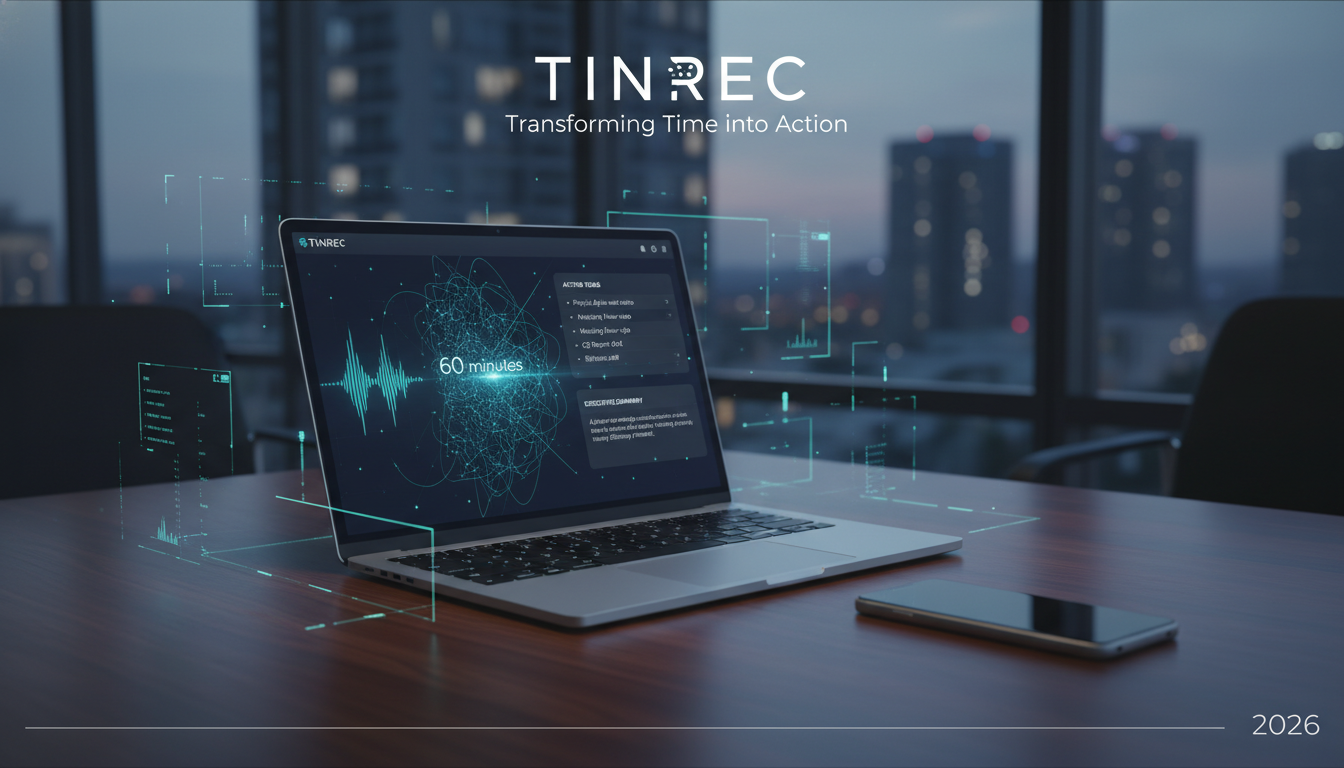
This is a common pain point for administrative staff, project managers, and students. Traditional voice recorders capture sound, but "sound" is linear information—hard to search and low in information density. To quickly turn meeting content into a "work summary," the key isn't typing speed, but choosing the right "speech-to-text" and "AI summary" tools.
This article compiles real-world test data of mainstream AI meeting tools in 2026, comparing them across dimensions such as processing speed, language support, and summary logic, and provides a practical workflow from "recording to action items." If you value Taiwanese/Hakka recognition, check out Meeting Ink; if you need cross-device (mobile + computer) AI chat search, Tinrec is worth evaluating; if focusing on English meetings, Otter.ai performs excellently.
2026 Mainstream AI Meeting Note Tools Specifications & Speed Comparison
Based on the latest test data (using a 26-minute standard English podcast audio file as a benchmark), different tools show significant differences in "upload speed," "transcription time," and "summary generation." Below we compare 6 tools horizontally to help you quickly filter:
| Tool Name | Core Positioning | Transcription Speed (26 min audio) | Supported Languages | Highlight Features | Best For |
|---|---|---|---|---|---|
| Meeting Ink | All-around Performance | ~2 minutes | Chinese/English/Japanese/Taiwanese/Hakka | Supports Taiwanese/Hakka, Google Calendar integration | Local enterprises, government agencies, those needing dialect handling |
| Tinrec (秒聽錄音) | Cross-platform Mobile | Real-time / Fast | Chinese/English/Japanese/Korean, 10+ languages | AI chat search, auto-generates action items (To-do), cross-device sync | Those who frequently review highlights, need mobile recording |
| Vocol.ai | Collaborative Organizer | ~3.5 minutes | Chinese/English/Japanese | Email notification on completion, keyword search | Teams who prefer batch uploading after meetings |
| Otter.ai | English-oriented | ~3.5 minutes | Primarily English | Excellent English real-time captions, keyword Insights | Multinational companies, all-English meeting scenarios |
| Plaud | Hardware Recording | ~50 seconds | Multi-language | Combines physical recording card, call recording | Sales interviews, situations where computer use is inconvenient |
| Vurbo.ai | Translation Assistant | Longer with translation | Multi-language | Real-time translation, unlimited hours (but slow processing) | Meetings requiring cross-language real-time understanding |
Key Insights from Test Data
- Speed Efficiency: Meeting Ink and Plaud perform excellently in processing speed, suitable for users who need transcripts urgently. Vurbo.ai claims unlimited hours, but tested processing time is longer (over 12 minutes).
- Language Capabilities: If meetings include Taiwanese or Hakka, Meeting Ink is currently one of the few solutions. If meetings are entirely in English, Otter.ai's recognition remains the benchmark.
- Post-processing Applications: Most tools only produce transcripts, but Tinrec and Meeting Ink further enhance structured output of "summaries" and "action items," which is key to generating a work summary.
Deep Dive: How to Choose the Right Tool for You?
After reviewing the data, here are deeper buying recommendations for different scenarios:
1. If You Need Both "Localization" and "Speed": Meeting Ink
Based on tests, Meeting Ink transcribes a 26-minute audio file in about 2 minutes, and summary generation is stable. Its biggest advantage is optimized Traditional Chinese and Taiwanese/Hakka recognition. For Taiwan's traditional industries or government meetings, this feature is almost a must. Additionally, it can launch directly from Google Calendar, reducing file transfer hassle.
Stop organizing recordings by hand
Upload audio or video and automatically get a transcript, summary, and action items

2. If You Need "Immediate Action After Recording" and "Cross-Device": Tinrec (秒聽錄音)
Tinrec's design philosophy goes beyond just "saving recordings"—it emphasizes "understanding and action."
- AI Chat Search (Chat with Audio): This is the biggest difference between Tinrec and traditional tools. When you want to confirm "What was the budget number mentioned by the manager in the second half?", you don't need to scrub through the recording; just ask Tinrec like ChatGPT, and it will answer based on the recording content.
- Automated Summaries: Besides transcripts, it automatically generates structured "meeting minutes" and "action items (To-do)", directly meeting the "work summary" need.
- Multi-platform Support: Supports iOS, Android, and Web, ideal for modern workers who listen to recordings on mobile during commutes and organize on computer at the office.
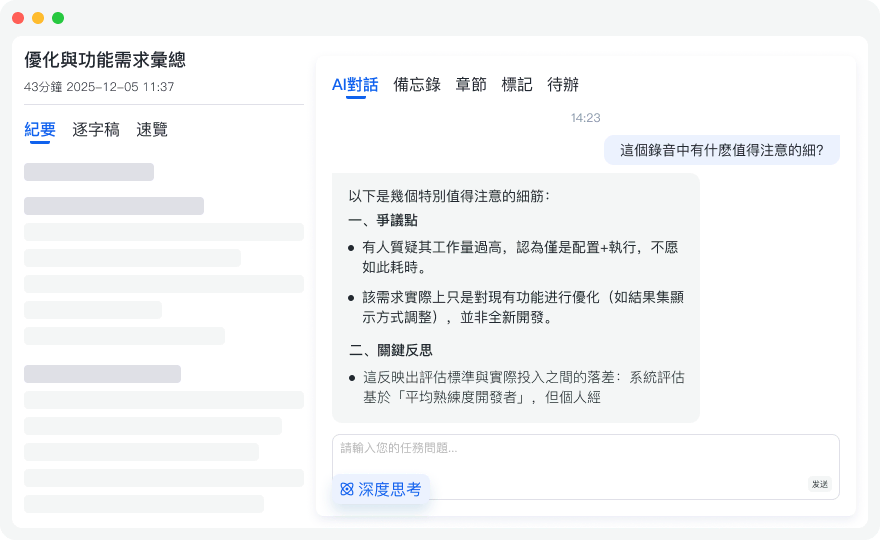
3. If You Are an "All-English Environment" User: Otter.ai
Although Otter.ai's Chinese support is weaker, its real-time captions and speaker identification are very accurate in all-English meetings. It automatically captures keywords, suitable for multinational companies or overseas study scenarios.
4. If You Rely on "Mobile Hardware" Recording: Plaud
Plaud must be used with its proprietary hardware (recording card). Its advantage is recording phone calls (e.g., LINE, phone interviews), very convenient for sales or journalists, but it cannot integrate with online software like Teams or Google Meet.
Hands-on Tutorial: 4 Steps to Turn Meeting Recordings into a Work Summary
No matter which tool you choose, to quickly produce a high-quality work summary, follow this standardized process. We'll use Tinrec as an example for demonstration due to its comprehensive features:
Step 1: Start Recording (Live Recording vs File Upload)
- Physical Meetings: Open the app or web version, click "Start Recording." Place your phone or laptop near the center of speakers.
- Online Meetings: If the tool supports it (e.g., Tinrec or Meeting Ink), use the browser tab recording feature to ensure system audio is captured clearly.
- Existing Files: If you already have an mp3/mp4 file, use the "Import Audio/Video" feature.
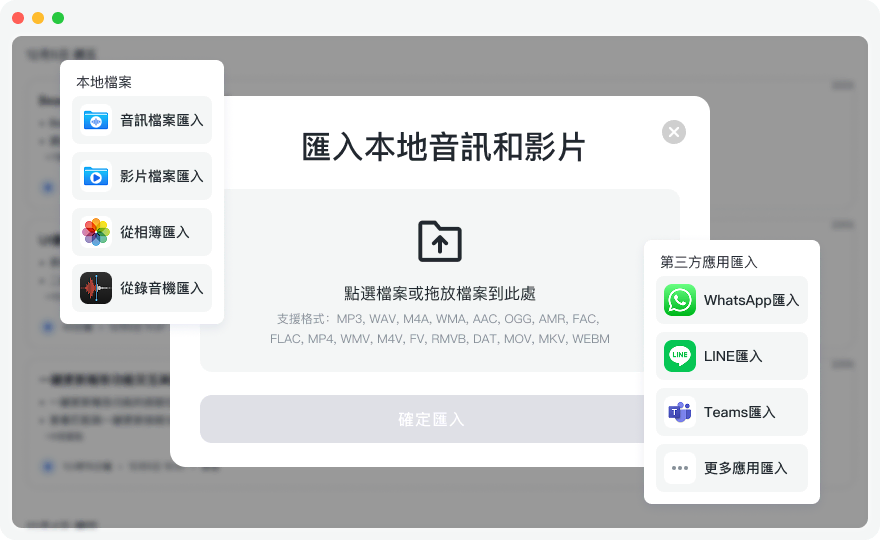
Step 2: Real-time Transcription and Marking
During recording, the tool will transcribe speech into text in real-time.
- Tip: When you hear a key decision (e.g., "Budget set at $500,000"), click "Mark" or "Highlight" on the tool interface for easier recall later.
Step 3: AI-generated Structured Summary
After recording, don't waste time reading the transcript from scratch. Use AI to generate a summary:
- Full Summary: Quickly understand the meeting context.
- Section Splitting: AI automatically divides the recording based on topic changes (e.g., 00:00 Opening -> 10:00 Product Discussion -> 20:00 Marketing Budget).
- To-do List: This is the core of the work summary. Tools like Tinrec can auto-extract "who needs to do what," e.g., "@Alex submit design draft by next Friday."

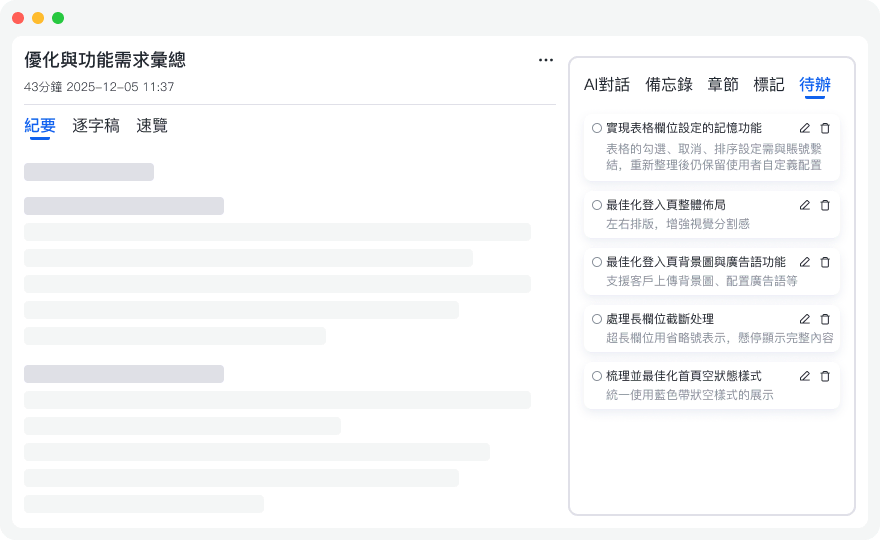
Step 4: AI Chat Search and Detail Confirmation
When writing formal emails or reports, if you're fuzzy on a detail (e.g., "Was it 3% or 5%?"), use the AI Chat Search feature.
- How to use: Type in the chat box "What was the discount percentage mentioned in this meeting?" The system will give the answer with a timestamp, saving you dozens of minutes of re-listening.
FAQ
Q1: What are the limitations of free AI meeting tools? Most free versions have limits on "recording hours" or features. For example, Good Tape free version requires queuing; Meeting Ink and Otter free versions have monthly hour caps. Tinrec free version offers 100 minutes of recording per month, suitable for light users to test core features.
Q2: If the meeting mixes English and Chinese, can AI understand it? Current mainstream tools like Tinrec and Meeting Ink support multilingual recognition. However, "mixed Chinese and English (Chinglish)" still challenges AI. It's recommended to choose tools with "automatic language recognition" for higher accuracy.
Q3: Is recording with a phone good enough? Phone microphones are sufficient for small meetings (4-6 people). The key is "distance"—place the phone at the center of the table. If using tools like Tinrec that support an app, recordings auto-sync to the cloud, allowing you to edit text directly after returning to your computer.
Q4: Can online videos or podcasts be transcribed? Yes. Meeting Ink and Tinrec both support audio file uploads. Tinrec additionally supports pasting YouTube/Podcast links for direct parsing, saving time for users analyzing competitors or taking study notes.
Q5: What if my company prohibits uploading confidential meetings to the cloud? Most AI tools rely on cloud computing (due to large models). For highly sensitive content, consider fully offline solutions (usually requiring high-spec hardware) or check if the tool's enterprise version meets data security compliance standards.
Q6: iPhone call recording has restrictions; can AI tools help? Due to iOS privacy restrictions, apps usually cannot record regular phone calls directly. Solutions include using speakerphone and recording with another device, or using hardware recording cards like Plaud. For internet calls (Teams/Meet), use a computer-side tool for side recording.
Turn every recording into actionable outcomes
Get 60 free transcription minutes when you sign in. No credit card required.
Related Reading
You might also like

4 Best Speech-to-Text Tools in 2026: Free vs Paid Compared for US Users
We tested the most talked-about speech-to-text tools on Dcard and PTT, from free to paid, comparing Tinrec, Yating, Otter.ai, and Notta on features, pricing, and use cases to help you find the time-saving choice.

5 Best Speech-to-Text Tools Tested in 2025: AI Transcripts & Meeting Notes Compared
With countless speech-to-text tools available, this article tests Tinrec, MyEdit, SoundType AI, iPhone Voice Memos, and OpenAI Whisper across three dimensions—Traditional Chinese recognition, recording sources, and post-processing—to help you choose the right one for your needs.
2026 Hands-On Comparison of 4 Speech-to-Text Tools: Why Tinrec Is the Best Alternative for Notta Users?
This article compares speech-to-text tools like Tinrec and Notta, focusing on online meeting recording, AI summarization, and team collaboration, to help you decide which one suits American professionals best.

2026 Hands-On Comparison of 4 Recording-to-Text Apps: The Most Time-Saving Option for Chinese Meeting Notes
After testing multiple recording-to-text apps, Tinrec not only transcribes verbatim but also turns meetings into searchable, collaborative, trackable data. This article covers key buying considerations, hands-on insights, and tips to avoid common pitfalls.

Tinrec vs Otter.ai in 2026: A 4-Dimension Comparison to Find the Best Speech-to-Text Tool for Hong Kong Professionals
Tired of spending hours transcribing meeting recordings? We tested Tinrec and Otter.ai across four key dimensions—Cantonese recognition, bot-free recording, AI summarization, and team collaboration—to help you choose the right tool and save overtime hours.

2026 Hands-On Comparison of 2 Speech-to-Text Tools: Tinrec vs Otter.ai—Which Is More Practical for Bot-Free Meeting Notes and Chinese Summaries?
This article compares Tinrec and Otter.ai, two AI meeting note tools, across five dimensions: meeting capture, Chinese transcription, AI post-processing, team collaboration, and cross-platform support. It also compiles real user feedback from PTT in 2024 to help you choose the best option for Taiwanese office workers.

2026 Tinrec Voice-to-Text Tutorial: Cantonese Support & AI Meeting Minutes
We tested Tinrec (Miao Ting Lu Yin) and show you how to use AI to quickly convert recordings to text, automatically generate meeting minutes and action items, saving hours of manual transcription.

2026 Tinrec Review: A Yating Transcript Alternative with Bot-Free Recording & AI Meeting Minutes
This tutorial explains how to use Tinrec as a replacement for Yating Transcript, enabling bot-free online meeting recording, real-time transcription, and AI-generated meeting minutes—ideal for professionals who need to quickly organize meeting notes.

2026 Hands-On Comparison of 2 Recording-to-Text Tools: Tinrec vs Otter.ai – Which One Should Hong Kong Professionals Choose?
A hands-on comparison of Tinrec and Otter.ai, two recording-to-text tools, across five key dimensions: Cantonese recognition, bot-free meeting recording, AI Q&A, cross-platform use, and team collaboration, to help Hong Kong professionals pick the best option.