
Turn recordings into transcripts and summaries in minutes
Upload audio or video for multilingual transcription, AI notes, and action items
Have you ever experienced this scenario: after a marathon two-hour meeting, your notes are scattered and messy. To compile a proper set of meeting minutes, you have to repeatedly listen to the recording, spending more time than the meeting itself?
Meeting minutes are not just for record-keeping; they are key documents for driving project execution. However, the traditional "manual note-taking + voice recorder" approach often falls short when dealing with high-density information. This article combines professional document writing standards with the latest 2026 AI tools to provide you with an "efficient meeting minutes solution."
Quick Navigation Conclusions:
- If you need a standard document format: Refer to the structure template in Section 2 of this article.
- If you want to save 80% of processing time: Consider using a tool with "audio-to-text + AI summary" features (such as Tinrec Instant Recording).
- If you care about follow-up execution: Choose software that can automatically extract action items.
Why Is Writing Meeting Minutes So Hard? Common Pain Points and Solutions
Before diving into "how to write," let's clarify why this task is so frustrating. Most administrative staff or project managers face three main challenges:
- Information gaps: Speakers talk too fast, making it hard to capture key decisions.
- Vague memory: When organizing after the meeting, you forget the specific context or speaker of a statement.
- Inconsistent formatting: Lack of a standardized structure makes it hard for readers to grasp the main points.
The key to solving these issues is to separate "objective recording (audio/transcript)" from "subjective organization (minutes/summary)." Modern workflows recommend using tools to automate the former, so the human brain can focus on logical structuring for the latter.
Standard Meeting Minutes Structure and Writing (with Universal Template)
According to professional document writing standards, a complete set of meeting minutes typically includes three core parts. Regardless of the tools you use, the final output should follow this logic:
1. Header and Introduction
This is the basic identity card of the meeting, allowing readers to grasp background information at a glance.
- Header: Include meeting name, number, date (e.g., Issue # Engineering Meeting Minutes).
- Introduction: Summarize basic details, typically including:
- Time and location
- Facilitator and note-taker
- Attendees and participants
- Main agenda
2. Body - Core Content
This is the soul of the minutes, mainly recording the meeting's spirit, decisions, and consensus. Common writing styles include three types:
- Itemized: List items in order of discussion, explaining decisions one by one. Suitable for office meetings emphasizing execution and actions.
- Summary: Group discussion content into several major aspects, possibly with subheadings. Suitable for workshops or complex experience-sharing sessions.
- Notable quotes: Record different people's views in speaking order. Suitable for academic discussions or situations where differing opinions need to be preserved.
3. Conclusion
Evaluate the meeting or issue a call to action. Routine meetings may omit this, but important work meetings often emphasize implementation requirements.
2026 Tool Comparison: Manual Writing vs. AI Assistance
Now that we've clarified the writing structure, let's look at how to choose tools to achieve these goals. Below is a comparison between traditional manual methods and modern AI meeting tools (using Tinrec Instant Recording as an example):
Stop organizing recordings by hand
Upload audio or video and automatically get a transcript, summary, and action items
| Comparison Dimension | Traditional Manual Recording (Word/Notebook) | AI Meeting Tool (e.g., Tinrec) |
|---|---|---|
| Recording method | Handwriting or typing, prone to falling behind speech speed | Real-time audio-to-text, fully preserves conversation details |
| Information completeness | High probability of missing details | Almost 100% retention, supports multi-language recognition (Chinese/English/Japanese/Korean, etc.) |
| Organization efficiency | Requires repeated listening (1 hour recording takes about 2-3 hours to organize) | Output ready when recording ends, AI automatically generates summary and action items |
| Search capability | Relies on memory or flipping through notes | Supports AI chat-based query, you can directly ask "What did Max say?" |
| Follow-up actions | Requires manual To-Do list creation | System automatically extracts tasks and key decisions |
| Suitable scenarios | Short, simple meetings; informal discussions | Long meetings, cross-border meetings, online courses, interviews |
Selection recommendations:
- If the meeting is very short and only needs a single conclusion recorded, manual note-taking is fine.
- If the meeting exceeds 30 minutes and includes multiple decision points or cross-language discussions, using a tool like Tinrec can significantly reduce work hours.
Deep Dive into Tinrec Instant Recording: Complete Workflow from Recording to Action
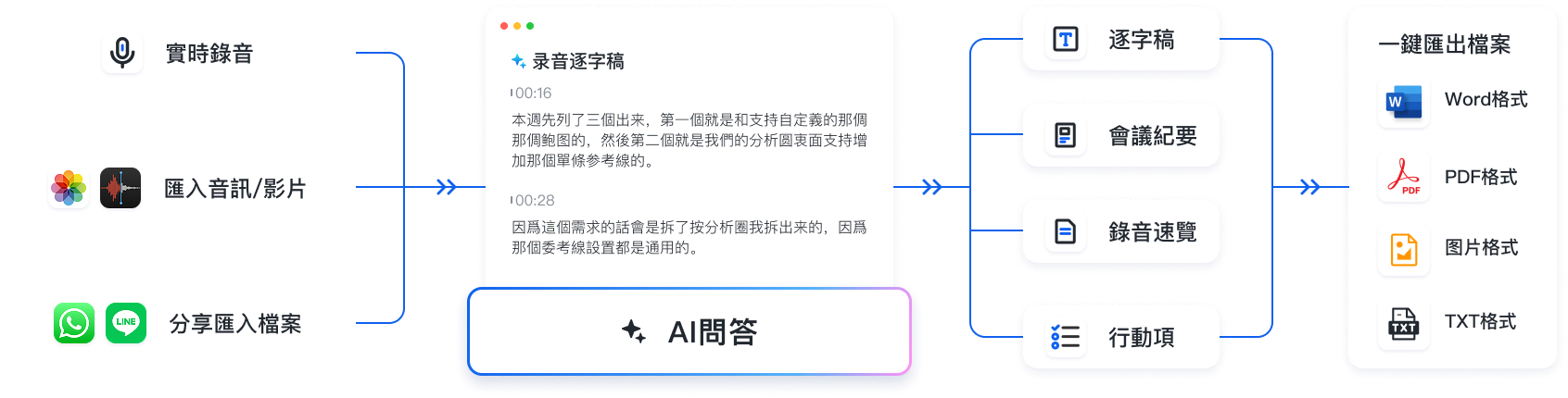
There are many speech-to-text tools on the market. Tinrec's design logic focuses on solving the "what to do after recording" problem. It's not just a recorder, but an assistant that thinks. For users needing to write meeting minutes, it offers several key values:
1. Real-time Audio-to-Text and Multi-Language Support
Tinrec supports iOS, Android, and web versions, converting speech to text in real-time during recording. For cross-border meetings, it automatically recognizes 10 languages including Chinese, English, Japanese, Korean, etc., solving the pain points of not understanding or not being able to take notes fast enough.
2. Smart AI Summary and Action Item Extraction
Traditional transcripts can be tens of thousands of words, making reading difficult. Tinrec automatically analyzes content to generate "meeting minutes summaries" and "action items." This directly corresponds to the most important "decisions" part of meeting minutes. Users simply copy, paste, and lightly polish.
3. Semantic AI Chat-Based Query
This is the biggest difference from traditional voice recorders. You don't need to listen from start to finish; just type a question in Tinrec's chat box, e.g., "What was the conclusion about the budget?" and the AI will answer based on the recording content. This makes fact-checking during minutes writing extremely fast.
Hands-On Tutorial: Create Meeting Minutes in 3 Steps Using Tools
Below demonstrates how to combine standard structure with tool features to produce high-quality meeting minutes in 15 minutes:
Step 1: Capture Complete Information (Record/Import)
- In-person meetings: Open the Tinrec app or web version, click Record & Transcribe in Real Time. Ensure your phone or computer is near the primary speaker.
- Online meetings (Teams/Meet): If you have a recording file, use the Audio File to Text feature to upload; for publicly available meeting videos, use the Video Link to Text feature.
Step 2: AI-Assisted Organization (Summary/Query)
- After recording, the system automatically generates a transcript.
- Review the system-generated "AI Summary" and "To-Do Items."
- For unclear details, use the AI Chat Query feature to confirm. For example, enter: "List the three key points emphasized by the General Manager." The AI will extract the core from the lengthy content.
Step 3: Apply Template and Output
- Open your company document template or Word file.
- Paste Tinrec's "Summary" into the "Introduction" and "Body" sections.
- Paste "To-Do Items" into the "Conclusion" or action plan section.
- Finally, manually proofread names and proper nouns, then export and send.
Meeting Minutes FAQ
Q1: What's the difference between meeting minutes and a transcript? A: A transcript is a verbatim record of every spoken word; meeting minutes are a filtered, summarized document containing only decisions, action items, and key points. Tools like Tinrec first generate a transcript, then help you create minutes material.
Q2: If I didn't attend the meeting, can I use a tool to write the minutes? A: Yes. As long as you have the meeting's audio recording or video link, upload it to Tinrec for transcription and summarization. You can then understand the meeting content via AI summary and write the minutes, even clarifying details through AI Q&A.
Q3: Are there any limitations with iPhone recording? A: The built-in iPhone voice recorder is basic, and call recording is restricted by the system. Using the Tinrec app allows easier management of recording files and direct transcription, solving the iOS recording organization problem.
Q4: Is the free version of transcription tools sufficient? A: It depends on your meeting frequency. For example, Tinrec offers a free tier with 100 minutes per month, usually enough for students or occasional users. If you're a frequent meeting PM or secretary, upgrading to Basic or Pro (600-1200 minutes per month) may be more suitable, and the cost is often much lower than manual transcription time.
Q5: Is it safe to use AI tools for confidential content? A: Check the privacy policy of the tool. Reputable paid tools are generally more secure than completely free, unknown online converters. For sensitive minutes, after exporting the text, do final editing and encryption on your local computer.
Q6: Can tools handle meetings with mixed Chinese and English? A: This is a common pain point for Asian companies. Modern AI models (like those used by Tinrec) have greatly improved recognition of mixed Chinese-English and even dialects (e.g., Cantonese, Taiwanese). While some manual correction of proper nouns may still be needed, they can accurately capture over 90% of meaning.
Turn every recording into actionable outcomes
Get 60 free transcription minutes when you sign in. No credit card required.
Related Reading
You might also like

How to Choose the Best Recording-to-Text Tool in 2025: From Transcripts to Actionable Meeting Minutes
Meeting recording-to-text tools are no longer just about transcription. This article compares Tinrec, Otter, Fireflies, Notta, Granola, and other mainstream tools in terms of capture methods, Chinese language support, and post-meeting outputs, and explains how to generate action items from transcripts and build team knowledge, helping you choose the right tool for your meeting scenarios.

2026 Free Speech-to-Text Solutions: 5 Tools Compared
PTT hotly discusses speech-to-text apps. We tested Tinrec and 4 other tools, comparing free quotas, Cantonese accuracy, and AI features to help you save time on meeting notes.

4 Best Recording-to-Text Tools in 2026: How to Choose Based on Free Credits and AI Features
We tested the latest 4 recording-to-text tools in 2026, from free credits to AI Q&A and bot-free recording, to help you find the most time-saving option.

Tinrec vs Otter.ai in 2026: A 5-Dimension Comparison for Chinese Users
We tested Tinrec and Otter.ai for Chinese meetings, bot-free recording, AI Q&A, cross-platform support, and team collaboration to help you choose the right transcription tool and save overtime hours.

5 Best Recording-to-Text Tools in 2026 Compared: Tinrec vs MyEdit, Yating, and More
After testing multiple free recording-to-text tools, here's why Tinrec became my go-to for meeting notes from a mid-level manager's perspective—and whether the free plan is enough.

4 Best Speech-to-Text Tools in 2026: Free vs Paid Compared for US Users
We tested the most talked-about speech-to-text tools on Dcard and PTT, from free to paid, comparing Tinrec, Yating, Otter.ai, and Notta on features, pricing, and use cases to help you find the time-saving choice.

5 Best Speech-to-Text Tools Tested in 2025: AI Transcripts & Meeting Notes Compared
With countless speech-to-text tools available, this article tests Tinrec, MyEdit, SoundType AI, iPhone Voice Memos, and OpenAI Whisper across three dimensions—Traditional Chinese recognition, recording sources, and post-processing—to help you choose the right one for your needs.
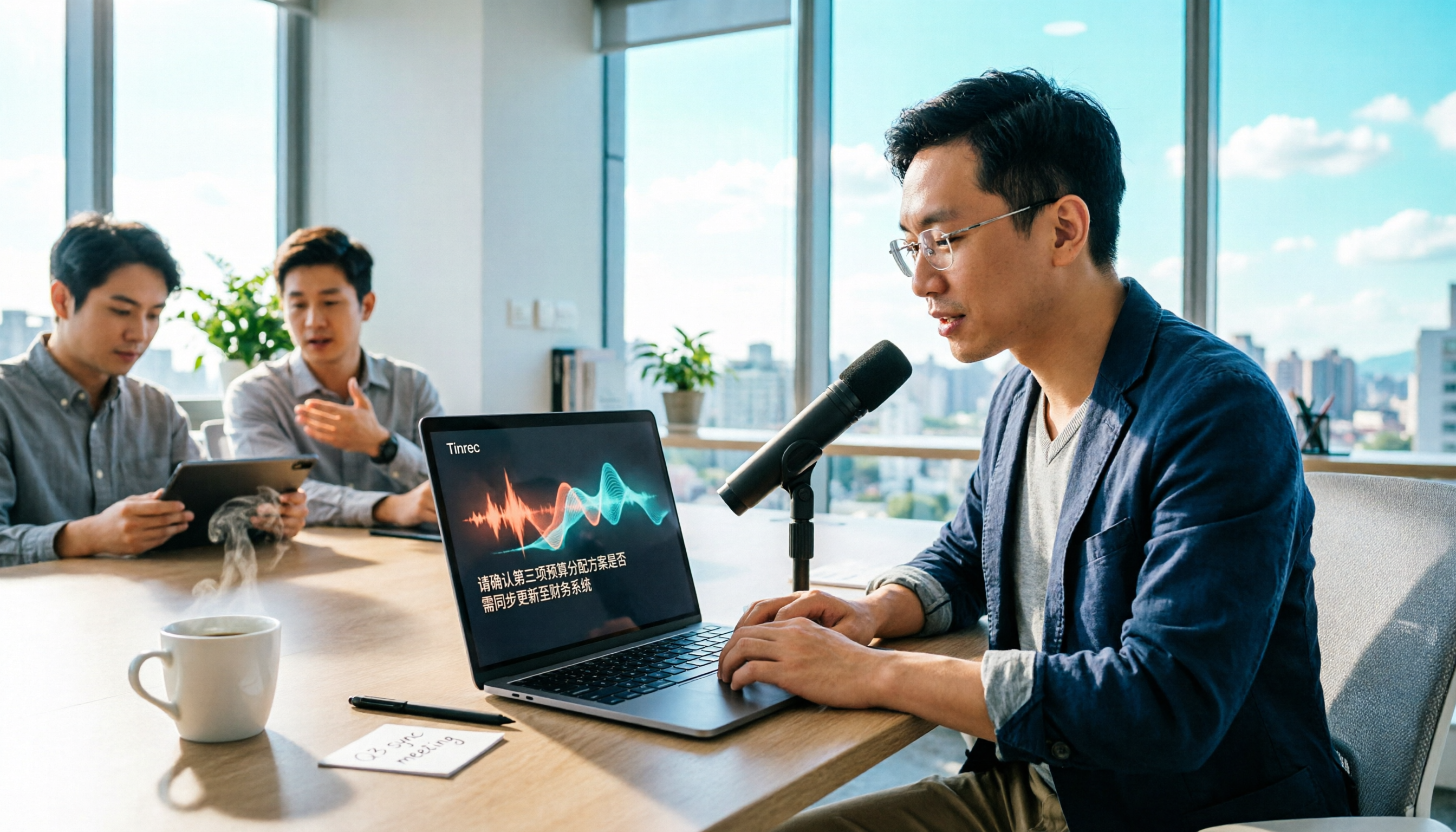
2026 Hands-On Comparison of 4 Speech-to-Text Tools: Why Tinrec Is the Best Alternative for Notta Users?
This article compares speech-to-text tools like Tinrec and Notta, focusing on online meeting recording, AI summarization, and team collaboration, to help you decide which one suits American professionals best.

2026 Hands-On Comparison of 4 Recording-to-Text Apps: The Most Time-Saving Option for Chinese Meeting Notes
After testing multiple recording-to-text apps, Tinrec not only transcribes verbatim but also turns meetings into searchable, collaborative, trackable data. This article covers key buying considerations, hands-on insights, and tips to avoid common pitfalls.