
Turn recordings into transcripts and summaries in minutes
Upload audio or video for multilingual transcription, AI notes, and action items
Have you ever experienced that moment of frustration: spending three hours re-listening and typing up a one-hour meeting recording? Or missing key points in class, recording the lecture, but never having the motivation to go back and listen?
Speech-to-text (STT) technology has matured, making manual transcription a thing of the past. However, there are countless tools on the market—some are free but have poor Traditional Chinese recognition, others can only transcribe without extracting key points. This article evaluates transcription tools worth trying in 2026 from dimensions such as "Chinese recognition accuracy," "free credits," and "feature completeness."
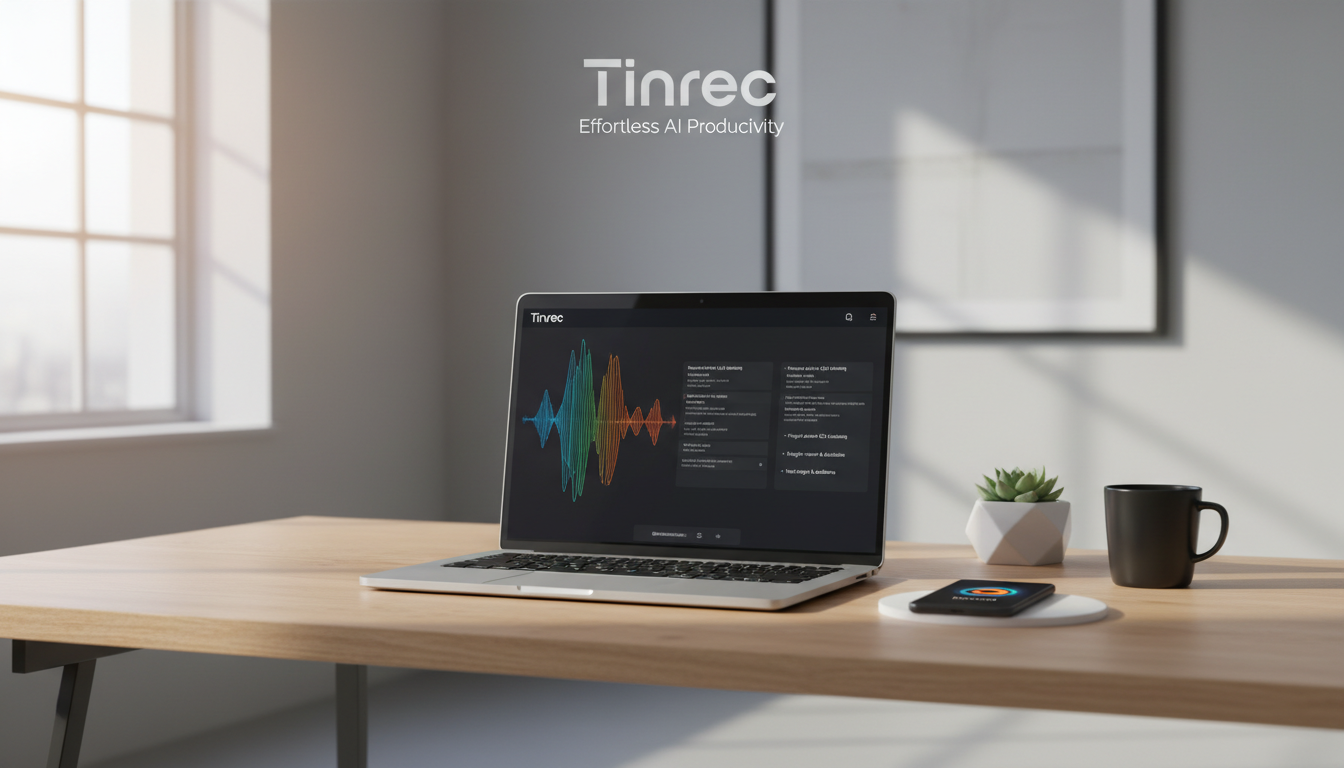
Quick Selection Guide:
- Only voice input needed: Consider Google Docs or your phone's built-in dictation (completely free but no recording file management).
- File-to-text needs: Suitable for Good Tape or similar pure conversion tools (good for occasional use).
- Need meeting summaries and action items: Choose an integrated "recording + transcription + AI summary" workflow tool like Tinrec (Miao Ting Lu Yin), which can directly convert recordings into actionable to-dos.
Why Traditional Recorders and Phone Voice Memos Are Not Enough?
Before diving into tool recommendations, let's clarify why simply "recording" doesn't solve the problem. Most people encounter three major pain points when using traditional recording apps:
- Extremely low information density (low signal-to-noise ratio): Recordings are linear; finding a key decision often requires repeatedly dragging the progress bar, wasting a lot of time.
- High transcription cost: Humans speak at about 160-200 words per minute, but typing speed is far lower. Organizing a one-hour interview can take half a day.
- Lack of structured output: A recording file is just a bunch of audio data; it cannot directly become meeting minutes, to-do lists, or exam key points.
Therefore, modern efficient workers no longer just need a "recorder" but an AI assistant that can "visualize" and "structure" sound.
Comparison of Popular Free Transcription Generators in 2026
Many tools claim to be "free," but the devil is in the details. Below are three representative solution categories for horizontal comparison to help you choose.
Tool Type Analysis
- Type A (Pure Conversion): Such as various online conversion websites. Pros: simple interface. Cons: usually no editor; once converted, it's gone, cannot search or manage.
- Type B (Input Method): Such as Google Docs voice typing. Pros: completely free. Cons: must "play and type" simultaneously; cannot upload files directly; does not support multi-speaker recognition.
- Type C (AI Workflow): Such as Tinrec (Miao Ting Lu Yin). Pros: combines recording management, real-time transcription, and AI analysis; can auto-generate summaries.
Comparison Table
| Dimension | Google Docs Voice Typing | Typical Online Conversion Tool | Tinrec (Miao Ting Lu Yin) |
|---|---|---|---|
| Traditional Chinese Support | Excellent (high accuracy) | Good (depends on model) | Excellent (supports mixed Taiwanese/Cantonese) |
| Supported Formats | Live mic input only | Audio file upload only | Live recording + file upload + video link |
| Speaker Diarization | Not supported | Partially supported (paid) | Supported (auto-identify different speakers) |
| AI Smart Summary | None | None | Yes (meeting minutes/action items/conclusions) |
| AI Chat Query | None | None | Yes (can directly ask AI about recording content) |
| Free Credits | Unlimited | Usually limited times or length | 100 minutes free transcription per month |
Stop organizing recordings by hand
Upload audio or video and automatically get a transcript, summary, and action items
From the table above, if your only need is "I don't want to type while writing," Google Docs is sufficient. But if you're dealing with meetings, interviews, or classes that require review and organization, tools with AI summary features like Tinrec will save more time.
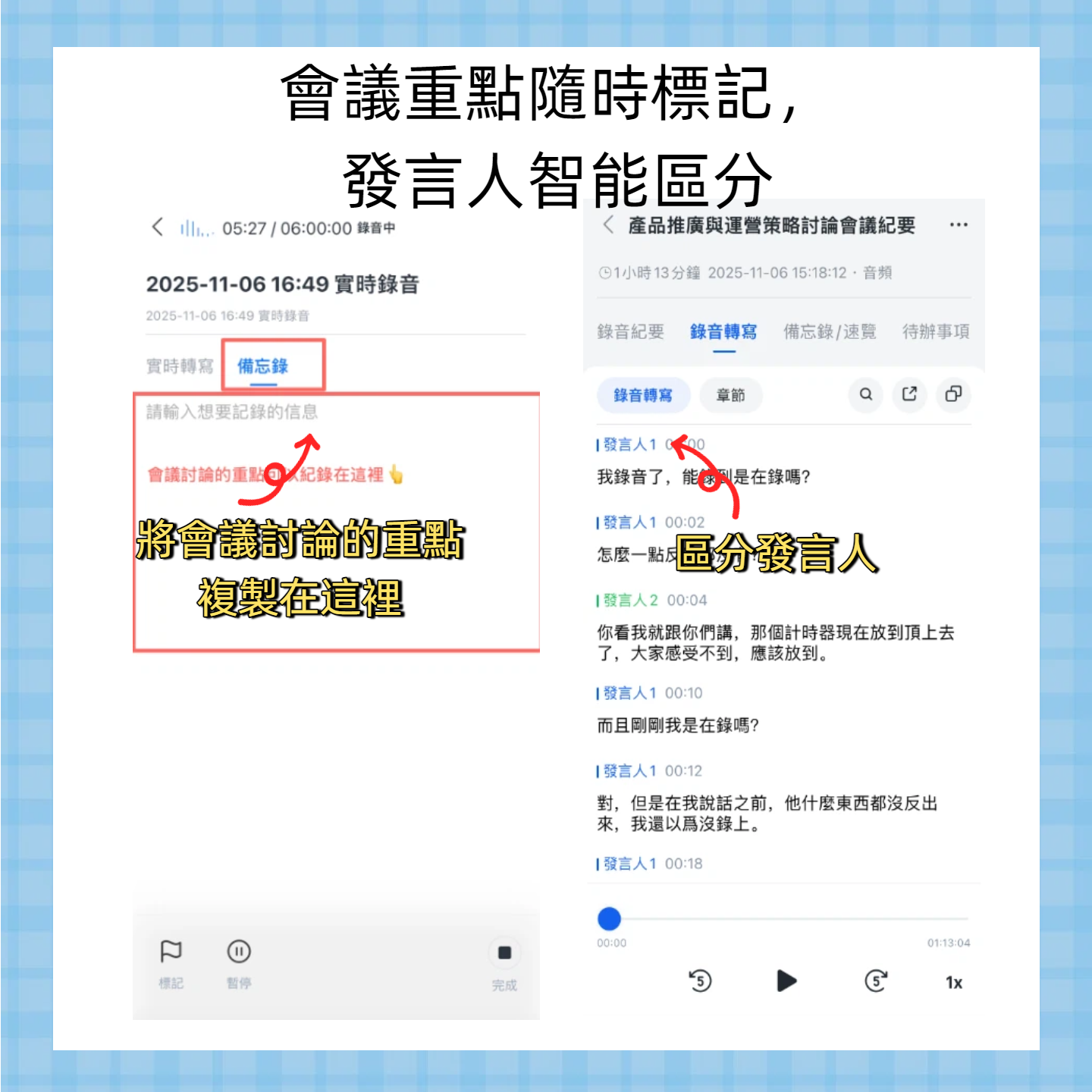
In-Depth Analysis: How Tinrec Solves the "Post-Recording" Problem
Among many tools, Tinrec (Miao Ting Lu Yin) has a unique design philosophy. It doesn't position itself as a mere transcription tool but emphasizes a complete workflow of "Recording → Understanding → Action."
1. More Than a Transcript: A Decision Assistant
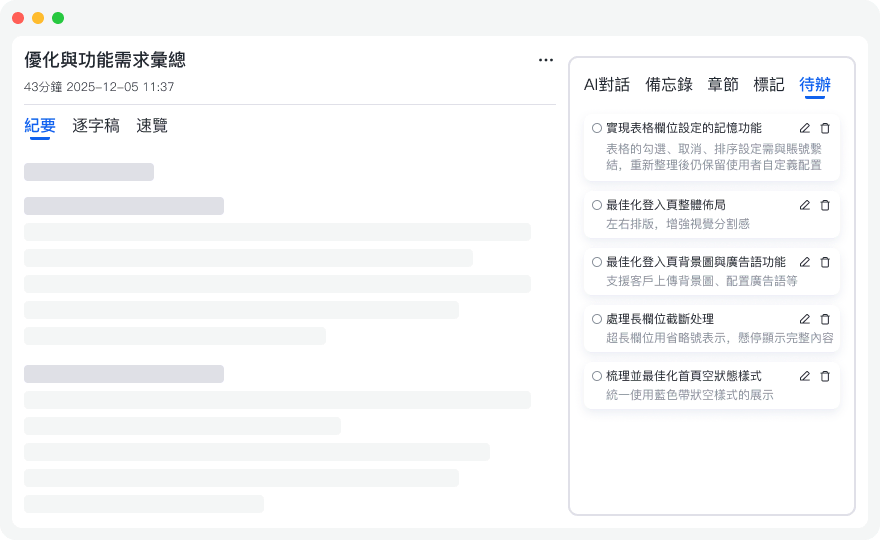
For corporate users or graduate students, transcripts can be tens of thousands of words, still laborious to read. Tinrec automatically generates "structured notes" after transcription, including:
- Full-text summary: Quickly grasp the gist of the recording.
- Chapter segmentation: Automatically split by topic.
- Action Items: Automatically extract task instructions mentioned in the meeting, such as "submit next week" or "who is responsible for what."
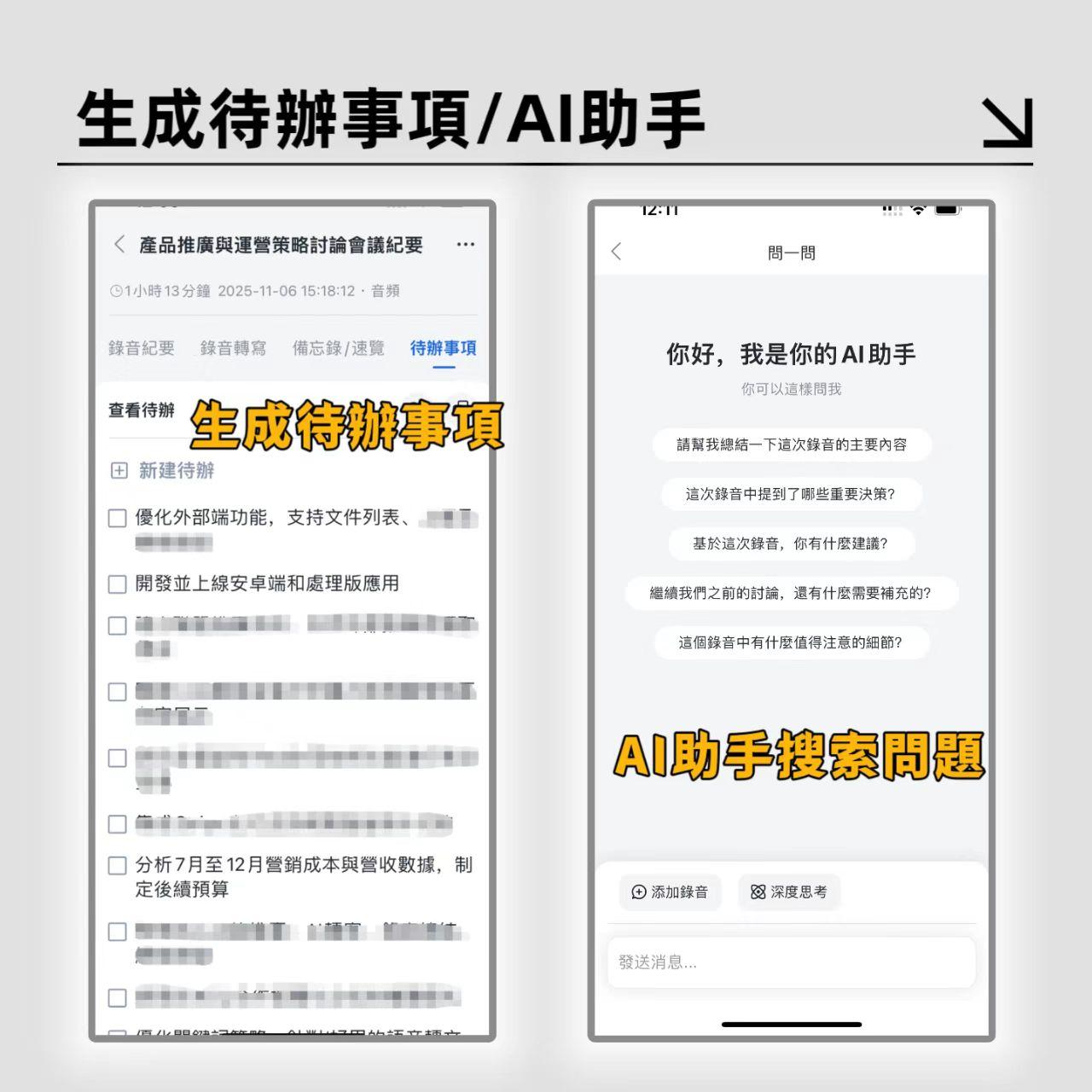
2. Find Answers by "Chatting"
This is an extremely useful feature for long recordings. Traditional tools only allow keyword search (Ctrl+F), but what if you forget specific wording?
Tinrec has a built-in AI Chat Query feature. You can ask questions like an assistant:
"In this meeting, what concerns did the marketing director have about the Q3 budget?"
"Which chapters did the professor say will be on the final exam?"
AI will answer based on the recording content, even listing timestamps, so you don't have to re-listen to the entire recording.

3. Friendly Support for Multilingual Environments
For international meetings or language learners, Tinrec supports automatic recognition of 10 languages including Chinese, Japanese, English, Korean, German, Taiwanese, and Cantonese. This means even tech meetings mixing Chinese and English, or interviews with Taiwanese dialect, maintain good accuracy.
Hands-On Tutorial: 3 Steps to Handle Meeting Minutes with AI
Using Tinrec as an example, here's how to organize a 60-minute meeting in 5 minutes.
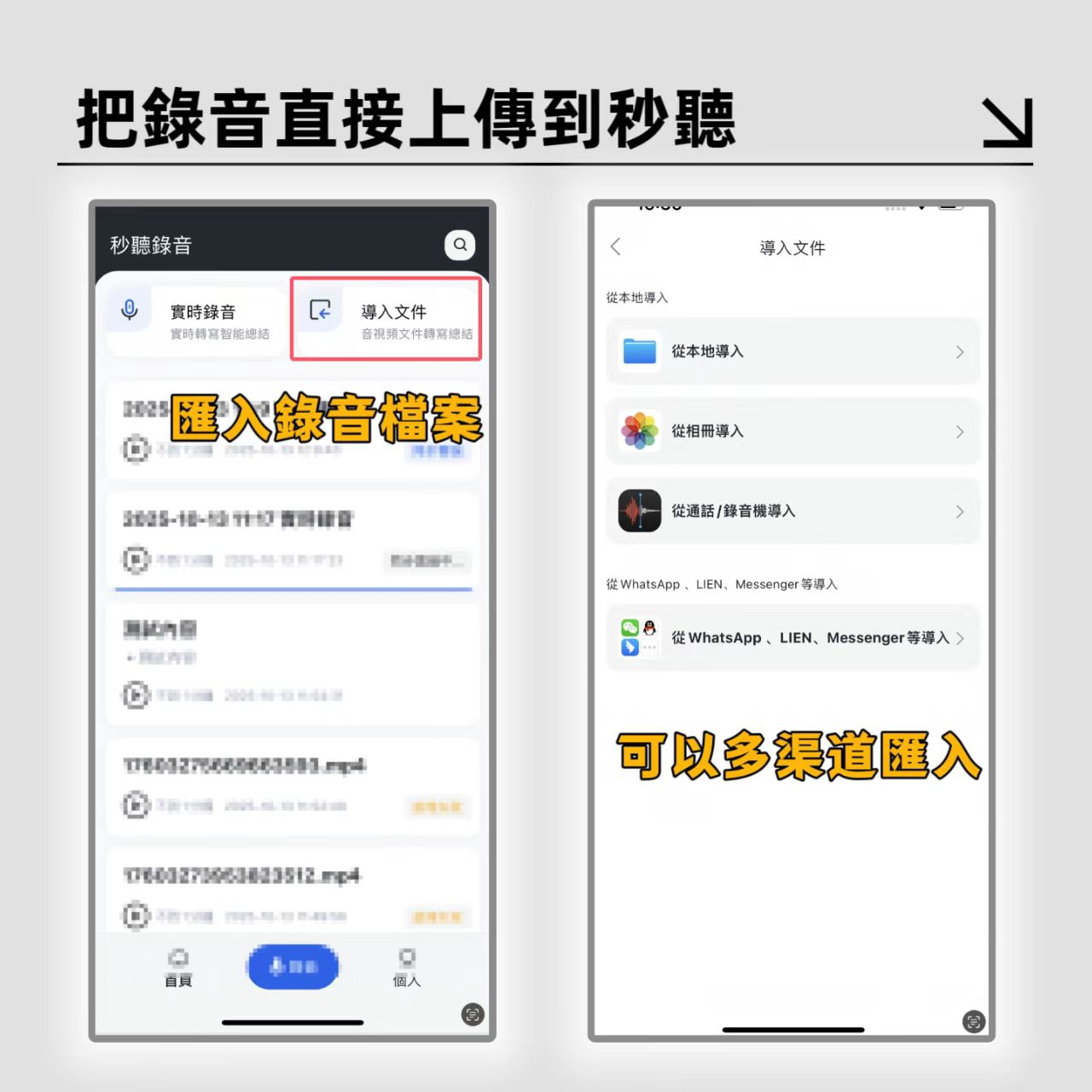
Step 1: Get the Audio Source
Tinrec offers three flexible entry points; choose based on your situation:
- Live Meeting: Use the mobile app or web version to start real-time recording with transcription; the transcript is ready when the meeting ends.
- Existing File: If you have a file from a voice recorder, use the audio file to text feature to upload.
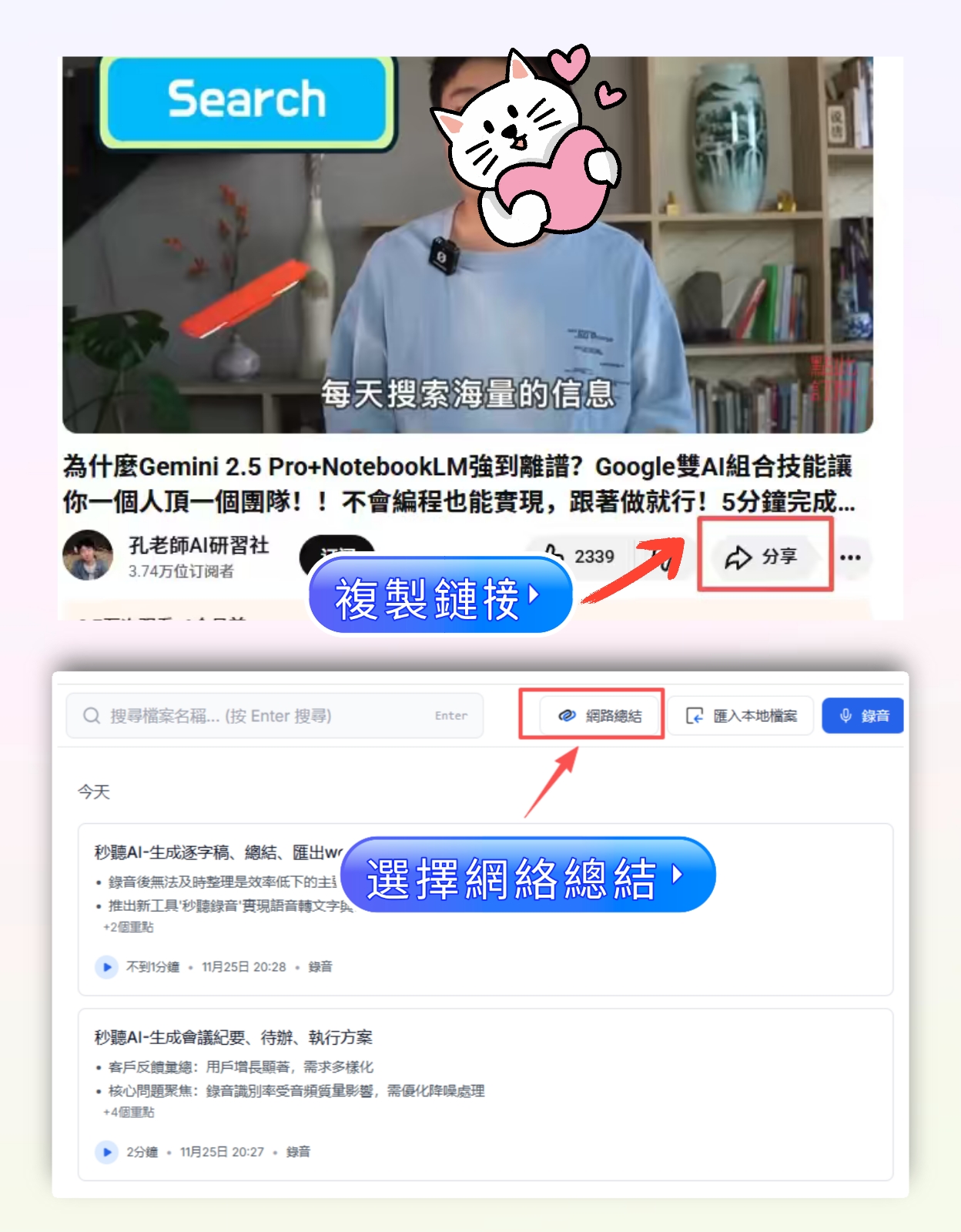
- Online Content: Want to organize a YouTube lecture or podcast? Just paste the link into video to text for parsing.
Step 2: Wait for AI Automatic Processing
After uploading or recording, the system automatically processes (typically taking only 1/10 of the recording duration):
- Speech-to-Text: Generates a coherent transcript.
- Speaker Diarization: Automatically labels Speaker A, Speaker B, etc.
- Smart Summary: Produces meeting minutes and key points.
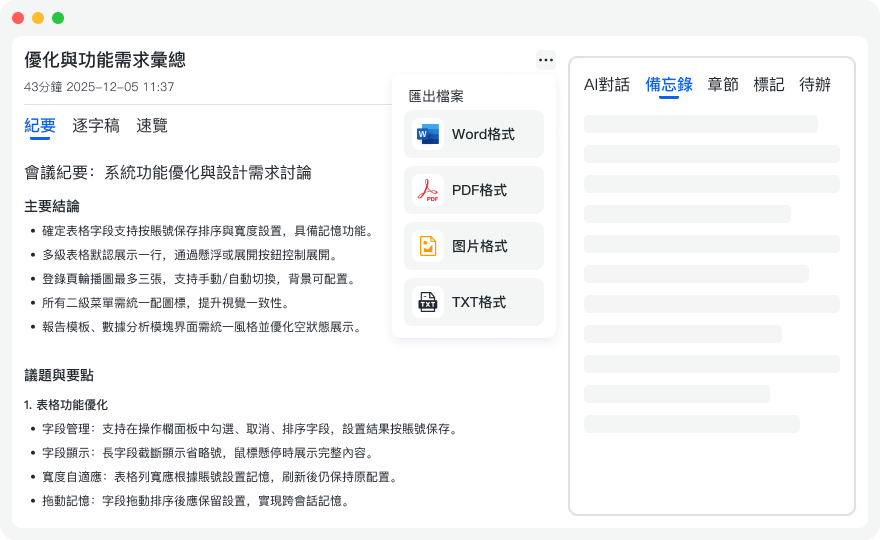
Step 3: Export and Share
Review the AI-generated to-do list, confirm it's correct, then export as Word, PDF, or Markdown and send to attendees, closing the meeting loop.
Frequently Asked Questions (FAQ)
Q1: How accurate is Traditional Chinese recognition for these transcription generators?
Most tools based on modern AI models (like Whisper or proprietary models) achieve over 95% accuracy with clear recordings. Accuracy drops with background noise or overlapping speech. Tinrec is optimized for Chinese contexts and supports Taiwanese recognition, making it relatively friendly for users in Taiwan.
Q2: Can iPhone call recordings be transcribed?
Due to iOS privacy policies, apps typically cannot directly record "phone line" audio. The recommended approach is to use speakerphone and record with another device, or use Tinrec's web or desktop version during online meetings (Teams/Meet/Zoom) for screen recording.
Q3: What are the limitations of Tinrec's free version?
Tinrec offers 100 minutes of free transcription per month, sufficient for occasional interview organization or single meetings. For heavy usage, consider upgrading to Basic or Pro.
Q4: Is there a risk of privacy leaks with recordings?
When choosing a tool, pay attention to the privacy policy. Legitimate tools like Tinrec typically use encrypted transmission and do not use user data for unauthorized purposes. Avoid using shady free online conversion websites.
Q5: Can I organize YouTube video content?
Yes. Tinrec supports pasting links from YouTube, TikTok, or podcasts to convert online media into text notes, ideal for online course study notes.
Q6: Can AI understand mixed Chinese-English content?
This depends on the tool's language model capability. Tinrec supports multilingual automatic recognition and usually correctly identifies common workplace mixed terms (e.g., "we need to align this project"), reducing manual corrections.
Turn every recording into actionable outcomes
Get 60 free transcription minutes when you sign in. No credit card required.
Related Reading
You might also like
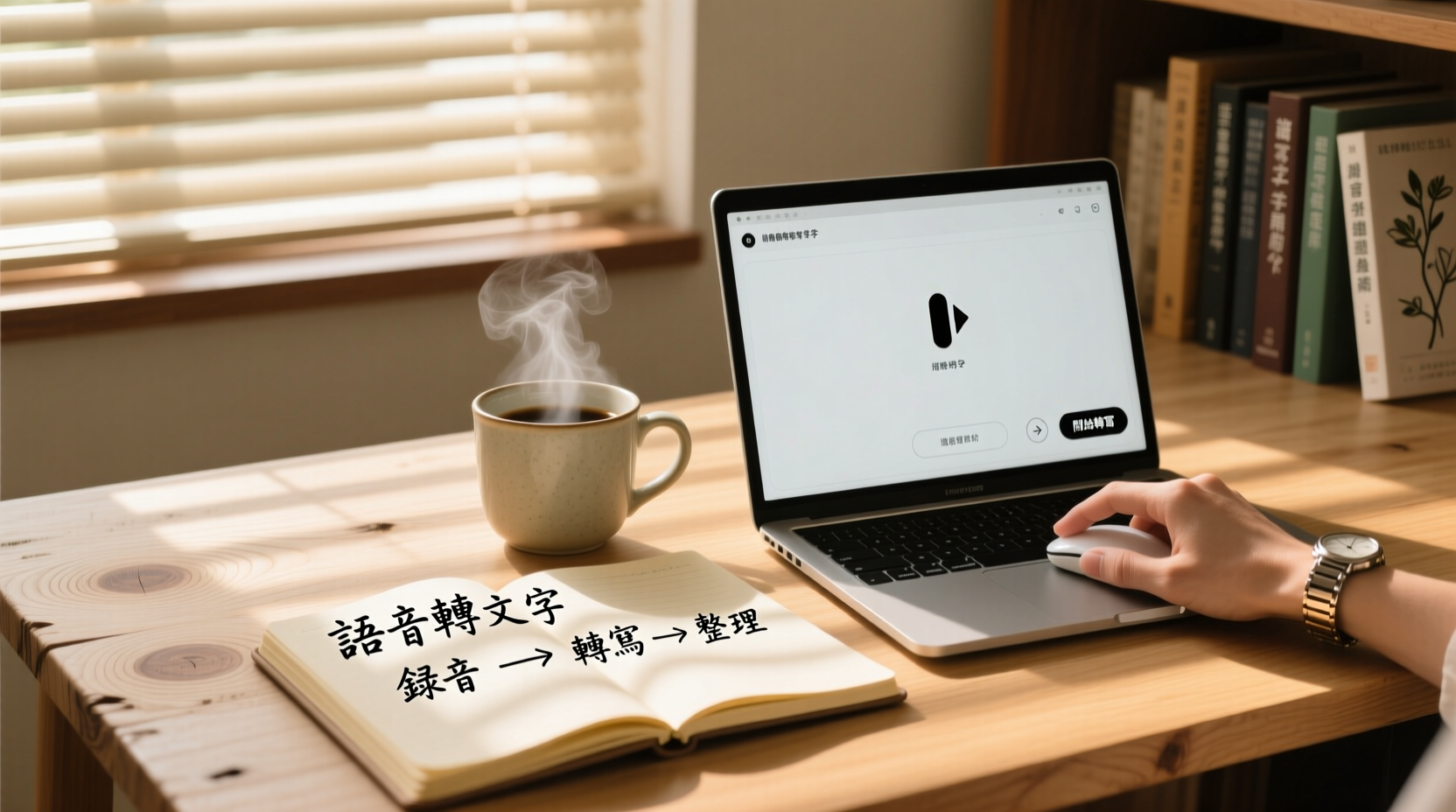
Which Speech-to-Text Tool Is Easiest to Learn? Choosing the Most Beginner-Friendly Option Based on Learning Cost
Looking for an easy-to-learn speech-to-text tool? This article starts from learning cost, compares the ease of learning of mainstream tools, breaks down the key steps to get started quickly, and provides recommendations for different groups such as sales, product R&D, and government employees, helping you learn and start using a tool in the least amount of time.

How to Choose the Best Recording-to-Text Tool in 2025: From Transcripts to Actionable Meeting Minutes
Meeting recording-to-text tools are no longer just about transcription. This article compares Tinrec, Otter, Fireflies, Notta, Granola, and other mainstream tools in terms of capture methods, Chinese language support, and post-meeting outputs, and explains how to generate action items from transcripts and build team knowledge, helping you choose the right tool for your meeting scenarios.

2026 Free Speech-to-Text Solutions: 5 Tools Compared
PTT hotly discusses speech-to-text apps. We tested Tinrec and 4 other tools, comparing free quotas, Cantonese accuracy, and AI features to help you save time on meeting notes.

4 Best Recording-to-Text Tools in 2026: How to Choose Based on Free Credits and AI Features
We tested the latest 4 recording-to-text tools in 2026, from free credits to AI Q&A and bot-free recording, to help you find the most time-saving option.

Tinrec vs Otter.ai in 2026: A 5-Dimension Comparison for Chinese Users
We tested Tinrec and Otter.ai for Chinese meetings, bot-free recording, AI Q&A, cross-platform support, and team collaboration to help you choose the right transcription tool and save overtime hours.

5 Best Recording-to-Text Tools in 2026 Compared: Tinrec vs MyEdit, Yating, and More
After testing multiple free recording-to-text tools, here's why Tinrec became my go-to for meeting notes from a mid-level manager's perspective—and whether the free plan is enough.

4 Best Speech-to-Text Tools in 2026: Free vs Paid Compared for US Users
We tested the most talked-about speech-to-text tools on Dcard and PTT, from free to paid, comparing Tinrec, Yating, Otter.ai, and Notta on features, pricing, and use cases to help you find the time-saving choice.

5 Best Speech-to-Text Tools Tested in 2025: AI Transcripts & Meeting Notes Compared
With countless speech-to-text tools available, this article tests Tinrec, MyEdit, SoundType AI, iPhone Voice Memos, and OpenAI Whisper across three dimensions—Traditional Chinese recognition, recording sources, and post-processing—to help you choose the right one for your needs.
2026 Hands-On Comparison of 4 Speech-to-Text Tools: Why Tinrec Is the Best Alternative for Notta Users?
This article compares speech-to-text tools like Tinrec and Notta, focusing on online meeting recording, AI summarization, and team collaboration, to help you decide which one suits American professionals best.