
Turn recordings into transcripts and summaries in minutes
Upload audio or video for multilingual transcription, AI notes, and action items
Have you ever diligently recorded a two-hour lecture, thinking you'd review it later, only to face dozens of hours of audio files before finals without ever opening a single one? This is a common pain point for most students and professionals: recording is easy, organizing is hard; storing is easy, retrieving is hard.
Traditional voice recorders or built-in phone recorders only give you a "dead" audio file. But by 2026, AI note-taking tools have evolved to "understand" your lectures and directly produce key summaries. This article reviews the mainstream AI note-taking tools from a practical perspective and provides a detailed comparison table and hands-on tutorial.
Quick Navigation Conclusion:
- If you value Google ecosystem and document analysis: Go with NotebookLM.
- If you need full English meeting/class recording: Otter.ai is the veteran.
- If you need accurate Chinese/multilingual recognition and mobile instant summaries: Tinrec (秒聽錄音) offers the best balance.
Why Are Recordings "Ineffective Notes"? What Do AI Tools Solve?
Before discussing tools, let's clarify why traditional recordings fail to improve learning efficiency. Three main reasons:
- Low information density: Humans speak at about 150-200 words per minute, but can read at over 500 words per minute. Re-listening is extremely inefficient for review.
- Cannot be searched: You can't Ctrl+F an audio file for a keyword (e.g., a professor mentioning "final exam focus").
- Lack of structure: Recordings are linear, without headings or highlights, making it hard for the brain to grasp logic.
The core value of AI note-taking tools is converting the "invisible time stream" into a visible, searchable, actionable text structure.
2026 Top Lecture Recording & Note-Taking Tools In-Depth Review
Below we select 4 representative tools for scenario analysis to help you decide.
1. NotebookLM: Google's Research Assistant
Google recently integrated NotebookLM deeply into the Gemini ecosystem. Its core logic isn't a "recorder," but a "data processor."
- Core Strength: Excels at processing large PDFs, handouts, and existing notes. Upload a professor's slides or references to generate deep summaries.
- Best for: Writing papers, organizing complex literature.
- Limitation: It's more of a "reading assistant" than a real-time recording tool, lacking the convenience of record-anywhere on mobile, and its real-time voice transcription is relatively limited.
2. Otter.ai: The King of English-Language Classes
For international students or all-English environments, Otter.ai remains the gold standard.
- Core Strength: Very high English recognition accuracy, with precise speaker identification.
- Best for: All-English lectures, group discussions.
- Limitation: Chinese support is mediocre. If the class is in Chinese or mixes Chinese and English, recognition drops significantly. Also, the free tier has many limitations (e.g., export formats).
3. Tinrec (秒聽錄音): Multilingual & Mobile-First Note-Taking Assistant
Tinrec is designed to solve the complete workflow from recording to action, with special optimization for Asian languages.
- Core Strength:
- Multilingual mixed recognition: Supports 10 languages including Chinese, English, Japanese, Korean; handles mixed Chinese-English classes well.
- Complete workflow: Not just transcription, but also auto-generates "AI summary," "to-do items," and "chapter segmentation."
- Multi-device: Apps (iOS/Android) and web sync—record on phone in class, organize on computer at home.
Stop organizing recordings by hand
Upload audio or video and automatically get a transcript, summary, and action items
4. Notion AI: The Final Stop for Knowledge Management
Notion is a note database, and with AI it becomes a powerful organization tool.
- Core Strength: Powerful formatting and database linking. Seamlessly connect notes with project progress.
- Best for: Final organization and archiving of post-lecture notes.
- Limitation: Notion is not a native recording/transcription tool; you typically need to import text from another recording app before using Notion AI to polish.
Detailed Comparison: Which One Suits Your Lecture Scenario?
Before choosing a tool, consider these 5 key dimensions:
| Dimension | NotebookLM | Otter.ai | Tinrec (秒聽錄音) | Notion AI |
|---|---|---|---|---|
| Core Positioning | Document reading & analysis | English meeting transcription | Cross-language recording & action items | Knowledge base & writing assistant |
| Chinese Recognition | Strong (depends on uploads) | Weak | Excellent (supports mixed CN/EN) | Depends on input source |
| Live Transcription | No (mainly upload) | Yes (strong) | Yes (App/Web) | No (needs import) |
| AI Summary | Deep analysis | Basic summary | Structured notes/action items | Writing polish |
| AI Q&A | Yes | Yes (English mainly) | Yes (ask about recording content) | Yes (against note base) |
| Supported Devices | Web primarily | All platforms | iOS, Android, Web | All platforms |
Hands-On Tutorial: How to Auto-Generate Lecture Notes with AI Tools
Here we use Tinrec as an example to show how to turn a 2-hour class into review-ready notes in 5 minutes. This workflow works for most transcription tools.
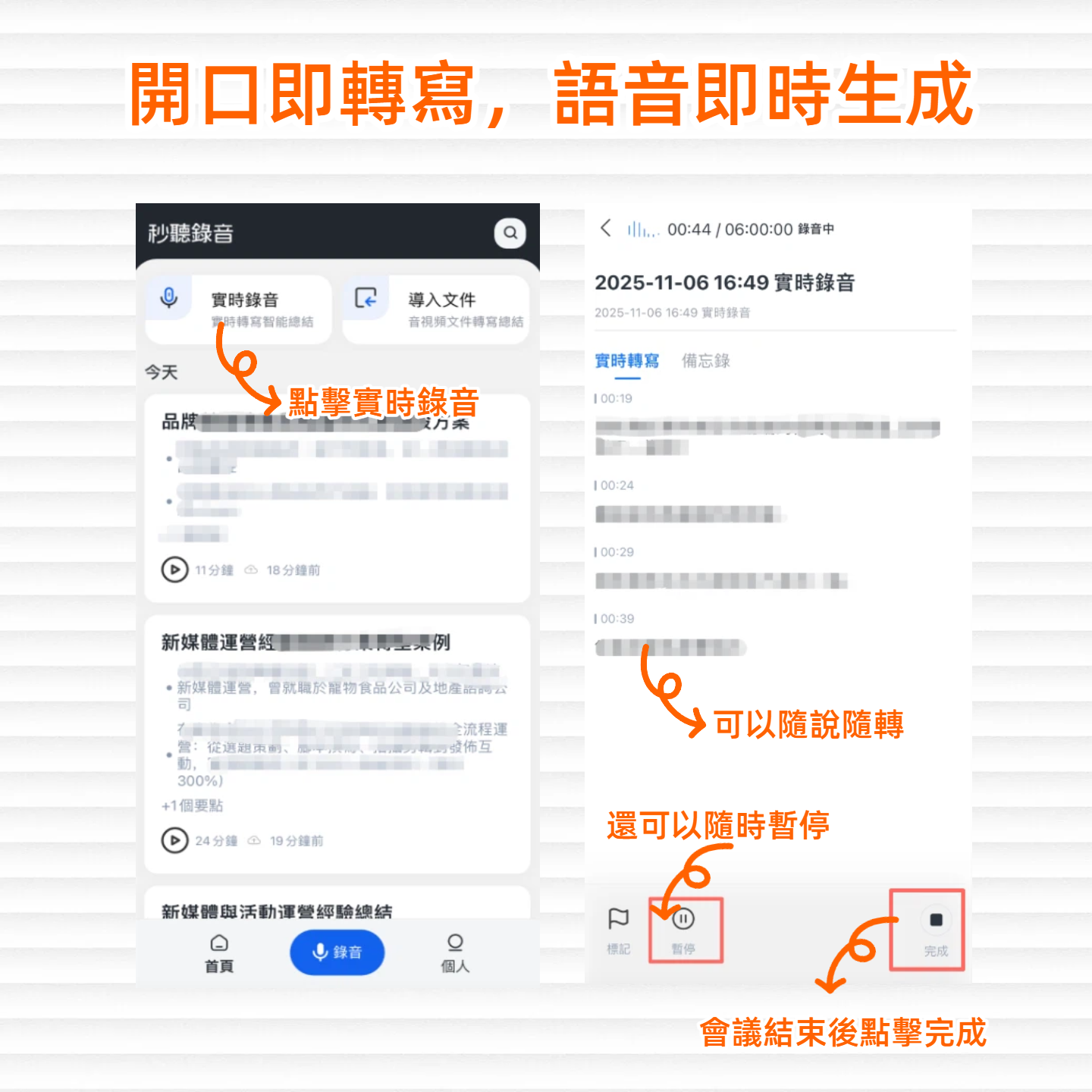
Step 1: Real-Time Recording & Transcription in Class
Open the app and tap record during class. Tinrec records and transcribes in the background, letting you focus on the lecture.
Step 2: Auto-Generate Structured Summary After Class
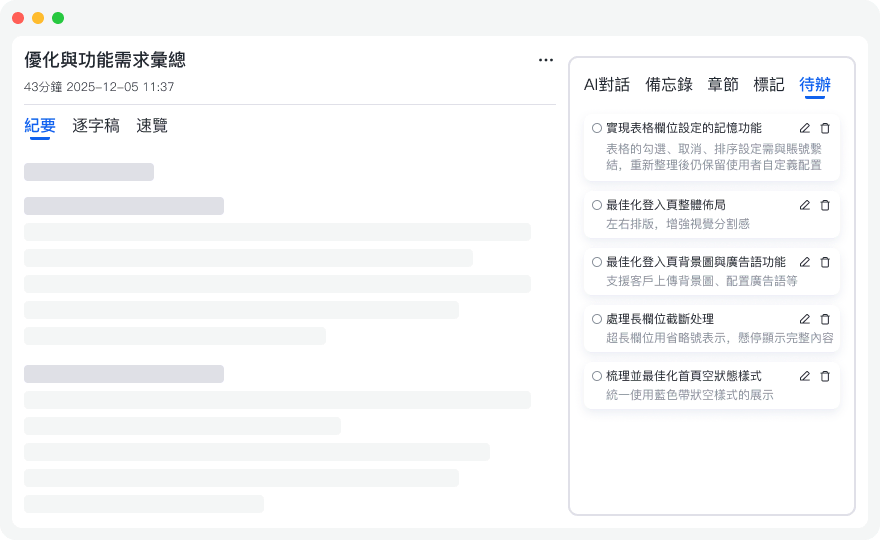
Stop recording when the class ends. The system processes the audio and converts spoken language into a bulleted "meeting minutes" or "lecture highlights."
- Tip: Use the AI auto-extracted "to-do items" to quickly grab assignment deadlines or exam scope.

Step 3: Process Online Courses (Video to Text)
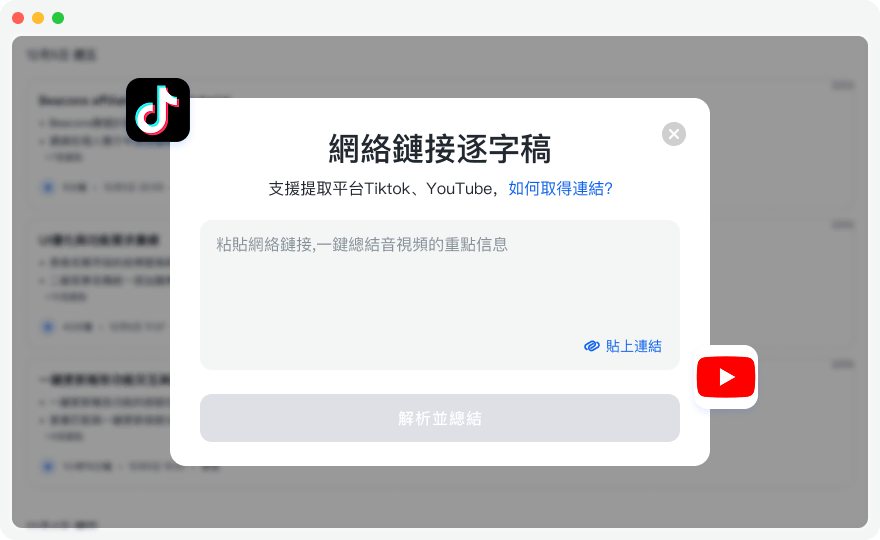
If watching YouTube tutorials or recorded Zoom sessions, you don't need to record audio externally. Use the "video link parsing" feature—paste the URL to generate a transcript.
Step 4: AI-Powered Conversational Review (Exam Cram)
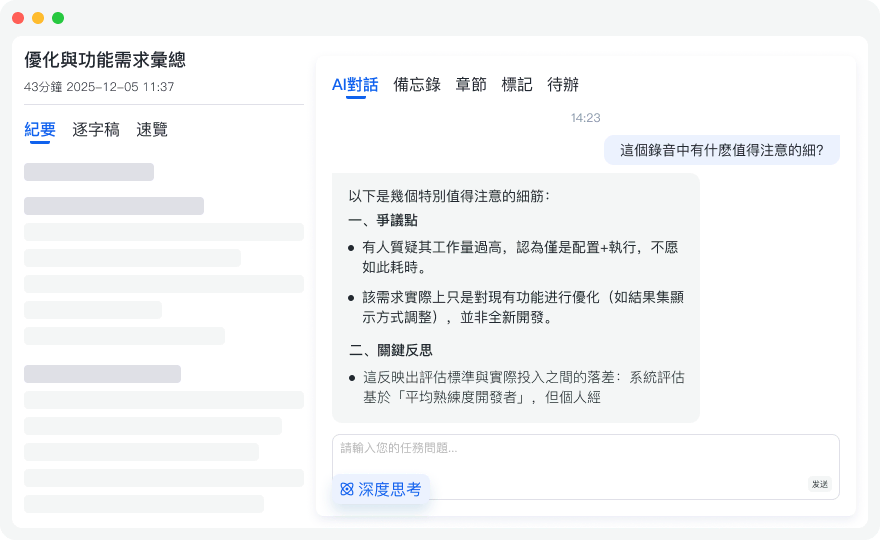
This is the most crucial step. When reviewing, you don't need to re-read the entire transcript. Use the "AI Q&A" feature to ask directly:
- "What are the midterm exam key points the professor mentioned in this class?"
- "Summarize the three core concepts of 'algorithms.'"
It's like having a personal assistant to find answers from the recording.
Frequently Asked Questions
Q1: If the professor is far away, will phone recording be clear?
A: Distance does affect audio quality. Sit near the front or use a directional external mic. Modern AI tools like Tinrec have noise reduction and gain algorithms; in moderately quiet environments, they can recognize over 80% of content.
Q2: Can AI handle mixed Chinese-English lectures?
A: It depends on the language model. Otter is great for pure English but garbles mixed Chinese. Choose tools advertised with "multilingual recognition" (e.g., Tinrec) that better handle code-switching.
Q3: Do these tools have free versions?
A: Most do. NotebookLM is currently completely free; Tinrec offers 100 free minutes per month, enough for casual use.
Q4: What export formats are available?
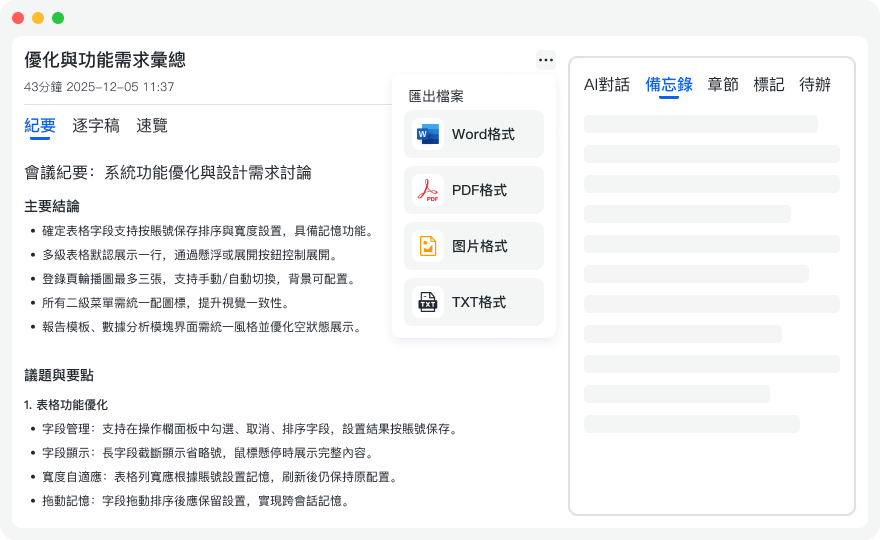
A: For editing, choose tools that export TXT, Word, PDF, or SRT. If you plan to bring transcripts into Notion, plain text or Markdown export is most convenient.
Q5: What's the difference between a transcript and an AI summary?
A: A transcript is every word the professor said—high volume with filler words. An AI summary is a structured logical digest. For review, read the summary first to grasp the structure, then search the transcript for details on unclear points.
Q6: Are there privacy concerns with these tools?
A: Good question. Choose paid products with clear privacy policies, and avoid uploading highly sensitive content (e.g., unpublished lab data, trade secrets) to public cloud AI. For regular class notes, standard encrypted cloud services (like Google, Tinrec) are generally safe.
Turn every recording into actionable outcomes
Get 60 free transcription minutes when you sign in. No credit card required.
Related Reading
You might also like

How to Automate Meeting Action Items in 2026: AI Summaries + Task Assignment Made Easy
The meeting is just the beginning. This practical guide from a mid-level manager's perspective reviews 6 tools that automatically turn meeting recordings into summaries, action items, and assignees—including Tinrec, Otter, Fireflies, Notta, Granola, and TurboScribe—covering their positioning, pricing, and best use cases, plus how to organize action items so they actually get tracked.

Tinrec vs Otter.ai in 2026: 5-Dimension Comparison — How to Choose Team Meeting Notes Software
A mid-level manager leading a 10-person team with 15 meetings per week shares hands-on experience. Compare Tinrec and Otter.ai across 5 dimensions: how meetings are recorded, Chinese recognition, post-meeting output, cross-platform support, and team governance. Also covers use cases for Notta and Granola, plus 3 common pitfalls to avoid.

2026 Team Meeting Transcription Tools Comparison: Tinrec vs Otter.ai
From the decision-making perspective of 'how to choose a meeting transcription tool,' this hands-on comparison examines Tinrec and Otter.ai across bot-free recording, Chinese meeting experience, post-meeting organization, team governance, and pricing to help you determine which is better suited for your team.

How to Build a Meeting Knowledge Base in 2026: 5 Steps and Tool Test
Starting from the pain point of meeting recordings scattered everywhere, I share my 5 steps to build a meeting knowledge base, using Tinrec as the core tool, comparing Otter, Granola, Notta, and explaining how to turn recordings into searchable, collaborative, actionable team data.

Which User Interview Research Report Tool Is Best? 2026 Hands-On Test of 3 Tools—This One Saves the Most Time for Chinese Interviews
How do you choose a user interview research report tool? This article compares Tinrec, Notta, Otter.ai, and Granola across five dimensions: Chinese recognition, audio file import, AI follow-up questions, team collaboration, and export. It also provides a pitfalls guide and scenario-based selection advice.

2026 AI Meeting Tools Comparison: Tinrec vs Otter.ai for SMBs
A hands-on comparison of Tinrec and Otter.ai from an SMB perspective, covering Chinese transcription, bot-free recording, meeting knowledge base, post-meeting output, team governance, and budget to help you decide which fits better.

2026 Meeting AI Agent Comparison: Tinrec vs Granola — Which Is Better for Chinese-Speaking Teams?
What is a meeting AI agent? This article starts with common misconceptions, defines AI meeting agents, and then compares two bot-free meeting tools, Tinrec and Granola, across 4 dimensions: Chinese transcription, post-meeting Q&A, team knowledge retention, and pricing, to help you decide which fits your workflow.

Tinrec Review 2026: AI Meeting Q&A + Team Knowledge Base for Historical Meeting Records
Three months after a meeting, can you still find that one key conclusion? This article starts with the real pain of retrieving historical meeting records, breaks down 4 key buying factors, tests Tinrec's semantic Q&A, bot-free recording, and team data retention, and briefly compares who Otter.ai, Notta, and Granola are each best for, with a pitfall guide and scenario-based recommendations at the end.

Tinrec vs Otter.ai 2026: 5-Dimension Comparison for AI Meeting Agents in Chinese Scenarios
From a mid-level manager's practical perspective, this article breaks down common misconceptions about AI meeting agents and compares Tinrec and Otter.ai across 5 dimensions. It covers bot-free recording, Chinese transcription, post-meeting action items, AI Q&A, and team data retention to help you find a solution that truly saves post-meeting organization time.