
Turn recordings into transcripts and summaries in minutes
Upload audio or video for multilingual transcription, AI notes, and action items
Have you ever stayed late at work to organize meeting recordings? Or scrambled to take notes in class, missing key points from the teacher?
With AI technology maturing, "speech-to-text" has evolved from simple dictation into a productivity tool that understands context and automatically generates summaries. There are many tools on the market, from built-in Windows features to professional AI note-taking apps. How do you choose the right one? This article provides scenario-based reviews of 8 popular tools (including Google products, Wispr Flow, Tinrec, and more) along with a full feature comparison chart.
Quick Navigation Conclusions:
- Short texts/replies (real-time input): Prioritize Windows 11 Voice Typing or Wispr Flow.
- Long recordings/academic analysis: Recommend NotebookLM or Tinrec (great for long files and action items).
- Cross-platform/meeting action items: If you need automatic to-do generation and multi-device sync, Tinrec is a solid candidate.
1. Why You Need AI Speech-to-Text: Common Pain Points
In digital workflows, turning "speech into productivity" revolves around: Input (speaking/recording) → Organize (AI transcription and polishing) → Output (articles/reports). However, traditional workers often face these pain points:
- Low information density: A 1-hour recording takes forever to replay.
- Fragmented organization: After recording on your phone, you have to manually transfer files to your computer; messy file management.
- Lack of action items: Even with a transcript, you still don't know what to do after the meeting.
- Device limitations: For example, iPhone has strict recording permissions, or some tools don't support Android.
With modern AI tools, we not only improve traditional Chinese recognition accuracy but also let AI help "extract key points."
2. 2026 Hot AI Speech-to-Text Tools: Feature Comparison
Based on real testing and user experience, here are tools categorized by use case:
1. Real-Time Voice Input (Best for replies, short texts)
Wispr Flow (Mac/iOS/Windows)
- Features: Like a real-time voice input method, supports cross-app input. AI auto-corrects typos and punctuation, with extremely smooth traditional Chinese. Also supports "custom dictionaries" for users with specialized terminology.
- Note: Android support is limited as of now, and the mode is more "speak a phrase, transcribe a phrase" rather than continuous long recording.
Windows 11 Built-in Voice Typing
- Features: Completely free, no installation needed; press
Win + Hto activate. Lowest barrier for Windows users, supports real-time sentence-by-sentence transcription. - Note: Does not save audio recordings. If your computer crashes or network drops, content is lost. Not suitable for important meeting notes.
- Features: Completely free, no installation needed; press
2. Long Recording & Note-Taking (Best for meetings, interviews)
Evernote
- Features: Veteran note-taking app, suitable for 5–30 minute recordings. Advantage: recordings and notes are integrated; AI can help segment and polish.
- Note: Occasionally recognizes as simplified Chinese, requiring manual correction.
Google Live Transcribe (Android)
- Features: A powerhouse for Android phones; can record and transcribe for long periods without interruption. Ideal for hearing assistance or long classroom notes.
- Note: Weak polishing; transcripts are usually one long block of text, making later formatting tedious.
3. File Processing & Analysis (Best for academia, deep organization)
NotebookLM
- Features: A powerful tool from Google, ideal for uploading "ultra-long recordings" or large documents. Not only transcribes but also allows you to "talk to your data" with Q&A.
- Note: Not suitable for real-time voice input; workflow is more cumbersome (record first, then upload).
Tinrec (Instant Recording)
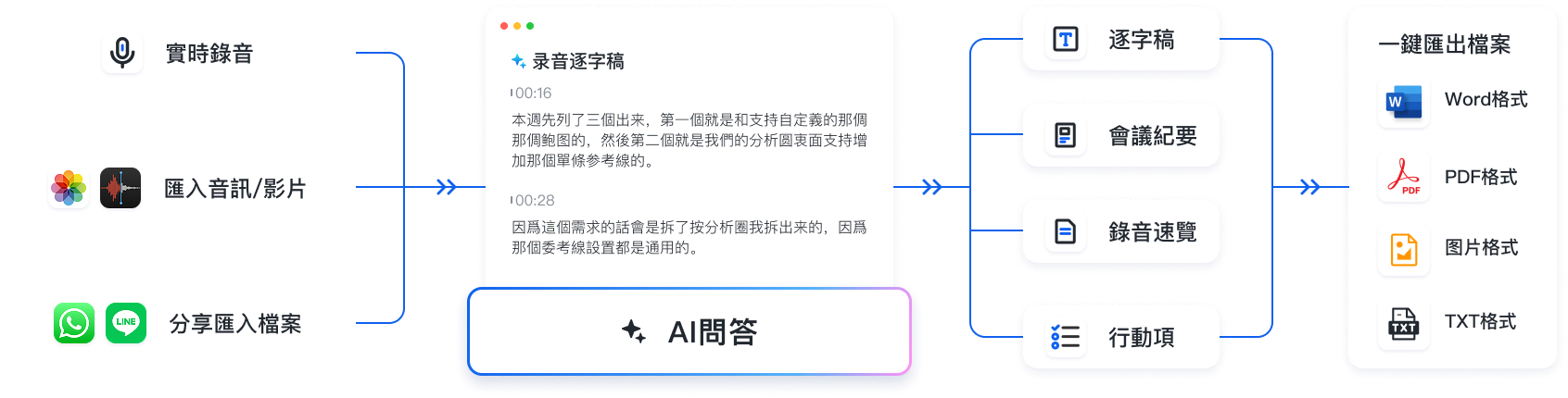
- Features: Provides a complete Record → Understand → Act workflow. Beyond basic real-time recording and transcription, it emphasizes automatic extraction of meeting minutes and action items. Supports iOS, Android, and Web multi-device sync, solving cross-platform transfer pain points.
- Differentiator: Compared to simple transcript tools, Tinrec offers "AI conversation queries." You can directly ask AI: "What was the conclusion about the marketing budget in this meeting?" without reading the entire transcript.
Stop organizing recordings by hand
Upload audio or video and automatically get a transcript, summary, and action items
3. Tool Specifications & Feature Comparison Table
To help you choose intuitively, here's a comparison of key dimensions for 5 representative tools:
| Dimension | Tinrec (Instant Recording) | Wispr Flow | NotebookLM | Win 11 Voice Typing | Google Live Transcribe |
|---|---|---|---|---|---|
| Core Focus | Meeting minutes & action item management | Real-time voice input method | Knowledge base Q&A | System built-in typing | Assistive dictation recording |
| Cross-Platform | Web / iOS / Android | Mac / Win / iOS | Web | Windows only | Android only |
| Save Audio | ✅ Cloud sync | ✅ Local save | ✅ (must upload yourself) | ❌ | ❌ (text only) |
| AI Summary/Action Items | ✅ Auto-generates to-dos | ✅ Basic polishing | ✅ Deep analysis | ❌ | ❌ |
| Long Recording Support | Supports long recording/upload | Segmented input | Supports very large files | Not suitable | Suitable |
| Video to Text | ✅ Supports links/files | ❌ | ❌ | ❌ | ❌ |
4. Practical Tutorial: Build an Efficient Voice Note Workflow
Different scenarios require different processes. Below, using Tinrec as an example, we show how to handle three common high-frequency needs:
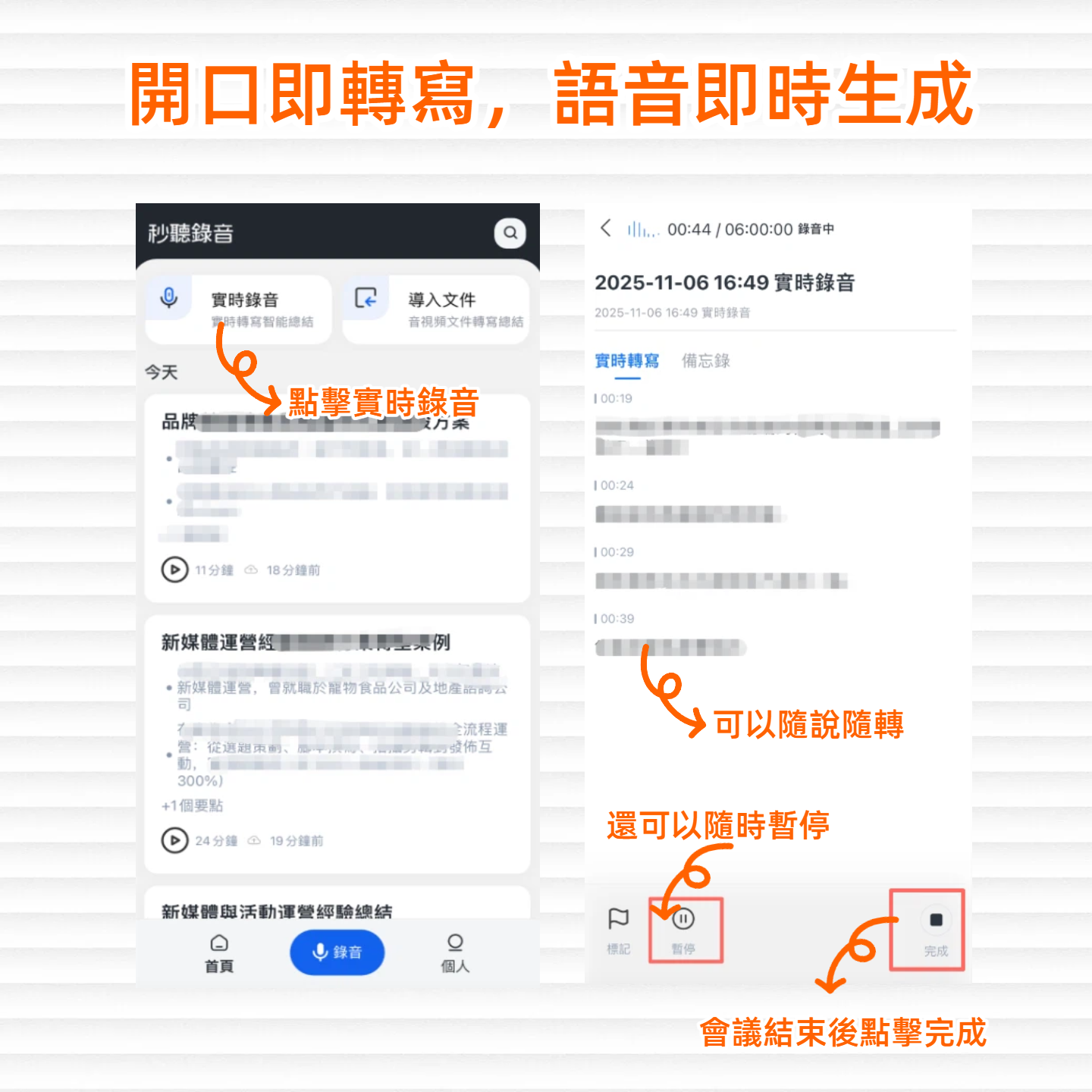
Scenario 1: In-Person Meeting/Classroom Recording (Real-Time Transcription)
When you're in a meeting or classroom and need to focus on listening without missing details:
- Open the mobile app or web version and tap "Start Recording".
- The system will transcribe speech into a rolling transcript in real time; you can mark important points anytime.
- After recording, tap "AI Summary". The system automatically performs speaker diarization and generates meeting minutes.
- Key step: Review the auto-generated "Action Items" to confirm follow-up tasks.
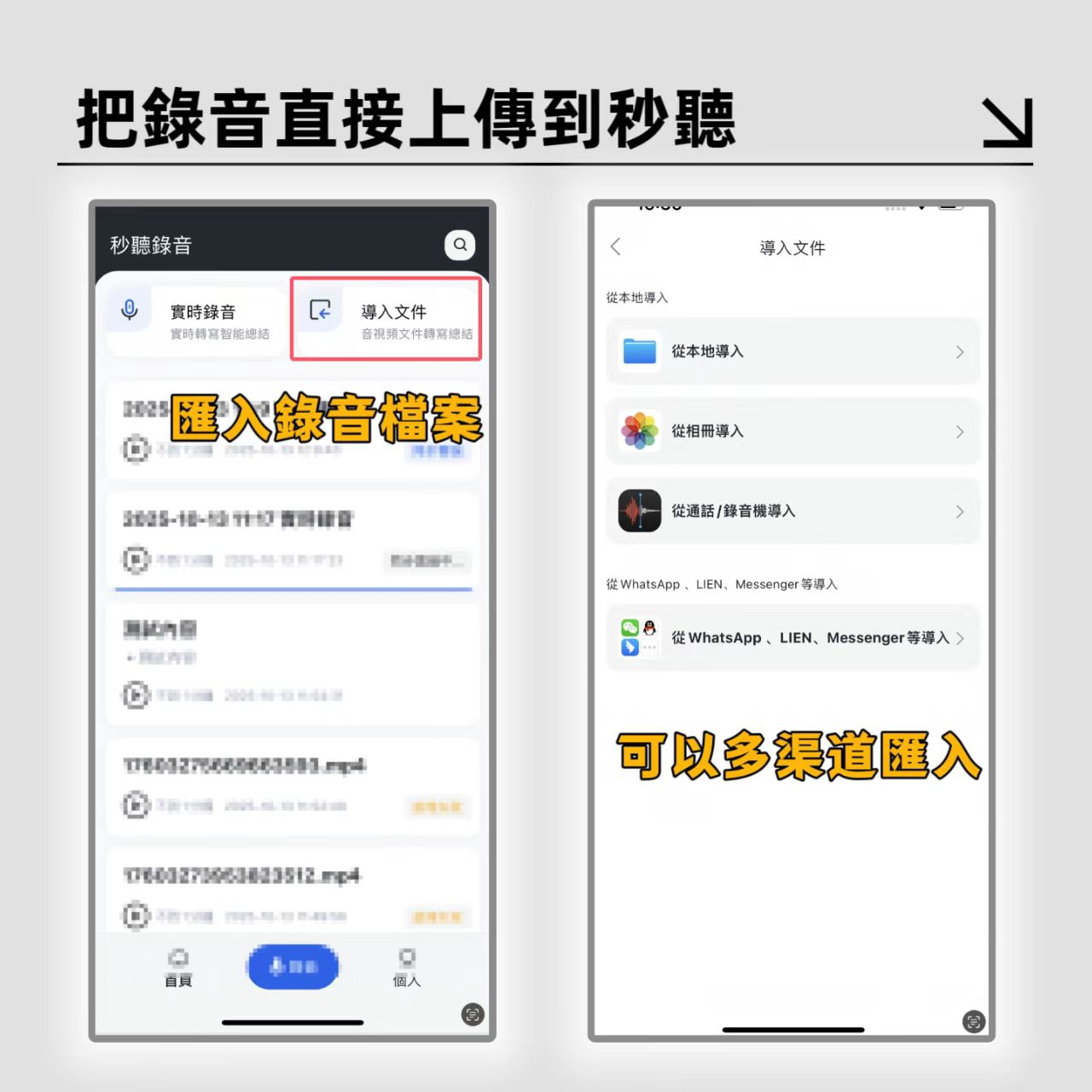
Scenario 2: Organize Past Recordings or Videos (File Upload)
If you have existing audio files from a recorder or want to summarize key points from a YouTube tutorial:
- Go to the feature menu and select "Audio/Video to Text".
- Upload an mp3/mp4 file directly, or paste a YouTube/Podcast link.
- Wait for cloud processing (usually a 1-hour audio file takes just a few minutes).
- Get a transcript with timestamps; click any text to jump to the corresponding audio segment for easy proofreading.
Scenario 3: Quick Review & Search (AI Chat)
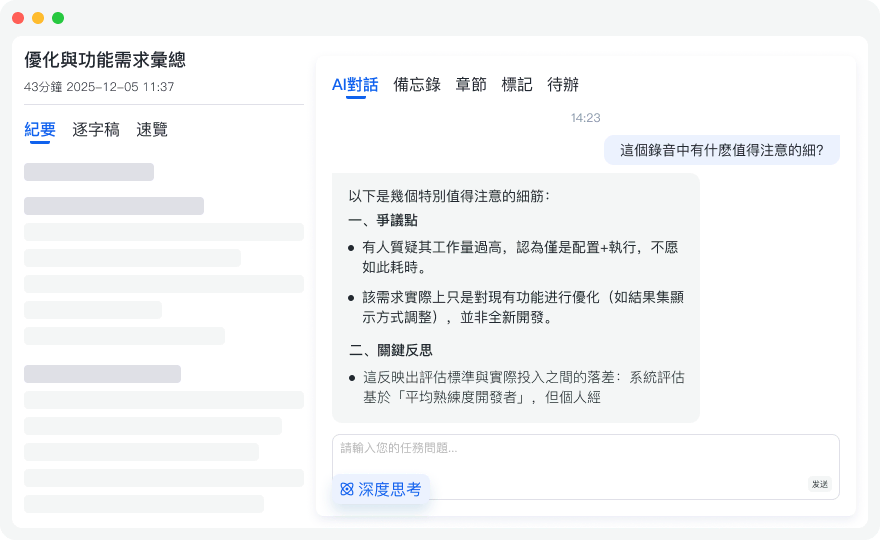
Facing a 2-hour interview recording, you don't need to read from start to finish:
- Open the processed recording note.
- Use the "AI Chat Query" panel on the right.
- Enter a command, e.g., "List the three main pain points the interviewee mentioned" or "What was the conclusion about the timeline in this conversation?"
- AI answers based on the recording content, drastically reducing information retrieval time.
5. FAQ
Q1: Do these tools have free versions? Most tools use a "freemium" model. For example, Windows built-in and Google Live Transcribe are completely free; NotebookLM is currently free; Tinrec and Wispr Flow typically offer monthly free trial quotas (e.g., Tinrec free plan gives 100 minutes per month), suitable for light users to try.
Q2: What limitations do iPhone users face? Due to iOS's strict privacy permissions, you cannot easily do "call recording" or "background long recording" like on Android. It's recommended to use dedicated apps (such as Tinrec iOS or Wispr Flow iOS) to manage recordings, and ensure your screen stays on or follow the app's instructions to avoid interruptions.
Q3: Can I use these to transcribe Teams or Google Meet meetings? Yes. For desktop, you can use "virtual audio cable" technology, or a simpler method: open Tinrec web or Windows Voice Typing and use your computer's Stereo Mix, or simply place your phone near the speaker to record (primitive but stable). Some tools support importing meeting recording files for post-processing transcription.
Q4: How accurate is traditional Chinese recognition? Will it output simplified Chinese? Current mainstream AI models (like Whisper) are quite mature for traditional Chinese. Tools like Tinrec and Wispr Flow support traditional Chinese output. Only Evernote and some older tools occasionally mix simplified and traditional; choose tools that allow you to set the output language.
Q5: Are my recordings private and secure? When using cloud AI transcription services, audio must be uploaded to servers for processing. Choose commercial software with clear privacy policies (like the recommended tools) and avoid unknown free conversion websites. For highly sensitive data, consider offline solutions (e.g., running Whisper locally), but this requires powerful hardware.
Q6: Can I directly convert YouTube videos to text? Not all tools support this. Windows Voice Typing cannot read links; NotebookLM requires you to download the audio first and then upload. If you need "paste link and get text," Tinrec's "Podcast/Online Video to Text" feature is a more direct solution.
Conclusion: Choose Your "Second Brain"
No tool is inherently good or bad—it's about what fits your needs.
- If you're a Windows user and just need simple typing, the Win + H shortcut is your best bet.
- If you're a Mac user seeking writing fluency, Wispr Flow offers a great experience.
- If you need cross-device management of meeting action items or need to handle videos/long audio, then Tinrec—which integrates recording, transcription, and AI summaries—is a complete solution that can save you significant time.
Leverage these AI tools to turn speech from fleeting sound into searchable, actionable assets.
Turn every recording into actionable outcomes
Get 60 free transcription minutes when you sign in. No credit card required.
Related Reading
You might also like

4 AI Meeting Recorder Tools Tested: Free Tiers and Chinese Meeting Support Compared (2026)
Is more free minutes always better? This hands-on comparison of Tinrec, Otter.ai, Notta, and Granola walks through real meeting workflows—how meetings get captured, what you get after transcription, Chinese-language performance, free tiers, and team permission management—plus four common selection mistakes and scenario-based recommendations.

2026 AI Meeting Notes Comparison: Tinrec vs Notta vs Otter.ai — Which Is Best?
After a two-hour meeting, your notes are just scattered fragments. This article compares Tinrec, Notta, and Otter.ai using the same criteria: how well they handle Chinese meetings, how they record online meetings, what you get after the meeting, whether teams can manage them, and how pricing works—so you can decide which one fits you best.

2026 AI Meeting Notes Software Comparison: Transcription Doesn't Equal Deliverable Minutes
Starting from the most common selection pitfalls, this hands-on comparison of Tinrec, Notta, Otter.ai, and PLAUD Note examines differences in meeting recording methods, post-meeting output, Chinese recognition, and team management. It also covers key buying criteria, pitfalls to avoid, and selection advice to help you find AI meeting notes software that truly saves post-meeting organization time.

How to Choose an AI Meeting Recorder in 2026: Testing 3 Tools + Tinrec Chinese Transcription and Post-Meeting Action Items
Before searching for 'which AI meeting recorder is best,' clarify your meeting language, recording method, and post-meeting needs. This article covers 4 key buying factors, hands-on comparisons of Tinrec, Otter.ai, Notta, and Granola, and 4 common pitfalls to help you choose the one you'll actually use.

2026 AI Meeting Notes Software Comparison: Free Tiers and Post-Meeting Organization—Which Is Enough?
A hands-on comparison of four AI meeting notes tools in 2026, covering recording methods, post-meeting outputs, AI Q&A, and team data ownership, plus three common buying mistakes to help you decide if a free plan is enough or a team plan is worth it.

Tinrec AI Meeting Recorder Review (2026): Bot-Free Recording & Chinese Transcripts
Most people choosing an AI meeting notes app ask 'which one is free' first, but overlook whether it understands Chinese, keeps audio files, and produces usable post-meeting output. This review compares Tinrec and Granola across 5 dimensions, with a 3-step getting-started guide and FAQs to help you decide which fits your meeting scenarios.

2026 AI Meeting Notes Free Plans Compared: 4 Tools at a Glance
Are free AI meeting notes tools good enough? This article compares Tinrec, Otter.ai, Notta, and TurboScribe on free quota calculation, per-session limits, Chinese recognition, and post-meeting organization, with hands-on testing to help you find the most suitable tool without spending money.

Which AI Meeting Notes Tool Is Best in 2026? 5 Steps to Find Your Perfect Fit
Spending extra time organizing meeting notes after a meeting is a common pain point for many office workers. This article starts from real-world usage scenarios and uses 5 steps to help you decide how to choose an AI meeting notes tool. Using Tinrec as an example, it explains how real-time transcription, AI summaries, action item extraction, AI Q&A, and team knowledge retention work in practice, helping you pick the one that truly works for you.

2026 AI Meeting Notes Tools Compared: Which Is Easiest to Learn and Fastest to Use?
Buying a meeting notes tool you can't use is more wasteful than not taking notes at all. Instead of stacking specs, this hands-on comparison looks at ease of learning across Tinrec, Otter.ai, Notta, Granola, and more. It breaks down four key factors that determine how quickly you can get up to speed, and honestly covers each tool's free tier, Chinese-language performance, and real limitations—so you can pick the one you can open and use right away.