
Turn recordings into transcripts and summaries in minutes
Upload audio or video for multilingual transcription, AI notes, and action items
When faced with a one-hour meeting recording or interview, have you ever struggled with the gap between Cantonese colloquial speech and written Chinese? Or felt helpless against the common Hong Kong and Taiwan workplace phenomenon of code-mixing (e.g., Presentation, Deadline, App)?
AI speech recognition technology is quite mature in 2026, but choosing the right tool for Cantonese still requires caution—the wrong tool can make proofreading take longer than the original recording. This article reviews 4 popular tools (Tinrec, Good Tape, Subanana, and Google) from three dimensions: accuracy, functionality, and decision-making efficiency, and provides actionable recommendations.

Quick Navigation Conclusions:
- If you care about meeting conclusions and action items: Choose Tinrec first—it directly generates action items.
- If you are a YouTuber needing subtitles and value colloquial-to-formal conversion: Consider Subanana, strong in subtitle processing.
- If you only need basic free note-taking: Use Google Docs voice input.
Why Is Cantonese Recording Transcription So Hard? Three Core Pain Points
Before choosing a tool, we must understand why Cantonese voice-to-text is especially difficult—these are the key criteria for evaluating tools:
- Separation of colloquial vs. written language: Cantonese recordings are often colloquial (e.g., "hai mai"), but formal meeting minutes typically require written form (e.g., "whether"). Most general AI only transcribes verbatim, leading to massive post-editing work.
- Severe code-mixing: In business scenarios, English terms appear very frequently. If the tool cannot automatically switch language models, the output will be pinyin or garbled.
- Low information density, high re-listening cost: A 60-minute recording requires 3–4 hours of manual transcription. Traditional recordings are unsearchable; a week later, you don’t remember when a decision was made.
2026 Top Cantonese Voice-to-Text Tools Comparison
We compiled a side-by-side comparison of tools with strong Cantonese support, including meeting-focused Tinrec, subtitle-oriented Subanana, and pure transcription tool Good Tape.
| Dimension | Tinrec | Subanana | Good Tape | Google Docs/Keep |
|---|---|---|---|---|
| Core Focus | Meeting minutes & knowledge management | Cantonese subtitle specialist | Pure text transcription | Basic voice input |
| Cantonese Accuracy | Excellent (optimized for multilingual mix) | Very high (strong in colloquial-to-written) | High (based on Whisper) | Average (needs quiet environment) |
| Code-mixing Recognition | Supports (auto-switch) | Supports | Supports | Poor (frequent errors) |
| Real-time Transcription | Yes (live output) | No (file upload only) | No (file upload only) | Yes |
| AI Summary & Action Items | Auto-generated (meeting highlights, to-dos) | No (focuses on subtitle timestamps) | No (plain text only) | No |
| AI Conversational Query | Yes (ask questions like "What's the conclusion?") | No | No | No |
| Free Tier | 100 minutes/month | Pay-per-credit/project | 3 uploads/month (queued) | Completely free |
Stop organizing recordings by hand
Upload audio or video and automatically get a transcript, summary, and action items
Tinrec In-Depth Review: More Than Transcripts, a "Second Brain"
Among tools, Tinrec’s biggest differentiator is its focus on post-recording efficiency. For professionals and students, getting a transcript is just the first step; real value lies in extracting key points.
1. Solving Code-Mixing Recognition Challenges
Tinrec supports automatic recognition of 10 languages including Cantonese, Chinese, and English. In testing, even mixed sentences like "The deadline for this proposal is next Wednesday" are accurately captured, greatly reducing time spent correcting homophones.

2. Generate Action Items Directly from Recording
This is the biggest difference from traditional recorders. After recording, AI automatically analyzes content and generates structured meeting minutes and a to-do list. No need to re-listen to the entire hour—just glance at the summary.
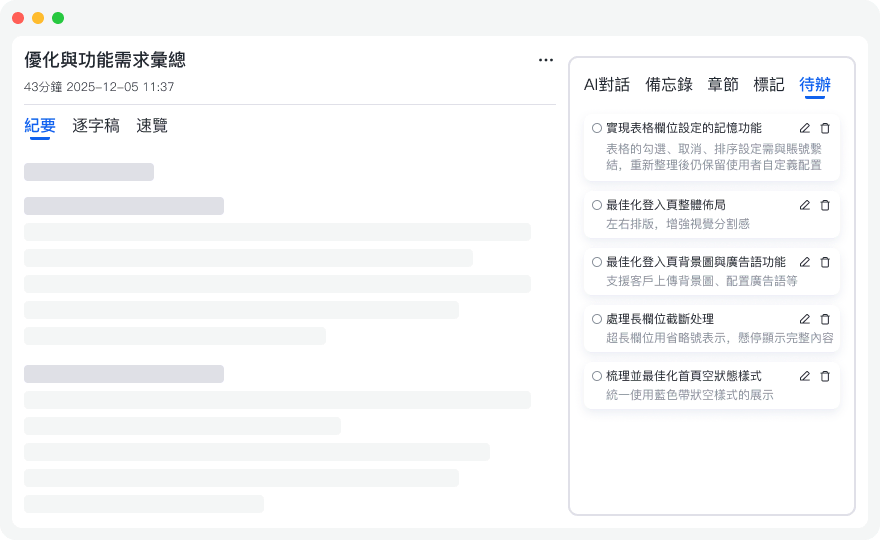
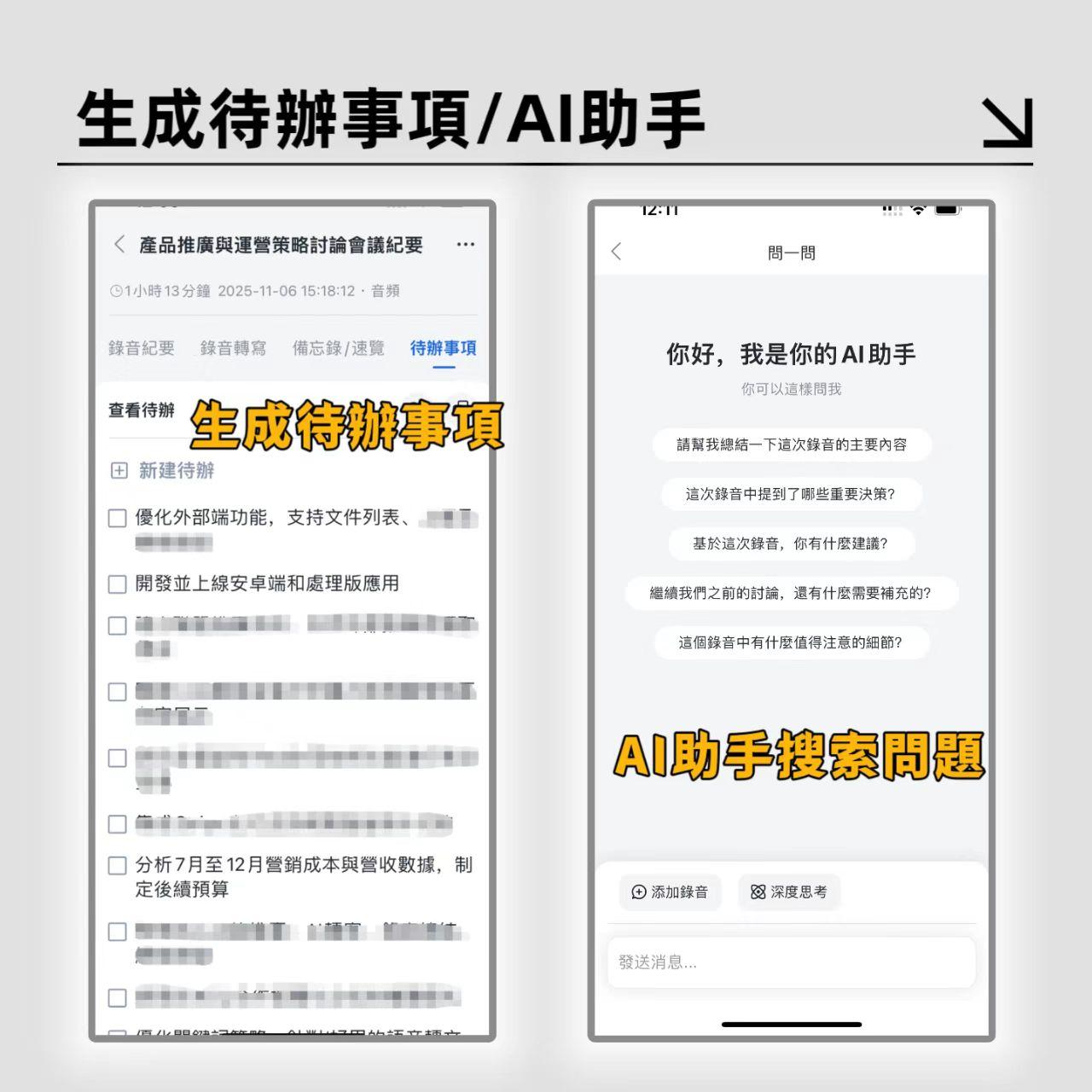
3. AI Conversational Query: Search Recordings Like Talking to Someone
Traditional tools only search by keywords (Ctrl+F), but what if you forget the exact phrase? Tinrec supports semantic AI Q&A. You can ask the chatbot directly: "What did David say about this project's budget?" and it will summarize relevant parts—extremely useful for long meetings or course reviews.
Practical Tutorial: How to Use Tinrec to Quickly Process Cantonese Meeting Notes
Here are the steps to turn a Cantonese meeting into key notes with Tinrec:
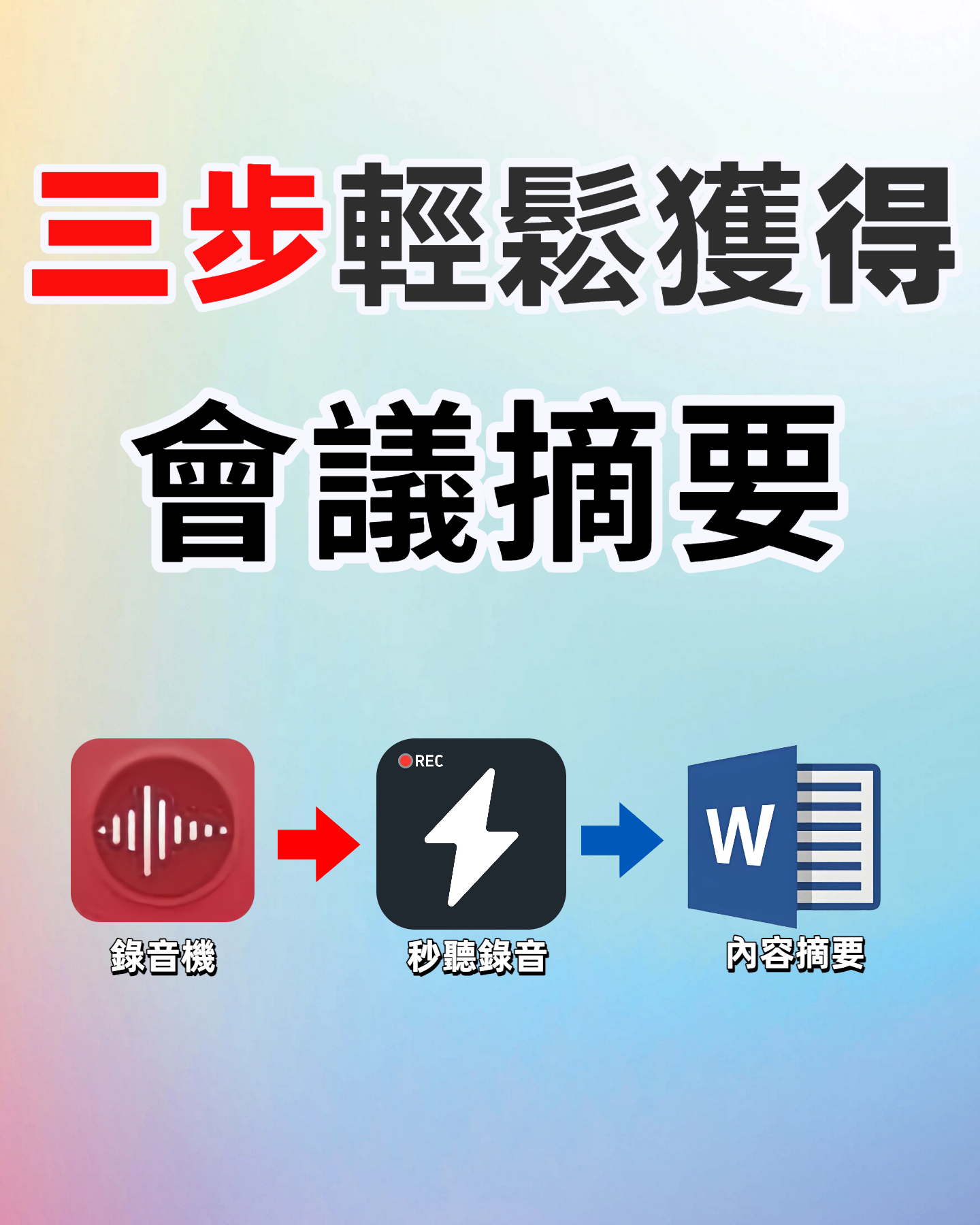
Step 1: Start Recording or Import File
- Live meeting: Open Tinrec app or web, choose "Record & Transcribe in Real Time," confirm language includes Cantonese. Tap start, and see text appear instantly.
- Existing file: If you already have an audio or video file, use "Audio File to Text" to upload. Even YouTube links can be parsed via "Podcast/Online Video to Text."
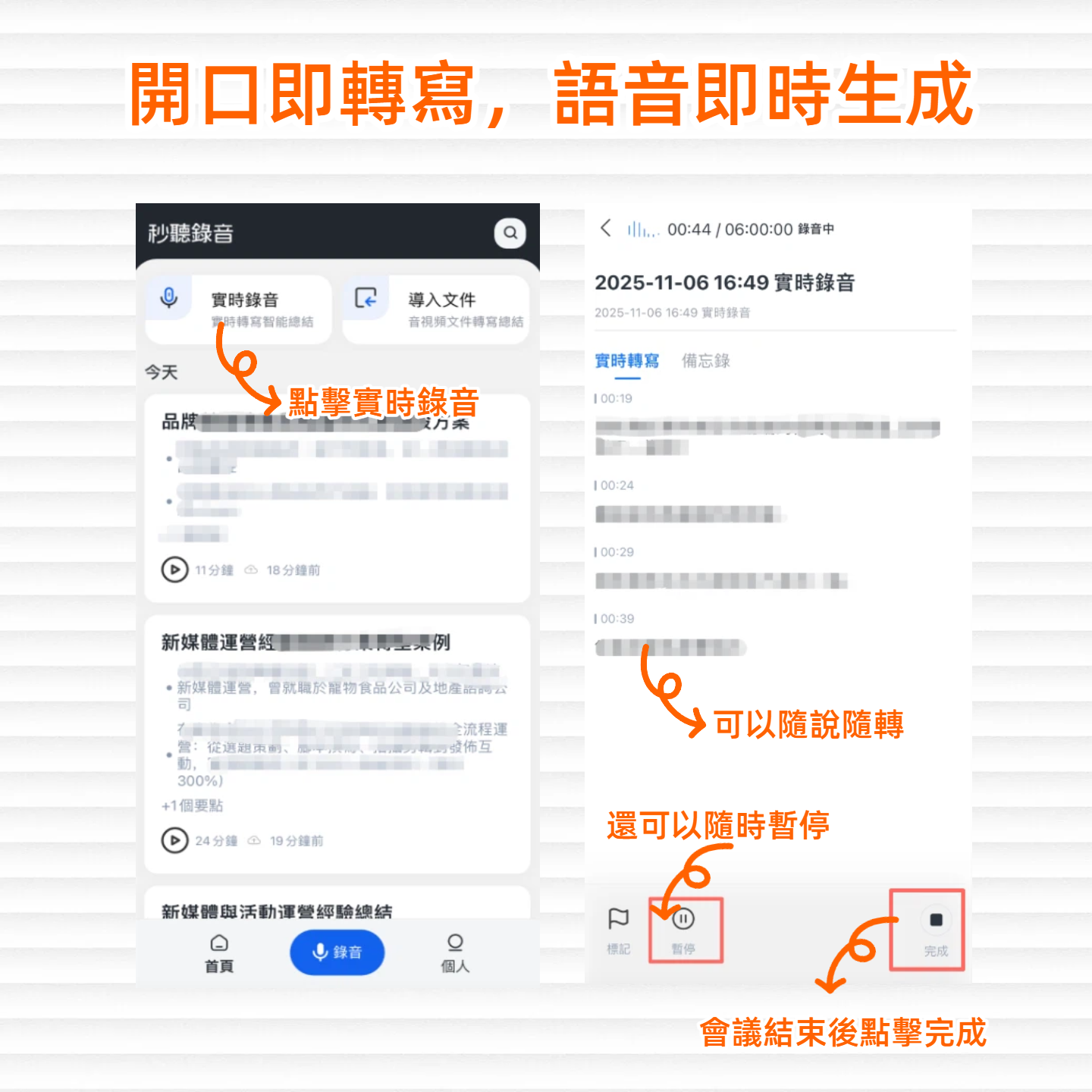
Step 2: Flag Key Points in Real Time
During recording, when hearing important decisions or data, tap the marker button. This leaves a timestamp mark for quick review later.
Step 3: Generate AI Summary & Action Items
After recording, the system processes automatically. Tap "AI Summary" button; within seconds, you get a complete note including summary, topic breakdown, and to-do list.
Step 4: Use AI Chat to Fill in Details
If the summary misses a detail (e.g., a supplier’s quote), no need to re-listen. Type in the AI chat box: "What was the supplier's quote?" AI immediately extracts the answer from the transcript.
Frequently Asked Questions
Q1: Is there a completely free Cantonese transcription software? Google Docs and Google Keep offer free voice input, but only suitable for short phrases and real-time dictation—no file upload, no speaker diarization. For long recordings, try Tinrec’s free plan (100 minutes/month) as an entry point.
Q2: What affects transcription accuracy? Background noise and distance from speaker are the biggest factors. Keep your device as close as possible. Though Tinrec has noise reduction, quiet environments yield the best recognition.
Q3: Can iPhone users use it? Yes. Tinrec supports iOS, Android, and Web, with data syncing. This solves the limitation of iPhone’s built-in voice memos (no direct text export).
Q4: What export formats are supported? Tinrec exports transcripts as TXT, Word, PDF, or subtitle files (SRT) for further editing or video subtitles.
Q5: Does it help convert colloquial to written Chinese? While Tinrec’s transcript is verbatim (including colloquial), the AI Summary function automatically converts colloquial discussion into formal, written meeting minutes, directly solving the manual rewriting problem.
Q6: Can I transcribe old recordings (mp3/m4a)? Yes. Tinrec’s "Audio File to Text" feature supports common formats; upload and get transcription and AI analysis.
Turn every recording into actionable outcomes
Get 60 free transcription minutes when you sign in. No credit card required.
Related Reading
You might also like

Best AI Office Tool Kits in 2026: We Tested 4, and This One Handles Chinese Meetings Best
Starting from the pain points of a mid-level manager juggling over a dozen meetings a week, we tested four AI office tool kits—Tinrec, Otter.ai, Notta, and Granola—comparing how they capture meetings, organize post-meeting notes, handle Chinese and mixed Chinese-English speech, manage team governance, and structure pricing. Here's how to pick the meeting notes tool that best fits teams in Taiwan.

Tinrec vs Good Tape 2026: 5-Dimension Comparison for Cantonese Speech-to-Text
Which Cantonese speech-to-text tool should you choose? This article compares Tinrec and Good Tape across 5 dimensions: Cantonese colloquial and mixed Chinese-English recognition, post-meeting organization, audio retention, multi-device use, and team collaboration. It also covers 6 options including Subanana, cSubtitle, Cantosub AI, and Speechnotes, with free quotas, paid plans, and selection advice.

2026 Comparison of 4 Cantonese Speech-to-Text Tools: Which Saves the Most Time for Mixed Chinese-English Meeting Notes?
The hardest part of Cantonese meetings isn't understanding the language—it's the mixed Chinese-English speech and the fact that no one can remember the decisions. This article starts with the key question of whether you need file transcription or live meeting transcription, and compares Tinrec, Notta, TurboScribe, and Granola based on real testing by a mid-level manager. It covers 4 key purchasing factors, 3 common pitfalls, and offers scenario-based tool recommendations.

2026 Cantonese Speech-to-Text Tools Buying Guide: 4 Hands-On Tests and Recommendations
Is Cantonese speech-to-text any good? First, figure out whether you need real-time meeting transcription or post-event file transcription. This article outlines 5 key buying criteria, hands-on tests Tinrec, Subanana, cSubtitle, and Otter.ai, and includes common pitfalls and scenario-based selection advice.
6 Cantonese Speech-to-Text Tools Tested for 2026: The Real Difference Is How Editable the Transcript Is
With Cantonese speech-to-text, most people get stuck not on whether it can transcribe, but on whether the resulting file can be edited. This article reviews 6 tools that handle Cantonese recordings—from AI meeting assistants to subtitle transcription to completely free options—comparing editing experience, export formats, free quotas, and pricing, with a scenario table to help you choose the right one for meetings, interviews, and video creation.

7 Cantonese Speech-to-Text Software Tested in 2026: Which One Really Understands Mixed Chinese-English?
Which Cantonese speech-to-text software is best? This article reviews 7 practical options in 2026, covering free quotas, pricing, and ideal users for both meeting transcription and file transcription types. It also answers common questions about converting spoken to written language, recording quality, and team permissions, helping you choose the right tool at once.

3 Cantonese Speech-to-Text Tools Tested for 2026: How to Choose for Spoken-to-Written Conversion & Translation
After transcribing Cantonese recordings, you still need to convert spoken language into written form, handle mixed Chinese-English content, and translate. This article uses Tinrec to demonstrate the complete workflow from recording, transcription, real-time translation to summaries and export, and outlines key considerations for choosing a tool: language support, translation methods, export formats, and team collaboration.

2026 Comparison of 5 Cantonese Speech-to-Text Tools: Can You Use the Transcripts Directly?
Cantonese speech-to-text is not just about turning audio into words—it's about turning a recording that you can understand but is hard to use into an editable, searchable, reusable transcript and subtitle file. This article starts with four common misconceptions and compares Tinrec, Subanana, UniScribe, cSubtitle, CantoSubAI, and SoundType AI in terms of output formats, free quotas, and use cases, helping you choose the right tool and avoid rework.

Tinrec vs Subanana 2026: 5-Dimension Comparison — Which Cantonese Audio-to-Text Tool Is Right for Hong Kong Office Workers?
Which Cantonese audio-to-text app works best? This article compares Tinrec and Subanana across 5 dimensions, tackling pain points like mixed Chinese-English, spoken-to-written conversion, post-meeting organization, and team collaboration. It also covers alternatives like Notely Voice and iPhone's built-in transcription, plus 4 common pitfalls to help Hong Kong office workers choose the right tool in one go.