
Turn recordings into transcripts and summaries in minutes
Upload audio or video for multilingual transcription, AI notes, and action items
Have you ever experienced that frustrating moment: after a one-hour meeting, you spend another two hours re-listening to the recording to extract key points? Or in class or an interview, you miss critical information because you can't type fast enough?
According to IDC's artificial intelligence application report, the demand for speech transcription is growing at 25% annually, making "speech-to-text" a must-have for the workplace and learning. From built-in voice memos on phones to professional AI transcription services, there's a dazzling array of tools—so how do you choose?

This article will evaluate six notable voice-to-text tools (including iFlytek, Tinrec, and Google) based on dimensions like "recognition accuracy," "multilingual support," and "AI summary capabilities." We'll also include a detailed comparison table and step-by-step tutorials.
Quick Navigation / Bottom Line:
- If you prioritize top-tier Chinese/dialect recognition: Go with iFlytek (an established player supporting multiple dialects).
- If you value "post-meeting action" and "AI conversational queries": Try Tinrec (designed to extract to-dos and decision summaries from recordings).
- If you only need simple short-phrase input: Your phone's built-in tool or Google Voice Input will suffice.
Why Do You Need an "AI Speech-to-Text" Tool? Pain Points of Traditional Recording
Before choosing a tool, we need to understand why traditional voice recorders or phone recordings aren't enough. Plain audio files suffer from three major flaws in information management:
- Extremely low information density: A 60-minute audio file can't be "scanned" for key points like text—you have to play it linearly, making replaying costly.
- No content searchability: You can't Ctrl+F to search for a keyword in audio, making it hard to find "who said what and when" when reviewing.
- Lack of action orientation: Audio recordings are raw material, not decision-making aids. Without transcription and summarization, they often become dead files taking up storage space.
Therefore, modern high-performers don't just need a "recording app"—they need an AI assistant that converts sound into searchable, editable, actionable text.
In-Depth Comparison of Popular Voice Memo-to-Text Apps in 2026
Based on market presence and feature completeness, we selected representative tools for a side-by-side comparison. The table below summarizes their core differences:
| Tool | Core Positioning | Language Support | Real-Time Transcription | AI Summaries/Action Items | Best For |
|---|---|---|---|---|---|
| Tinrec (Ting Recorder) | Meeting minutes & action management | 10+ languages (incl. Chinese, English, Japanese, Korean, Taiwanese) | Yes | Yes (incl. task extraction, AI Q&A) | Multilingual meetings, class notes, long interviews |
| iFlytek | Professional transcription | Multiple languages and 12 dialects | Yes | Yes (meeting minutes) | Government/corporate users and journalists needing high accuracy |
| Google Voice Input | Lightweight voice input | Multiple languages (Google engine) | Yes | No (plain text only) | Daily texts, short notes |
| Sogou Recorder Assistant | Interview & writing assistant | Primarily Chinese | Yes | Basic transcription | Journalist interviews, student quick notes |
| Otter.ai | English meeting specialist | Primarily English | Yes | Yes | English-only work environments |
Key Tool Analysis
1. iFlytek: The Benchmark for Chinese Recognition
As a product of iFLYTEK, iFlytek boasts deep technical expertise in Chinese speech recognition. According to relevant benchmarks, its Mandarin recognition accuracy can reach 98%, and it supports multiple dialects. For users handling many formal meetings with high precision demands (e.g., legal, government), iFlytek is a solid choice.
Stop organizing recordings by hand
Upload audio or video and automatically get a transcript, summary, and action items
2. Tinrec (Ting Recorder): More Than Transcription, Focused on "Understanding"
Tinrec's design philosophy differs slightly from traditional transcription tools. It doesn't just convert speech to text but emphasizes the "usability" after processing. Its core differentiator is powerful AI analytics that automatically distinguish speakers, generate chapter summaries, and extract "action items"—solving the problem of "having a transcript but no conclusion." Additionally, it supports 10 languages including Taiwanese and Cantonese, making it suitable for users in Taiwan.
3. Google / Apple Built-In Tools
For zero budget or light users, Google Docs voice typing or iOS Voice Memos are great entry-level options. Pros: completely free and readily available. Cons: cannot handle structured organization of long recordings and lack AI summarization features.
Tinrec In-Depth: A Complete Workflow from Recording to Action
Among the many tools, Tinrec aims to solve the problem of "post-recording processing efficiency." Here are some key features of the tool in an actual workflow:
1. Beyond Keyword Search: "AI Conversational Query"
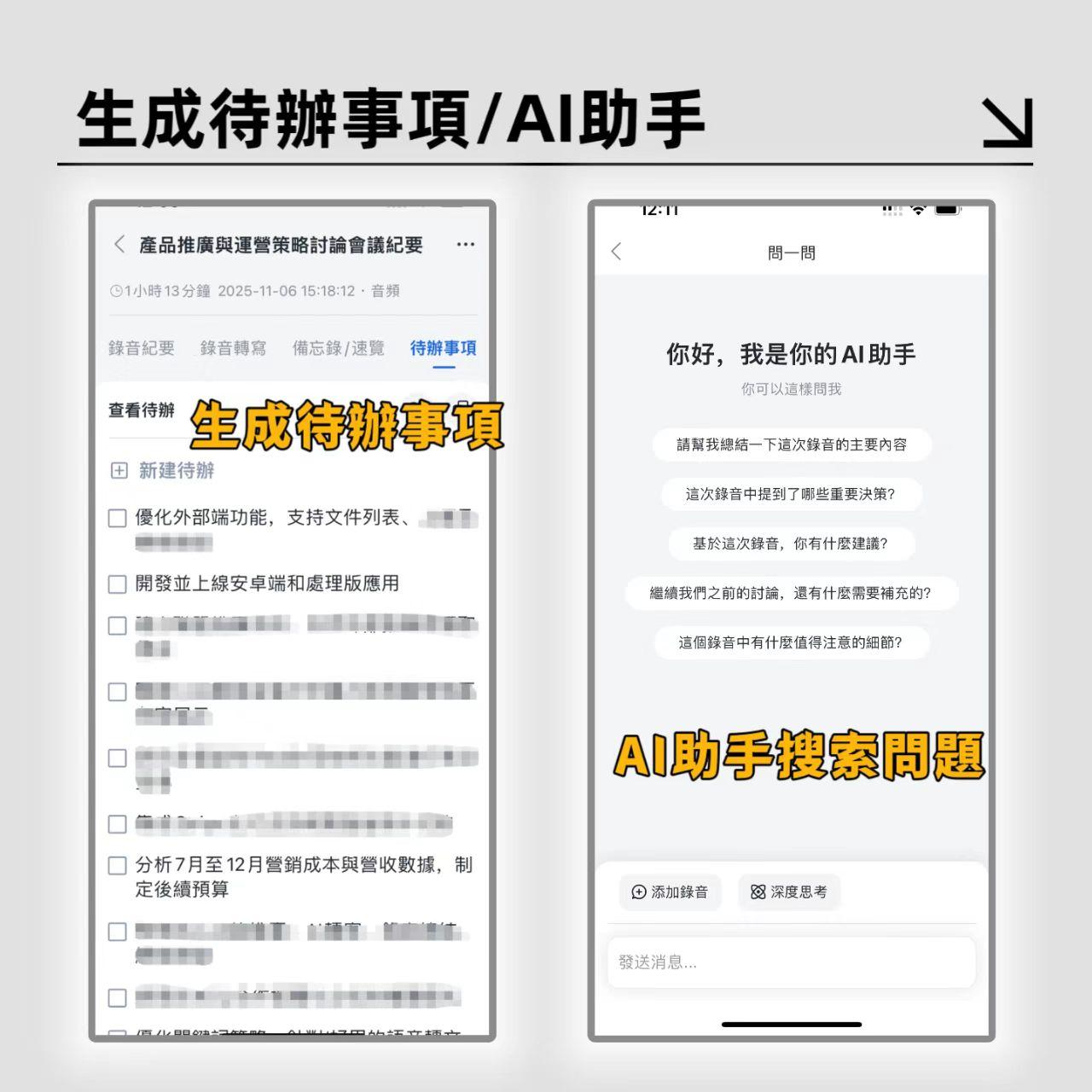
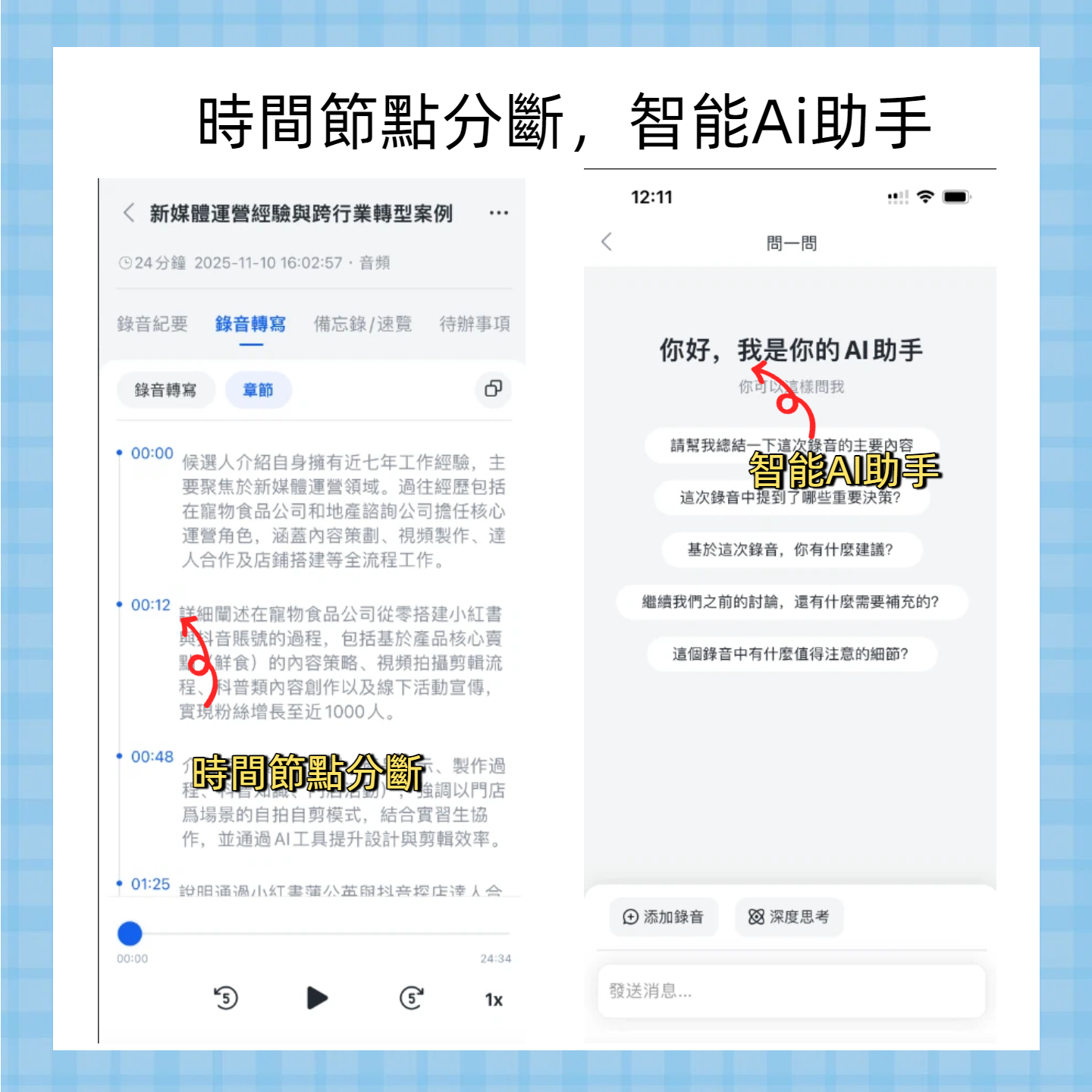
Traditional transcripts only allow users to search for specific keywords, making it hard to find content if you forget the exact wording. Tinrec features a semantic AI conversational query (Chat with Audio) function. You can "ask" your recording as if talking to a person, e.g., "What was the conclusion about the marketing budget in this meeting?" or "What tasks were assigned to David?" The AI answers based on the recording content and cites the source.
2. Automated Meeting Summaries and Action Item Extraction
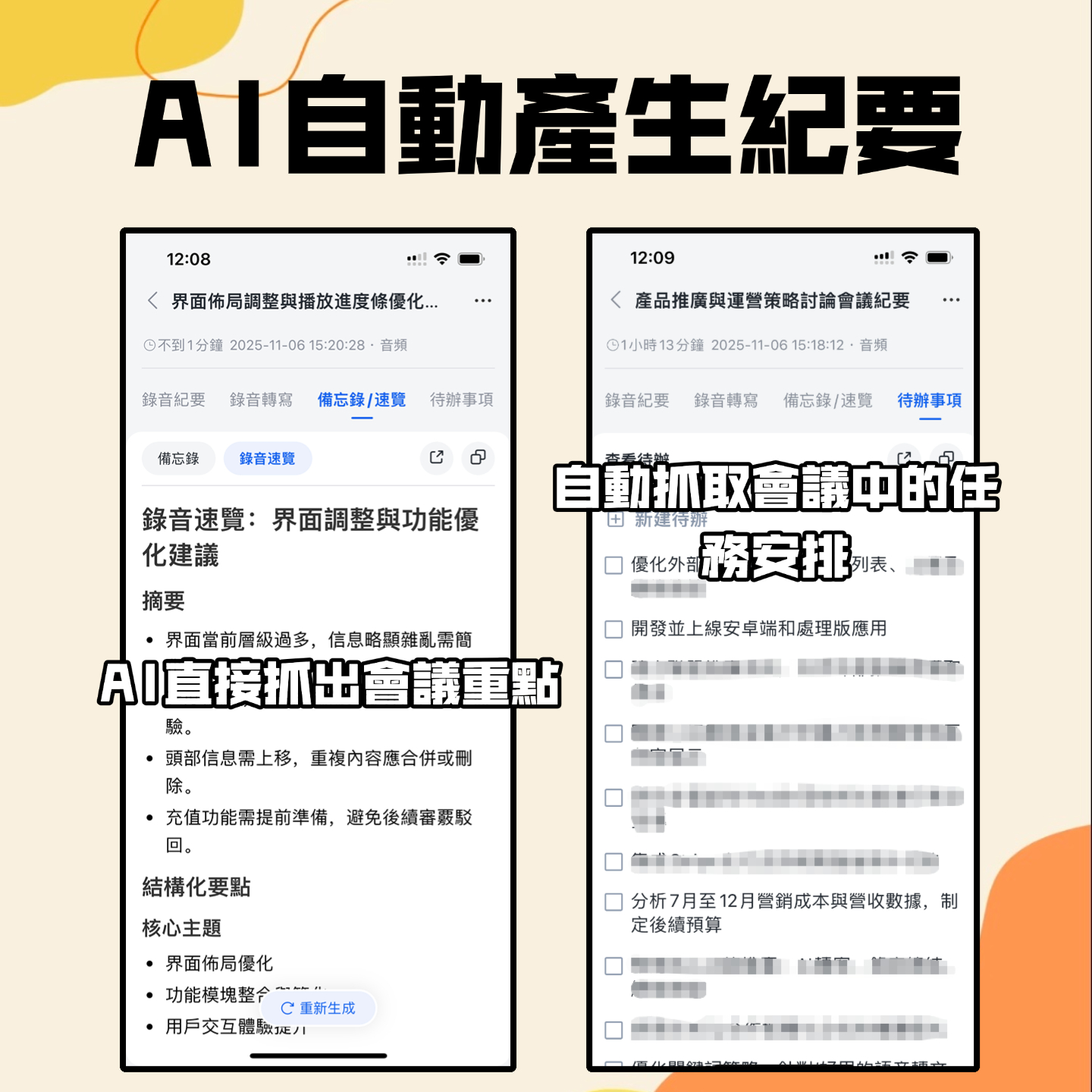
For lengthy meetings, Tinrec automatically generates structured notes including:
- Summary: Quick overview of the meeting.
- Chapter segmentation: Auto-splits by topic.
- To-do list: Automatically captures phrases like "complete by next Wednesday" or "please contact the vendor" and compiles them into a to-do list.
3. Multiple Input Types and Multi-Platform Support
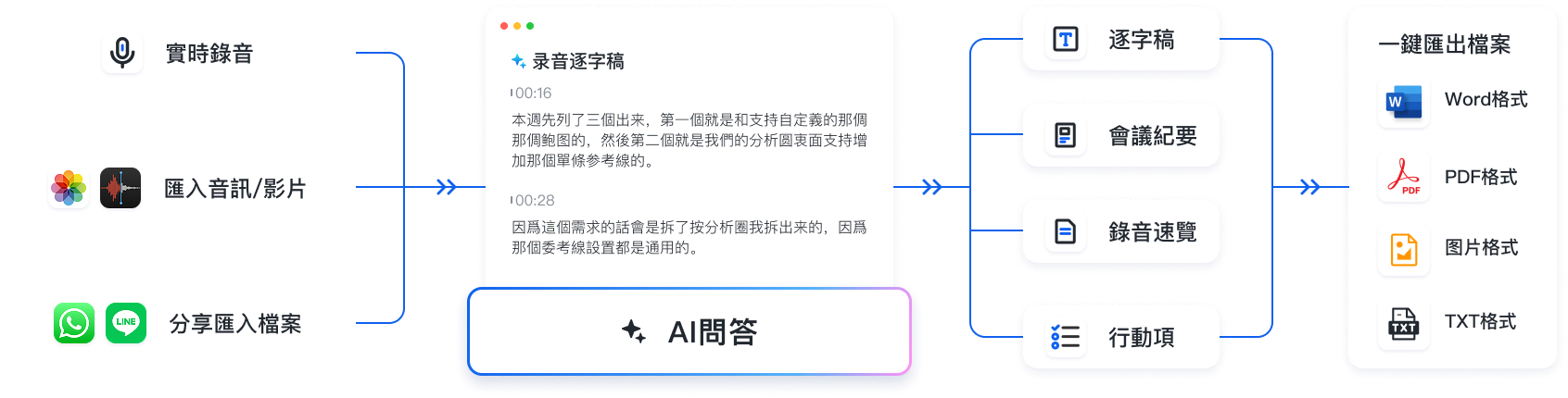
Beyond live recording, it also supports uploading audio/video files or pasting YouTube/Podcast links for transcription. This is especially convenient for content creators needing to transcribe online courses or competitor video analyses. The tool supports iOS, Android, and Web versions with cloud sync.
Step-by-Step Guide: How to Efficiently Convert Voice Memos to Text
Below, using Tinrec as an example, we demonstrate how to turn a messy meeting recording into a clear action plan:
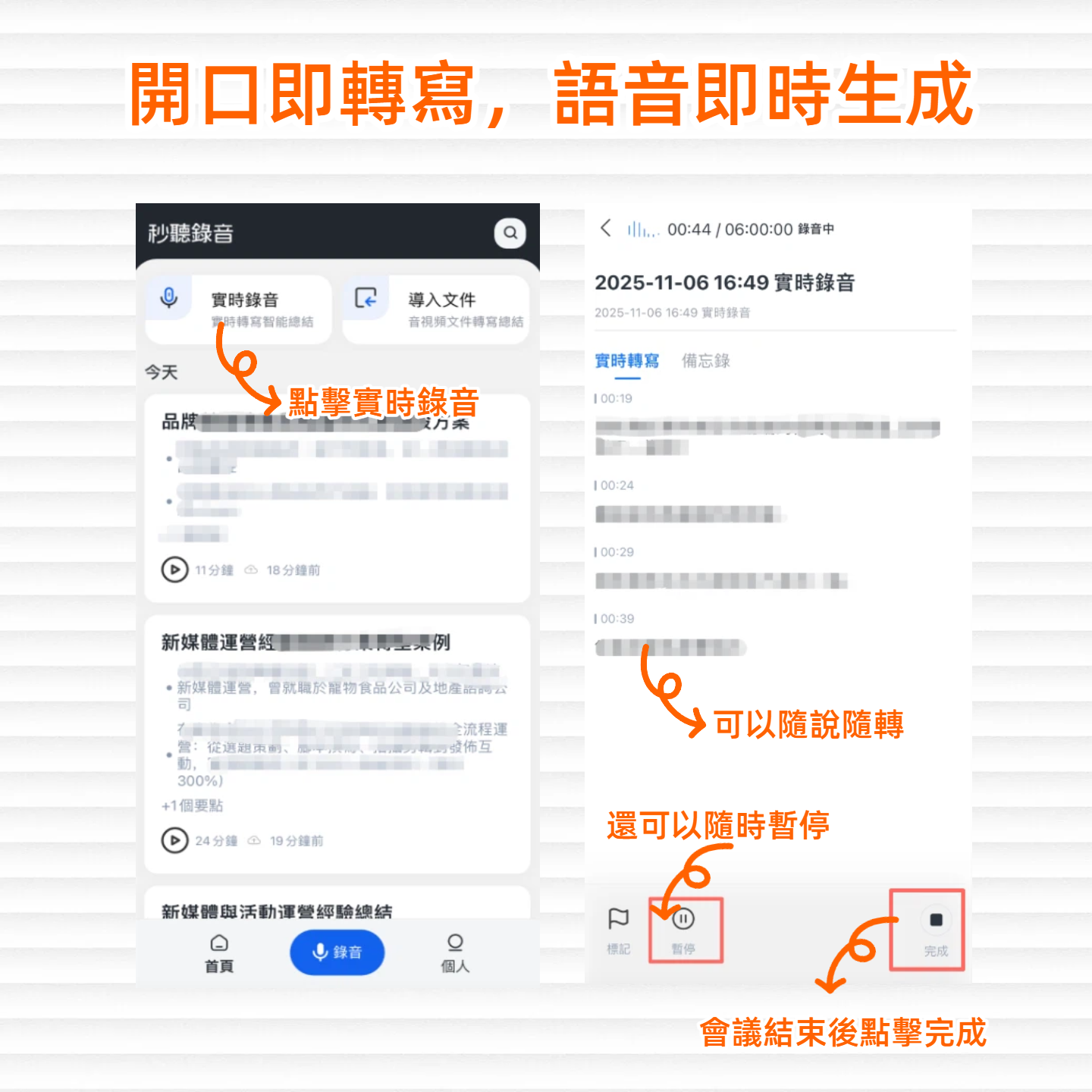
Step 1: Start Recording or Import a File
- Real-time recording: Open the app or web version, tap "Record & Transcribe in Real Time." Ideal for meetings or classes; the transcript appears instantly.
- Import a file: If you recorded audio using an iPhone Voice Memo, export the file (supports mp3, m4a, wav, etc.) and upload it via the "Audio File Transcription" feature.

Step 2: Speaker Diarization and Language Settings
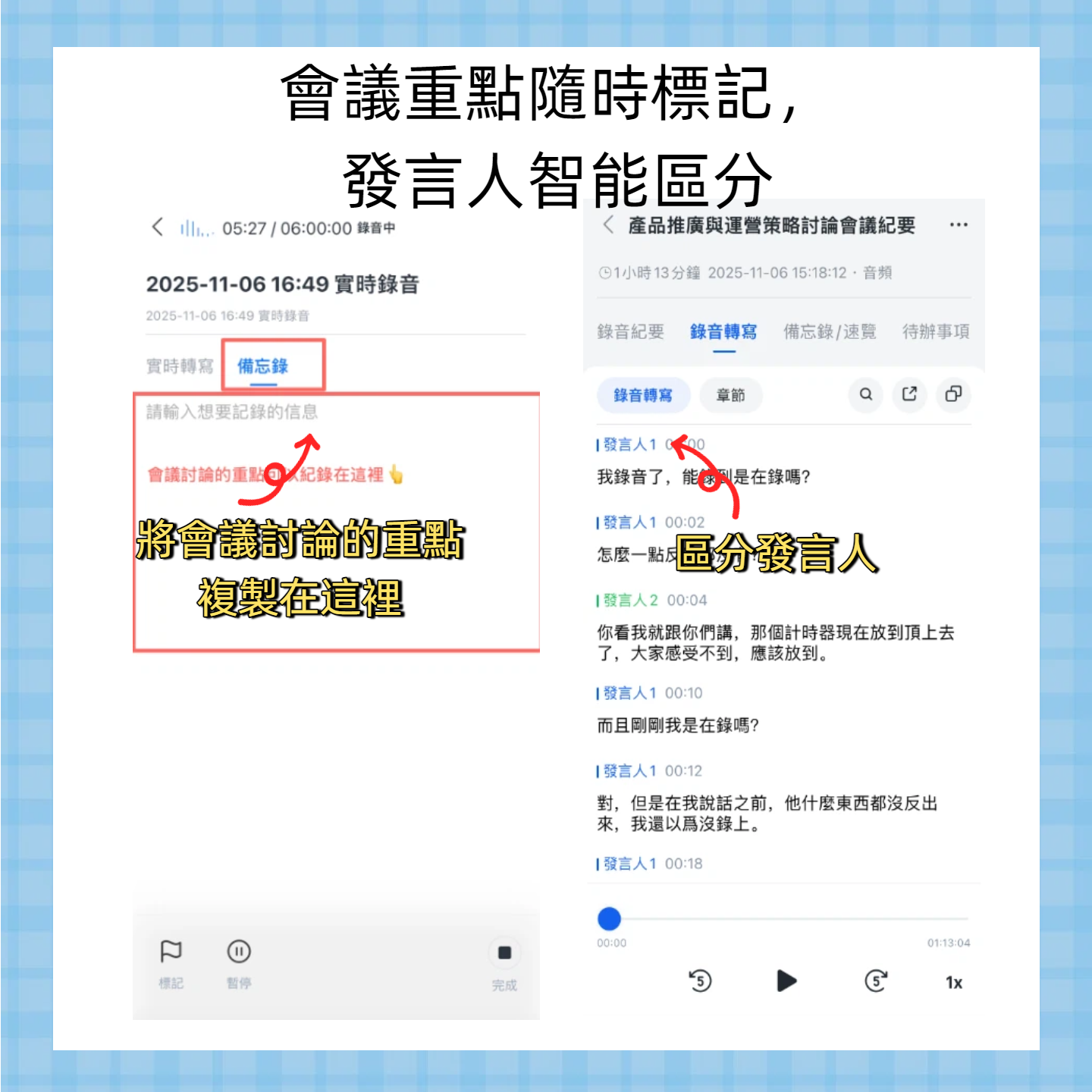
When uploading or recording, ensure you select the correct language (e.g., Traditional Chinese). If multiple people speak in the meeting, Tinrec automatically performs voice recognition to separate different speakers' content for easier reading.
Step 3: Use AI to Organize Content
After transcription, don't just read the raw transcript. Click the "AI Summary" button to let the system generate a meeting summary. If you need to check a specific topic, use the chat box on the right to ask questions, e.g., "What exam key points were mentioned in this class?"
Step 4: Export and Share
Once you're satisfied, export the organized notes as Word, PDF, or TXT, or copy the to-do items directly into your project management software.
Frequently Asked Questions (FAQ)
Q1: Can the built-in Voice Memos on iPhone directly transcribe to text?
Apple has enhanced speech-to-text in newer iOS versions, but it's usually limited to real-time dictation or short clips. To transcribe an hour-long old recording, you typically need to share it to a dedicated app like Tinrec or iFlytek for processing.
Q2: How much free transcription time do voice-to-text apps typically offer?
It varies. For example, Tinrec offers a free plan with up to 100 minutes of transcription per month, which is sufficient for occasional meeting needs. For heavier usage, paid plans (e.g., Basic at 600 minutes per month) are available.
Q3: Does noisy environment affect accuracy?
Absolutely. Although modern AI has noise reduction, excessive background noise or echo can significantly reduce recognition accuracy. When recording, try to get close to the sound source or use a directional microphone.
Q4: Do these tools support Teams or Google Meet recordings?
Yes. As long as you have the meeting recording file (mp4) or pure audio file (mp3), you can upload it via the "Import File" feature for transcription and summarization.
Q5: Are there privacy concerns with sensitive meetings?
Choosing reputable and compliant tools is important. Professional tools typically use encryption for transmission and storage. Before use, review the service's privacy policy to confirm that data is only used for generating your personal output.
Q6: Can they recognize mixed Taiwanese and English content?
Top tools today generally support Chinese-English mixed recognition. Tinrec explicitly supports Taiwanese, Cantonese, and other dialects, making it well-suited for local communication scenarios in Taiwan.
Turn every recording into actionable outcomes
Get 60 free transcription minutes when you sign in. No credit card required.
Related Reading
You might also like

How to Choose the Best Recording-to-Text Tool in 2026: A Complete Guide from Transcripts to Actionable Meeting Minutes
This article compares the leading recording-to-text tools in 2026, covering capture methods, Chinese language support, post-meeting outputs, and team collaboration. It helps sales, business, and product development professionals select the most suitable tool based on meeting type and team size, and master the complete workflow from recording to actionable meeting minutes.
Which Speech-to-Text Tool Is Easiest to Learn? Choosing the Most Beginner-Friendly Option Based on Learning Cost
Looking for an easy-to-learn speech-to-text tool? This article starts from learning cost, compares the ease of learning of mainstream tools, breaks down the key steps to get started quickly, and provides recommendations for different groups such as sales, product R&D, and government employees, helping you learn and start using a tool in the least amount of time.

How to Choose the Best Recording-to-Text Tool in 2025: From Transcripts to Actionable Meeting Minutes
Meeting recording-to-text tools are no longer just about transcription. This article compares Tinrec, Otter, Fireflies, Notta, Granola, and other mainstream tools in terms of capture methods, Chinese language support, and post-meeting outputs, and explains how to generate action items from transcripts and build team knowledge, helping you choose the right tool for your meeting scenarios.

2026 Free Speech-to-Text Solutions: 5 Tools Compared
PTT hotly discusses speech-to-text apps. We tested Tinrec and 4 other tools, comparing free quotas, Cantonese accuracy, and AI features to help you save time on meeting notes.

4 Best Recording-to-Text Tools in 2026: How to Choose Based on Free Credits and AI Features
We tested the latest 4 recording-to-text tools in 2026, from free credits to AI Q&A and bot-free recording, to help you find the most time-saving option.

Tinrec vs Otter.ai in 2026: A 5-Dimension Comparison for Chinese Users
We tested Tinrec and Otter.ai for Chinese meetings, bot-free recording, AI Q&A, cross-platform support, and team collaboration to help you choose the right transcription tool and save overtime hours.

5 Best Recording-to-Text Tools in 2026 Compared: Tinrec vs MyEdit, Yating, and More
After testing multiple free recording-to-text tools, here's why Tinrec became my go-to for meeting notes from a mid-level manager's perspective—and whether the free plan is enough.

4 Best Speech-to-Text Tools in 2026: Free vs Paid Compared for US Users
We tested the most talked-about speech-to-text tools on Dcard and PTT, from free to paid, comparing Tinrec, Yating, Otter.ai, and Notta on features, pricing, and use cases to help you find the time-saving choice.

5 Best Speech-to-Text Tools Tested in 2025: AI Transcripts & Meeting Notes Compared
With countless speech-to-text tools available, this article tests Tinrec, MyEdit, SoundType AI, iPhone Voice Memos, and OpenAI Whisper across three dimensions—Traditional Chinese recognition, recording sources, and post-processing—to help you choose the right one for your needs.