
Turn recordings into transcripts and summaries in minutes
Upload audio or video for multilingual transcription, AI notes, and action items
Have you ever frantically recorded lectures in class, only to end up with dozens of hours of audio files that you can't bear to re-listen to during finals? Or tried using your phone's built-in recorder, only to find too much background noise and the teacher's key points unintelligible?
This isn't just a tool problem—it's a gap in the information processing pipeline. The real solution isn't just capturing audio, but being able to quickly convert sound into searchable, readable knowledge. This article highlights the top 6 AI recording and note-taking tools for students and educational settings in 2026, evaluating them on three dimensions: Traditional Chinese recognition accuracy, summarization capabilities, and suitable use cases.
Quick Selection Guide:
- If you need to process extra-long seminar recordings: Choose Google NotebookLM first.
- If you're used to typing notes while recording: Evernote remains a classic choice.
- If you need to directly extract key points and action items from recordings: Tinrec is the most efficient integrated solution.
Why Traditional Voice Recorders No Longer Fit Modern Classrooms?
We used to rely on hardware recorders or simple recording apps, but these methods have clear pain points when facing high-density knowledge delivery (e.g., university lectures, cram school courses):
- High review cost: An hour of class can take two hours to review and organize.
- Difficult information retrieval: You can't search for a keyword the teacher said using
Ctrl+Flike you can with text. - Lack of structure: Audio files are just a stream of consciousness with no highlighting or chapter divisions.
With AI technology maturing, current tools have evolved into an all-in-one process of "recording → transcript → AI summary → knowledge base," which is key to improving study efficiency.
In-Depth Analysis of Popular Classroom Recording Tools in 2026
Based on hands-on testing and user experience, here is an analysis of tools for different learning scenarios:
1. Wispr Flow: The Ultimate Tool for Real-Time Voice Input
Best for: Writing papers, voice diaries, short reports
Wispr Flow excels at recognizing and correcting Traditional Chinese. It's more like a "real-time voice input method" that can type text into any app. It's very convenient for students who prefer dictation.
- Pros: High accuracy for Traditional Chinese, automatically smooths grammar, supports custom dictionaries (to fix specialized terms).
- Limitations: As of late 2025, no Android app is available; its design is geared toward "dictate as you go," making it less suitable for processing hours of passive recordings.
2. NotebookLM: Long-Form Research and Knowledge Base Organization
Best for: Final exam review, organizing semester-long recordings, seminars
Google's NotebookLM is a powerhouse for handling "very long recordings." You can dump multiple recordings and PDF handouts into it, and let AI become your tutor.
- Pros: Can handle extremely long audio content; can combine handouts for comprehensive answers; doesn't cut off due to length.
- Limitations: Does not support live transcription; workflow is more cumbersome (must record then upload); mobile experience is less intuitive than dedicated apps.
3. Tinrec: The All-Round Classroom Recording Assistant
Best for: Live classroom recording, online course note-taking, key point summarization
Tinrec is designed to bridge the gap between "recording and action." For students, it not only provides transcripts but also automatically generates "class summaries" and "to-dos" (e.g., homework deadlines), and supports multi-device sync.
- Pros:
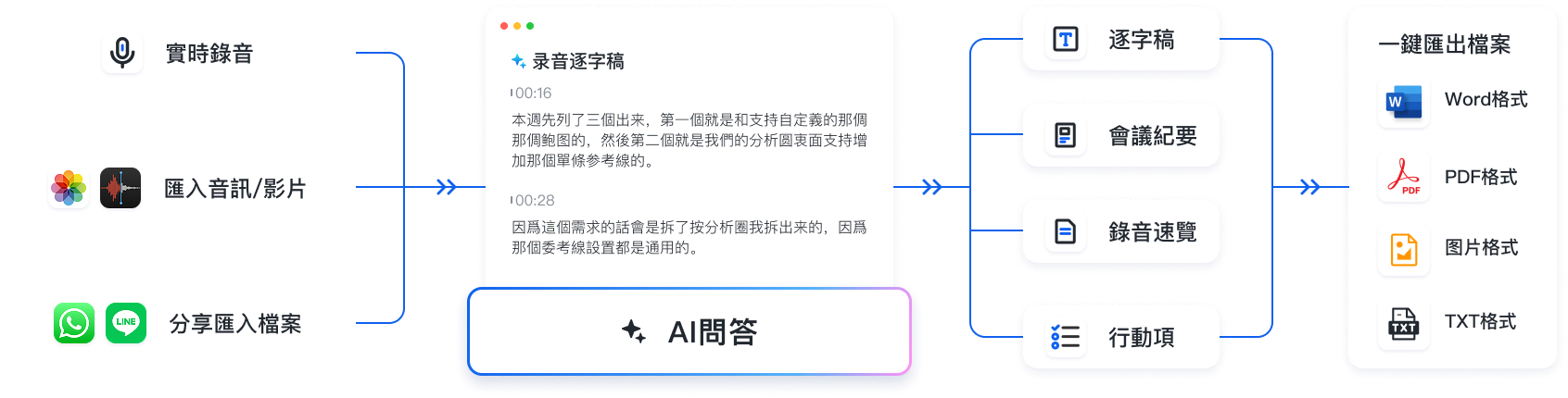
- Complete workflow: Supports real-time transcription during recording and uploading recordings afterward.
- Multi-language support: Automatically detects and transcribes foreign languages (English, Japanese, Korean, etc.) used in class.
- AI Chat Query: Extremely useful for review—you can ask AI, "What were the key exam points mentioned around 20 minutes?" and it will answer based on the content.
- Limitations: The free plan has a monthly recording limit (100 minutes); heavy users may need a subscription.
Stop organizing recordings by hand
Upload audio or video and automatically get a transcript, summary, and action items
4. Evernote: The Veteran for Syncing Notes and Recordings
Best for: Those who prefer handwriting or typing notes but want audio backup
Evernote is ideal for people who "take their own notes" but worry about missing details. You can type notes while simultaneously recording.
- Pros: Notes and recordings are stored in the same note for easy management; AI cleanup can segment and polish.
- Limitations: Transcription is usually post-processed, and Traditional Chinese is occasionally mistaken for Simplified Chinese; transcription wait times are long for recordings over an hour.
5. Google Live Transcribe (Android)
Best for: Hearing assistance, real-time caption viewing
This is a built-in (or free download) tool for Android phones, focused on real-time capability.
- Pros: Completely free, transcribes as you record, works for long periods without interruption.
- Limitations: Designed for "real-time communication," so the transcript has little polish, is harder to use for AI summarization, and has a relatively higher error rate for Traditional Chinese character selection.
Tool Feature Comparison Table
For a more intuitive comparison, here's a table of core dimensions:
| Dimension | Tinrec | NotebookLM | Wispr Flow | Evernote | Google Live Transcribe |
|---|---|---|---|---|---|
| Primary Focus | Recording + AI Summary + Action Items | Knowledge Base Q&A | Real-Time Voice Input | Notes + Audio Backup | Live Captions |
| Live Transcription | Yes (App/Web) | No (must upload) | Yes (Mac/iOS) | Yes (post-recording) | Yes (Android) |
| AI Summary | Auto-generates briefs & action items | Strong (needs prompts) | Auto-polishes text | Strong (AI cleanup) | None |
| Language Support | 10+ languages including Chinese, English, Japanese, Korean | Multi-language | Multi-language (excellent Traditional Chinese) | Multi-language | Multi-language |
| Special Features | Video link transcription, AI chat | Integrates PDF handouts | Cross-app input | Note integration | Sound event detection |
| Best For | Full lecture/meeting records | Final review/deep study | Dictation writing | Traditional note-taking aid | Immediate transcription |
Practical Guide: How to Build an Efficient "Recording to Notes" Workflow
Once you have the tools, you need a standard operating procedure (SOP) to maximize learning efficiency. Here's an example using Tinrec to condense a 2-hour class into a 15-minute summary.
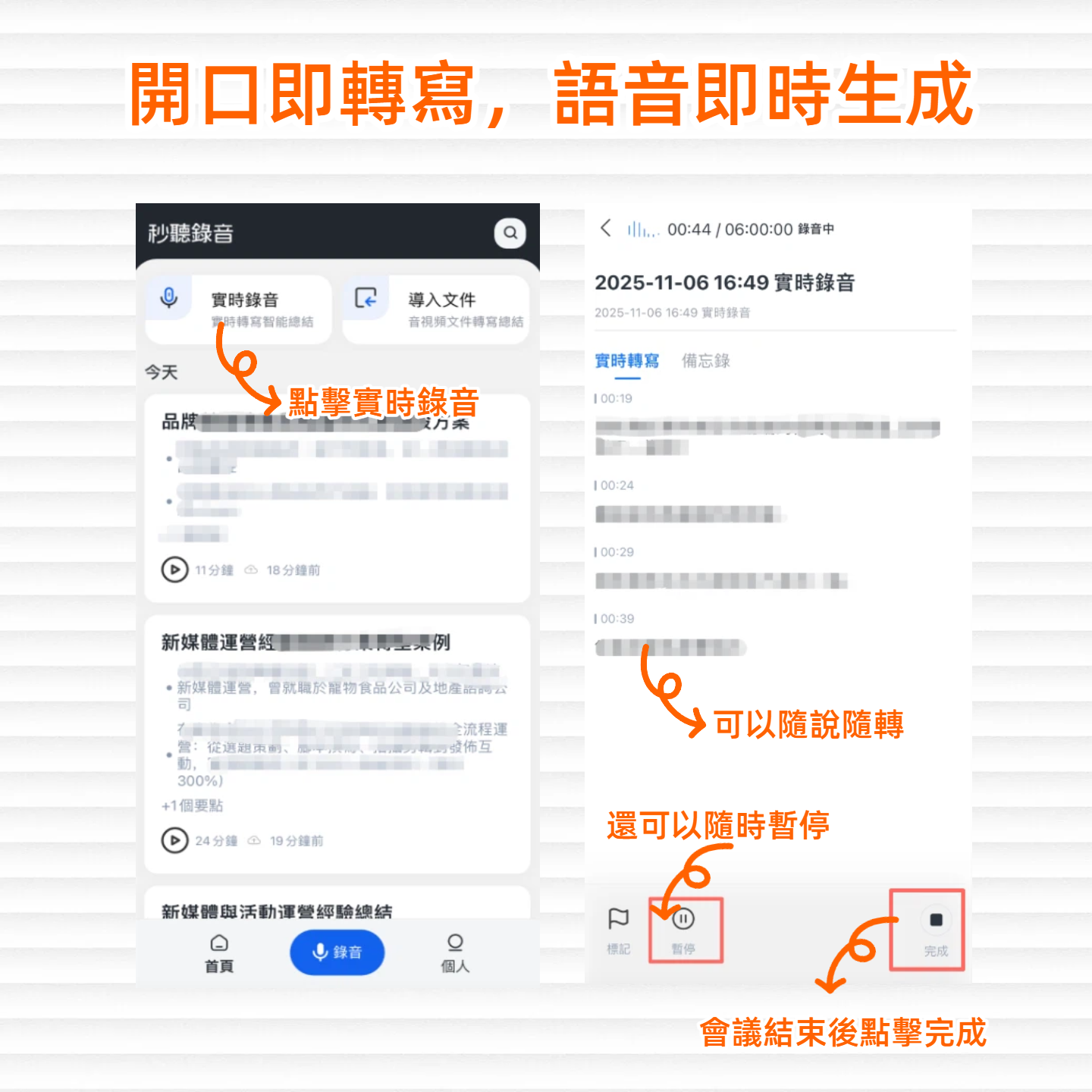
Step 1: Live Recording and Marking in Class
Open the app and start recording at the beginning of class. Unlike traditional recorders, Tinrec displays real-time transcripts. If the teacher highlights something important, note the timestamp.
Step 2: Import Supplementary Materials
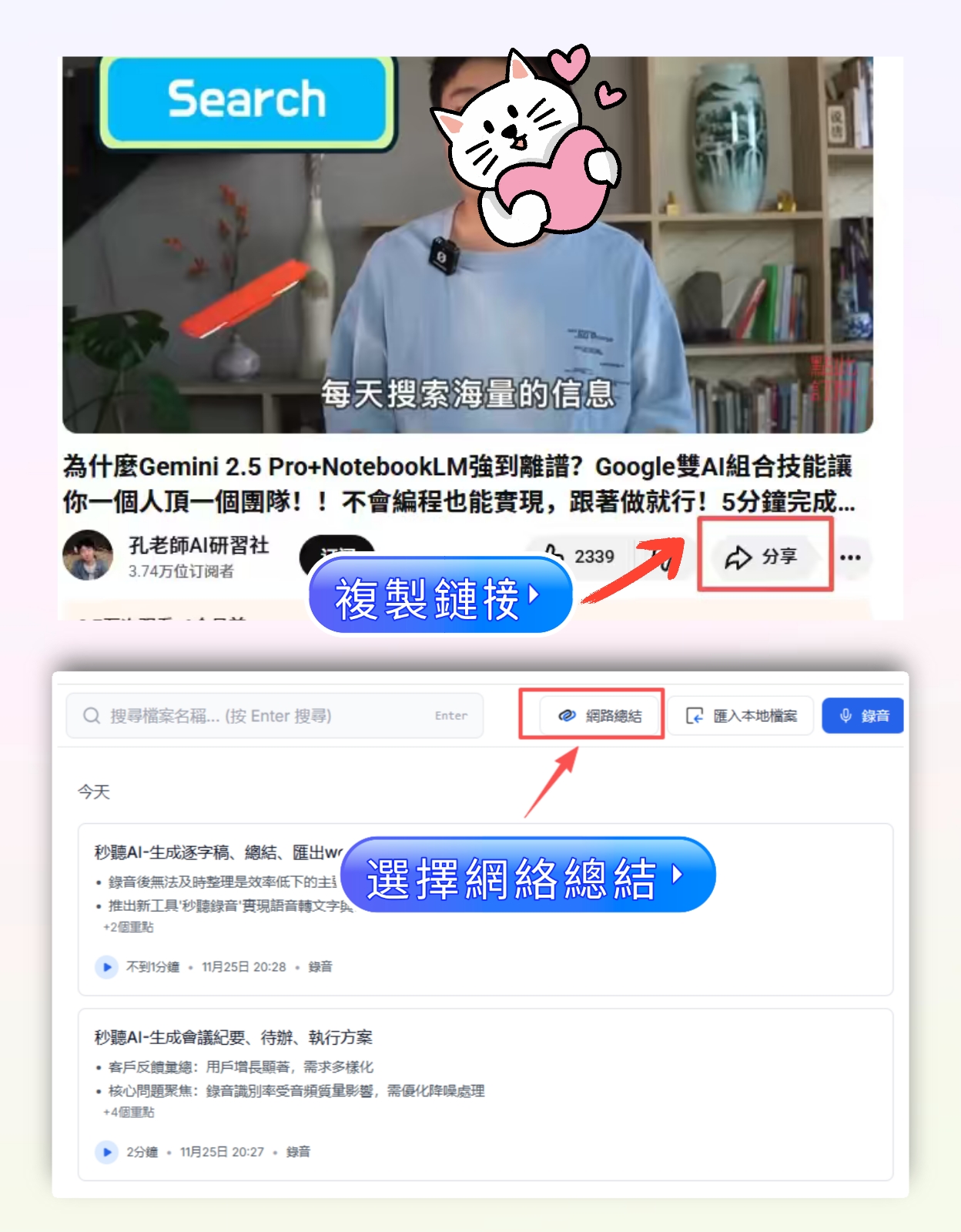
If the teacher provides online video links (e.g., YouTube supplements) or pre-recorded audio, use the "audio/video file to text" or "link parsing" feature to convert these materials into text files and manage them centrally.
Step 3: Extract Action Items and Exam Points with AI
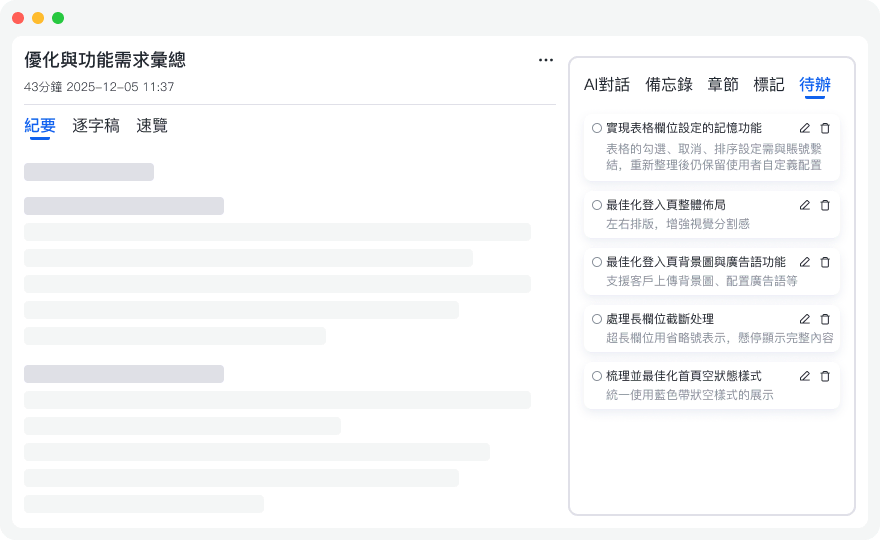
No need to re-listen to the two-hour recording after class. Check the AI-generated "meeting summary" and "action items." In a classroom context, these action items are often "assignment deadlines," "exam scope," or "must-know topics."
Step 4: Use "AI Chat" for Unclear Concepts
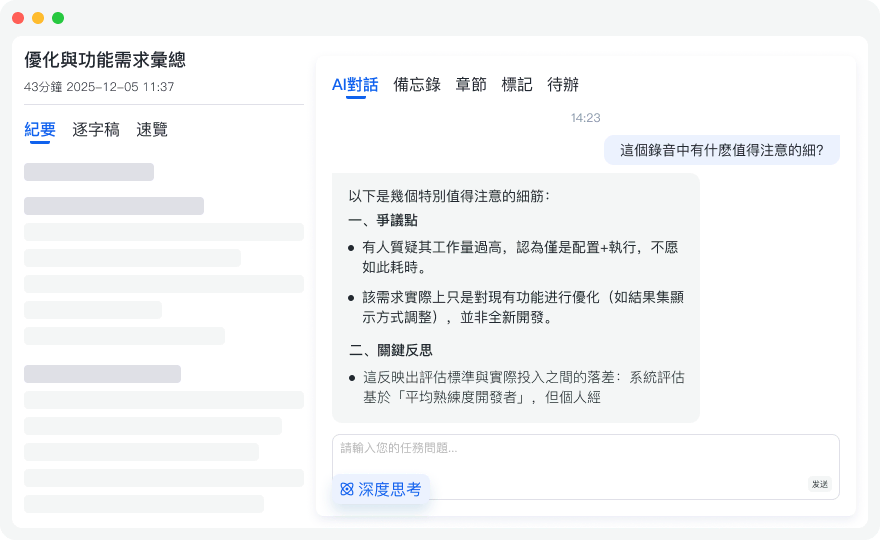
This is the most critical step. Instead of flipping through books, use the "AI chat query" feature. Ask: "What is the definition of 'macroeconomics' in this recording?" The system will accurately answer based on the recording, like having a personal teaching assistant.
FAQ
Q1: Will the recording on iPhone be interrupted by incoming calls?
Most professional recording apps (e.g., Tinrec, Evernote) can usually continue recording in the background, but we recommend enabling Airplane Mode or Do Not Disturb during class to ensure clean audio without interruptions.
Q2: Do these tools support recording remote classes on Line or Teams?
For computer-based classes, Windows 11's built-in recorder or Tinrec's web version can capture system audio. For mobile devices, due to system privacy restrictions, it's usually not possible to record audio from calling apps directly. Use a second device or a tool that supports system audio recording on a computer.
Q3: Is the recognition accuracy for Traditional Chinese high enough, or does it require heavy manual editing?
Current AI models (e.g., Whisper and its variants) achieve over 95% accuracy for Traditional Chinese. Errors mainly occur with mixed Chinese-English content or specific academic jargon. Tools with custom dictionary features can help mitigate this.
Q4: What are the typical limitations of free versions?
Most tools (e.g., Tinrec, Otter.ai) use a freemium model, usually limiting monthly recording minutes (e.g., 60–100 minutes) or recording length. Google Live Transcribe is completely free but offers fewer features.
Q5: Should I keep the original audio files after transcription?
We strongly recommend keeping them. While text is convenient, tone, pauses, and emotion cannot be fully conveyed by text. Quality tools like NotebookLM and Tinrec support clicking on text to jump to the corresponding audio timestamp, making it easy to verify the original meaning.
Q6: Can I directly convert YouTube instructional videos into notes?
Yes. Tools like Tinrec or specific Chrome extensions support pasting a YouTube link to generate transcripts and summaries directly. This is especially helpful for watching open courseware (OpenCourseWare) from foreign universities, automatically overcoming language barriers.
Turn every recording into actionable outcomes
Get 60 free transcription minutes when you sign in. No credit card required.
Related Reading
You might also like

Which Speech-to-Text Tool Is Best? A Practical Comparison and Buying Guide for Traditional Chinese Users
Compare Tinrec, Otter, Fireflies, Granola, and more across four dimensions: Traditional Chinese transcription quality, bot-free recording, post-meeting outputs, and team collaboration, to help professionals in Taiwan and Hong Kong choose the best speech-to-text solution.
Which Speech-to-Text Tool Is Easiest to Learn? A Guide Based on Learning Curve
Compare the ease of learning of popular speech-to-text tools from a learning cost perspective, and get a complete workflow from recording to usable meeting notes to help sales, product development, and government employees get started quickly.

How to Choose the Best Recording-to-Text Tool in 2026: A Complete Guide from Transcripts to Actionable Meeting Minutes
This article compares the leading recording-to-text tools in 2026, covering capture methods, Chinese language support, post-meeting outputs, and team collaboration. It helps sales, business, and product development professionals select the most suitable tool based on meeting type and team size, and master the complete workflow from recording to actionable meeting minutes.
Which Speech-to-Text Tool Is Easiest to Learn? Choosing the Most Beginner-Friendly Option Based on Learning Cost
Looking for an easy-to-learn speech-to-text tool? This article starts from learning cost, compares the ease of learning of mainstream tools, breaks down the key steps to get started quickly, and provides recommendations for different groups such as sales, product R&D, and government employees, helping you learn and start using a tool in the least amount of time.

How to Choose the Best Recording-to-Text Tool in 2025: From Transcripts to Actionable Meeting Minutes
Meeting recording-to-text tools are no longer just about transcription. This article compares Tinrec, Otter, Fireflies, Notta, Granola, and other mainstream tools in terms of capture methods, Chinese language support, and post-meeting outputs, and explains how to generate action items from transcripts and build team knowledge, helping you choose the right tool for your meeting scenarios.

2026 Free Speech-to-Text Solutions: 5 Tools Compared
PTT hotly discusses speech-to-text apps. We tested Tinrec and 4 other tools, comparing free quotas, Cantonese accuracy, and AI features to help you save time on meeting notes.

4 Best Recording-to-Text Tools in 2026: How to Choose Based on Free Credits and AI Features
We tested the latest 4 recording-to-text tools in 2026, from free credits to AI Q&A and bot-free recording, to help you find the most time-saving option.

Tinrec vs Otter.ai in 2026: A 5-Dimension Comparison for Chinese Users
We tested Tinrec and Otter.ai for Chinese meetings, bot-free recording, AI Q&A, cross-platform support, and team collaboration to help you choose the right transcription tool and save overtime hours.

5 Best Recording-to-Text Tools in 2026 Compared: Tinrec vs MyEdit, Yating, and More
After testing multiple free recording-to-text tools, here's why Tinrec became my go-to for meeting notes from a mid-level manager's perspective—and whether the free plan is enough.