
Turn recordings into transcripts and summaries in minutes
Upload audio or video for multilingual transcription, AI notes, and action items
Facing mountains of audio recordings, do you ever feel overwhelmed? "One hour of recording, three hours of organizing" is a common pain point for administrative staff, students, and content creators. While iPhones and Android phones have built-in voice memo apps, they usually only handle recording, not transcription, making subsequent organization extremely difficult.
This article reviews popular voice-to-text tools on the market in 2026, analyzing them from dimensions such as Chinese recognition accuracy, AI summarization capabilities, cross-platform support, and pricing, along with a detailed comparison table. If you just need simple notes, built-in phone features may suffice. But if you value "turning recordings into actionable lists" or need to search within conversations, tools like Tinrec with AI comprehension can be a more efficient choice.
Why Is Organizing Voice Memos So Hard?
Before choosing a tool, let's clarify the "three invisible time sinks" of transcription. Traditional voice recorders or phone memos are convenient, but the resulting audio files are unstructured data, leading to the following issues:
- Low information density, high cost of replay: To confirm a specific point, you often need to repeatedly drag the progress bar, wasting a lot of time.
- Inability to search for keywords: Audio cannot be searched with
Ctrl+Flike text documents, making it nearly impossible to find specific decisions or data. - Lack of action orientation: After listening to the recording, you still need to manually summarize "who does what." Without immediate organization, recordings often become useless digital clutter.
Comparison and Selection Guide for Popular Voice-to-Text Tools in 2026
Tools on the market mainly fall into "pure transcription" and "AI comprehension" types. The former provides only verbatim transcripts, while the latter offers summaries and conversational search. Below, we compare five solutions with different positioning (including iPhone built-in, Tinrec, Otter, and common options):
Feature Deep-Dive Comparison Table
| Dimension | iPhone Built-in Dictation | Tinrec (Instant Recording) | Google Recorder | Traditional Human Transcription | Mainstream AI Tools (e.g., Otter) |
|---|---|---|---|---|---|
| Primary Use | Short notes | Meeting minutes, study notes, action item tracking | Pixel phone real-time recording | Court/medical precision records | English-language meeting notes |
| Chinese Support | Good (requires manual activation) | Excellent (supports Chinese/Japanese/Korean/Cantonese/Taiwanese, etc.) | Moderate (depends on model) | Excellent (relies on human) | Poor (specializes in English) |
| Real-time Transcription | Supported (limited length) | Supported (real-time output during recording) | Supported | Not supported | Supported |
| AI Summary/Action Items | None | Auto-generates meeting minutes, to-do lists | Basic summaries | None | Strong in English, weak in Chinese |
| Conversation Search | None | Supports AI conversational search (query recording content) | Keyword search | None | Keyword search |
| Input Sources | Microphone | Microphone, file upload, video links | Microphone | File transfer | Microphone, meeting software |
| Use Cases | Personal quick notes | Work meetings, course study, content creation | Personal reminders | High-precision publishing needs | International English meetings |
Stop organizing recordings by hand
Upload audio or video and automatically get a transcript, summary, and action items
Selection Recommendations
- Personal quick notes: iPhone built-in or Google Recorder suffice for free needs.
- Work and study efficiency: If you need to handle long recordings, generate meeting minutes, or summarize action items, Tinrec's AI comprehension capabilities greatly reduce organization time.
- English-only environment: Consider tools like Otter.ai from Western vendors.
In-Depth: How Tinrec Turns Recordings into Actionable Assets
Among many tools, Tinrec's core difference is that it doesn't just "turn voice into text," but focuses on "extracting value from recordings." For users who frequently deal with interviews, meetings, or courses, the following three features solve traditional transcription pain points:
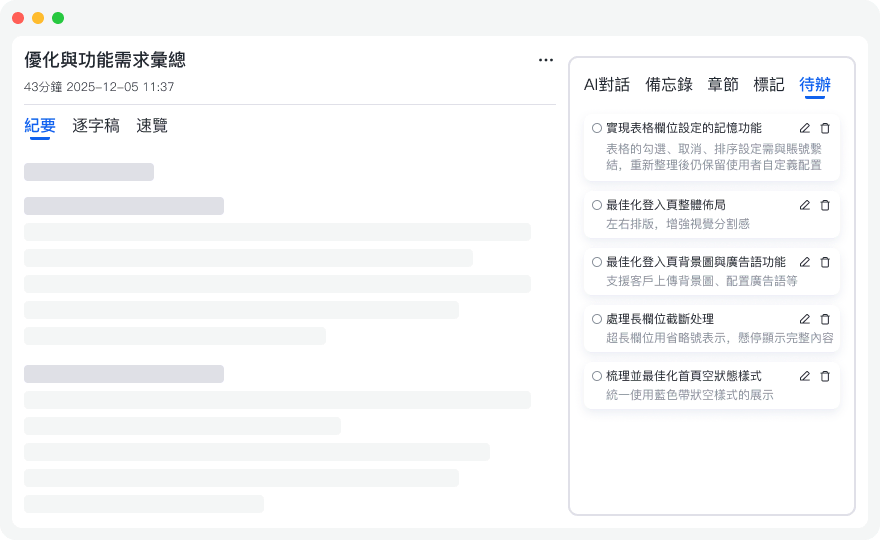
1. From "Verbatim Transcript" to "AI Meeting Minutes"
Traditional tools output transcripts that are thousands of words long and hard to read. Tinrec simultaneously analyzes content during transcription to generate structured meeting minutes and action items. This means after the meeting, you don't need to reread the full transcript; just review the AI-extracted conclusions and assignments.

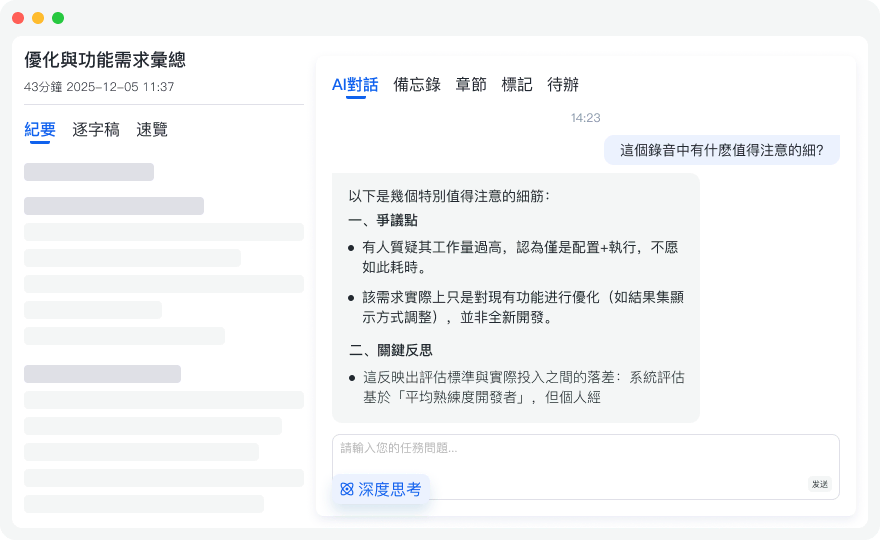
2. First-Ever "AI Conversation Search": Find Answers by Asking
This is the biggest difference from traditional voice recorders. When you forget "What was the marketing budget in last week's meeting?", you don't need to search through the transcript—just type the question into Tinrec's chat interface, and the AI will answer directly based on the recording content, citing the source. This turns the recording into a consultable knowledge base.
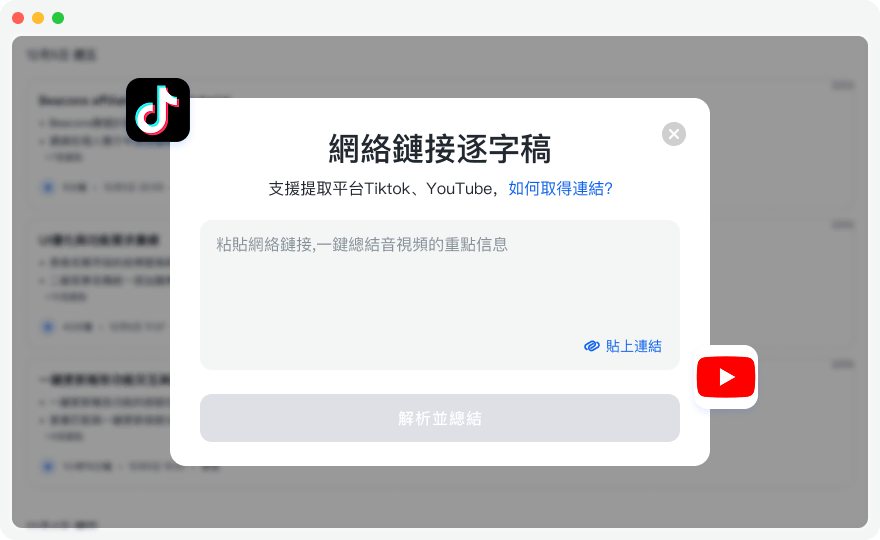
3. Universal Input: Supports Videos and Links
Besides live recording and uploading MP3/M4A files, Tinrec also supports pasting YouTube or podcast links for transcription. This is very useful for students taking notes from online courses or marketers analyzing competitor video content.
Hands-On Tutorial: 3 Steps to Automatically Organize Recordings with AI
Below is a demonstration of how to use Tinrec to turn a chaotic meeting recording into a clear written report in 5 minutes.
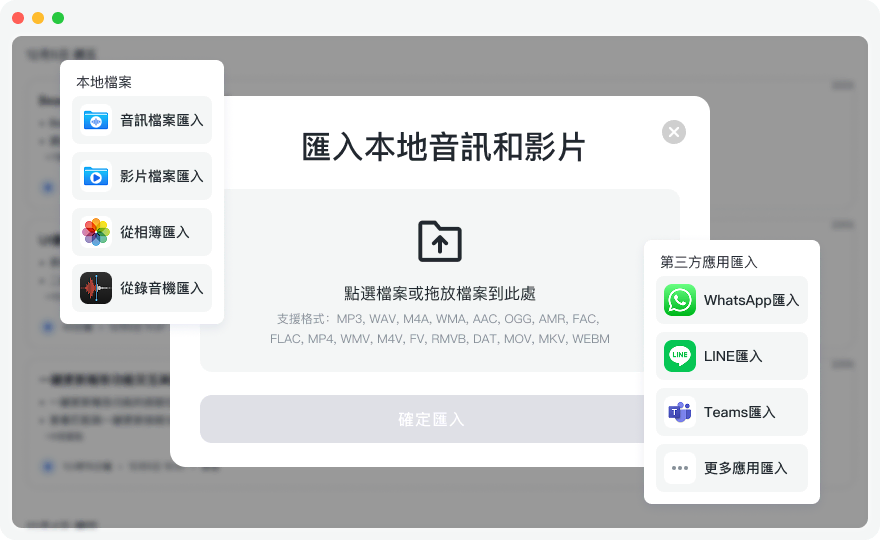
Step 1: Import Recording or Start Recording
- Live meeting: Click "Start Recording" on the homepage; the system will convert speech to text in real time. Suitable for classes or in-person meetings.
- Existing file: If you already recorded with your phone, choose "Import Audio/Video"; supports common formats like MP3, WAV, M4A.
- Online material: To organize a YouTube course, select "Link to Text" and paste the URL.
Step 2: Review AI Summary and Action List
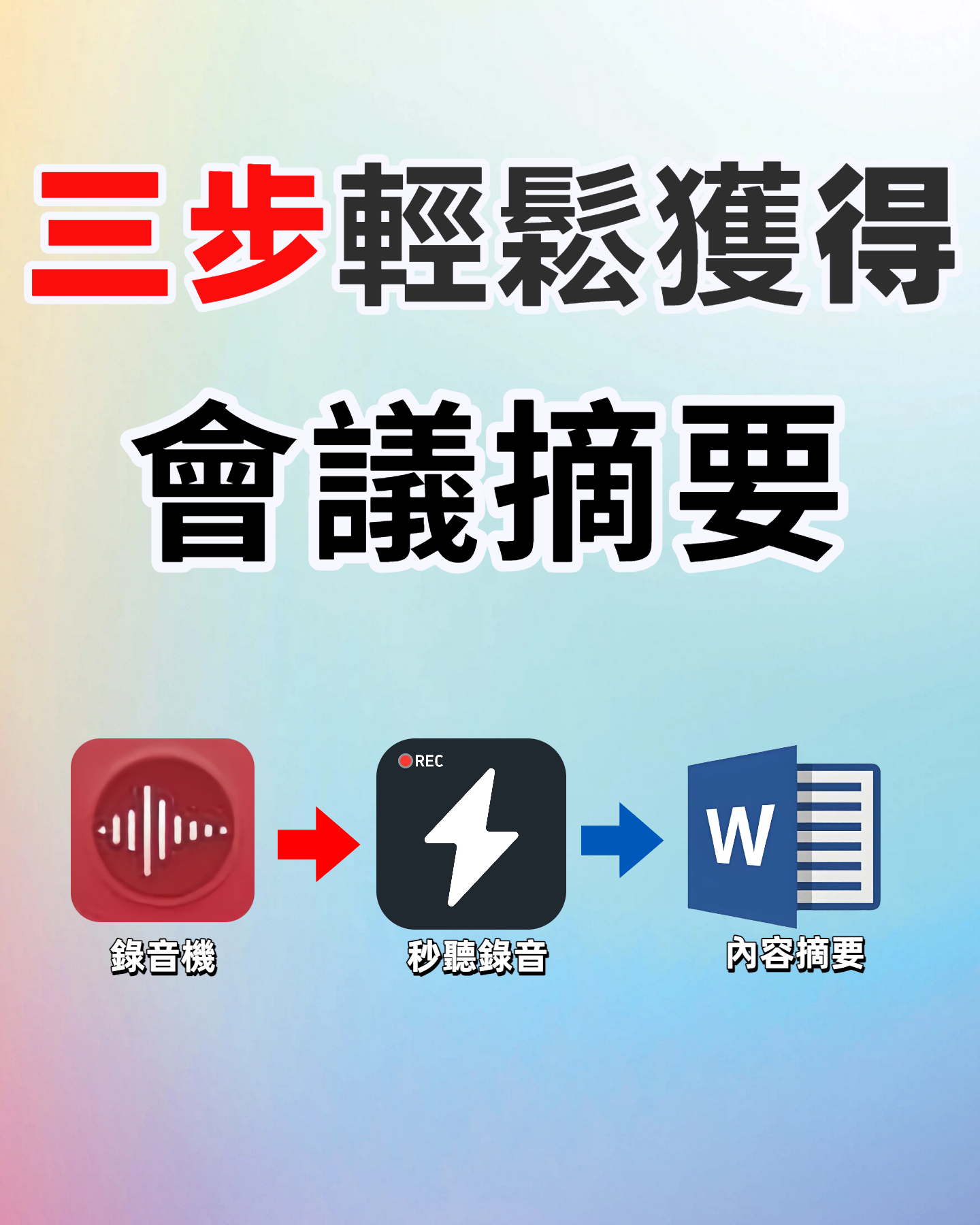
After transcription is complete, don't rush to read the full transcript. First, switch to the "AI Summary" page. The system will automatically condense an hour-long session into a few key points and list a To-Do List. You can modify or highlight important points at this stage.

Step 3: Deep Review with AI Conversation
If the summary lacks details you need (such as specific data or names), use the "AI Conversation" feature on the right. Ask questions like "List the key discussion points about Q3 budget" or "What are the exam topics mentioned by the teacher?" The AI will precisely locate and answer.
Step 4: Export and Share
Once confirmed, you can export the results as TXT, Word, or PDF, and paste directly into Notion or send to team members.
Frequently Asked Questions (FAQ)
Q1: Can the iPhone's built-in voice memo app directly transcribe to text? The built-in "Voice Memos" app only records. To transcribe, you need to use the keyboard's "Dictation" feature (suitable for short phrases) or third-party apps like Tinrec for long recordings.
Q2: What languages does Tinrec support? Can it handle Taiwanese or Cantonese? It supports automatic recognition of 10 languages including Chinese (Traditional/Simplified), English, Japanese, Korean, German, as well as Taiwanese and Cantonese, making it suitable for multilingual workplace environments.
Q3: What is the free tier usage limit? Tinrec offers a free version with 100 minutes of transcription per month. This is sufficient for occasional student or personal use; for heavy meeting needs, consider upgrading to Basic or Pro.
Q4: Can I use it to transcribe YouTube videos or podcasts? Yes. With the "Video Link to Text" feature, just paste the URL, and the system will extract the audio track and generate transcripts and summaries—perfect for online course learning.
Q5: How is the privacy and security of recordings ensured? Always check the privacy policy when choosing a tool. Reputable tools like Tinrec use encrypted transmission, and data is used only for the user's own transcription service, never publicly shared.
Q6: Can I transcribe recordings from Teams or Google Meet? Yes. Download the meeting recording file (usually MP4) and upload to Tinrec, or start the web version during the meeting for side recording (ensure clear audio) to generate minutes.
Summary: Using the right tools can reduce the time spent "listening to recordings" by 90%. Start with free built-in phone features; if you pursue automated summaries and search efficiency, AI tools like Tinrec are key investments for productivity.
Turn every recording into actionable outcomes
Get 60 free transcription minutes when you sign in. No credit card required.
Related Reading
You might also like

Which Speech-to-Text Tool Is Best? A Practical Comparison and Buying Guide for Traditional Chinese Users
Compare Tinrec, Otter, Fireflies, Granola, and more across four dimensions: Traditional Chinese transcription quality, bot-free recording, post-meeting outputs, and team collaboration, to help professionals in Taiwan and Hong Kong choose the best speech-to-text solution.
Which Speech-to-Text Tool Is Easiest to Learn? A Guide Based on Learning Curve
Compare the ease of learning of popular speech-to-text tools from a learning cost perspective, and get a complete workflow from recording to usable meeting notes to help sales, product development, and government employees get started quickly.

How to Choose the Best Recording-to-Text Tool in 2026: A Complete Guide from Transcripts to Actionable Meeting Minutes
This article compares the leading recording-to-text tools in 2026, covering capture methods, Chinese language support, post-meeting outputs, and team collaboration. It helps sales, business, and product development professionals select the most suitable tool based on meeting type and team size, and master the complete workflow from recording to actionable meeting minutes.
Which Speech-to-Text Tool Is Easiest to Learn? Choosing the Most Beginner-Friendly Option Based on Learning Cost
Looking for an easy-to-learn speech-to-text tool? This article starts from learning cost, compares the ease of learning of mainstream tools, breaks down the key steps to get started quickly, and provides recommendations for different groups such as sales, product R&D, and government employees, helping you learn and start using a tool in the least amount of time.

How to Choose the Best Recording-to-Text Tool in 2025: From Transcripts to Actionable Meeting Minutes
Meeting recording-to-text tools are no longer just about transcription. This article compares Tinrec, Otter, Fireflies, Notta, Granola, and other mainstream tools in terms of capture methods, Chinese language support, and post-meeting outputs, and explains how to generate action items from transcripts and build team knowledge, helping you choose the right tool for your meeting scenarios.

2026 Free Speech-to-Text Solutions: 5 Tools Compared
PTT hotly discusses speech-to-text apps. We tested Tinrec and 4 other tools, comparing free quotas, Cantonese accuracy, and AI features to help you save time on meeting notes.

4 Best Recording-to-Text Tools in 2026: How to Choose Based on Free Credits and AI Features
We tested the latest 4 recording-to-text tools in 2026, from free credits to AI Q&A and bot-free recording, to help you find the most time-saving option.

Tinrec vs Otter.ai in 2026: A 5-Dimension Comparison for Chinese Users
We tested Tinrec and Otter.ai for Chinese meetings, bot-free recording, AI Q&A, cross-platform support, and team collaboration to help you choose the right transcription tool and save overtime hours.

5 Best Recording-to-Text Tools in 2026 Compared: Tinrec vs MyEdit, Yating, and More
After testing multiple free recording-to-text tools, here's why Tinrec became my go-to for meeting notes from a mid-level manager's perspective—and whether the free plan is enough.