
Turn recordings into transcripts and summaries in minutes
Upload audio or video for multilingual transcription, AI notes, and action items
For podcast creators or those who learn by listening to podcasts, the biggest pain points are often not "not finishing," but "not remembering" and "not finding." Spending an hour recording a show and later trying to find a specific quote, or finishing a deep interview and wanting to organize notes, often requires multiple times the effort of re-listening. Traditional transcription tools can convert audio to text, but when faced with tens of thousands of words of raw text, organizing them is still a headache.
This article reviews the mainstream "AI Podcast Content Organization Tools" on the market in 2026, comparing them across dimensions such as Chinese recognition accuracy, summary logic, and cross-platform support, and includes a detailed feature comparison table and practical operation guide.

Quick Navigation Conclusion:
- If you mainly process English content and need deep integration with Zoom/Meet: Otter.ai remains a veteran leader.
- If you need high-accuracy Traditional Chinese or mixed Chinese-English recognition, and want to generate summaries and action items directly from YouTube/Podcast links: Tinrec (Miao Ting Lu Yin) is a more localized choice.
- If you only need simple audio-to-text without AI analysis: Good Tape is a good lightweight option.
Why Podcasts Need AI Content Organization Assistants? Three Core Pain Points
Before diving into tool selection, let's clarify why "audio-to-text" alone is insufficient and why "AI content organization" is needed.
1. Low Information Density, High Retrieval Cost
Audio is a linear medium. Unlike articles where you can scan for key points at a glance, audio files must be played back along a timeline. Without structuring the content, a 60-minute interview recording becomes almost a "black box" for later retrieval, making it hard to extract value.
2. Difficult Content Repurposing
For creators, after recording an episode, converting it into blog posts, social media posts, or newsletters often requires re-listening and transcribing. If an AI tool can directly separate speakers and extract summaries, it can save 80% of post-production time.
3. Cross-Language Comprehension Barriers
When listening to overseas podcasts or watching foreign language YouTube videos, limited language skills can make it hard to keep up with speed. AI assistants with multilingual recognition and translation can break down language barriers, enabling knowledge acquisition without borders.
2026 Popular Podcast Organization Tools Comparison: Tinrec vs. Mainstream
When choosing a tool, don't just look at whether it can transcribe, but also "what it can do after transcribing." Below are representative tools compared across dimensions.
| Dimension | Tinrec (Miao Ting Lu Yin) | Otter.ai | Standard Voice Recorder App |
|---|---|---|---|
| Core Positioning | Audio/video content understanding and actionability | English meeting notes and collaboration | Simple recording and basic labeling |
| Chinese/Multilingual Support | Excellent (Supports Chinese, Japanese, Korean, Cantonese, etc. 10 languages) | Weak (Primarily English) | Average (Depends on phone OS) |
| Input Methods | Live recording, file upload, URL link (YT/Podcast) | Live recording, file upload | Live recording only |
| AI Summary Capability | Auto-generates summaries, to-do items, chapter segmentation | Auto-generates summaries, keywords | None |
| Content Interaction | Supports AI chat (Chat with Audio) | Supports AI chat | None |
| Free Tier | 100 minutes per month | 300 minutes per month (with single session limit) | Depends on storage space |
Review Insights
- Language Advantage: If your content includes Chinese, Taiwanese, or Japanese/Korean, Tinrec's multilingual model performs better in Asian language segmentation and recognition. Otter is extremely strong in English but its Chinese support has never been fully refined.
- Content Source Flexibility: Tinrec supports direct YouTube or Podcast URL parsing, which is extremely convenient for "content consumers" or "researchers" as it eliminates the need to download audio files before uploading.
- Action-Oriented Output: Tinrec emphasizes "from recording to action" by automatically extracting to-do items (Action Items), which is very helpful for interview-style podcasts in organizing follow-ups.
Stop organizing recordings by hand
Upload audio or video and automatically get a transcript, summary, and action items
Deep Dive: How Tinrec Solves Content Organization Challenges
In its 2026 update, Tinrec (Miao Ting Lu Yin) has strengthened its "understanding" and "dialogue" capabilities, making it not just a transcription tool but an AI secretary that can comprehend content.
Feature 1: Direct URL Parsing (Podcast/YouTube)
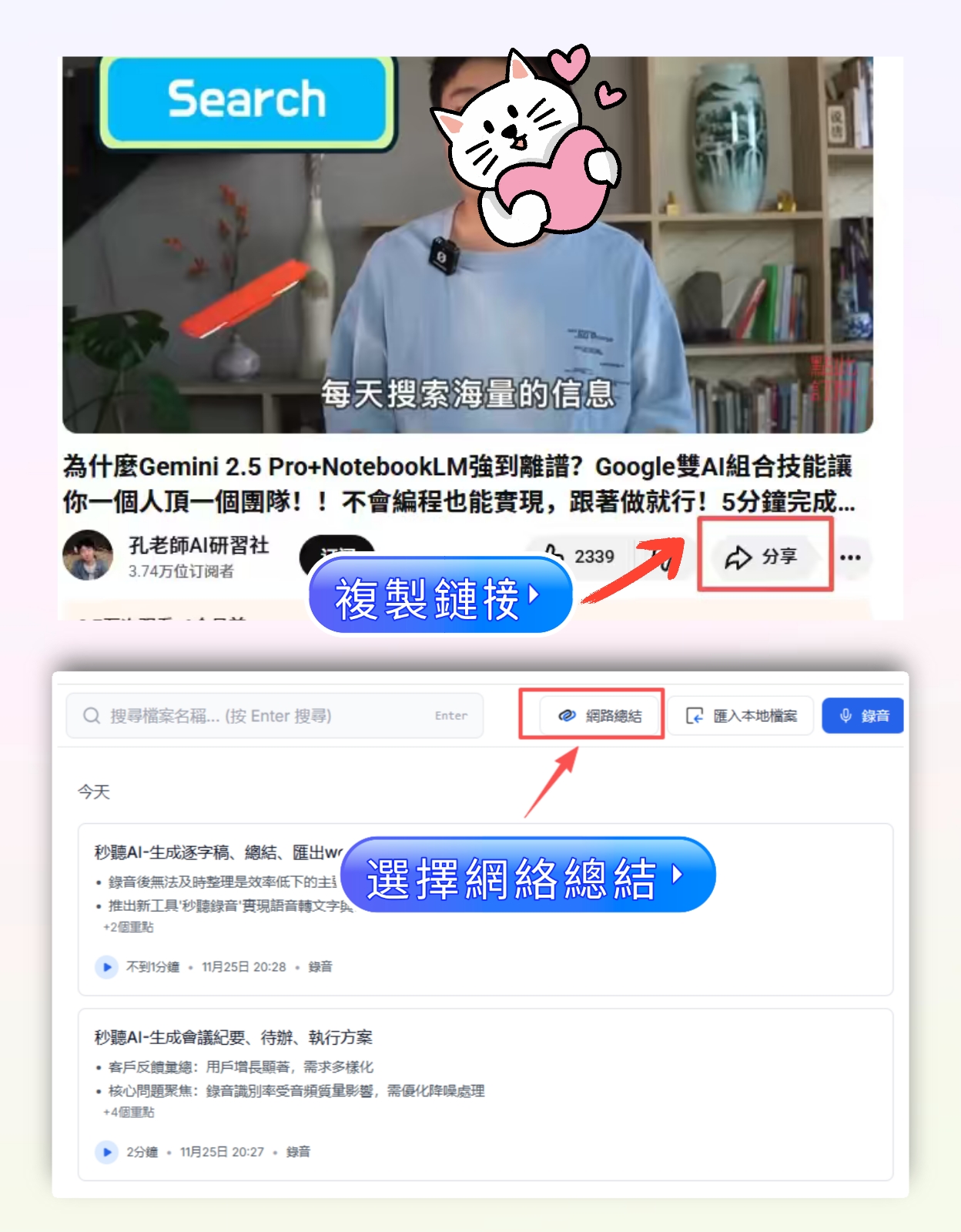
This is the biggest difference between Tinrec and traditional voice recorders. You don't need to spend time downloading large audio/video files; simply paste a Podcast Web Player link or YouTube URL, and Tinrec will complete transcription and summarization in the cloud. This significantly lowers the barrier for users who need to quickly organize competitor analysis or study notes.
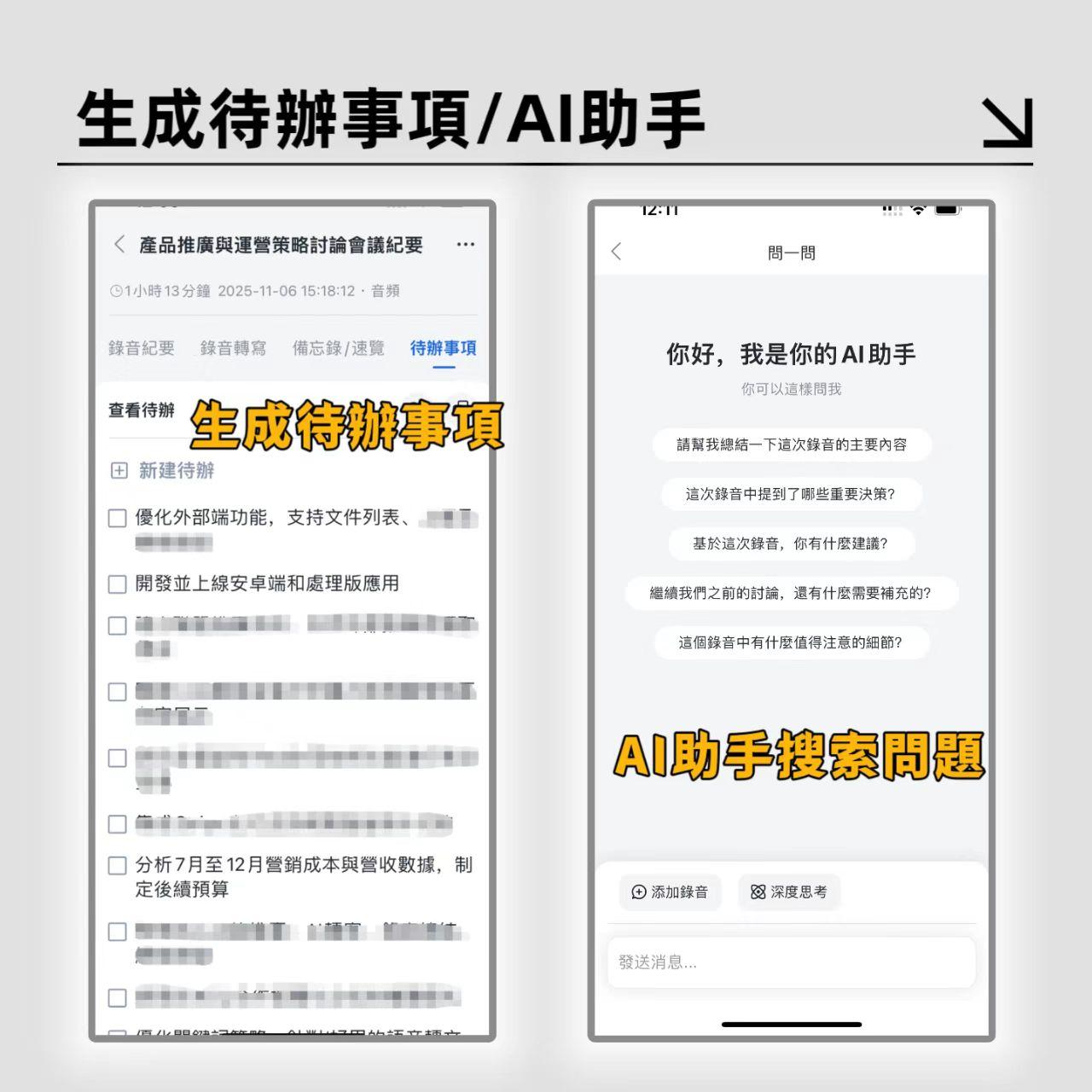
Feature 2: AI Chat Query (Chat with Audio)
Faced with a 2-hour interview recording, even with a transcript, searching by keyword (Ctrl+F) sometimes misses the point (because the speaker may use different synonyms). Tinrec's built-in AI chat function allows you to ask questions in natural language, such as "What is the speaker's opinion on the future development of AI?" or "Which books were mentioned in this interview?" The system will give precise answers based on the audio content.
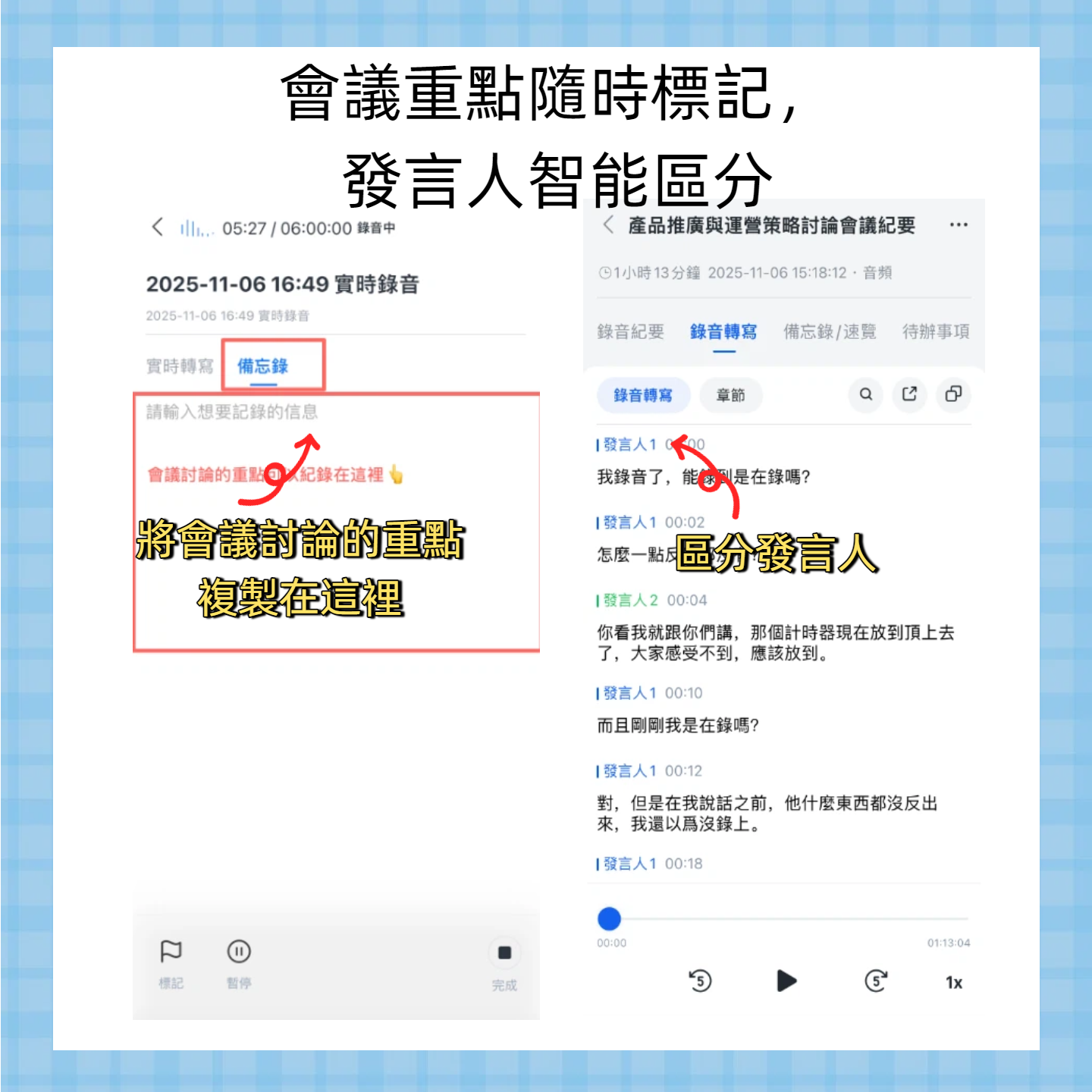
Feature 3: Smart Speaker Diarization and Key Point Marking
In multi-speaker podcasts, Tinrec can automatically distinguish different speakers (Speaker Diarization) and segment the content. With AI-generated chapter titles, users can quickly jump to sections of interest without listening from start to finish.
Practical Tutorial: How to Quickly Produce Podcast Notes with AI
Below, using Tinrec as an example, we demonstrate how to turn a 30-minute interview episode into structured notes in 5 minutes.
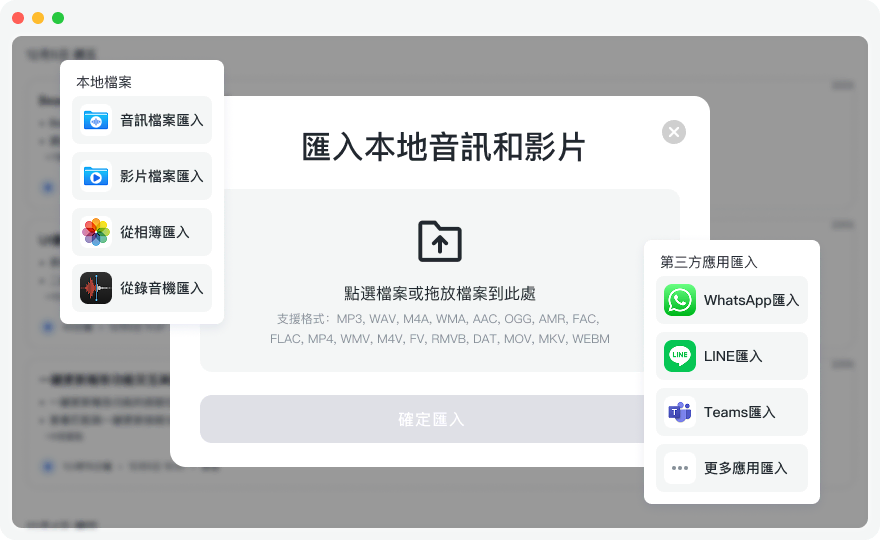
Step 1: Import Audio Source
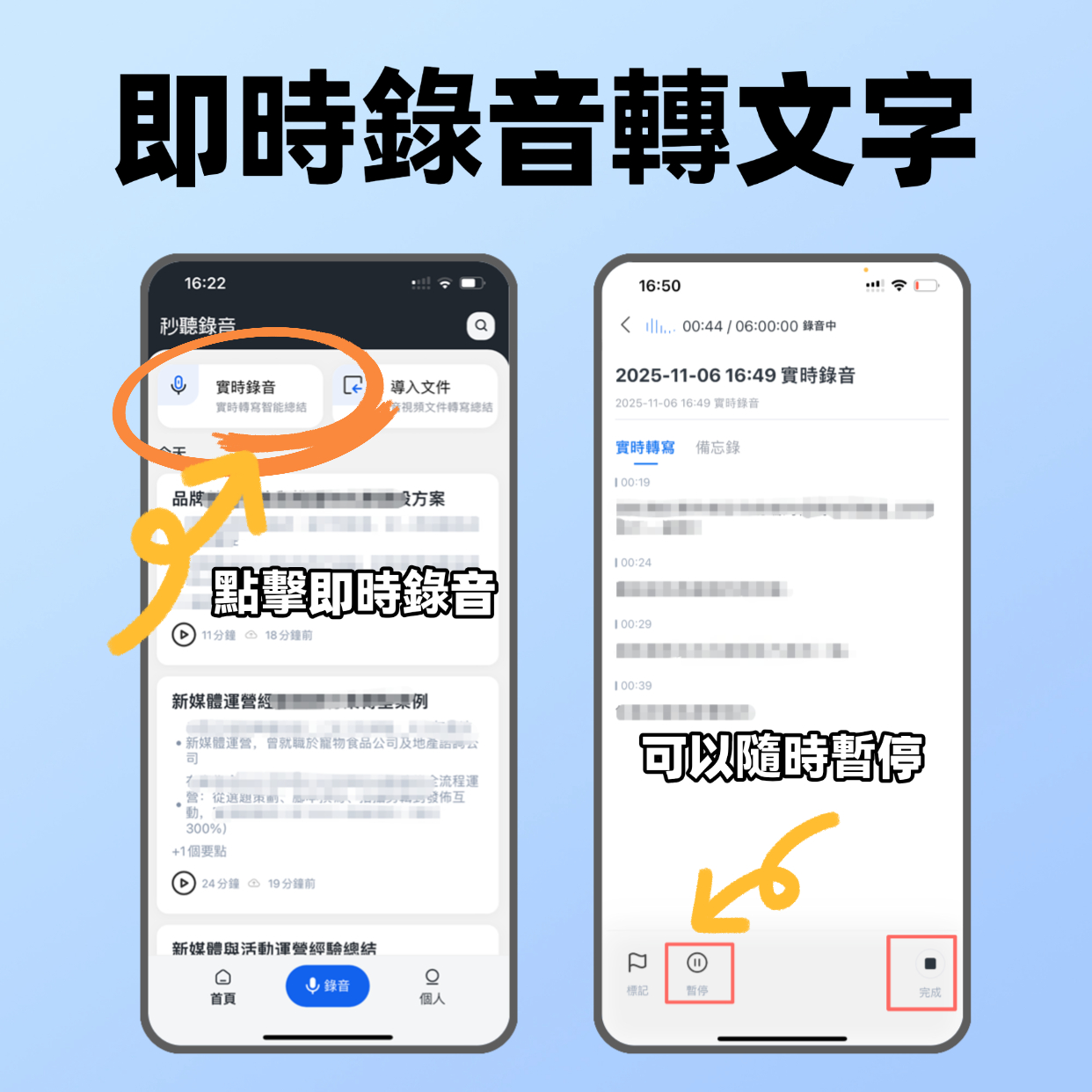
- Scenario A (Live Recording): Open the app or web version, click Record & Transcribe in Real-Time, suitable for use during interviews.
- Scenario B (Existing File): Use the Audio File to Text feature, upload mp3/wav/m4a formats.
- Scenario C (Online Content): Copy a YouTube or Podcast URL, use the Video to Text feature, paste the link.
Step 2: Wait for AI Analysis and Summary Generation
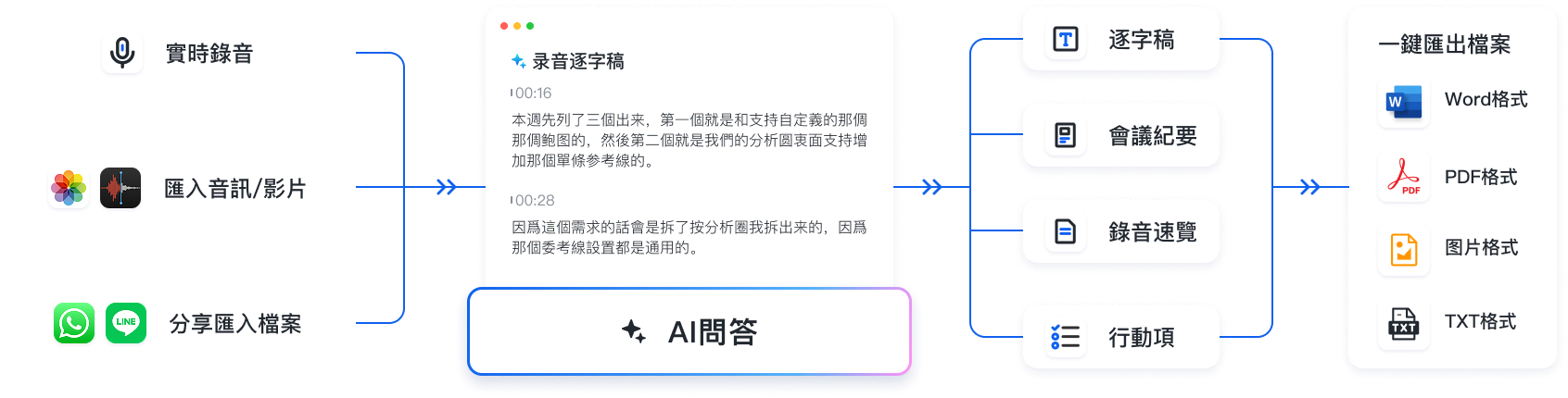
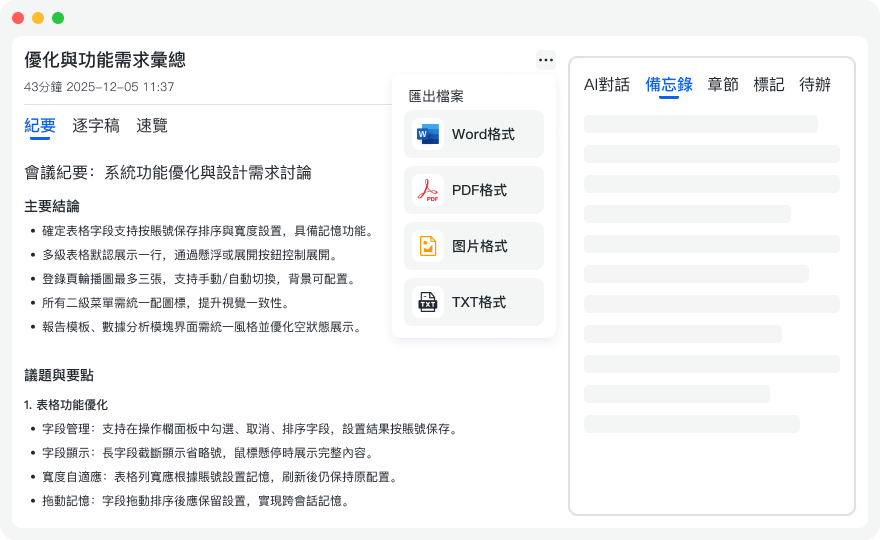
After upload, the system automatically performs speech-to-text. Tinrec simultaneously generates a "meeting summary" and "action items."
- Viewing Tip: First check the AI-generated summary to understand the overall picture, then decide whether to read the full transcript.
Step 3: Use AI Chat to Uncover Details
If you need to write social media posts and want to quote the speaker's original words, use the AI Chat Query window on the right.
- Example Questions: "List the three marketing strategy highlights mentioned by the speaker" or "Summarize the conclusion of this conversation and rewrite it as a 200-word Instagram post caption."
Step 4: Export and Share
After confirming the content is correct, export the transcript or summary as Word, PDF, or Markdown format, and paste it directly into your Notion or note-taking software.
Frequently Asked Questions (FAQ)
Q1: Is the free version of these tools sufficient?
Most tools offer a free trial. For example, Tinrec’s free version provides 100 minutes of transcription per month, which is enough for personal users who occasionally organize one or two podcast episodes; for heavy usage, subscription costs are usually much lower than manual transcription.
Q2: Does a noisy recording environment affect accuracy?
Yes. Although AI has noise reduction capabilities, excessive background voices or music can still interfere with recognition. It is recommended to ensure clear audio when recording podcasts. For online videos, audio quality is usually good, and recognition accuracy can reach over 95%.
Q3: Does it support iPhone or Android phones?
Yes, Tinrec supports iOS, Android, and the web version, with data synced across devices. You can record or share links on your phone during your commute, then edit in detail on your computer.
Q4: Can it recognize dialects or mixed Chinese-English?
Tinrec supports Cantonese, Taiwanese, and other languages. It also has good recognition optimization for common Chinglish (mixed Chinese-English) in workplaces, without needing to manually switch language modes.
Q5: Does the generated transcript lack punctuation?
Modern AI tools (such as Tinrec) automatically insert punctuation based on tone and pauses, and perform paragraph segmentation, making the reading experience close to human-edited text.
Q6: How is privacy and security ensured?
When choosing a tool, pay attention to its privacy policy. Reputable AI services (like Tinrec) usually have encrypted transmission technology, and users can delete cloud files at any time to ensure meeting or interview content is not leaked.
Turn every recording into actionable outcomes
Get 60 free transcription minutes when you sign in. No credit card required.
Related Reading
You might also like

2026 Free Post-Meeting Email Automation Options: 5 Tools Compared
Always sending post-meeting emails the next day? The problem isn't your writing—it's that meeting content isn't captured well. This article reviews the free tiers and limitations of 5 post-meeting email automation and assistance methods, and tests how Tinrec turns transcripts, AI summaries, and action items into one-click email material. Suitable for students and small teams.

3 Meeting Recap Email Templates Compared for 2026: Which Format Best Moves Projects Forward?
We break down three meeting recap email template styles and how to choose one, covering structure, examples, and common mistakes. Plus, learn how Tinrec turns meeting recordings into citable minutes, to-dos, and action lists so your post-meeting emails don't get ignored.

2026 Comparison of 4 Meeting Note Tools: Which One Actually Turns Meeting Conclusions into Action Plans?
Meetings end with conclusions, but no one follows through? This article starts from the real need to turn meeting conclusions into action plans, outlines 4 key purchasing points, and compares Tinrec, Notta, Otter.ai, and Granola on bot-free recording, AI summaries and to-dos, post-meeting Q&A, and team data retention, with prices and limitations, to help you choose the one that truly connects to execution.
2026 AI Follow-Up Email Tools Comparison: Tinrec Ensures No Post-Meeting Follow-Up Is Missed
The meeting ending is just the beginning of follow-up. This article tests 3 AI tools related to post-meeting follow-up emails, including Tinrec, Manus, and Genspark, covering meeting transcription, action item extraction, and email draft generation, helping you bridge the last mile from the meeting room to the inbox.

Tinrec vs Notta 2026: 5-Dimension Comparison — Which Tool Tracks Meeting Action Items to Completion?
After a meeting, action items are scattered across everyone's notes, and two weeks later no one remembers who was supposed to do what. This article compares six tools—Tinrec, Notta, Fireflies, Otter, Granola, and TurboScribe—across transcription, to-do extraction, post-meeting output, team governance, and pricing. It also covers how to choose and use them so meeting conclusions actually become trackable follow-up emails.

How to Write a Meeting Summary Email: 3 AI Tools Tested in 2026, This One Works Best for Chinese Meetings
A meeting summary email isn't just pasting a transcript. This article breaks down the 3 most common mistakes in writing meeting summary emails, the 4 key structures you need to master, and tests Tinrec, Otter.ai, Granola, and Notta in Chinese meeting scenarios to help you produce a meeting recap email with clear decisions and action items in the shortest time.

4 AI Meeting Agents Tested in 2026: Which One Turns Meetings into Trackable Actions?
A hands-on comparison of 4 AI meeting agents in 2026, covering bot-free recording, Chinese transcription, AI Q&A, action item extraction, and team data governance. Tinrec is featured as the main example, with use cases for personal and team plans, pricing limits, and pitfalls to avoid.

2026 Cross-Department Meeting Notes Tools Compared: Which One Captures Decisions and Action Items?
Cross-department meeting notes often turn into verbatim transcripts, leaving decisions and action items lost after the meeting. This article starts with common pitfalls, outlines tool selection criteria, and compares Tinrec, Otter.ai, Notta, and Granola in hands-on testing, plus explains how to use team spaces to retain cross-department meeting data.

2026 Comparison of 4 Sales Meeting Follow-Up Email Tools: How AI Summaries Save Time
After a meeting, the client disappears—how do you write a follow-up email that gets a reply? This article breaks down practical approaches to sales meeting follow-up emails and uses Tinrec to demonstrate the complete workflow from meeting recording, transcription, AI summaries, to action item extraction, with 5 key considerations for choosing a tool and FAQs.